Most of your investing life you and your adviser (if you have one) are focused on wealth accumulation. But, we tend to forget, eventually the whole idea of this long process of delayed gratification is to actually spend this money! That’s decumulation as opposed to wealth accumulation. This stage may also involve downsizing from larger homes to smaller ones or condos, moving to the country or otherwise simplifying your life and jettisoning possessions that may tie you down.
My latest MoneySense Retired Money column looks at whether the multiple interest rate hikes of 2022 means its time for retirees to start adding annuities to their retirement-income product mix. You can find the full column by clicking on the highlighted headline here: Rising rates are good news for near-retirees seeking longevity insurance.
The Bank of Canada has now hiked rates twice by 50 basis points, most recently on June 1, 2022. That’s good for GIC investors, as we covered in our recent column on the alleged death of bonds, but it’s also welcome news for retirees seeking longevity insurance.
As retired actuary Fred Vettese recently wrote, retirees may start to be tempted to implement his suggested guideline of converting about 30% of investment portfolios into annuities. As for the timing, Vettese said it is “certainly not now: but it could be sooner than you think.” He guesses the optimal time to commit to them is around May 2023, just under a year from now.
After the June rate hikes, I asked CANNEX Financial Exchanges Ltd. to generate life annuity quotes for 65- and 70-year old males and females on $100,000 and $250,000 capital. The article provides the option of registered annuities and prescribed annuities for taxable portfolios. It also passes along the opinion of annuity expert Rona Birenbaum that she greatly prefers prescribed annuities because of the superior after-tax income. Of course, many retirees may only have registered assets to draw on: in RRSP/RRIFss and/or TFSAs.
For a 65-year old male investing $100,000 early in June 2022, with a 10-year guarantee period in a prescribed (non-registered) Single Life annuity, monthly income ranged from a high of $548 at Desjardins Financial Security with a cluster at major bank and life insurance companies between $538 and $542. (figure rounded). Comparable payouts on $250,000 ranged from $1299 to $1,390. Because of their greater longevity, 65-year old females received slightly less: ranging from around $500/month to a high of $518, and for the $250,000 version from $1238 to $1319.
Here’s what Cannex provides for comparable registered annuities (held in RRSPs):
For a 65-year old male (born in 1957), $100,000 in a Single Life annuity nets you between $551 and $571 per month, depending on supplier; $250,000 generates between $1,399 and $1,461 a month. For 70-year old males (born 1952), comparables are $625 to $640/month and $1,578 to $1,634 a month. Continue Reading…
There’s been a lot of talk about recessions lately: Whether one is near, far, or perhaps already here. Whether we can or should try to avoid it. What it even means to be in a recession, and how it’s related to current market turmoil.
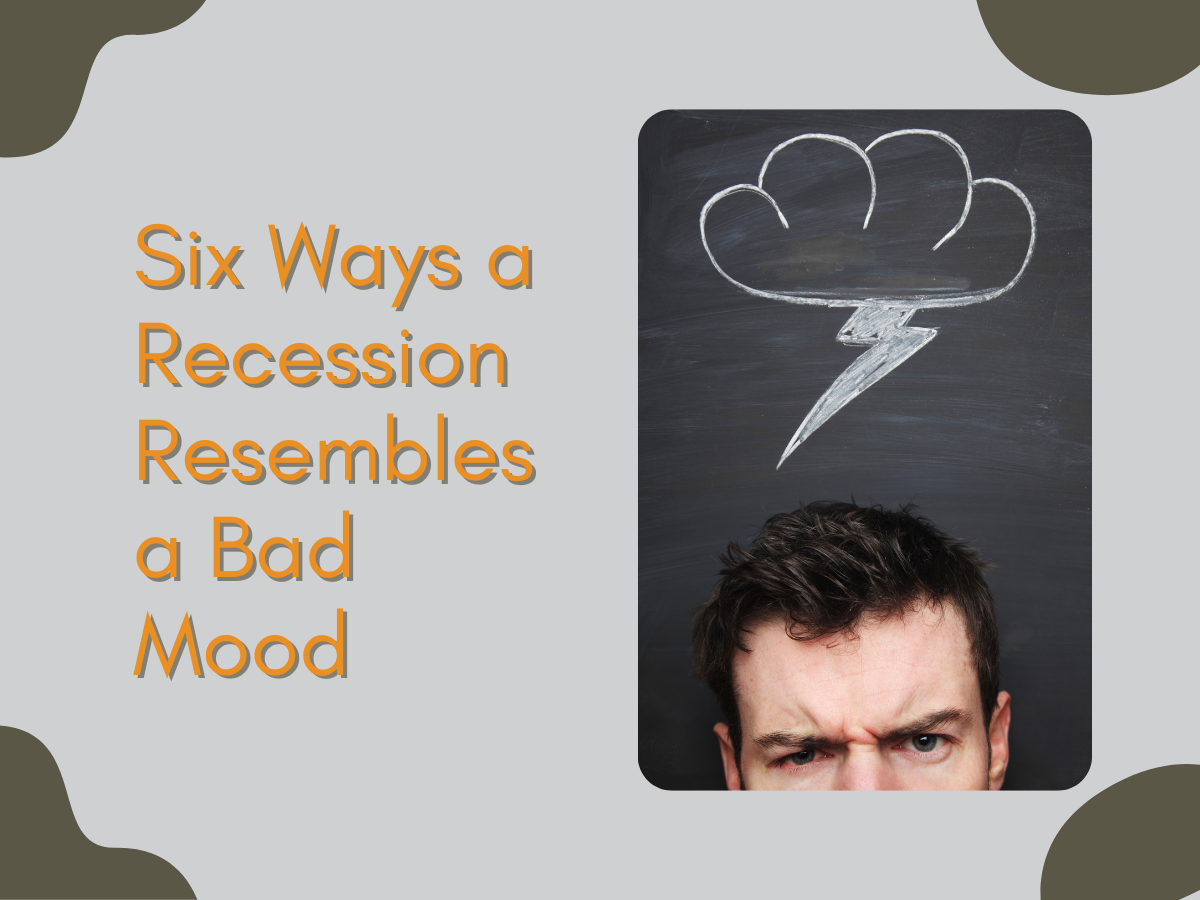
To put market and recessionary concerns in perspective, it might help to describe six ways a recession resembles a bad mood. There are some intriguing similarities!
1.) There is no Precise Definition
We all know what a bad mood feels like. But there is no clear definition for a nebulous mix of real and perceived setbacks, and how they’re going to affect us.
Likewise, there is no single signal to tell us exactly when a recession is underway or when it’s over. Instead, recessions can trigger, and/or be triggered by a number of conditions connected in various fashions and to varying degrees. These usually include a declining Gross Domestic Product (GDP), along with rising unemployment, sinking consumer confidence, gloomy retail forecasts, disappointing corporate balance sheets, a bond yield curve inversion, stock market declines, and similar combinations of objective and subjective events.
In the U.S., the National Bureau of Economic Research (NBER) intentionally defines a recession rather vaguely as follows (emphasis ours):
“A recession is a significant decline in economic activity that is spread across the economy and that lasts for more than a few months.”
Closer to home, the Bank of Canada and/or the minister of finance typically let us know once we’re in a recession. As described here, they base their calls on guidance from the 2015 Federal Balanced Budget Act, economic indicators coming out of Statistics Canada, and economic analyses from Canadian economists such as C.D. Howe Institute’s Business Cycle Council.
Globally, the World Bank Group has stated, “Despite the interest in global recessions, the term does not have a widely accepted definition.”
2.) You usually can’t spot one except in Hindsight
How do you know when you’re in a bad mood? Often, you don’t, until you’re looking back at it.
Recessions are similar. Since a widespread downturn must linger for a while before it even qualifies as a recession, governments typically only declare one after it’s underway. For example, triggered by the abrupt arrival of the global pandemic, Canada and the U.S. alike entered into their shortest recessions to date, beginning and ending in first quarter 2020. However, neither government announced the news until July and August, respectively.
3.) Sometimes, we get stuck for a while
Hopefully, your bad moods come and go, resulting in more good times than bad. But sometimes, one misfortune feeds another until you feel gridlocked. It may take a while before improved conditions, a more upbeat attitude, or a blend of both help you move forward.
In similar fashion, recessions can become a self-fulfilling prophecy. As Nobel Laureate and Yale economist Robert Shiller describes, “The fear can lead to the actuality,” in which (for example) economic conditions might feed inflation, which inverts the bond yield curve, which signals a recession, which shakes corporate and consumer confidence, which leads to unfortunate reactions that further aggravate the challenges. And so on. When this occurs, a recession and its related financial fallout may last longer than the underlying economics alone might suggest.
4.) They’re Inevitable
It’s never fun to be in a bad mood, but we can all agree they’re part of life. It would be unhealthy, exhausting even, if we were endlessly giddy every minute of every day.
Similarly, nobody celebrates a recession. But it helps to recognize they aren’t aberrations; they are part of natural economic cycles. And while they may not be anyone’s favorite tool for the job, they can sometimes help rein in runaway spending, earning, and pricing for companies, consumers, and creditors alike. Continue Reading…
Financial and wealth-management advisors tend not to be big fans of robo-investing. No surprise there because service and understanding the client are front and centre in what they do.
But for many investors today, especially younger ones, robo-investing may be seen as a low-cost, low-maintenance way to grow their wealth. Robo-investing relies on algorithms to make investments automatically and this is with minimal human supervision at best. But there is no ‘expert’ service involved and that is not good.
On the other hand, how about using Artificial Intelligence (AI) to assist advisors in better serving their clients and, in the process, help those clients build better portfolios? Don’t look now but the technology is here and it can start with meetings. Nowadays people are slowly but surely returning to the office and financial advisors are even getting back to meeting face-to-face with their clients. But a face-to-face meeting is not always required.
A new world of hybrid meetings
Today, however, we are in a new world of meetings where firms big and small are adopting a mix of online, in-person and ‘hybrid’ meetings which utilize both the virtual and in-person variety. With AI an advisor can make this choice wisely.
It involves human-like AI that enhances the meeting experience for both the host and the attendees by allowing participants to focus on the meeting and forget about labour-intensive tasks like note-taking. How? A full transcript and recording of what transpired are automatically created and then crafted into a concise executive summary. And the technology can do even more by using what is called ‘collected telemetry’ (the conversation data that pertains to everything from context to emotion) to build an advanced analysis of performance and even sentiment. Continue Reading…
By Billy and Akaisha Kaderli, RetireEarlyLifestyle.com
Special to the Financial Independence Hub
According to the Mexican Government, around 1.1 million expatriates lived in Mexico as of 2020. Of those, about 700,000 were from the United States, making Mexico the #1 country worldwide for American Expats.
We have listed a dozen reasons below why Mexico is attractive to those with plenty of money, and also to those who don’t have that much.
Freedom
While there are many reasons to move to Mexico, the Number One reason people come here is for the freedom they experience.
With less regulation on all fronts, critics might think that Mexico is a lawless frontier.
Not so.
Mexico is still a place where one can walk the beach with a beer in hand. We can give a homeless person food without filling out countless forms to gain permission or explain if there is mayonnaise on the sandwich or have the food rejected because it’s not in a paper bag. While we personally are not smokers, an individual who chooses to smoke can do so without being read the riot act or be subjected to invectives about their personal worth as a human being.
Many medications can be purchased over the counter without a prescription. One can afford medical care and not be forced into buying an expensive health insurance policy that doesn’t coincide with their personal health approach. Homeopaths, Naturopaths, Chiropractors and those who practice acupuncture or massage can be found easily and their services are affordable. One can walk into a lab and order an x-ray or a blood test on their own without a prescription.
There is respect for the elderly and those over 60 are not invisible. People who are chubby are not judged and can easily find someone to date or marry. People on the street say hello and good morning to complete strangers, and men still tip their hats to women. The young offer their bus seats to those of us who have more years than they do.
People say “excuse me” when they walk in front of you, and it’s perfectly safe to walk through a group of teenage boys without fear.
Common sense is common.
Some are moving due to political climate at home
The world is changing, no doubt. Many have chosen Mexico to get out from under the tense political climate back home.
Mexican culture is lively and accepting and it’s a breath of fresh air to live here. Smaller towns, especially, are like Norman Rockwell paintings.
But bigger cities offer fabulous diversions away from home country political pressure. There are museums, international dining, hiking, cultural events, music, art and volunteer opportunities too.
The caution here, is to not bring the “old” political attitude with you when you move. Grow into the easy and into the pleasantry here in this country.
Zicatela Beach, Puerto Escondido
Affordability
Having money or not, your quality of life should expand over what you are experiencing now in your current home town. The cost of living is such that you will get more for your money and your nest egg will go farther.
Truthfully, depending on where you might choose to live, purchasing a home can be expensive, but rents are cheap. And if you are at retirement age, you might find that putting your money into “living” versus “housing” might be the better choice, anyway.
In either case, gardeners, housekeepers, maintenance people and supplies are all cheaper than you will find in the US or Canada. In Chapala, Mexico, a housekeeper runs about $6USD for 2.5 hours. In Ajijic, Mexico – another popular Gringo town – it is twice that price, but still not outrageous.
Legalities of permanent status are easier
Getting a permanente or a temporada card is easy to do. While some choose to fill out the paperwork themselves, having a lawyer arrange for this is also quite affordable.
Qualifying for residency is based on your annual income and/or net worth, and the threshold is easy enough to meet. The requirements for getting a temporary card are lower, and after renewing annually for 5 years, the temporada moves into becoming a permanente.
If you have your own state’s driver’s license, you can use that here in Mexico, but if you are not able to renew it, you can obtain a Mexican driver’s license in its place. So long as your present driver’s license is still active, you will only need to take the written exam of 10 questions. You won’t have to perform a driving test in the parking lot.
One can live on Social Security alone
While it’s always great to have more money, one can easily live comfortably on Social Security. The average [monthly] SS check as of 2021 is US$1,658. Rents are available for $300-$600USD per month for a one bedroom or a casita. So, those who are on a limited income can readily find a comfortable place to live and still have money left over for a social life and medical expenses.
For those who actually are millionaires, one can live like royalty in homes with lake views, swimming pools, 3- and 4 bedrooms, plus house and garden help: and they can still keep their millions.
Adaptability
Yes, Mexico is a foreign country. However, our ability as Norte Americanos to adapt to these perspectives can be far smoother than with cultures with which we have less in common.
Celebrating many similar holidays, perceptions and values run concurrent with those we already have. The time zones are also similar to the US and Canada, making contact with family members on Zoom, Facetime, or Skype a breeze.
Weather is better: geographic choices
No matter if you enjoy having four seasons or prefer a tropical climate, Mexico offers it all. Continue Reading…
What makes a great Canadian dividend Exchange Traded Fund?
What are the top Canadian dividend ETFs to own?
You’ve come to the right site and the right post.
Top Canadian Dividend ETFs – what is an ETF?
An ETF (Exchange Traded Fund) is a diverse collection of assets (like a mutual fund) that trades on an exchange (like a stock does).
This makes an ETF a marketable security. It has trading capability. Since you and buy and sell ETFs on an exchange during the day, prices can change throughout the day as they are bought and sold.
ETFs typically have lower fees than mutual funds (although not always), which can make them an attractive alternative to mutual funds.
Based on my personal experiences approaching 20 years as a serious DIY investor, ETFs are easy to buy using a discount brokerage and offer a low-cost way to own dozens if not hundreds of stocks to diversify your portfolio.
Although you don’t need to buy equity ETFs, it is my belief that you’re FAR better off owning more equities than bonds over long investing periods.
The reason for this is rather simple: if you want predictable returns you’re going to have to live with lower, long-term returns that offer this predictability. If you want higher, long-term returns, you’re going to have to live with the short-term volatility that comes with higher-risk equities.
What goes into a good ETF? What should you consider?
Before we get into my favourite Canadian dividend ETFs, here are some elements that make up a solid ETF:
1. Style – ETFs can track an index, follow an industry sector, be rules-based like some smart-beta funds are, or be much more. For the most part, I prefer either plain-vanilla, broad market equity indexed ETFs or dividend ETFs when I share my favourites with readers or other investors. This is because the former provides market-like returns less skimpy money management fees. Dividend ETFs can provide income; tangible money you and I can use as we please while offering some long-term growth. I avoid other types/styles of ETFs based on futures, hedges or swap agreements. By and large those products tend to make the company offering those funds rich, not you.
2. Fees – Hopefully by now you know high money management fees kill portfolio values over time. When it comes to fund fees in particular, my bias is, I try to keep the management expense ratio (MER) (the fee paid to the fund’s manager, as well as taxes and other costs) low for as long as possible. That means I wouldn’t consider owning any ETF over an MER of about 0.50% – including any Canadian dividend ETF. You should also be considering investing in products with fees that are lower than that.
3. Tracking error – In short, tracking error is the difference between the performance of the fund (the ETF) and its benchmark (what it tracks). I would advise you to look at the fund’s prospectus before you buy it and strive to own ETFs with low tracking errors.
4. Diversification – Along the same lines ‘Style,’ you should be very mindful of the assets within an ETF before you buy it. ETFs are not created equal.
XIU holds the largest 60 stocks in Canada. XIU however has nowhere near the number of holdings that VCN has (214 at the time of this post) yet XIU has delivered stellar long-term returns better than most. Just because of the limited fund holdings, is XIU really an inferior product to VCN for our Canadian market? Hardly.
Based on my personal experiences, diversification can be a great ally as a risk mitigation tactic against stock picking but that doesn’t mean it’s bulletproof. Indexed ETFs hold all the studs and duds in fact. Typically the larger the ETF equity holdings are, the better the chance you’ll own all the stock duds and studs as well. More stock holdings does not automatically equate to better returns.
5. Tax efficiency – If you never intend to max out your TFSAs, RRSPs, kids’ RESPs, or other registered accounts then this is a non-issue for you.
For some investors however, who invest outside registered accounts (such as the aforementioned RRSPs, RRIFs, TFSAs, RESPs, LIRAs) like I do, then you need to consider the tax efficiency of your ETFs.
Be wary of ETFs that have lots of turnover by the fund manager (through buying and selling securities) – those funds are likely to result in more costs to you.
In taxable accounts, I would advise you to look at the fund’s prospectus before you buy it and strive to own ETFs that are as tax efficient as possible.
6. History – While past performance is never indicative of future results unfortunately history is all we have since nobody can predict the financial future with any accuracy.
I think owning funds that have an established history of > 3 years or more is generally smart.
While new ETF entrants are fine, ETF tactics can change by the company that runs the fund at will – so buyer beware of any ETF niche products. This is yet another reason I believe sticking to plain vanilla funds or dividend ETFs that are easy to understand; something you can explain to a 10-year-old. Simplicity when it comes to investing is usually more value to you as the long-term investor.


 Posted By
 Posted By