General

Today Self vs Tomorrow Self

By Mark Seed, myownadvisor

Special to the Financial Independence Hub

From one of my favourite blogs and podcasts to listen to (Farnam Street), I recently read a few lines about today-self and tomorrow-self that offered up some reflection.

In a nutshell:

“There is a constant battle in all of us between our today-self and our tomorrow-self.”

Today-self tends to care about today … looking for immediate gratification or in some cases, avoiding doing things today that can be done tomorrow. Very child-like.

Tomorrow-self is like our inner adult, who has the knowledge and experience that it takes time to get meaningful results. That could be working on things like your career, your relationships or your financial independence journey.

From the Farnam post:

“Imagine you are tasked with building a brick wall. Today-self looks at the empty space in disbelief, discouraged at the size of the project. Today-self decides to start tomorrow. Only tomorrow never comes because the empty space again seems insurmountable. Today-self decides to talk about the wall they’re going to build, as if it were the same as building the wall. It’s not.

Tomorrow-self knows that no one builds a wall all at once. It’s going to take a month of consistent effort from the time you start before it’s done. Tomorrow-self wishes you’d stop thinking about the wall and focus on one brick.”

How true.

So, as so many sayings tend to go related to behavioural psychology for any sort of success:

think BIG, act small. 

Life is complex. Life is very uncertain. We can be easily and often overwhelmed by the magnitude of things and things to do.

At the end of the day, while we need to have our long-term brick wall in mind, we should just focus on one or two bricks each day. Do some of the smallest things well that move you forward. Then repeat. The logic is simple but not simplistic.

From The Behavior Gap:

Simple but not Easy

The wisdom of tomorrow-self is this: Focus on one thing you can do today to make tomorrow easier. Repeat.

(Click here to share this Tiny Thought on Twitter.)

More Weekend Reading…

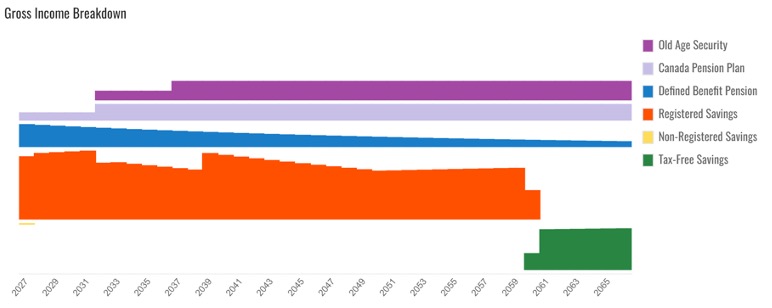
Thinking about today-self and tomorrow-self, that’s a good reflection for this chart: Continue Reading…

Maintaining Balance in Volatile Markets

Franklin Templeton/Getty Images

By Ian Riach, Portfolio Manager,

Franklin Templeton Investment Solutions

(Sponsor Content)

It’s been a volatile first half of the year for the world’s capital markets. In many countries, both equities and fixed income have declined, which has led to the second-worst performance for balanced portfolios in 30 years. Typically, bonds outperform stocks in down markets, but not this time. In fact, this has been the worst start to the year for fixed income in the past 40 years, thanks to higher inflation and the resultant rise in interest rates.

Supply-side inflation harder to tame

Central banks use rate hikes as a tool to curb demand for goods and services; but the current inflation is being driven more by supply-side issues stemming largely from the COVID-19 pandemic and exacerbated by the Russia/Ukraine war. Unfortunately, central banks have little influence over supply. All they can do is try to dampen demand with an aggressive interest-rate adjustment process, but they must be careful not to overshoot. Raising rates too quickly runs the risk of tipping weak economies over the edge into recession territory.

Canada’s most recent inflation imprint, released in June, showed an increase to 7.7% year-over-year. One negative consequence is that real incomes are being squeezed as inflation continues to accelerate.

Rates are rising quickly

Both the U.S. Federal Reserve (Fed) and Bank of Canada (BoC) have increased their overnight lending rates from essentially 0% prior to March of this year to 1.5%-plus in June. The Canadian futures market had priced another 75-basis point (bp) increase at BoC meeting in July, which ended up an even higher 100-bps with indications of more to come in September.

Rising interest rates are hurting several sectors of Canada’s economy, notably real estate — especially risky for the economy as housing and renovations have been leading Gross Domestic Product (GDP) growth for the past few years. A significant correction in that sector could lead to a recession.

If there is any silver lining in the current situation, it may be in the Canadian dollar versus its U.S. counterpart. Short-term rates in Canada have moved higher than in the United States. This differential, along with the direction of oil prices, affects the value of the Canadian dollar against the U.S. dollar. If the differential widens and stays higher in Canada, the loonie will likely benefit.

Recession risks are growing

The likelihood of recession is hotly debated within our investment team. Recession in North America is not our base case, but a soft landing will be very difficult. We are currently in a stagflationary environment and recession risks are increasing daily. Europe may already be in recession.

The stock market is a good leading economic indicator, and its recent decline indicates the risk of recession is rising. In addition, the yield curve is very flat, which typically portends an economic slowdown. These market signals have somewhat altered our team’s thinking. Given the current environment, we are reducing risk in our portfolios. In fact, we recently went slightly underweight equities.

Regionally, we are reducing the Europe weighting as that region is more exposed to the negative headwinds associated with war. We are slightly overweight the U.S. but acknowledge that valuations are subject to disappointment with declining earnings growth. We are overweight Canada, which continues to benefit from rising resource prices. Continue Reading…

12 Questions to Ask when Buying a House

What is the one question to ask when buying a house?

To help you be informed when purchasing a home, we asked business owners and finance experts this question to hear their best advice. From inquiring about homeowners’ fees to asking about renovations, there are several questions that may help you when buying property in the future.

Here are 12 questions to ask when buying a house:

  • Are There any Homeowners Association Fees?
  • How Old are Appliances and Major Systems?
  • How Long Has the House Been on the Market?
  • What does the Inspection Reveal?
  • How Much Have Nearby Properties Sold for?
  • Are There Any Risks to One’s Health Or Safety?
  • What Do the Seller’s Disclosures Signify?
  • What Kind of People Live Nearby?
  • Is the Home Prone to Floods Or Other Natural Disasters?
  • What is the Seller’s Reason for Leaving?
  • What’s Included in the Sale?
  • Were any Additions or Major Renovations Made?

Are there any Homeowners Association fees?

When looking for a home, you usually think about the payments that affect your mortgage, like taxes, insurance and upgrades. You may also try to estimate what you will have to pay for your utilities. However, when you find that perfect home, you should also consider if there are any homeowner association (HOA) fees that come with living in a new community. HOA fees are required payments that help ensure the neighborhood and properties are maintained to a certain standard.

HOA fees can cause you to lose your home if you don’t pay them monthly or annually. They are separate from your mortgage, and the fee can range depending on where you live, possibly ranging from $100–$1,000 per month. Because these fees are not included in your mortgage, you have the responsibility to pay them, and you should factor the cost into your budget so that you don’t find yourself in a dire financial situation or risk losing your home. — Annette Harris, Harris Financial Coaching

How old are appliances and major systems?

This is one question that I believe should be asked when purchasing a home, because knowing the expected lifespan of important systems and appliances—such as the air conditioner, furnace, water heater, washer, dryer and stove—can help you budget for major repair or replacement costs. Request a house warranty from the seller to cover the expense of replacing these things if they are nearing their end of life, or if they have already reached it. — Gerrid Smith, Joy Organics

How long has the house been on the market?

I believe this is an important topic to ask before making an offer on a house, since a seller will be more willing to negotiate a lower price if their house is on the market for a longer period of time. As a result, you may be able to haggle on the price, conditions, terms and credits associated with the replacement of worn-out carpet or other obvious difficulties. 

If a home is overpriced from the start, it may sit on the market for a long period before finally selling after several price reductions. For some purchasers, an overly long time on the market and frequent price decreases suggest that something is amiss with the property. As a result, you have a fantastic opportunity to work out a bargain. — Edward Mellett, Wikijob

What does the inspection reveal?

You can never ask too many questions when buying a house. It’s a major investment and one that a lot of people spend a lifetime saving up for, and it’s important to have all the information before making your purchase. Generally speaking, the important questions will be answered during the inspection and appraisal processes, which you should ensure always happen if you can help it. Continue Reading…

Bond ETFs vs. GIC Ladders

By Justin Bender, CFA, CFP

Special to the Financial Independence Hub


If there were ever a contest held for “Canada’s Most Boring Investment Ever,” I’ll bet that bond ETFs and guaranteed investment certificates (or GICs) would duke it out in the final round. We buy one or the other, or maybe some of both, to offset our more glamorous (and more risky) stock funds with some sensible dependability. Then, thankless crowd that we are, we cringe at their related paltry returns.

So in the boring battle between them, which should you use? Laugh at the humble GIC if you must, but GICs may just help save the day in today’s fixed income markets.

Consider this. Between January 1st and April 30th, 2022, the 10-year Government of Canada benchmark bond yield has more than doubled, rising from 1.4% to 2.9%. As yields increased, bond prices dropped, causing Canadian broad-market bond ETFs to suffer double-digit losses so far this year, losing over 10% of their value.

Now, seasoned investors may be used to the gut-wrenching double-digit drops we periodically see in the stock markets, but some of you haven’t had to stomach seeing your supposedly “safe” bond ETF holdings show up in bright red when you login to your online accounts. If fixed income is going to be so boring, the least it can do is keep its head above water.

I don’t typically recommend switching up your holdings every time a market disappoints. But if your bond funds are giving you serious heartburn, GICs may be worth a second look.

Let’s start off by talking about returns. Many GICs have yields that rival those of your favourite bond ETFs, but with a much lower average maturity. In fact, a 1–5 year GIC ladder currently boasts an average yield of 3.6%, with an average maturity of just 3 years. It’s called a “ladder” because you typically spread your GIC purchases evenly across 1-to-5-year maturities. This eliminates the need to predict future interest rate movements. So, if you have $100,000 to invest in GICs, you buy a $20,000 1-year GIC, a $20,000 2-year GIC, and so on, until you’ve built each “rung” in your 1-5 year ladder. As each GIC matures, you continue the ladder by reinvesting the proceeds into another GIC maturing in 5 years.


With a bond ETF, the best estimate we have of its future return is its weighted average yield-to-maturity. These days, in spring 2022, the yield-to-maturity on a broad-market Canadian bond ETF is about 3.4% after costs. And at 10.3 years, the weighted average maturity of the underlying bonds is significantly higher than a GIC ladder, exposing your investment to more interest rate risk.


With the GIC ladder, you can currently expect similar returns with far less term risk than what you’ll find in a bond ETF. In fact, since the end of 2011, a ladder of GICs has actually outperformed a broad-market Canadian bond ETF, with a much smoother ride along the way. It’s interesting to note that both options had the same 2.3% yield at the beginning of this measurement period.

Looking forward, there’s no guarantee that a ladder of GICs will always outperform a bond ETF over your specific investment timeframe, but there are still additional advantages of the strategy worth noting.

Advantages of GIC Ladders

GICs have shorter maturities. As mentioned earlier, the average maturity is 3 years for a typical 1–5 year GIC ladder (with an equal investment in each of the ladder’s “rungs” or years). In comparison, the average maturity is 10 years for a broad-market Canadian bond ETF, like the BMO Aggregate Bond Index ETF (ZAG). This makes the bond ETF more vulnerable to interest rate increases than a GIC ladder. If you’re concerned with the potential of further interest rate hikes down the road, a ladder of GICs may be more appropriate for your risk appetite. Keep in mind that if bond yields decrease from their current levels, bond ETFs could recover some of their losses (while your GIC ladder won’t experience the same price pop). Continue Reading…

Inflation: What is Normal?

Outcome Metric Asset Management public domain CC0

By Noah Solomon

Special to the Financial Independence Hub

Just as beauty is in the eye of the beholder, what one considers normal depends on their perspective. One of the single largest contributors to booms and busts is the tendency of investors to suffer periodic bouts of long-term memory loss. During such episodes, people view recent market dynamics as being normal, regardless of whether such behavior is an aberration from a long-term historical perspective.

We cannot understate the degree to which the economic and investment climate that has prevailed since the global financial crisis of 2008 has deviated from its long-term historical norm. It is challenging to identify any other time in history when financial markets have been as influenced by ultra-low interest rates and vast amounts of fiscal stimulus.

Given the unprecedentedly powerful “wind” of governments and central banks at their back, it is no surprise that the best strategies for investors have been:
• Buy almost anything – stocks, bonds, real estate, cryptocurrencies, art, etc. (take your pick, it’s all good!).
• Buy even more during dips, which consistently proved to be good buying opportunities.
• Use maximum leverage to turbocharge buying power and returns.
It is fair to say that there by the grace of the authorities have gone corporate profits, asset prices, and investor portfolios!

The Phillips Curve has been sleeping, but it’s not Dead

The Phillips curve is an economic concept developed by A. W. Phillips, which describes the relationship between inflation and unemployment. The theory holds that there is an inverse tradeoff between the two variables. All else being equal, lower unemployment leads to higher inflation, while higher unemployment is associated with lower inflation.

Phillip’s theory proved largely resilient for most of the postwar era. Until recently, the one notable exception occurred in the early 1970s, when OPEC issued an embargo against Western countries, resulting in stagflation (both high inflation and high unemployment).

The second aberration covers the time between the global financial crisis of 2008 and mid-2021. Until rearing its head several months ago, the inflation genie has been dormant. It has calmly remained in its bottle in the face of monetary and fiscal conditions that in times past would have caused it to bust out full of fire and brimstone!

The combination of low unemployment and tame inflation provided a goldilocks backdrop for corporate profits and asset prices. But, to steal the tagline from Jaws 2, “Just when you thought it was safe to go back in the water,” inflation has returned, prompting central banks to slam on the brakes. This has changed the landscape in ways that have and likely will continue to have far reaching implications for investors’ portfolios.

The Kazillion Dollar Question

The laws of supply and demand can vary in terms of timing, but they cannot be eradicated. You can either eat your entire cake all at once or piece by piece over time. You can’t do both. The free money, one-way asset prices, all-you-can-eat risk party that has been raging since the global financial crisis of 2008 has given way to today’s hangover of rising inflation, higher interest rates, falling stock prices, and risk-aversion.

The kazillion dollar question is whether the current market malaise is merely a garden variety hangover involving Advil (i.e., a mild and short-lived bear market), or a case of alcohol poisoning that will entail a trip to the emergency room (a severe and long-lasting bear market).

Japan’s Addiction

Without a doubt, there are vast structural, economic, demographic, and political differences between Western economies and that of Japan. Nonetheless, the Japanese experience serves as a small “w” warning of the potential consequences when extreme levels of monetary stimulus are applied for an extended period. Continue Reading…

Powered by the Financial Independence Hub.
© 2013-2026 All Rights Reserved.
Financial Independence Hub Logo

Sign up for our Daily Digest E-Mail!

Get daily updates from the FindependenceHub.com straight to your inbox.