


General

Nobody knows what will happen to an Individual Stock

Image via Pixels/Tima Miroshnichenko

By Michael J. Wiener

Special to the Financial Independence Hub


When I’m asked for investment advice and I say “nobody knows what will happen to an individual stock,” I almost always get nodding agreement, but these same people then act as if they know what will happen to their favourite stock.

In a recent case, I was asked for advice a year ago by an employee with stock options.  At the time I asked if the current value of the options was a lot of money to this person, and if so, I suggested selling some and diversifying.  He clearly didn’t want to sell, and he decided that the total amount at stake wasn’t really that much.  But what he was really doing was acting as though he had useful insight into the future of his employer’s stock.

He proceeded to ask others for advice, clearly looking for a different answer from mine.  By continuing to ask others what they thought about the future of his employer’s stock, he was again contradicting his claimed agreement with “nobody knows what will happen to an individual stock.”

How a seemingly token amount can become a painful loss

Fast-forward a year, and those same options are now worth about 15 times less.  Suddenly, that amount that wasn’t that big a deal has become a very painful loss.  He has now taken advantage of a choice his employer offers to receive fewer stock options in return for slightly higher pay.  It’s hard to be sure without seeing the numbers, but in arrangements I’ve seen with other employers, a better strategy is to take the options and just sell them at the first opportunity if the stock is far enough above the strike price.  Again, he’s acting as though he has useful insight into the future of his employer’s stock.

The lesson from this episode isn’t that people should listen to me.  I’m used to people asking me for advice and then having my unwelcome advice ignored.  What I find interesting is that even if I can get someone to say out loud “I don’t know what’s going to happen to any individual stock,” they can’t help but act as though either they know themselves, or they can find someone who does know.

Michael J. Wiener runs the web site Michael James on Money, where he looks for the right answers to personal finance and investing questions. He’s retired from work as a “math guy in high tech” and has been running his website since 2007.  He’s a former mutual fund investor, former stock picker, now index investor. This blog originally appeared on his site on Sept. 20, 2022 and is republished on the Hub with his permission. 
An Ode to Dividends

By Noah Solomon

Special to the Financial Independence Hub 

Companies that pay sustainable dividends have provided the best returns over time, including during periods of elevated inflation.

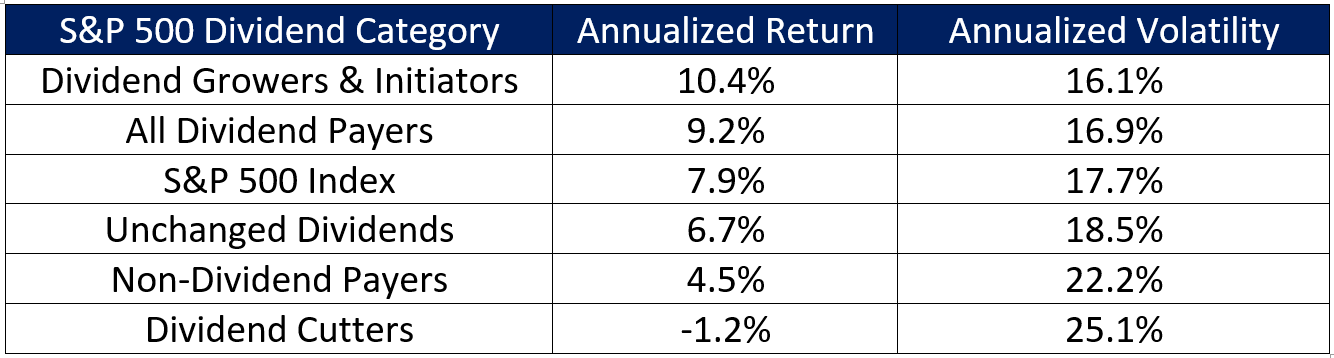
Ned Davis Research (NDR) studied the relative performance of S&P 500 stocks according to dividend category from 1973-2020. Their findings are summarized in the following table:


Returns by Dividend Category (1973-2020)

Over the past 48 years, dividend-paying stocks have outperformed their non-dividend paying counterparts by 4.7% on an annualized basis. When coupled with the power of compounding, this difference is nothing short of astronomical. A $1 million investment in dividend payers over the period would have been valued at $68,341,836 as of the end of 2020, which is $60,070,380 higher than the value of only $8,271,456 for the same amount invested in non-dividend paying stocks.

Within the dividend-paying complex, dividend growers and initiators have been the clear champions, with an annualized return of 10.4% vs. 9.2% for all dividend-paying stocks. A $1 million investment in dividend growers and initiators would be valued at $115,482,326, which is $47,140,940 more than the same amount invested in all dividend payers.

Not only have dividend-paying companies outperformed their non-dividend paying counterparts, but they have done so while exhibiting lower volatility.

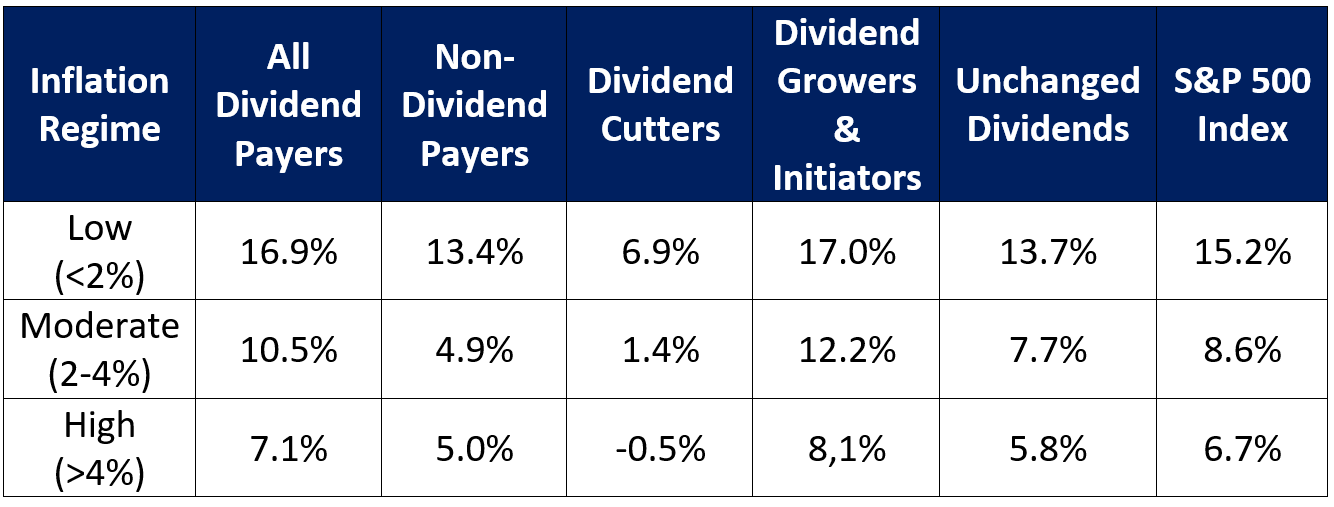
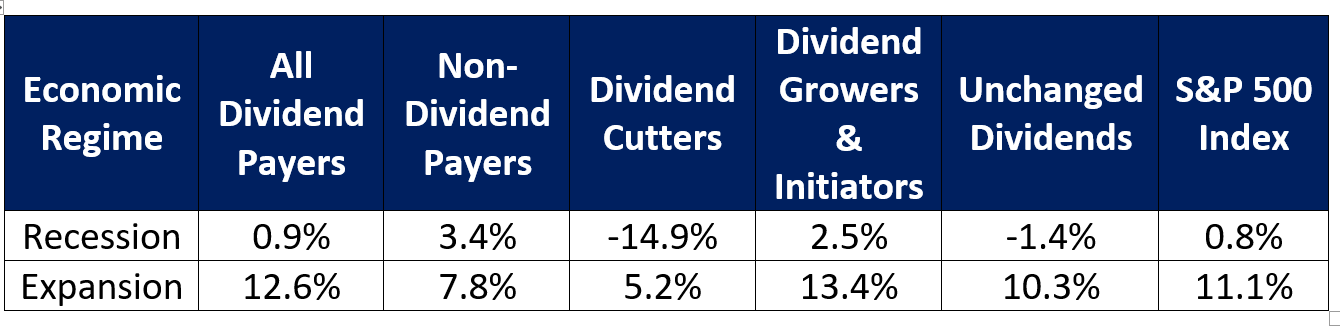
NDR’s study also examined the relative performance of dividend payers vs. non-payers in various macroeconomic environments. Specifically, their research set out to ascertain how the outperformance of dividend vs. non-dividend paying stocks has been impacted by inflation, economic growth, and interest rates.

Inflation’s Impact on Returns by Dividend Category (1973-2020)

Dividend-paying stocks have on average outperformed their non-dividend paying counterparts regardless of whether inflation has been low, moderate, or high.

Unsurprisingly, dividend growers and initiators outperformed other dividend-paying companies during periods of moderate to high inflation.

The Economy’s Impact on Returns by Dividend Category (1973-2020)

During recessions, dividend-paying stocks have underperformed non-payers by 2.5% on an annualized basis. This shortfall pales in comparison to their 4.8% outperformance during economic expansions, especially considering that economies spend far more time expanding than contracting. Continue Reading…

Issues that arise when Financing your Small Business yourself

Photo Credit: Unsplash

By Beau Peters

Special to the Financial Independence Hub

When you get an idea for a new business, it’s easy to want to launch it right away. It might seem like a “now or never” situation, and your eagerness makes it nearly impossible to think about waiting a year or two to get things running.

However, it’s not uncommon for small business start-ups to cost thousands of dollars. Applying for small business loans can take time, and if you’re worried about launching quickly, you might be tempted to bankroll your business and use your own money to finance it.

Unfortunately, that’s a risky move. While it might seem like an investment, it could be a bad idea for a small business looking to grow.

If you’ve got a great idea for a small business and you’re anxious to launch it, you already know the importance of funding. However, it’s just as important to recognize some of the risks of financing it on your own. Let’s talk about what that might look like, and some issues that often arise when you’re putting in your own money to get things off the ground.

Mixing Business and Personal Funds

One of the biggest problems that can arise when you finance your small business yourself is drawing a line between your personal funds and what you’re spending on the business. It might not seem like a big deal for the two to commingle, especially if you’re starting out as the only employee. Some of the most common ways of commingling funds include:

  • Using one bank account for business and personal needs
  • Moving money back and forth between accounts
  • Depositing personal money to pay for business expenses
  • Withdrawing from your business account to pay for personal expenses

Not only can commingling funds get confusing, but it could put both your business and your lifestyle at risk. First, if your business is listed as an LLC, you could end up being held personally responsible for any business debts or lawsuits. You’ll also risk your personal assets being exposed.

One of the easiest ways to keep yourself from commingling funds is to dedicate a separate bank account to your business. Even if you end up putting some of your personal money in there for funding, you’ll be less likely to tap into it for personal reasons, and it will be easier to keep things organized and easy to understand, especially when tax season rolls around.

Ignoring the Fine Print

Financing your small business yourself doesn’t always mean reaching into your own pocket. It could simply mean you’re taking other routes to fund your idea, rather than relying on a bank or small business loan.

One popular option nowadays is crowdfunding. In the United States, over $17 billion is generated each year through crowdfunding sites. If you need money quickly, setting up a crowdfunding campaign is a great way to get it while encouraging people to get excited about your new business. It can be a solid marketing tool if you invest some time into it.

However, don’t ignore the fine print when it comes to these campaigns.

There are several different sites and platforms that allow you to ask for money. Each of them has a different set of rules and regulations. Some might require a small percentage of whatever you make. Others will charge a fee. Even if you understand that part, make sure you know what you’re liable for if you reach your funding goal. Many platforms require you to offer incentives to people willing to donate or pledge. It’s important to follow through on those incentives. Not only could you end up getting reported and lose some of your funding, but it’s a bad look for your business if you don’t give the people helping you out what they deserve.

If you decide to go with a crowdfunding site, make sure you understand the rules and are willing to stand by them, whether you make your goal or not.

Not Building your Skills

When you’re starting a business, you have to wear many hats. You might have a great idea, but you’re going to have to learn how to market yourself, deal with accounting, work with technology, and even how to hire the right people. In addition to the hard skills you’ll need, there are plenty of soft skills small business owners should have, including:

  • Leadership
  • Strong communication
  • Organization
  • Emotional intelligence

Not only are these skills important for running your business, but they’re necessary if you’re trying to work with angel investors or you want to secure venture capital. Refining your soft skills can make it easier to communicate with potential investors. By communicating clearly and effectively and showcasing your leadership skills, they’ll be more likely to trust your business plan and your projections. Continue Reading…

Life after Twitter: Mastodon & other alternatives

As I posted on Twitter a few days ago, Elon Musk’s ownership is causing a lot of Twitter regulars to rethink their commitment to the platform. Personally, I have invested a lot in the Bird since joining in 2009 and so I am reluctant to storm out of there merely out of sheer petulance. Better, I think, to take a wait-and-see approach and give Elon a chance to salvage it or to burn it to the ground.

But it does behoove regulars to have a contingency plan or Plan B. Once upon a time, I viewed Google Plus as an alternative but it proved to be a virtual ghost town until Google pulled the plug on it. If Twitter keep imploding, perhaps the folks at Google will think of giving it a go again. But in the meantime, there are still LinkedIn and Facebook.

While in Spain this month, I started to experiment with the platform that seems most likely to accumulate disaffected Twitter users: Mastodon. (spelt with the letter o in two places, NOT the letter “a”!

Unlike the centralized Twitter platform, Mastodon is decentralized and that’s the first thing you need to know about it when signing on. First you have to pick a server, which is run by volunteers around the world. I picked one of the few (or only?) Canadian ones: mstdn.ca. It’s also called Mastodon Canada and bills itself as being run by Canadians for Canadians

A new meeting ground for Canadian finance Tweeters and bloggers?


Perhaps it’s too early to say, or that it’s wishful thinking, but it seems possible that a critical mass of disaffected Canadian Twitter users may be building there, including a subset of Canadian financial tweeters; I mean tooters!

For me, Truth Social was never an option, for reasons that should be obvious, given its ownership. If there are other Canadian Mastodon servers and there may be, Google Canadian Mastodon servers.

Mastodon takes some getting used to and the learning curve seems steeper than Twitter was in its heyday. At the same time, it’s fun to give one’s atrophied social media little grey cells a new workout, and it’s a learning experience to see new networks and patterns of networks evolve almost from the ground up.

It was helpful to be fairly early with Twitter and in the same way Mastodon has that pioneering feeling here in November of 2022, the first full month of Elon’s Twitter ownership. Mastodon has been around much longer but there’s little doubt there is now a wave of Twitter users descending on the place. Most of the new arrivals admit they’re looking for a possible alternative, or don’t really know why they are there, and most either need a bit of help or encouragement or are a bit more experienced and willing to offer assistance to the newbies.

In fact, mstdn.ca is so new they are still asking for volunteers to moderate and assist with the technical side for those who have the skills. They’ve also just set up a PayPal account to accept donations to offset the server costs.  Continue Reading…

This is your Investment Brain on Pessimism

Lowrie Financial: Canva Custom Creation

By Steve Lowrie, CFA

Special to the Financial Independence Hub

I’m no psychic. But I bet I can still correctly divine what’s on most investors’ minds these days.

Pessimism, bordering on despair …

Have you been reading the headlines, viewing your investment portfolio, and assuming the worst is yet to come? Welcome to your painful crash course on what market risk really looks like—and more importantly, how it feels.

Most investors say they’re ok living with periodic market risk, as long as it helps them achieve better returns over the long run. We accept (in theory) that tolerating the interim damage done to our own investment portfolios will help us meet our long-term financial goals.

But that’s investment risk in theory. Since it’s been a long time since we’ve encountered an extended bear market climate, you may have forgotten or never known the reality of it. It may not have clicked then, when significant market declines happen, it is usually due to despairingly bad news … amplified by headlines screaming how things are only going to get worse from here.

The reality is, when we’re in the middle of a storm of stuff, our behavioural biases make it very difficult to believe we’ll ever see better days.

Now and Then Investment News

History informs us otherwise. Even in the current climate, there have been plenty of days when stock markets have delivered positive outcomes. Some days, it’s even been very positive.

How does the popular financial media (aka, “group think central”) report the good news? They have a gloomy story to tell, because that’s what’s been selling lately. So, they dig up market pundits who downplay the uptick. They discount the event as being a “short covering,” “relief rally,” “dead cat bounce,” or some other meaningless adage, rather than accurately reporting that this is just how efficient markets operate every day. Without a scrap of plausible evidence, their confident conclusion is that the markets must soon continue their downward spiral.

A relevant question is: What is the pundit’s track record? You have to dig hard to find the data, but even those with the best reputation score less than a coin flip across their body of forecasts. (Actually only 46.9% accurate according to this study.)

On the subject of forecasting generally, David Booth, the co-founder of Dimensional Fund Advisors, recently offered this very practical insight:

Do you really want to invest your hard-earned savings—the money you’ll need for your kids’ college or your own retirement—based on someone’s hunch or wish?

What Goes Down …

From an analytic perspective, the general economy does have its work cut out for it over the foreseeable future. But, believe it or not, I remain optimistic about staying invested in our financial markets, and I think you should be too.

While I’m admittedly an optimist by nature, I’m also evidence-based. So, let’s look at what we know, and how it shapes what to prepare for—i.e., financial markets that should continue to deliver solid rewards to patient investors in the years ahead.

Let’s start with one of those pictures to replace a thousand words. Compliments of our friends at Dimensional Fund Advisors, here’s what U.S. stock and bond markets have done in the past after stumbling into bear market territories. Defying gravity, it would seem what goes down in financial markets has typically gone back up — and kept going over time.

lowrie dimensional equity returns to 2021
*Dimensional Fund Advisors LLP – Past performance, including hypothetical performance is not a guarantee of future results. Indices are not available for direct investment; therefore, their performance does not reflect the expenses associated with the management of an actual portfolio. In USD. Market declines or downturns are defined periods in which the cumulative return from an a peak is -20% or lower for equities and -2% or lower for fixed income. Returns are calculated for the 1-, 3-, and 5 year look-ahead periods beginning the day after the respective downturn thresholds are exceeded. The bar chart shows the average returns for the 1-, 3-, and 5-year periods following the 20% for equities and 2% for fixed income thresholds. For the 20% threshold, there are 15 observations for 1-year look-ahead, 14 observations for 3-year look-ahead, and 13 observations for 5-year look-ahead. For the 2% threshold, there are 29 observations for 1-year look-ahead, 26 observations for 3-year look-ahead, and 25 observations for 5-year look-ahead. See “Index Descriptions” in the appendix for descriptions of Fama/French index data. Eugene Fama and Ken French are members of the Board of Directions of the general partner of, and provide consulting services to, Dimensional Fund Advisors SP. Bloomberg data provided by Bloomberg.

As always, we can’t guarantee that’s what will happen this time. Nor is it going to be pleasant to wait for markets to likely do what they’ve done before. But one thing is for sure: If you sell out of today’s markets or make significant changes, you’ll lock in at today’s lows, despite the logic and data that suggests we should expect above-average returns over the next few years. In past posts, I’ve referred to this as one of the Big Mistakes in investing.

Markets, Economies, and Different Drummers

You may also have noticed that financial market pricing is often quite out of sync with economic indicators, especially in more volatile markets. The economy will stumble … and markets will end higher for the day. Or the economy will catch a break, and stock prices drop. Continue Reading…