Posted By
By Akaisha Kaderli
Special to the Financial Independence Hub
I did not want to book a ticket only to receive a voucher for a cancelled flight, so for weeks beforehand, I did my homework and had been tracking arrivals and departures from both Guadalajara, Mexico (GDL) and Phoenix Skyharbor Airport (PHX) in Arizona.
While other airlines were no longer flying this route, American Airlines had been dependable, with daily flights on time and arriving in one piece.
I made my reservations online and signed up for text alerts on my flight. The day of the departure, I had our driver take me to GDL International airport hours before departure in the event of any snafu’s. I knew things were going to be different, flying in the time of COVID, and I wasn’t sure what I would be meeting.
Arrival into bureaucracy
I registered at the desk and checked one bag. All went smoothly, until I found out I needed to fill out a “health form” before I entered the security x-ray area. No problem, just hand me one: oops, no paper form available, it’s all online. First, I must add this contact number to my WhatsApp, then fill out the form, and scan the bar code at the security entry like your boarding pass on your phone. I was good to go.
Except that my flight had no gate assigned yet, because it was delayed!
Oh no.
Glad I signed up for the alerts!
My flight continued to be delayed over the next 7 hours with my phone beeping every 20 minutes to let me know I wasn’t flying yet.
I tell myself: I just want to leave today! I don’t care if I have to snooze a few hours in PHX airport so my ride can come get me at a reasonable time the next day. I just wanna go.
Normally, my wait time in airports is filled with my catching up on emails, perhaps watching a video and then gliding onto the plane. Today, I was far too nervous to get interested in anything long term like an email … With the public announcement mentioning this flight leaving, that flight leaving, my phone beeping, my husband whatsapping me, my ride in AZ is whatsapping me, things were getting too crazy.
C’mon guys, give me some clue!
Hours into the delay, I figured I needed to speak to someone at the American Airline desk. Where the heck is THAT?!
Do you know how big airports are?
After literally walking thousands and thousands of steps (I have a step counter on my digital device) and realizing that I would have to go outside of security, then back in “somewhere”, wait in line, speak to an agent, fill out the health form again, go through security again, lose the $3 bottle of water I just purchased … I started to get frustrated.
Meanwhile, my phone continues to beep letting me know: that my flight had been delayed, yet again.
Should I reschedule myself for another flight another day? After speaking with agents at the desks by the gate where I had parked myself, they tell me “no, no, your flight is leaving today. It’s not canceled, just delayed.”
I wonder if I should just take a taxi back home and start over. I’m beginning to get a little confused as to what might be the best thing for me to do. Meanwhile I was hungry beyond nuts and raisins to tide me over.
All passengers for flight #5902, come to your gate
A young Hispanic bi-lingual girl sitting next to me also waiting for the same flight, suddenly jumps up and said “They want to talk to us.”
Digitally contacting my family in Arizona and Billy in Chapala, all of us were watching this unfolding scenario. I eventually received a meal voucher after 4 hours, which was very nice of the airline, and the right thing to do.
I use mine to get some grilled tilapia, mojo de ajo, and a mango lemonade. The dang phone keeps beeping – yeah yeah, I get it. My flight’s been delayed.
This goes on until I get my new update. My flight – isn’t cancelled – it’s delayed until tomorrow afternoon! What!?
Back to the gate desk to see what’s going on.
Sweet dreams
The man at the gate explains that my flight will leave tomorrow and for now, here’s another voucher for free transport to a hotel, prepaid night at the hotel, dinner and breakfast the next morning, then transport back to the airport.
So now I must get my checked luggage from the original check-in desk.
I’m still walking around (thousands more steps) until I can find an exit out. I speak to some young girls at a table, then a young man whom they call over who promises to help me obtain my luggage.
Getting to the American Airline counter, the guy who took me there says I don’t have to wait in line in a case such as this, just go to the front. Perfect.
Now what?
I speak to an agent who is very kind, explains to me more of what is going on (in English, thank God) and I take my luggage and myself to the shuttle meeting place. Lots of other passengers are there as well … and I wonder … where will they take me? As we crawl through Guadalajara commuter traffic, I’m curious as to if this hotel will be a cheapie? Will there be hot water? Oh gawd, I hope there aren’t cockroaches or other critters. The way this day has been going anything could happen.
I look around in the transport van, and I notice a well-dressed young family, several women with coifed hair and freshly done nails… No, they wouldn’t DARE put me up in a cheapie. These high-class women would rise up in rebellion!
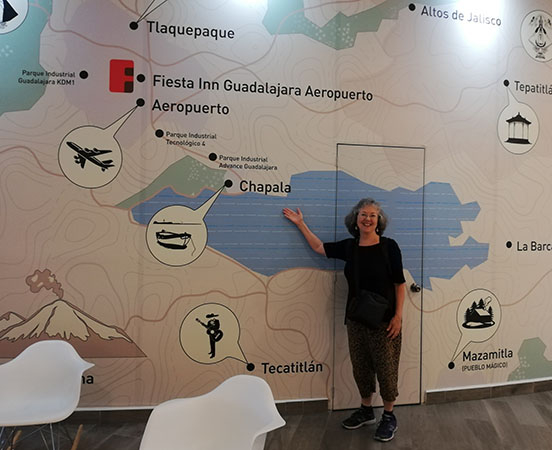
Arriving at the Fiesta Hotel
Arriving at the hotel, people are friendly and with big smiles. I get signed in, get a credit-card type of entry key, sign a few forms, and the check-in clerk hands me a small box, which I’ll open when I get to my room. It’s now past 8:00 in the evening and I am ready to call it a day. I’m not slap-silly yet, but close.
Wandering around some more looking for elevators or stairs, I find myself directed to the elevator and I push floor #2. Nothing happens. I know I’m tired … so I press again, only this time, harder.
Soon the door opens and a young man and older woman enter. He scans his credit card entry key and presses floor #1. He instructs me to do the same. Oh jeeze. Country bumpkin discovered.
Cripes.
I get to my room, use the credit card entry key and now can’t seem to find the way to turn the lights on.
A completely gorgeous young woman who is a fellow passenger is outside my door and offers to help me to get anything I need. Mexicans are so well-trained by their mothers to be polite, helpful and considerate: to women and especially older women. That would be me.
I am very grateful.
My comfy hotel room
After I get inside my hotel room, I open my box. There is more hand sanitizer gel, wipes and another mask. With 9 masks on me and my own bottle of hand gel, I have gel and masks coming out the wazoo.
My room is huge, clean and has 2 queen size beds, shower amenities, a desk, and a huge digital wall TV. I fiddle with the air conditioner which is set on – 16 Celsius, roughly 61* F. It felt like you could hang meat in this room.
It takes me a few moments to realize that my digital weather station is telling me that soon, I’ll be sleeping in a freezer and I adjust it up to a comfortable 24 C.
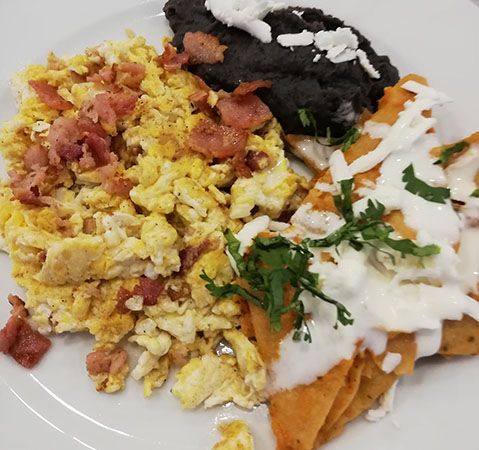
Breakfast
With the voucher for another free dinner at the hotel I couldn’t fit two dinners into one evening since I just finished the one at the airport. Oink, oink.
I was so tired I couldn’t even make it down for the free glass of wine.
However, the comp’d breakfast the next morning was delicious also, with great service.
All of us passengers are shuttled back to the airport, and a big surprise awaits me.
No kidding, Billy finds me in the airport!
Billy – on his way to meet up with friends for the weekend – was flying to Puerto Vallarta, Mexico, and for curious reasons, his domestic departure gate is just one down from my international departure gate! Go figure.
So, my knight-in-shining-mask walks up to me as I’m waiting in the gate area. You can notice how happy I am to see him!
I finally did make it to PHX, albeit, a day late and a few Pesos short.
Returning to Mexico – smooth as silk
Shuttle shenanigans
Initially, back in Mexico when I was trying to make reservations for transport from the airport to my sister’s home, the local shuttle was not running. For a special driver, I would have had to pay $350USD+ for a round trip ticket, purchased in advance for the discount. This is about what I paid for my roundtrip flight, and I wasn’t keen on spending my money in this manner. Continue Reading…