Money is an ever important facet of living in human society. As they say, “money makes the world go ‘round,” but it often seems like your bank account is never full enough to meet all your needs, let alone desires. However, there are methods available to help the average person get ahead of the curve to improve their finances and otherwise build their dream lives. Here’s what you need to know.
Financing Luxuries
When thinking of financing, one tends to think of a house or a car. This service has been integral in providing the working class with things that are necessary but prohibitively expensive for quite some time. However, there are other scenarios in which financing expensive products can be the best way to balance smart financial decision making with living your best life. For example, you can finance swimming pools to get the summertime recreation and relief you desire without spending a fortune on it in the moment. By spreading that cost out over time, you can bring your vacation to you without breaking the bank. This principle can also apply to many high end electronics, such as iPads, and it can also apply selectively with general retail products via layaway programs. Using these methods, you can gain the advantages of living beyond your means without actually taking the risk of doing so.
Reducing Costs
One of the most important methods of saving money is by spending less. Some might argue that refusing to spend money on creature comforts and luxuries is the right choice, that is only partially true. While some luxuries can be eliminated, those that enrich your life are important to maintaining mental health. Instead of making meaningful sacrifices, costs can be cut by simply buying less expensive alternatives to costly staples. Name brand products often fill that role, but you can often get the same value at a lower price by choosing off brand products instead. Continue Reading…
There’s never a lack of commentary on what we know about investing: or at least what we think we know. Experts and amateurs alike love to opine on the subject.
For a change, let’s cover three things we don’t know about investing, and how to use our “ignorance” to become better investors.
1.) We don’t know what tomorrow will bring
What’s money for? It’s for funding everything you would like to consume in your lifetime (and bequest to your heirs). The catch is, none of us knows exactly how our lives and financial positions are going to unfold. In “How To Think About Investment Risk,” Professor Ken French describes this risk as “uncertainty about lifetime consumption.”
Because we don’t know what lifetime risks we’ll be facing, or when we’ll be facing them, it’s best to build them into your investment strategy from the beginning. That way, you’re already as ready as possible when they do occur. It’s why we suggest maintaining liquid lifestyle reserves, balancing your portfolio between stocks and bonds, diversifying across broad market risks, and buying insurance to safeguard your most valuable consumables.
2.) We don’t know ourselves
Another common blind spot is how often our subconscious thinking tends to drive our supposedly deliberate decisions. In his book of the same title, Nobel laureate Daniel Kahneman calls this “Thinking, Fast and Slow.” Fast thinking keeps us alive in an emergency. Slow thinking helps us solve complex equations. By realizing you’re usually thinking on two levels, you can build this into your planning, particularly when balancing risks and expected rewards.
For example, Kahneman describes how people are inherently loss averse: We usually hate losing money about twice as strongly as we enjoy making money. You can leverage this hidden bias (along with basic math) to create an appropriate investment balance between the risks and expected rewards you choose to invest in. For example, would you bet your entire life savings on a 70% chance of doubling your money, but a 30% chance of losing everything? Most people wouldn’t take that bet, as the downside would seem too severe.
By acknowledging our hidden “fast thinking” tendencies, we stand a much better chance of sensibly building its influence into the financial choices we face.
3.) We don’t know what we don’t know
Ever heard of “the Dunning-Kruger Effect”? It’s a fancy term for describing how people who are less familiar with a subject tend to be more confident about their understanding of it than someone who is an expert in the same.
This MindfulThinks video describes how the effect works by comparing a college basketball fan to an actual player. An ardent fan may believe they know almost everything about the game, while the player may feel they’ve only mastered half of its intricacies. Why the disconnect? The player’s deep, hands-on experience leads to a more realistic assessment of everything there is to know about the sport. In contrast, the fan is blissfully unaware of huge gaps in their second-hand understanding. Continue Reading…
Yes that is an ironic headline. While many of the asset allocation or one ticket ETFs are quite similar, Horizons asset allocation ETFs stand out. For starters as you may know, the ETFs used within these portfolios are held within a corporate structure that do not pay out taxable distributions. They primarily use swap-based ETFs to create the portfolios. That will enable greater tax efficiency with respect to withholding taxes on foreign dividends.
With the shackles of unwanted tax hits removed Horizons TRI (Total Return Investments) one ticket ETFs can create the most efficient mix of Canadian, US and International equities and bonds. They do not have to worry about how an over weighting to US equities might create those tax inefficiencies.
I had the pleasure of chatting with Mark Noble, the Executive Vice President, ETF strategies for Horizons. The general topic was building the Balanced Portfolio for the times. Will the traditional Balanced Portfolio be able to cut it moving forward? Certainly the classic 60/40 portfolio model is built upon studies from decades past. We’ll get to that later in this post.
I had also looked at the subject and offered the New Balanced Portfolio. Not surprisingly, you’ll find mention of Horizons asset allocation ETFs in that post.
The 70/30 is the new 60/40.
It might all start with the stock to bond ratio. With bond yields so low, their contribution is likely to be much less compared to the last few decades. Good bonds might be there as risk managers but their total contribution is likely to be quite muted. How low can yields go? The question might end up being ‘how negative’ can rates go? While lower rates might deliver some higher prices, the bonds would then paint themselves into a corner with no yield to offer. It’s a Catch-22.
We might need a greater allocation to growth – more stocks.
Horizons Balanced Portfolio is 70% stocks and 30% bonds. Here’s the make up of that portfolio – ticker HBAL.
On September 10, 2020 the breakdown (rounded figures) …
40.8% US stocks
19.6% International stocks
10.0% Canadian stocks
19.7% Canadian bonds
9.7% US bonds (treasuries)
The target stock to bond ratio for the Balanced Portfolio (HBAL) is 70/30.
Mark had explained how the largely embraced 60/40 model is built on studies and data from the 70’s and 80’s. The portfolio design was based on looking at the long term Sharpe ratio (risk/return profile) of owning equities from many decades past.
Over the last 20 years the optimal risk return mix has moved closer to 70% stocks and 30% bonds. HBAL offers a 70/30 allocation vs. Vanguard’s VBAL of 60/40. It results in a better return trajectory. And once again, those lower yielding bonds add another reason to slightly stretch the stock allocation if we want or need to eke out some greater gains. Keep in mind that you will be taking on some greater equity risk.
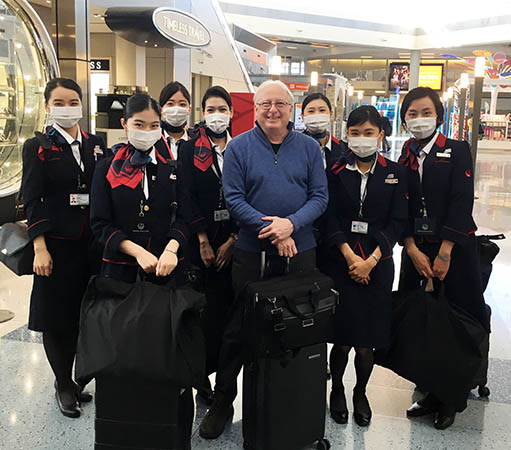
Japan Airlines flight crew departing from Dallas in March, 2020. Dale Knight is in blue, without the mask.
By Billy and Akaisha Kaderli
Special to the Financial Independence Hub
The COVID restrictions have been very difficult for those of us world travelers in the Early Retirement Community. We have had friends stuck for months in Europe, The Philippines, and Peru, among other countries.
We who travel as a lifestyle have found our footloose approach to life… encumbered, to say the least!
Here we have a travel update from one of our World Traveling Buddies, Dale Knight.
Take a look.
RetireEarlyLifestyle: You have been a world traveler now for decades, Dale. How have these COVID travel restrictions affected your traveling lifestyle?
Dale Knight: It’s been devastating, as I’m sure it has for anyone who is passionate about travel.
Since March, I’ve had to cancel six trips previously booked through the end of 2020. I had plans to travel to SE Asia, then Australia and New Zealand… a Europe trip in August that included London, the Balkans and Paris… German Christmas markets in November, skiing in Japan in December.
All cancelled.
It’s as if a year of my life has been snatched away.
RetireEarlyLifestyle: Where were you when COVID started to shut the travel world down?
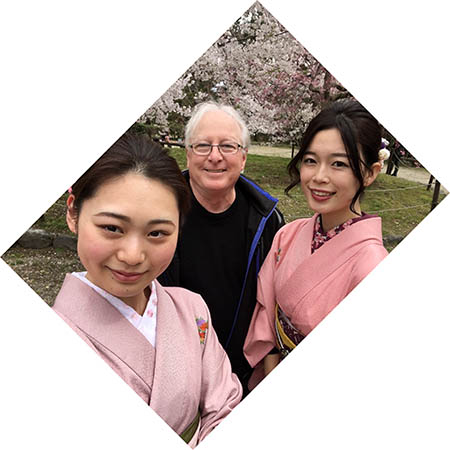
Cherry blossom season in Kyoto, Japan
Dale Knight: In mid-March, I flew to Japan with plans to spend four days visiting friends in Sapporo before continuing on to Thailand. I was in Sapporo when Thailand abruptly closed its border to all International arrivals.
What to do?
I flew to Tokyo for a couple of days, then took the train to Kyoto, where the cherry blossoms were in full bloom. Perfect timing! It was delightful, and everything at that time felt “normal” in Japan. People were out and about, bars and restaurants were open.
At the same time, the US was seeing a surge in COVID cases, and I began to hear from friends in Dallas about a strict lockdown. They warned that I might not be able to get back. I debated on whether or not to just stay in Japan but decided to return to Dallas.
That was not the best decision. In hindsight, I’d rather have spent more time in Japan.
RetireEarlyLifestyle: Have you done any traveling recently? Where have you gone?
Dale Knight: I tried a couple of road trips in the US … The Oregon coast in June and Colorado in August. Those trips sort of scratched that travel itch, but in many ways it was still very frustrating. Hotels didn’t provide housekeeping services for one thing.
Traveling solo, I like to find a local bar or pub and chat with the locals. That is very difficult when everyone is behind a mask, and you have to sit off by yourself. The lone exception was in Laramie, Wyoming, where I happened upon a small friendly bar where nobody was wearing a mask. Some might think risky, but to me it was refreshing.
Twice I have gone to Mexico, meeting up with friends in Puerto Vallarta and then to the little beach town of Chacala to meet up with you and the Chapala gang. Just last week, I returned after a month in Mexico. – Two weeks with you and Akaisha and friends in Chapala. It was a wonderful time.
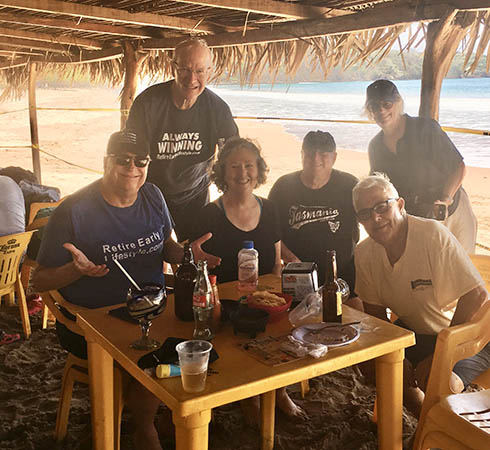
The gang’s all here in Chacala, Mexico
RetireEarlyLifestyle: Is the “whole world” shut down or only certain places?
Dale Knight: For Americans, it does seem like the whole world is shut down. Australia, New Zealand, and almost all of Asia are completely off-limits, probably through the end of the year. Same with most of Europe. There are a few exceptions like Croatia, Ukraine, Serbia, Belarus – each is open with different entry requirements, such as needing a negative COVID test within so many hours of your departure or arrival.
Turkey is also open to Americans, and Tanzania in Africa. Several Caribbean Islands are open as well as Brazil and Ecuador in South America. At the same time, many US states require quarantine for out-of-state visitors and Canada is closed to Americans.
It’s a constantly changing dynamic and I follow blogs as well as the IATA Travel Centre website to stay up-to-date.
RetireEarlyLifestyle: How do you see the future of travel?
Dale Knight: I’m afraid it will be a long time before we return to the way it was just six months ago.
In 2019 a record 1.5 billion people worldwide traveled internationally. This year, the numbers have fallen off a cliff, with estimates of up to 80% decline. Countries that are heavily dependent on tourism such as Thailand, have made the choice of safety over the economy. They are being overly cautious about reopening borders.
I think we may have to accept COVID testing and quarantines as part of our traveling future. If a vaccine is ever developed, you might have to carry a card much like the Yellow Fever vaccination card, to show you are ok.
RetireEarlyLifestyle: Is it easier in some places to get around versus other locations?
Dale Knight: When I was in Japan, it was easy to get around. Flying to Mexico and getting around Mexico is easy.
However, within the US, right now I cannot go to several states — mainly in the Northeast — without quarantining for 14 days. Before embarking on a road trip, I had to check each state’s restrictions to make sure I wouldn’t have to isolate in a hotel room. Attempting to go to Europe is difficult and even to those handful of countries allowing Americans, it requires planning, testing and possible quarantine.
RetireEarlyLifestyle: How has it been in the airports you have flown? What is different? Both flying into Puerto Vallarta, Mexico and out of Guadalajara, Mexico.
Dale Knight: Airports are pretty busy. People are flying and going places. The main difference is that the wearing of masks is strictly enforced both at airports as well as on the aircraft. Food and beverage service is minimal — or not at all — with the US airlines. My most recent flight was with the Mexican airline Volaris, from Guadalajara to Dallas Fort Worth. Flight attendants come through the cabin with a cart of beverages and snacks. Immigration was a breeze at both Puerto Vallarta and Guadalajara. Continue Reading…
It seems safe to assume that 2020 has been considerably different than what you expected when you first started your higher education. Back then, your future may have seemed assured. Though things are more uncertain now, do not give up hope. There are still opportunities available to you.
Even if there were not a pandemic, chances are good that you would not have been able to acquire your dream job immediately upon graduating anyway, due to your lack of experience. While the economic fallout of COVID-19 is troubling in many ways, this may be an opportunity for you to pursue a new career option that you might not have thought of before, one that offers you more stability or teaches skills that you can transfer to your chosen field. Here are some of the top recession-proof career options for newly minted graduates:
1.) Attorney
If your dream is to become a Phoenix criminal defense lawyer or attorney in another practice area, there is no need to give that up. Granted, your career path may have to take some detours as the bar exam has been rescheduled in some states. Nevertheless, there will always be a need for people with in-depth knowledge of the law to represent the interests of ordinary citizens.
2.) Teacher and Teacher’s Aide
Even before the pandemic, traditional classroom education was adapting to new technologies that allow for distance learning. Nevertheless, someone will always have to be there to provide instruction to students, whether in person or online. Distance and on-demand learning offer advantages such as flexible scheduling to teachers as well as students. Granted, if you wish to pursue a nontraditional career path in education, you must make sure that not only your teaching credentials but your technological literacy levels are in impeccable order.
3.) Health Care Professional
The medical field encompasses a broad range of professionals, not only doctors and nurses but physicians assistants, lab technicians, physical therapists, and many more. There are also health care professionals not involved directly in patient care, such as administrative support staff and medical records technicians. All have a vital role to play in providing adequate health care while protecting patient safety.
Health care professionals will still be in high demand even after the pandemic eventually subsides. There is always a need for patients to receive treatment for medical conditions. Even before COVID-19, health care professionals were aggressively sought after. Physicians and other professionals belonging to the baby boom generation are nearing retirement age, and more providers are needed to care for boomers as they become more vulnerable to age-related disease and disability.
4.) Actuary
You might be surprised that financial services are in greater demand during an economic downturn. However, when one’s financial situation is less stable, it becomes more important to keep careful tabs on it. Continue Reading…


 Posted By