Last time we talked about boosting retirement savings during your final working years. In an ideal world you’ll have the double-effect of being in your peak earning years while your largest financial obligations are in the rear-view mirror.
In the real world, however, many Canadians are faced with an uncertain retirement because they lack adequate savings, don’t have a company pension plan, they’re still carrying a mortgage, line of credit, or even (gasp!) credit card debt, or they’re still providing financial support to their adult children.
Preparing for Retirement
Much like preparing for a new addition to the family, or for one spouse to stay home with the children full-time, preparing for retirement is about understanding new spending patterns.
If your final working years aren’t spent in savings overdrive mode, perhaps there’s time to test out your retirement budget in the year or two before you retire. You might as well try living on 40 – 60% of your income while you’re still working to see if it’s realistic.
If it’s not, there’s still time to adjust course by altering your income expectations, working longer (and saving more), or revisiting your investment strategy. Speaking of which …
Investing in Retirement
One of the biggest worries for retirees is outliving their money. That’s why it’s crucial to have a proper investment strategy in retirement. Investors don’t simply sell their stocks and move to bonds, GICs and cash once they retire. Canadians are living longer and our portfolios need to be built to last.
One strategy to consider is the bucket approach. The idea is that while retirees need cash flow, they also need a diversified portfolio of stocks and fixed income. Your first bucket is for immediate needs and should contain one or two years’ worth of living expenses in easy-to-access cash. Bucket two is for medium-term needs and is filled with bonds or GICs. Bucket three is meant for long-term needs and so it’s typically filled with stocks, ETFs, or index funds.
Whether you think you’ll rely on government benefits or not, it’s important to understand how CPP and OAS benefits work and how they might impact your retirement income plan.
The maximum monthly payment amount for CPP in 2020 is $1,175.83 [if taken at 65], but the average monthly amount for new beneficiaries is actually $696.56. You can take CPP as early as 60, but the amount is reduced by 0.6% for every month you receive it before 65.
Alternatively you can delay taking CPP until as late as age 70. In this case your pension amount will increase by 0.7% for each month you delay receiving it up to age 70. Continue Reading…
Congratulations! You are sending your son or daughter to college in the United States to further their education and help put them on the road to a great career. But have you as the parent done your due diligence to make sure this doesn’t end badly with a big chunk of money ending up in the hands of the IRS? It could happen.
The IRS has long arms and extensive resources, and once it starts examining the earnings and assets of your child who is attending a U.S. school, well, as the saying goes all is fair in love and war. What’s more, the IRS might even wind up investigating the finances and assets of the whole family!
How do you avoid a muddle with the IRS? Good, sound, cross-border tax planning. That’s how. It will protect the income and assets of your child, and of you, and ensure full compliance in Canada and the U.S.
Start with the Visa
Let’s go to the beginning. Your son or daughter has been accepted for admission to the U.S. university or college of their choice, which means they have an F-1 Student Visa or a J-1 Exchange Visitor Visa. All the necessary documentation is complete and there is nothing to worry about.
Well, not exactly. As Canadians you better be up to snuff on all the rules for your child to attend school south of the border or Uncle Sam might have the last laugh, and here’s why. The moment Bobby or Jennifer sets foot in the U.S. the IRS day-counter gets rolling. They keep tabs on the number of days your child is in the country and this is why you, the parent, must do everything to make sure your Canadian child retains their status as a non-resident alien.
Tax residency in the U.S. is based on citizenship/lawful permanent residence (i.e., Green Card) and/or the Substantial Presence test (i.e., days present in the U.S.). This means that if your son or daughter is not a U.S. citizen or a Green Card holder, they will likely meet the criteria for the Substantial Presence test, which is calculated based on the number of days spent in the country over a three-year period. So, if your child’s magic number is 183 days or more, they are considered a U.S. tax resident.
Key is avoiding U.S. residency status
Thus, avoiding U.S. residency status is key and you can do that by filling out a form: Form 8843, which is called ‘Statement for Exempt Individuals.’ It allows students to exclude the number of days they are present in the U.S. for purposes of the Substantial Presence test. But the student must avoid any activities that disqualify this exemption. That could be looking for a job or buying a home in the U.S., or marrying a U.S. person.
If the student has a home in Canada and actively maintains it, but they do not qualify for the exemption as per Form 8843, they can still avoid U.S. taxation on their worldwide income and those IRS filings because of the Canada-US Income Tax Convention (the Treaty). And even if your child is not able to maintain their non-resident status, being aware of a few important things can be a big help.
It all has to do with good tax planning. Here are some examples: Continue Reading…
Advisor John DeGoey, author of STANDUP to the Financial Services Industry.
By John DeGoey, CFP, CIM
Special to the Financial Independence Hub
Perhaps the most conspicuous disconnect in the financial services industry today revolves around cost. It should be noted at the outset that the cost paid by a client comes in two forms: the cost of advice and the cost of products used to construct portfolios. Both matter a great deal.
The adage that many in the financial services industry use is: “price is what you pay; value is what you get.” I’ll leave it to you to do your own due diligence about both the cost of advice and the value provided. Today, I want to talk about the confluence of those two factors as it pertains to product cost. The combination of quality advice with low-cost products can be a powerful one. Unfortunately, my experience has been that some otherwise excellent advisors remain dogged in their determination to use high cost products: or at least to be indifferent to cost as a primary determinant when making product recommendations.
After over a quarter century in the business, my sense is that many advisors who work at brokerage firms with a “traditional” mindset (i.e., a firm that has historically recommended individual securities as building blocks) are more cost conscious if only because the individual securities that they sometimes recommend don’t have MERs. Of course, individual securities can add to portfolio risk due to their reduced diversification, so there’s a trade-off to be considered.
Big price difference between Mutual Funds, ETFs and Seg Funds
For those advisors like myself that want their clients to have broadly-diversified baskets to get access to specific asset classes and strategies, the options generally boil down to segregated funds, mutual funds and exchange traded funds. All of these options cost money, but the difference in price is often substantial. Does your advisor care?
In a ground-breaking paper entitled “The Misguided Beliefs of Financial Advisors” released in late 2016, some American academics show that many advisors are essentially indifferent to product cost. The paper also shows that advisors tend to chase past performance and recommend unduly concentrated portfolios, but those very real problems are beyond the scope of what we’re looking at here. Continue Reading…
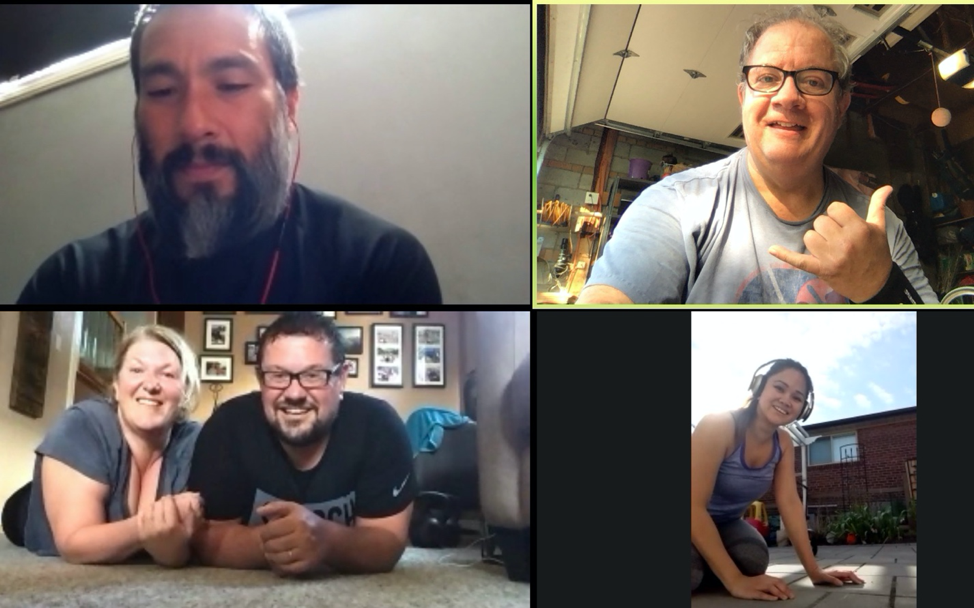
Figure 1 Darin Diehl (top right) in Post Workout Group shot with his trainer and classmates, May 17, 2020.
I was crushing it on the morning of May 17, 2020. The kettle bells somehow felt a little lighter that Sunday: even as my trainer, who I have worked with for a decade, was driving us a little harder that morning. Three times a week my classmates and I gathered online for this punishment: with most of us taking in a yoga stretch class up to three more times a week with the same trainer. It had all become part of the Covid-19 lockdown routine, along with all the bread and cookie baking.
But later that morning I developed some discomfort horizontally across my chest that I thought might just be muscle strain. And while this sensation abated by midday, I also started to feel nauseous, headachy and would later develop the chills. These symptoms led me to bed for the next few days. My wife and I wondered about Covid, but by Thursday of that week all the symptoms had gone. However, I was now feeling a new chest irritation – more centred in my chest versus across my chest as before.
My wife’s cousin, a nurse, had sent us a list of updated Covid-19 symptoms and encouraged us to call Ontario Telehealth and walk through the screening questions. I waited till Friday, May 22 to do that. The nurse asked me all the Covid questions but was most interested in me describing the different chest pains I felt that day and five days earlier. Then, in a decision that I believe may have saved my life, she told me she believed I had suffered a heart attack and was ordering an ambulance.
Maybe you are thinking, ‘Of course you had a heart attack you idiot.’ But, hey, I had never had one before and there was no chest clutching or left arm pain – any of the stuff you hear about. So, as my wife, my younger of two daughters and son waited with me for the ambulance we mused that at least I’d get checked out and undergo a Covid-19 test.
“Mr. Diehl, you’ve had a heart attack.”
I was taken to the Covid-19 emergency intake at Trillium Health Partners, Mississauga Hospital just a 10-minute drive from our home. I was swabbed and blood was drawn for a battery of tests. At one point in the afternoon a doctor came to see me and said I’d likely be sent home and asked to self-isolate until they called with my Covid-19 test results. But he first wanted to conduct a couple more blood tests for specific heart attack indicators. I was arranging pick up with my wife when he returned a little later and told me, “Mr. Diehl, you’ve had a heart attack.”
The words, spoken so manner of fact, left me stunned. I recovered from the initial shock and asked what would happen next. The answer was more tests, including chest scans. The next day a cardiologist came by and explained that I would be undergoing an angiogram in a few days so they could see what was happening inside my heart. And it seemed that indeed that was a heart attack I’d experienced on Sunday, May 17th and that as a result the sack around my heart had become irritated and inflamed by the following Thursday, when I started to feel the second chest discomfort.
Later that evening the cardiologist paid me another visit to mention that one of the scans indicated nodules on both of my lungs which would need to be investigated. That night it all caught up to me. Alone in an isolated room (my Covid test result was still pending), no visitors allowed, and news of a heart attack and “some other problem” in my lungs bouncing around in my head, I cried for some time in fear and shock. What the hell just happened? I had been exercising regularly, had never been under treatment for high cholesterol and I was not a smoker.
Figure 2 A visit from Darin’s family in the parking lot outside his hospital room window.
By Sunday morning I arrived on the cardiac floor. My Covid-19 test was negative (I’d have three more negative tests before leaving the hospital). My angiogram was scheduled for the following Tuesday. A respiratory doctor had come in to talk to me about the nodules on my lungs, explaining that they could be a number of things, some more worrisome than others. At this point no one had said the word cancer, yet there it was taking up residence inside my thoughts. But for now, we’d all focus on the heart.
My angiogram revealed I would need at least four bypasses as some of the plumbing feeding my heart had blockages ranging from 30 per cent to almost 100 pe rcent. I was told I could be scheduled for the procedure by the end of the week. In fact, on Thursday morning a nurse came into my room and shaved my chest, arms, thighs and nether regions to prep me for possible surgery that afternoon.
But there was a problem. I had developed a gastrointestinal issue which at first, they thought might be a reaction to some of the myriad medications I was on. But by noon I learned my surgery was canceled because, as a doctor explained to me, I had a parasite. Confusion and incredulity were the feelings of the moment as the he asked if I’d recently been to a farm or agricultural plantation. I mean, it’s 2020 and all, but this was just nuts. “Perhaps you should test me for Ebola,” I quipped. He chuckled and said my system would clear the parasite in a day or two, so no worries.
My surgery was rescheduled for Monday, June 1st. I was feeling good because I’d checked on the reputation of the surgeon and he was clearly an ace. In fact, to that point I had experienced an array of fantastic medical professionals – doctors, nurses and nurse practitioners, various technicians – all of them so well qualified and so compassionate. Continue Reading…
Whether you’re a late starter or seasoned saver, the five years or so leading up to retirement might be the most crucial time to get your finances in order. Here’s how to take advantage of your final working years.
Most retirement readiness checklists suggest your final working years is a time to double-down on retirement savings. The idea being that major financial burdens, such as paying down the mortgage and raising children, should be behind you and those savings can be parlayed into big contributions to your retirement nest egg.
High-income earners should look to their unused RRSP contribution room and contribute as much as possible in their final working years. This has the added benefit of generating big tax returns, which can be reinvested into your RRSP or used to pay down any outstanding debts.
Procrastinators have a final chance to break any bad spending habits and set their finances straight. The first step is to draw up a financial plan. Make it a top priority to pay down any remaining debt and get spending under control. You should then have a rough idea when debt-freedom is in sight and from there decide how long to continue working to meet your retirement savings goals.
Retirement income target
The often-used retirement income target is 70% of your final pay, meaning if you earned a $100,000 salary in your final working years then you should aim for a retirement income goal of $70,000 per year. But a more realistic retirement income target may be closer to 50%.
Regardless, you’ll need to find YOUR retirement number and determine whether you can reach your income goals through some combination of workplace pension, personal savings (RRSP, TFSA, non-registered investments), CPP, OAS, and/or GIS.
Piecing that puzzle together takes a lot of planning (and still plenty of guess work). No wonder choosing a retirement date can seem like such a daunting challenge!
Taking advantage of your final working years
According to a Tangerine survey, one-quarter of Canadians nearing retirement age don’t understand how their personal finances will work in retirement. I think that number may be understated.
With that worrying statistic in mind, here’s a retirement planning checklist for your final working years:
1. Determine where you stand – Take stock of your current financial situation by listing your assets and liabilities and analyzing your current income and expenses. Identify any opportunities to save more.
2. Define future needs – How will your expenses vary in retirement? Remember, you’ll no longer be paying into programs like CPP and EI, but your retirement bucket list might need to include money for travel and new hobbies. Add up your expected CPP payments and OAS benefits, plus any workplace pension plans, and determine the gap between your income and expenses. That gap will need to be filled from your personal savings.
3. Ramp up savings – Take advantage of unused RRSP or TFSA contribution room and boost your retirement savings into overdrive. Your final working years are a chance to make up for lost time; make sure to maximize your full employment income to have the most impact on your retirement savings. Continue Reading…


 Posted By
 Posted By