Posted By
  By Fritz Gilbert, RetirementManifesto.com
Special to the Financial Independence Hub
It’s interesting how much controversy the FIRE (Financial Independence Retire Early) movement seems to cause in our society. Personally, I find it a fascinating topic and view the discussion generated by the FIRE community as valuable to everyone working toward retirement, whether they’re in pursuit of early or traditional retirement. I’m encouraged by the FIRE community and feel that ANYTHING that makes more people aware of the need to save for their retirement is a good thing.
For the record, I’m a fan of FIRE.
However, is it right to accept the movement without question, or should we take some time to think comprehensively about FIRE and attempt to determine if there are some “gaps” in the strategy that warrant discussion? It’s always good to question things, so today we’re going to do just that. We’re still a land of Free Speech, and we’d be wise to leverage that Freedom for a more complex discussion around important issues. Money and Retirement are certainly important issues.
So …
Let’s have some fun. Let’s challenge ourselves. Let’s learn to keep our minds open.
Let’s look for gaps in the FIRE movement.
I recently had one of the most comprehensive comments I’ve ever received on this blog. As you’ve likely guessed, it was regarding the FIRE movement. Given the quality of the comment, I’m dedicating this post to answering the issues raised.
Phil raises the questions about FIRE respectfully and they deserve a thoughtful response. Is FIRE hypocritical? Today, my thoughts… Click To Tweet
Regardless of where you are on your journey to retirement, I trust you’ll find some value in the discussion.
The comment which generated this post was in response to my article titled “What the FIRE Movement Is All About – In One Word”. The reader, Phil, prefaced his comment with a generally favorable view of the FIRE movement, including a few comments I’ve summarized below:
- Darrow Kirkpatrick and others ” have had a big and, largely, positive impact for me and my family.”
- “To be clear, I find nothing wrong with trying to improve people’s financial literacy and promote a culture of frugality.”
However, Phil soon moves into the “meat” of his comment with this statement:
“ …After being on my own FIRE journey for 4+ years, I have developed some serious reservations about what I am reading these days…” Phil
Turns out that Phil has been a member of the FIRE community for 4 years! My curiosity peaked as I continued to read his words. Here’s a member of our community, and he’s raising some questions. “Hmmm, this could be interesting,” I thought as I continued to read his words.
What followed was this statement:
However, FIRE bloggers are ignoring some serious issues with their collective community and their message. Click To Tweet
Phil follows this claim by writing 4 well-thought-out concerns about the FIRE movement. Given his tone, I took his comments seriously, and have spent some time thinking about the issues he’s raised.
I challenge you to do the same.
4 questions about FIRE
Phil’s comment, respectfully raised, has merit. In an effort to look more critically at the FIRE movement the points he makes deserve to be considered. In our culture of increasing “Political Correctness,” it bothers me that folks aren’t open to exploring ideas that contradict their own. Personally, I love to look at arguments that don’t fit the conventional narrative. What I like in particular about Phil’s arguments is that he has been a self-professed member of the FIRE community for 4+ years. In full transparency, I consider myself a member of the FIRE community, having retired at a (by society’s standards) relatively young age of 55, though “older” than most in the world of FIRE.
If Phil has questions, perhaps others do as well. Let’s air it out. Let’s look for gaps. Let’s discuss the issues.

Arguments which contradict our narrative make us think. Thinking Is Good. Challenge your brain, and learn to think through alternative ideas. Click To Tweet
Today, I’m going to look objectively at the 4 questions Phil raises.
My approach for each question will be the same:
- Phil’s Comment: I will copy each of the issues Phil’s raised verbatim from his comment.
- What’s The Point? I will summarize what I believe are the main points raised by Phil “What’s The Point.”
- My Thoughts: I will provide my thoughts on the topic raised.
- Subjective Score: Where I’ll rate my agreement with the validity of the comment (100% = Total Agreement)
With that, let’s challenge our brains …
1.) We should be skeptical of FIRE bloggers
Phil’s comment:
“FIRE bloggers are “lifestyle influencers,” and merit the same level of skepticism as anyone in this game. Most FIRE-bloggers monetize their blogs and so are sellers of a product, a product that should be evaluated objectively. I’m sorry, but the general defense that FIRE can be anything you want it is not accurate. Every single FIRE-blogger is selling the idea that financial independence and a lifestyle of much less work or no work will improve your happiness significantly. The reality is that this may not be true for everyone. I applaud Chris Mamula, Sam Dogen, Joe Udo and others who have written about the downsides of this lifestyle: depression and loss of purpose. JD Roth has been willing to write about the down-side of the FIRE-blog community and people should read his posts.
Unfortunately, many other bloggers refuse to acknowledge this. The fact is that most research into the psychology of happiness in the past several decades has shown that people are actually more happy when producing than when consuming. The simple fact is that remaining productive is difficult for many people outside the context of a standard career. FIRE bloggers should talk more openly about this.”
What’s The Point? Phil raises three issues in his first comment:
- We should be skeptical of the motives of FIRE-bloggers who are attempting to monetize.
- FIRE-bloggers promote the idea that less work will improve your happiness; it may not be a reality.
- Research indicates that people are happier when productive, and that may be harder outside a career.
My Thoughts: In my view, the most valid point raised is the question of happiness after FIRE is achieved (I also agree we should always be skeptical of folks trying to “sell us something,” but don’t see that as a major flaw in the FIRE movement. I think it’s also fair to mention that there are likely more FIRE followers who don’t blog than do. While this comment questions the blogging element of FIRE, it’s not fair to throw the non-bloggers under the same bus).
But, more importantly, on to the “happiness” question:
As I was moving toward retirement, I did a lot of research on the topic of happiness after retirement, which I summarized in my post “Will Retirement Be Depressing”. For the record, I agree with Phil that this element of early retirement is not covered to the extent that it should be. Having said that, I also provide some suggestions on how to ensure you’ll avoid some of the traps that cause depression in retirement in the post mentioned above.
I’ve implemented those steps, and I’ve found my retirement to be anything but depressing. I agree more should be written about the topic, and agree with Phil that this is a valid point regarding the FIRE movement. Too many folks focus on the financial side of early retirement, but true happiness requires an equal (or greater) focus on the “non-financial” aspects of retirement. I suspect we’ll see a natural shift as more of the FIRE bloggers achieve RE.
(For the record, this is why I’ve been writing a larger % of my posts about the “soft” side of retirement. Now that I’m in retirement, I realize the importance of the non-financial topics in achieving a great retirement. I also realize it’s not covered to the same extent as the financial side, so I’m doing my part to rectify the situation.)
Subjective Score: 80% Skepticism is good, and there should be more written about the “softer” side of happiness post-RE.
2.) FIRE as a Marketing scheme
Phil’s Comment:
FIRE bloggers are too much like multi-tiered marketing sales people.
Blogger: “You should save a lot of money to retire early.”
Reader: “Why?”
Blogger: “It will give you freedom to pursue more creative pursuits.”
Reader: “Like what?”
Blogger: “Blogging. Take my course!” Continue Reading…

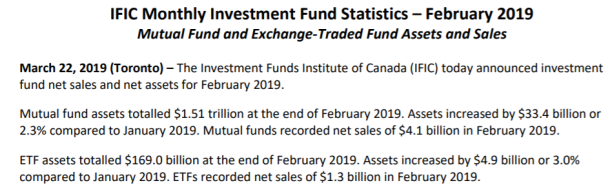
 And here’s the sales figures for the ETF industry for RRSP season:


 Posted By