


General

Another week. Another (Kiddie) stock roller coaster ride

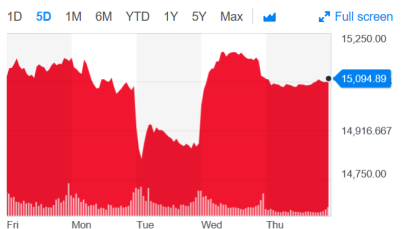
And here’s the performance of the Canadian Markets (TSX Composite), 2018 year to date:
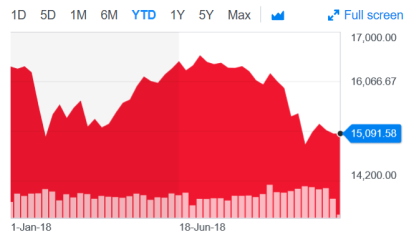
While that might look like a wild ride it’s all more of a kiddie coaster compared to the real thing such as the Leviathan at Canada’s Wonderland in Vaughn, Ontario. That coaster makes the 12 Scariest Rides according to tripsavvy.com.

Canadian markets are down by about 5% for the year. Once again: Kiddie Coaster. Serious stock market roller coaster rides will take you down by about 30%, 40%, even 50% or more. Yup, in a major correction you might have to watch your monies get cut in half if you’re in an all-stock portfolio. That 50% haircut has happened twice in the last 20 years. Many of us have been ‘lucky enough’ to invest through the two biggest market corrections since the Depression of the 1920s/1930s.

Those real roller coaster rides taught us some valuable lessons. Some investors did lose a lot of money through those corrections. Why? Because they invested outside of their risk tolerance level. They took on too much risk. They were not emotionally prepared to watch their investment portfolio drop by 40%, 50% or more. They perhaps needed some of those shock absorbers known as bonds.

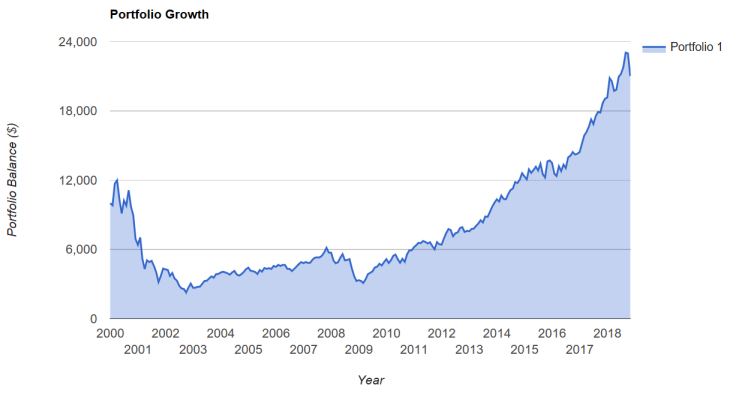
Those of us who were heavily invested in the tech-heavy indices such as the Nasdaq 100 (QQQ) or science and technology funds had to watch those investments drop by some 80%. Imagine watching every $100,000 fall to $20,000. Of course, many would jump off that roller coaster before hitting the bottom. Here’s a roller coaster ride that would make the list of Scariest Investment Rides. This is the QQQ ticker Nasdaq, chart courtesy of portfoliovisualizer.com. Full disclosure: I was ‘on’ that ride, and I don’t want to talk about it.  Once again the stock market can teach us some expensive lessons.
Friday Nasdaq

We can see that investors who did hang on were eventually rewarded with positive returns, even more than a doubling of their initial investment. In fact, if an investor had been consistent and had kept investing on a regular schedule through those ups and downs they could have seen returns approaching 9% annual.

Buy. Hold. Add. 

We might say that the risk assessment is deciding what roller coaster ride you can handle. Continue Reading…


Abenomics & Japan focus: Positive Earnings Power


By Jesper Koll

Special to the Financial Independence Hub

Japan is not a value trap. Against a backdrop of very attractive equity valuations — at 13.7x, the TOPIX price-to-earnings (P/E) multiple has dropped back to the lowest 5% level reported over the past decade  — the trigger for upside performance must come from positive earnings surprises. Our analysis suggests the probability of a sharp positive inflection in earnings visibility is about to be delivered in Japan, possibly as early as the upcoming fiscal half-year results season, which was about to get going by the end of October (FANUC reports October 25; Toyota, November 7; Mizuho Bank, November 13).

All said, we maintain our forecast for TOPIX earnings growth of 20%, against consensus expectations of 2.5% (according to Bloomberg).

Why?

Corporate guidance and consensus estimates are based on, in our view, extremely cautious baseline assumptions. Most important, top-line sales growth is forecast to drop from 6.7% last year to a mere 3.7% in the current FY 3/2019. Now, we know that sales growth has a high correlation with nominal gross domestic product (GDP) growth; and here in Japan as well as in Japan’s major export markets — America, China and Asia — nominal GDP growth is actually accelerating. Given the high operational gearing of Japanese companies, the sensitivity of earnings to sales growth is very high. Basically, a 1% difference in baseline sales adds (or subtracts) as much as 10% to the bottom line of listed companies in Japan.

The exchange rate assumptions are the second factor making positive earnings surprises likely. Corporate guidance and consensus estimates are still based on an average of ¥105 to the U.S. dollar for the fiscal year ending March 31, 2019. Now, the fiscal-year-to-date has averaged ¥110.6 to the dollar (April 1 to September 27). That difference alone should add approximately 5% to earnings.

To be sure, Japanese corporate managers may have been wise to operate on very cautious baseline assumptions this year. At the start of the year, the threat of tariffs and other geopolitical risks were very high indeed. Personally, I doubt that managers will go all-out bullish and abandon their instinctive conservatism quite yet. However, the reality of better-than-expected top-line sales growth and a more favorable exchange rate are likely to compound into fact-driven positive earnings revisions momentum. Against the backdrop of attractive valuations, this should very much help create more positive equity market momentum in the coming months. Continue Reading…

Money never sleeps, even when you’re retired

By Billy Kaderli

Special to the Financial Independence Hub

Just because you retire, your money doesn’t have to.

In the words of Gordon Gecko from the 1987 movie Wall Street, “money never sleeps.” And your money definitely won’t once you leave your job.

Many people are shocked to learn that since we left the conventional work force almost thirty years ago our net worth has actually increased, significantly out-pacing inflation and spending. Reading financial articles about what if retirees run out of money, I get the impression that the authors do not understand that once retired, your money can – and should – continue to work for you.

Working smart, not hard

Once you clock out or walk out of the office for the last time, that doesn’t mean your investments are frozen at that point. The stock market is still functioning and now your “job” is to become your own personal financial manager. Actually, you should have been doing this all along, but if not, start now.

You need to get control of your expenses by tracking your spending daily, as well as annually. This is so easy — only taking minutes a day — and this will open your eyes as to where your money is going. Not only that, but it will give you great confidence to manage your financial future. Every business tracks expenses and you need to do the same. You are the Chief Financial Officer of your retirement.

Income is important, but …

Many people structure their investments for income knowing they need $3,000 or more per month to cover their lifestyle. Which is fine, but inflation will be eating away at those numbers and most likely taxes will do the same. Over time your expenses will rise and your purchasing power will drop. You need protection to cover the increases.

Stocks provide that protection and there is an added bonus; when you sell, capital gains are taxed at a lower rate than ordinary income. Therefore, tilting your investments for growth as compared to income will help protect yourself against future inflation. Plus, it will minimize your tax liability.

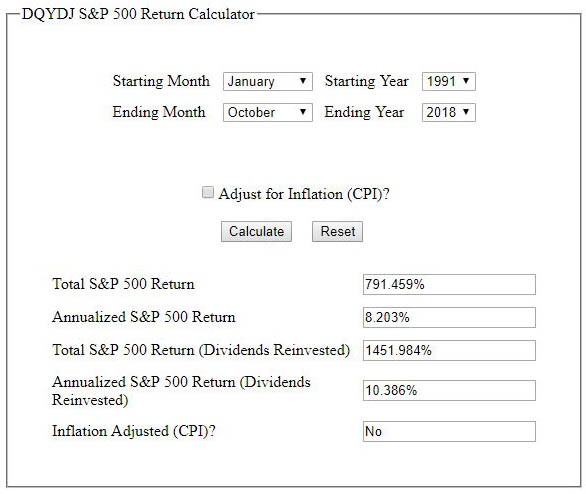
The day we retired the S&P 500 index closed at 312.49. Today, this equates to a better than 10% annual return including dividends.

That’s pretty good for sitting on the beach working on my tan.

Making 10% on our portfolio annually while spending less than 4% of our net worth has allowed our finances to grow out-pacing inflation, while we continue to run around the globe searching for unique and unusual places.

The key is to start as young as you can with as much as you can and let the markets work in your favor. Time is the greatest asset with investing and younger people can utilize this to their advantage.

But what if you’re fifty?
Continue Reading…

When High Income meets High Debt

By Laurie Campbell

Special to the Financial Independence Hub

November is Financial Literacy Month, a month in which Canadians are encouraged to focus on their financial well-being.  I’ve worked in the non-profit credit counselling industry for over 25 years. One thing that is as true today as it was more than 50 years ago, when credit counselling was first introduced in Canada, is that financial literacy benefits everyone: and everyone can use a refresher.

As the CEO of Canada’s first and longest-standing credit counselling agency, I’m always asked who our clients are, and to be honest, you only need to look in the mirror to understand the people we help.

Our agency sees people from all walks of life and all income levels, as debt can affect anyone and we can all run into financial difficulties. At Credit Canada, we see professional athletes, celebrity personalities, teachers, lawyers, medical professionals and actors. We see millennials dealing with student loan debt and credit-card debt, trying to buy their first home and build a family; we see couples heading into retirement with little-to-no savings, still dealing with debt while financially supporting their adult children; we see single parents trying to make ends meet while saving up for their child’s education, and in many cases, handling their elderly parents’ finances as well.

Many people might think debt problems and financial difficulties only affect those with low income, and while that might be true to some degree, not only do higher-income earners experience financial difficulties too, but they can also be more severe as their debt loads are typically higher. The math is simple: The higher your income is, the more credit you are granted: and the likelihood of spending beyond your income becomes much greater. Unfortunately, more money usually means more debt.

Also, having a higher income doesn’t necessarily mean you have better money management skills or spending habits. In fact, some of the best money managers and budgeters are those living on low or fixed incomes, simply because they can’t afford to lose control. Whereas people earning higher incomes might think to themselves that they have the money, so they might as well spend, spend, spend.

Regardless of income, anyone can run into financial difficulties if they do not practice sound money management and budgeting, because they won’t know what their financial limits are, and we all have them.

Sadly, financial literacy isn’t a skill typically taught in most schools or homes, so people from all income levels can struggle with financial management and control. Additionally, sometimes it’s more difficult for higher income earners to admit they need help, and much less seek it, because of the stigma around debt. Many people think they should know better, but the reality is many of us don’t.

It’s never wrong to admit you need help, but it is important to get the right kind.

If you are beginning to struggle with maintaining monthly expenses and other financial obligations, additional credit is, at best, a short-term solution, because you’ll end up having more debt to pay back. Plus, acquiring additional credit doesn’t come with budgeting and money management support, which are necessary for understanding how to balance income with spending to achieve future goals. Without that knowledge and support, you will be up a creek without a paddle. Continue Reading…

The first steps for investing in stocks

By Gary Bordeaux

Special to the Financial Independence Hub

The stock market is the 21st century’s version of the gold rush. You can make millions by just investing a thousand dollars if you know how to invest in the right stocks. You have to learn to read the signs of the stocks and you have to know which stocks to start your investments in. If you haven’t started your investments then here are the first six steps of investing.

1.) Find an App that works for you

If you’ve decided to invest in stocks on your own (instead of paying someone to do it for you) then you need a platform to work from. Apps like Robinhood are usually the best place to start since they let you invest for free without any fees. There are other apps that allow you to do the same thing as well. The trick is finding the one that works best for you. Some give you more features that are better for a more experienced stock trader but that can be a hindrance and confusing for someone who just started out with trading.

2.) Learn what you need to know about Stocks

Before you can put any money into the market, you need to understand what exactly you should expect. That is where sites like Option Animals come in handy. They have courses that will teach you exactly what you need to know in order to invest intelligently. Learn as much as you can before you put your money into a stock.

3.) Start Investing

It’s hard to make a massive mistake right away if you start small. So start small with what you have. Don’t put all of your money in at once. If you’re uncomfortable with it, only start at $100. Let it sit and wait until you’re comfortable with the unpredictability of the stock market. It’s okay to be nervous, but start with whatever you’re comfortable with. If you’re ready, then start moving faster and put more in it.

4.) Watch your Stocks

To be successful in the stock market there are a couple of things that you need to pay attention to. First, you need to be watching the money that you put in. You don’t want to be caught off guard and you need to know what to expect with the stocks. The second thing is Continue Reading…