General

What women want – and how to get it

By Ed Rempel, CMA, Fee-for-Service Planner

Special to the Financial Independence Hub

There was a gasp from the audience, when this photo of a homeless woman was shown at a talk I recently attended.

A new survey shows that almost half of women fear they will become a “bag lady” someday. They fear being financially desperate and living on the street.

No job. No income. No partner. That is the fear.


I have asked thousands of people: “What’s important about money to you?” The #1 answer for women is security.1

What does “security” mean? It’s surprising how often the “bag lady fear” comes up. The #1 explanation is similar, but less severe:

Security: “Having enough so I never have to worry about money.”

Women want to know there will always be enough income for their family, for emergencies, and for the things that are important to their lifestyle. They want to focus on their life, their family and their friends and not have to constantly worry about whether they can afford it.

What does that look like and how do you get there? The answer might surprise you.

First, three questions:

1.) Jennifer has $2 million in stock market investments. This is:

A. Very risky.

B. Financial security.


2.) Financial security is:

A. No debt and safe investments.

B. Large diversified portfolio.


3.) Who is more secure?

A. Mary has no debt.

B. Andrea has a $200,000 mortgage and $1 million in investments.


Whether you ever become financially secure depends a lot on your picture of financial security.

Most people who want security do exactly the opposite of what they need to do to get it. The biggest mistake most people make is to think they can be financially secure by paying off all debt and having safe investments, instead of investing wisely for long-term growth.

I call this the “Zero Plan.” You retire with zero debt, zero investments (nearly), and zero income (except a bit from the government). People who do this are actually making it hard for themselves to have the nest egg they will need to be secure.

The truth is, investing very little money and buying low-return investments means you will never build up much of a nest egg.

What does financial security look like? What I have learned from experience helping thousands of people become financially secure is this:

Real security comes from having a huge nest egg.

A large portfolio of equities (stock market investments) is financial security. That’s what security looks like. Continue Reading…

The financial benefits of carrying Life Insurance

Photo credit: Pixabay.com

By Gloria Martinez

Special to the Financial Independence Hub

For some, life insurance may feel like an unnecessary expense. It can range from a few to many hundreds of dollars each month — it’s something you hope you don’t need, and when you’re faced with other expenses, it’s natural to want to trim it from your budget.

However, life insurance can provide a host of financial benefits besides the death benefit, which is certainly an important element of any life insurance policy.

In fact, a 2017 Insurance Barometer Study by the nonprofit organization LIMRA and Life Happens found that 85 per cent of people carry life insurance to cover burial and funeral expenses. Those expenses can range between $7,000 and $10,000, and few people are prepared to incur such a large expense unexpectedly.

Don’t discount importance of the Death Benefit

 Even if you’re close to retirement or retired, keeping life insurance is a valuable asset. If you’re still paying off a mortgage that you’ve refinanced or you purchased your home later in life, consider purchasing a life insurance policy to cover the remaining mortgage should you pass away. A life insurance policy will also cover you or your spouse against lost pensions. If you have a large estate on which you’ll incur estate taxes after your death, you can purchase a life insurance policy that will cover the cost of those taxes.

What’s more, you’ll also protect yourself and your family with a good insurance plan that covers your children’s college expenses and pays off other debts besides the mortgage, such as medical expenses, other loans, or credit cards.

You can benefit from Life Insurance while still living

You can use your life insurance as more than just a death benefit, depending on the type you carry. Continue Reading…

Finance 101: How currency hedging affects your investment return

By Neville Joanes

(Sponsor Content)

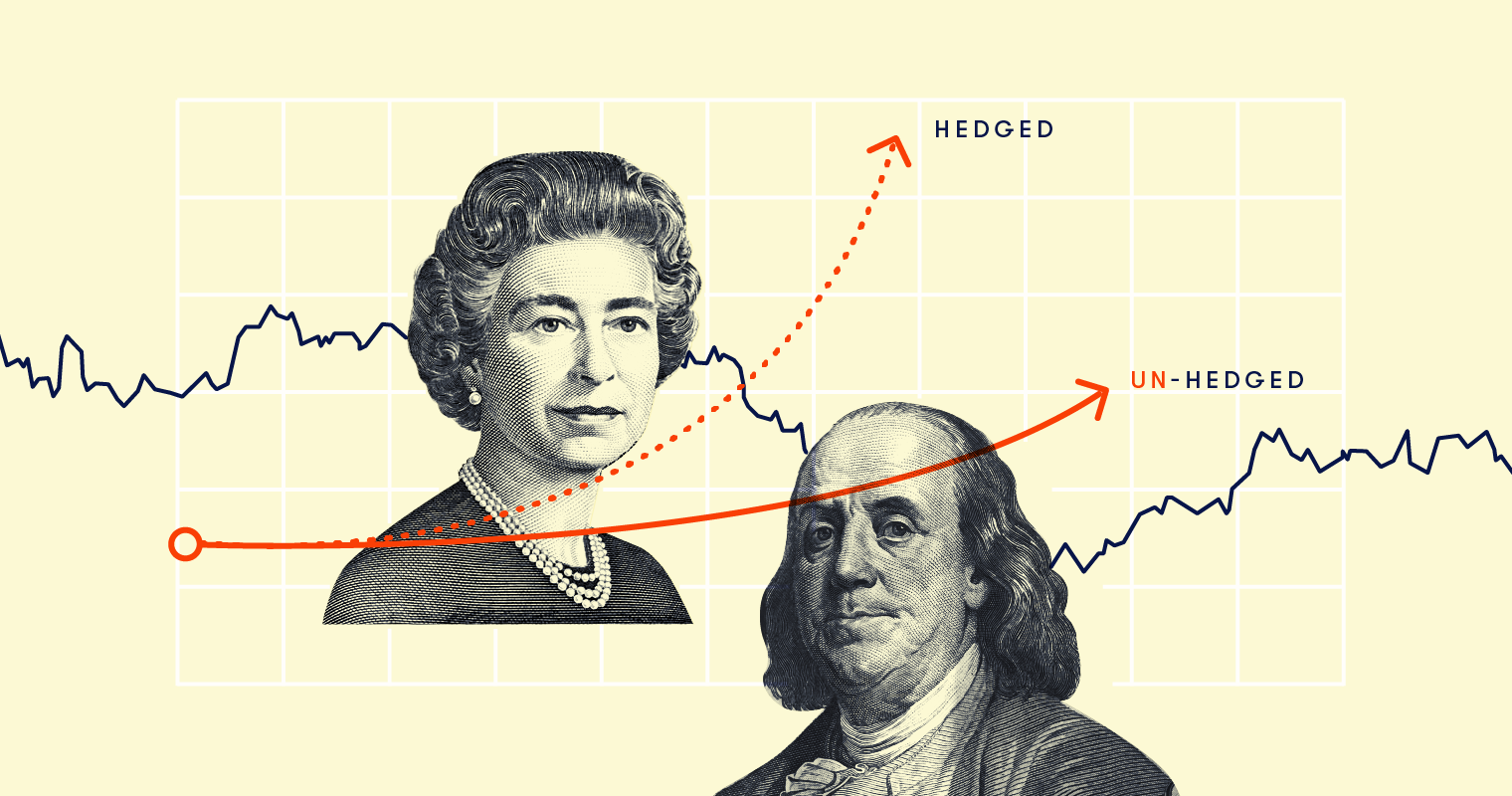
If you invest overseas, your holdings may be valued in foreign currency. When markets are volatile, a portfolio manager can use currency hedging to protect the value of the investment.

Let’s look at how currency changes can affect how your money works. For instance, let’s say you book a vacation in Miami, Florida for your family. You’ll fly down from Toronto and enjoy some fun in the sun in the wintertime. You can relax while your kids cool off in the hotel swimming pool.

But between booking your reservation in the summer and actually paying your bill at the end of your stay in January, you notice that your costs jumped nearly 10 per cent – even though the bill in US dollars was the same as when you booked it months before! What gives?

If you had purchased US dollars at the time you booked and paid for your vacation with it, you’d be fine. But you used a credit card (like most folks), and had to pay the difference in the value of the currency. Now the vacation is over and you spent more than you intended.

A similar thing can happen with investments. Let’s see how it works.

Non-hedged vs. hedged investing: a simple example

Imagine a Canadian investor with diversified, international holdings. A few months ago, they bought some tech stocks that looked ready to go up. And lo and behold, they did! Their US tech company stock went up 8 per cent (measured in US dollars).

But there was another factor working against this investor: Canada! Surging oil prices powered the economy ahead at full speed. The Canadian dollar appreciated by an impressive 6 per cent against the US dollar!

What’s the result of this non-hedged investment? The investor’s US tech stock investment gives them a positive return of just 2 per cent. Not so impressive.

What would have happened if the investor hedged their investment? In that case, the investor gets the full 8 percent return!

See, hedging is like an insurance policy, when volatility is high. But here’s the catch: hedging is complicated. It’s time-consuming. You need high-level expertise and bandwidth to watch the market carefully.

For most Canadian investors, that’s not an option. It’s probably something you want to let your portfolio manager (like ours) take care of for you.

Hedging on an income stream to ensure steady returns. That’s how we do it

Let’s say there is an income stream from a dividend-paying investment, like in our bond and income-generating ETFs. That income stream is where we look to hedge the investment. Continue Reading…

China: the Emerging Markets haven


By Jeff Weniger, WisdomTree Investments

Special to the Financial Independence Hub

The S&P China 500 is down 28.5% since January 26,1 an ugly and quick plunge that fits the common definition of a bear market. Who in their right mind would use “haven” in the same sentence as “China?”

We will, in context.

Compared to cash in a Zurich vault, no, Chinese equities are not even close to a haven. But is the Chinese equity market a haven compared to other nations in the emerging world? We hypothesize yes.

The fragile five

Part of the market’s focus in 2018 — and maybe 2019 too — is the so-called “Fragile Five” current account deficit nations: Brazil, Indonesia, India, Turkey and South Africa (the “BIITS”).  Brazil has recently caught a rally in sentiment amid hopes that recently elected Jair Bolsonaro will implement free market economic reforms, but nevertheless, it is still one of the five countries watched like a hawk by market observers.

In Getting More Defensive in European Portfolios, we discussed the effect the Turkish debt crisis may have on its neighbors, particularly Europe and its banks. Along with Argentina, Turkey is at the top of the crisis malaise leaderboard, courtesy of a burgeoning hard currency debt load and runaway inflation that exceeds the state’s 24.5% official number.  Its deep 6.3% current account deficit gauge of two-way capital flows is the icing on the cake.2

It is that latter metric — the current account — that is the primary reason the BIITS currencies came under pressure, although there are other factors. For example, South Africa’s expropriation of Afrikaner farms raises serious questions about general property rights in a country whose stock market has a history of state-mandated equity redistribution.

Which takes us back to China. Five-year credit default swaps, which gauge the cost of insuring against default by Beijing, pale in comparison to those of other emerging market sovereigns.  For good reason. While it costs $384,000 per year to insure $10mm of hard currency 5-year Turkish debt, the price for covering Chinese exposure is just $72,000.

Beijing is no Bern or Oslo, but then again it also isn’t facing down instability like many other emerging markets.  From a risk-of-not-getting-paid-on-your-bonds perspective, China is one of those in-between countries— not the most stable, but nevertheless a veritable haven in the context of some of these other governments.

Figure 1: Five-Year Sovereign Credit Default Swaps (CDS) Prices, Emerging Nations

Figure 2 summarizes some of the risk drivers befalling the nations viewed as most risky by the credit default swaps market.

Figure 2: Market Concerns, Six Focal Nations

Market Concerns Six Focal Nations

Others

Beyond the already mentioned trouble-spot nations, embattled Russia is hit with sanctions for both the Crimean and Ukrainian invasions and the Salisbury poisoning, which involved the brazen use of a military-grade nerve agent on British soil. Then there is Russia’s support for the al-Assad regime in Syria, which, by the way, is in opposition to the U.S.-Saudi alliance.

As for Indonesia, the country had to tighten monetary policy this summer in an attempt to stave off the rupiah’s waterfall decline to levels last seen in the Asian contagion of the 1990s.

Mexico has long suffered from trade war headlines but now that the new trade deal with Washington was agreed, the risk is morphing into the very real concern that Andrés Manuel López Obrador (“Amlo”) will choose the Venezuelan or Cuban route instead of, say, the Chilean one.

China: The relative haven?

China is, of course not without warts. Coastal housing prices are in runaway territory, with cities like Shanghai witnessing home price-to-income levels that would make New York City blush. Then there is the Trump and Xi chest thumping, with North Korea smiling, stage left. However, we question how, even if all $619 billion of Chinese exports to the U.S. completely disappeared, it warrants sending the equities of China’s $16.1 trillion economy3 into bear territory.

At this time next year, we suspect the market will still question South Africa’s property laws and Turkey’s debt serviceability. But China, a current account surplus nation, may be in a different place, a place where WisdomTree no longer feels alone in the darkness, wondering why so few investors even know about its massive tax code overhaul.

The South China Morning Post, Hong Kong’s paper of record, said this on August 27, in direct parallel with our Gipper Comes to China research note:

Ernst & Young estimates that changes in exemptions and tax brackets – including raising the monthly tax exemption allowance by 40 per cent to CNY5,000 per month – would trim the monthly burden of a taxpayer with a gross monthly wage of CNY60,000 by 16 per cent, to CNY11,006.

Individuals at lower income levels will fare better. Someone with a CNY10,000 monthly salary will see their tax bill slashed by 71 per cent to CNY115.  

        -Xie Yu, South China Morning Post (Hong Kong)

In CAD terms

Look at the last sentence of the passage and convert CNY to CAD. Someone who makes $22,586 per would see a tax cut of $636.  Tell us: what would happen to U.S. or Canadian retail sales or local stock markets if Trudeau or Trump started cutting tax liabilities on Wal-Mart-equivalent income by more than $600 per head?

In other words, while many countries may be dealing with debt issues or social unrest in 2019, it is quite possible that the images from China will be of packed shopping malls.

China is the haven in emerging markets, with an unappreciated upside catalyst poised to click when the market shifts focus from trade wars to tax reform.

Our TSX-listed WisdomTree ICBCCS S&P China 500 Index ETF (CHNA.B) is based on the S&P China 500 Index CAD, so it can be used as a solo holding to cover the whole country.

1Source: Bloomberg, through 10/30/18, in CAD.
2Source:  Consumer price inflation from the Turkish Statistical Institute, as of 9/30/2018.  Current account from Bloomberg, as of Q2/2018.
3Sources: Exports by Customs General Administration PRC, as of 9/31/18. GDP by the World Bank, with all figures in CAD

Jeff Weniger, CFA serves as Asset Allocation Strategist at WisdomTree. Jeff has a background in fundamental, economic and behavioral analysis for strategic and tactical asset allocation. Prior to joining WisdomTree, he was Director, Senior Strategist with BMO from 2006 to 2017, serving on the Asset Allocation Committee and co-managing the firm’s ETF model portfolios. Jeff has a B.S. in Finance from the University of Florida and an MBA from Notre Dame. He is a CFA charter holder and an active member of the CFA Society of Chicago and the CFA Institute since 2006. He has appeared in various financial publications such as Barron’s and the Wall Street Journal and makes regular appearances on Canada’s Business News Network (BNN) and Wharton Business Radio. 

Important Risks Related to this Article
There are risks associated with investing, including possible loss of principal. Foreign investing involves special risks, such as risk of loss from currency fluctuation or political or economic uncertainty. The Fund focuses its investments in China, including A-shares, which include risk of the RQFII regime and Stock Connect program, thereby increasing the impact of events and developments associated with the region, which can adversely affect performance. Investments in emerging or offshore markets are generally less liquid and less efficient than investments in developed markets and are subject to additional risks, such as risks of adverse governmental regulation and intervention or political developments. The Fund’s exposure to certain sectors may increases its vulnerability to any single economic or regulatory development related to such sector. As this Fund can have a high concentration in some issuers, the Fund can be adversely impacted by changes affecting those issuers. The Fund will be required to include cash as part of its redemption proceeds which introduces additional risks, particularly due to the potential volatility in the Chinese market and market closures. The Fund invests in the securities included in, or representative of, its index regardless of their investment merit and the Fund does not attempt to outperform its index or take defensive positions in declining markets. Due to the investment strategy of this Fund, it may make higher capital gain distributions than other ETFs. Please read the Fund’s prospectus for specific details regarding the Fund’s risk profile.


What is Asset Allocation really?


By Tony Porcheron

Special to the Financial Independence Hub

What everyone wants is for their money to grow without any risk. This is of course impossible, especially over a short time period.

Risk is usually measured by volatility, however risk and volatility are not exactly the same.

Risk for most investors is the chance that they lose money or do not meet their long term financial goals.

Volatility is the amount that your investments go up and down over a certain time period.

sigma  is the usual definition of Volatility

Beta  defines how much a return is based on an underlying index or other investment

Alpha   is your return earned above your index and volatility.

This is the holy grail of investing.

What methods do professional investors use so that volatility does not turn into risk? Asset Allocation.

You may have heard the term, “Don’t put all of your eggs in one basket”, this is Asset Allocation.

In most investment research, 80 to 90% of your investment returns are from you asset allocation, not your individual investment picking. Given this fact, this is what you should be paying attention to more than picking your winning investments.

Asset Allocation is deciding on what percentage of your portfolio should go into asset classes. Generally this is broken up by:

  1. Asset Type (Equity, Fixed Income, Alternative)
  2. Size of the underlying company (Large, Mid and Small)
  3. Geographic Region (USA, Canada, Western Europe, Asia, Emerging Markets)

You then make the decision:

  1. Manager type (Index, Active, Hedge)
  2. What are your financial goals? How close are you to them? Are you contributing or withdrawing money?
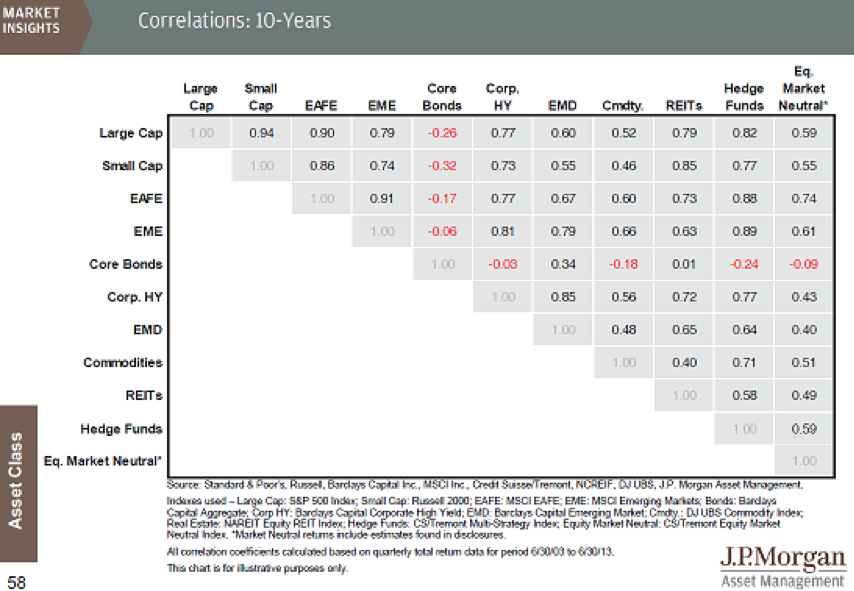
  3. What is the correlation between the different asset classes (how much do they go up and down together

The chart at the top of this blog shows a correlation analysis.

Strategic and Tactical Asset Allocation

The 2 main types of Asset Allocation are Strategic and Tactical. The adjustments to asset allocation are called rebalancing.

Strategic Asset Allocation is determining your asset allocation based on your long term investment return goals, volatility acceptance based on historical investment returns, volatility and correlation. Continue Reading…