General

Retired Money: Should you worry a large TFSA will trigger a CRA audit?

MoneySense/Shutterstock

Should you worry that a large TFSA will trigger a CRA audit? My latest MoneySense Retired Money column looks at a legal debate between the Canada Revenue Agency and taxpayers who have succeeded too well in growing their Tax-free Savings Accounts (TFSAs) with shrewd investing. You can access the full story by clicking on the highlighted headline: Why the CRA is targeting some TFSAs in court. 

If you’ve contributed regularly to the TFSA since it began in January 2009 you now have $57,500 of cumulative contribution room. With decent growth, it’s easily possible to have accumulated $100,000 in a TFSA by now: in fact, the CRA told me for the article that of the 13.5 million TFSA accounts that existed by 2016, 18,000 have balances of at least $100,000 (a number that includes myself and my own Millennial daughter, thanks to a few good FANG stock picks).

A Globe & Mail article last week profiled several ordinary Canadian investors and financial bloggers who have TFSAs of at least $100,000. See How to Grow your TFSA: Tips from Financial Bloggers to Fatten Your Account.

My MoneySense article quotes an unnamed investor who is being audited because his TFSA has grown to $500,000, owing to  timely growth of some private technology companies. He doesn’t think $100,000 is enough to trigger an audit but suggests $250,000 may be. In other words, the CRA may be fine with TFSA doubles but five-baggers will invite scrutiny and ten-baggers most certainly so.

But the real controversy involves TFSAs that are run as de facto securities trading businesses. The Globe highlighted this latest crackdown in an earlier article in July but was merely the latest of a series of TFSA audit scares that have been surfacing virtually since after the first year the program existed.

Shrewd stock-picking is not “aggressive tax planning” 

Some of those earlier audits involved TFSAs that soared because they held private companies but my guess is that, as in my own case or that of my daughter, the vast majority of TFSA holders are neither day traders nor experts in investing in private companies. We only buy exchange-traded funds or blue-chip North American stocks, including the FANG tech giants (Facebook, Amazon, Netflix and Google).

True, depending on when you bought them, it’s quite possible TFSA investors may have experienced 5- or even 10-baggers on stocks like Facebook, Amazon or Netflix. I doubt many investors would make concentrated bets on just one or two of these but if they did, then a $250,000 TFSA would not be inconceivable. That might invite scrutiny from the CRA but I strongly doubt they’d have a case for running a securities business.

Based on the CRA numbers cited in the MoneySense column, Tim Clarke estimates the CRA would have to audit 9,000 TFSAs in order to “recover” the amount of tax specified in the July G&M column that sparked this latest round of TFSA audit worries.

“I love how they say successful traders are conducting ‘aggressive tax planning’ “, Clarke told me in an email, “The purpose of TFSAs was stated in the budget that announced them to be a vehicle to allow taxpayers to save for retirement and other legitimate purposes. How can being successful at that be aggressive tax planning?”


TFSAs remain a critical tax-shelter for retirees

If you’re a retiree or close to it, presumably your TFSA will be invested fairly cautiously, just like an RRSP or RRIF, which means some combination of blue-chip dividend-paying stocks and fixed income. The TFSA is too valuable a tax shelter to get scared by audits of a handful of aggressive investors. Keep in mind that unlike RRSPs, you can still keep adding to your TFSAs well after age 71, to the current tune of $5,500 a year, and perhaps with future inflation adjustments.

There’s no reason that a retiree shouldn’t keep adding to their TFSAs until their late 90s or even beyond: not necessarily with “new” money but from post-tax money liberated from non-registered investments or after tax is paid on forced annual RRIF withdrawals.



The two main types of Financial Independence

By Vicki Peuckert Cook

Special to the Financial Independence Hub

If you are financially savvy and on your way to a secure retirement, you may already know the steps you should take to work toward financial independence. Maybe you’re already there.

But if you are climbing out of debt and just taking control of your money, financial independence (aka “Findependence”) might seem entirely out of reach. If you have kids, focusing on solving your own money problems may be complicated by your concern about their financial future too.

Financial independence means two different things at two different points in life. And they are both significant milestones. You and your adult children may even be working toward them at the same time!

Here are explanations of both kinds of financial independence and actions to consider to make the path to “FI” attainable, no matter where you are starting from.

Becoming Financially Independent from your parents

Adult children who no longer require any monetary support from their parents are financially independent. This doesn’t mean that a parent can’t provide some kind of financial aid if they choose, it means a child can meet their financial obligations without parental help.

With money concerns including five-figure student loans, rising rents, and considerable consumer debt, many young adults face an uphill battle when trying to leave their parents ‘financial’ nest. And parents may also be “sandwiched in” – helping their kids and providing support for aging parents while trying to save for retirement.

For the benefit of everyone involved, parents and adult children have a responsibility to each other to focus on changes and develop a plan to make financial independence a priority.

What can young adults do?

They can learn how to track expenses and make (and stick to) a budget. Making choices like sharing housing with friends and buying used cars or taking public transportation can also help 20-somethings tackle debt.

Over time, increased income from second jobs paired with making frugal choices like cooking at home, can provide the money adult children need to minimize and finally eliminate the need for parents to provide financial support.

What should parents do?

Parents should start setting limits on the assistance they provide their children. And they should work closely with them to create a plan to end all financial support over a set period of time. Parents need to realize they may actually be harming their kids by enabling their kids to make decisions that aren’t always focused on them becoming financially secure.

If a parent always steps in with a solution, their kids may not learn the importance of meeting their needs while putting off wants for the future. And this will only lengthen the time needed to reach financial independence.

Providing advice, emotional support, and helping adult children problem solve money troubles shifts the financial relationship to adults talking, rather than a parent instructing their child on what to do.

Becoming Financially Independent from Work

The other definition of financial independence is one that’s sometimes debated. But there is little argument that it should be a future goal of everyone. In general, reaching financial independence means you have enough income to pay for your living expenses for the rest of your life without having to work. Continue Reading…

Want an affordable neighbourhood with top Schools? Head for the ‘Burbs

By Penelope Graham, Zoocasa

Special to the Financial Independence Hub

The mantra for real estate shoppers is typically “location, location, location” – but for those with kids in tow, it might as well be “schools, schools, schools.”

For parents, whether or not a home is close to a highly-ranked educational institution is a top consideration, alongside affordability, number of bedrooms, and parking.

In fact, living within a certain school catchment can significantly impact one’s home value: even homes located across the street from one another that are in different school zones may see that difference reflected on their home listing prices.

EQAO school ranking and home price are especially correlated in high-demand urban centres, such as the City of Toronto, where home buyers pay a premium of hundreds of thousands of dollars to live within their coveted catchment.

For example, in Etobicoke, where the top EQAO-ranked school of Lambton Kingsway Junior Middle School boasts a score of 3.2 (out of 4), home buyers would pay a premium of $821,580 to dwell nearby. In York, that premium is $689,178 to live near Humbercrest Public School (3.1), and $444,183 to be close to CD Farquharson Junior Public School in Scarborough (3.3).

Exploring affordability in the Greater Golden Horseshoe

However, those who wish to live close to a top-ranked school at a more affordable price are wise to head to the suburbs: according to recent data compiled by Zoocasa, the correlation between school ranking and average home price isn’t as strong in surrounding Greater Golden Horseshoe markets.

Consider the city of Hamilton, located just west of Toronto along the shores of Lake Ontario. Also known as “Steeltown” or the “Hammer” for its roots as a steel manufacturing centre, it’s now highly sought for its growing “eds and meds” industry; and the fact that detached Hamilton houses with large lots are relatively inexpensive.

Those looking to live close to the best schools have many options in Hamilton; for example, one of the top-ranked schools, Sacred Heart Separate School (2.9) is located in East Hamilton, where the average home price clocks in at $396,964. In upscale Ancaster, where the average home sells for $838,337, is the similarly-ranked Immaculate Conception Elementary School, illustrating similar education standards are available for buyers regardless of home budget.

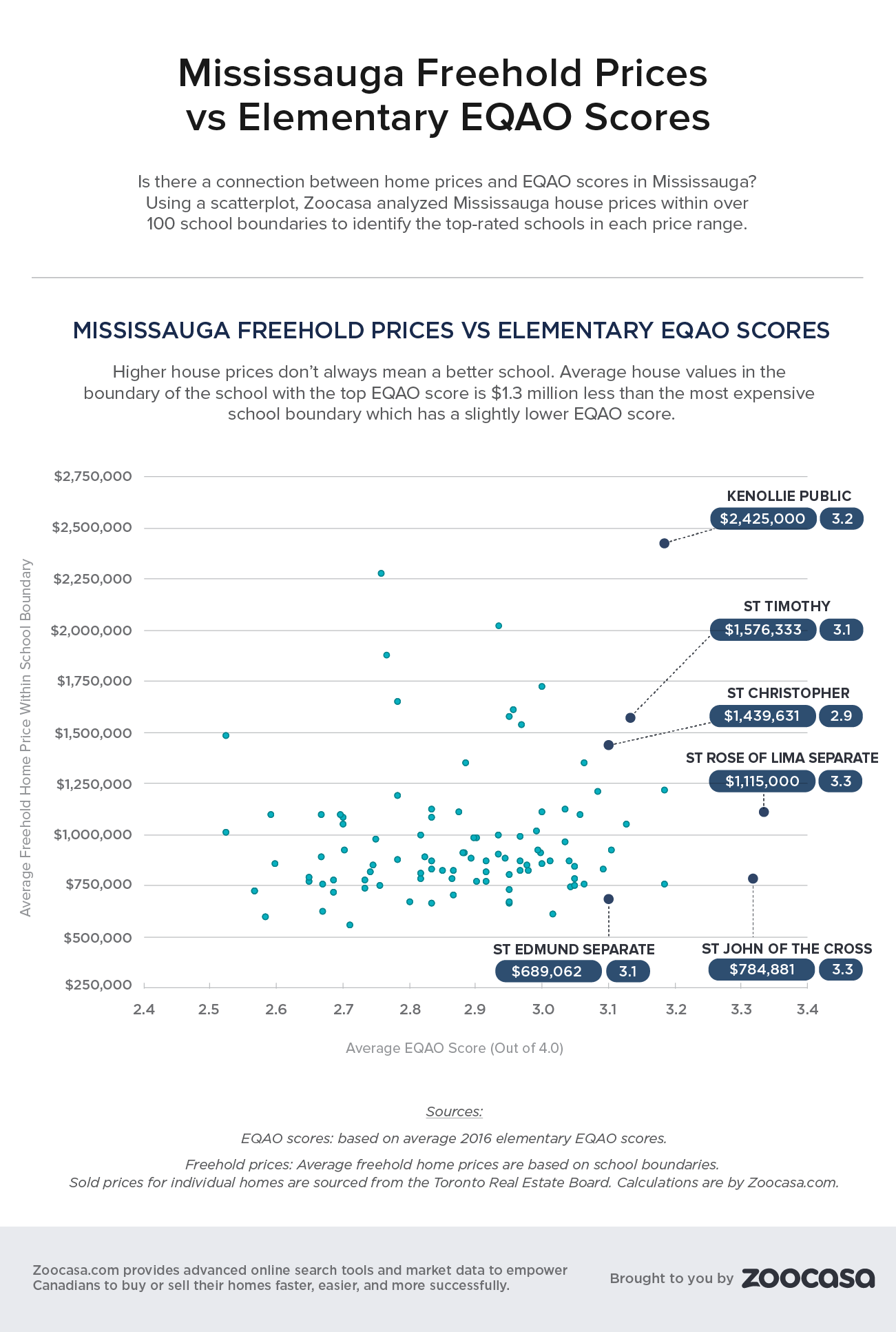
Mississauga schools among the best

The City of Mississauga is also a great example of a municipality where good schools and real estate affordability go hand in hand. Continue Reading…

Avoiding the “big mistake” — How Evidence-based investing saves long-term wealth

By Steve Lowrie, CFA
Special to the Financial Independence Hub
“Buy low, sell high.”

Sure, it’s a tired cliché, but it’s actually good advice.  Everyone knows it.  Most of us may even manage to do it by simply leaving well enough alone instead of constantly questioning our investments.  This is especially so if you’ve preceded your inactivity by setting up a solid plan and investing accordingly.

But here’s the challenge: Even the most stay-put investor is still at risk for making that rare “big mistake.”  It happens when seemingly game-changing news tricks you into falling for a different financial platitude: This time is different.

Even if you only deviate from your routine in the face of an extreme event, the financial damage done can last a lifetime.  One of the biggest, most recent anomalies was the Financial Crisis of 2008/2009.  At the time, many investors (and many advisors as well) wondered whether the markets would ever recover.

Although we are almost 10 years removed from this time, it was a highly emotional period for investors.  In fact, one of my favourite financial commentators — Nick Murray — refers to this period as The Great Panic. To put this into context, let me share a few real-life investor anecdotes.

Take “Joe,” for example, who reached out to me to inquire about my services in October 2008.  At the time, Joe had a $2.6 million portfolio.  He had a very stable and successful business and wasn’t planning to tap into his investments for a couple of decades.  His portfolio wasn’t perfect.  Some of his holdings had high expense ratios, and some of them could have been better managed.  But overall, they seemed relatively well diversified and well structured.  He was doing okay.

Still, Joe was thinking about abandoning his balanced approach and moving to cash.  I offered Joe this timeless advice:  When we’re in the thick of a bear market, nobody knows when or how it might reverse course.  But we do know it is highly likely it eventually will: often quickly and without warning.  If you try to time when to be in and out of the market for optimal effect, you must not only correctly guess when to get out, you’ve also got to predict exactly when to get back in.

Cashing out in 2008

So, November 2008 came and, along with it, a second major market drop. This was too much for Joe.  In late November, he called me and told me something like this:  “Thanks for your time.  However, this time really is different, and your history and evidence doesn’t matter.  I have sold my entire portfolio and moved all my investments into cash.”

I don’t know what happened to Joe after that, because we went our separate ways.  In the short run, he was right.  We didn’t know it then, but the third (and final) major drop in the equity markets arrived in January/February 2009.  Using historical index data and assuming a balanced portfolio of 60% Global Equities and 40% Global Bonds, liquidating his portfolio ahead of this final drop “saved” him from a loss in the range of $200,000.

Once again, using index data, had he simply held his portfolio he would have made back the “$200,000 loss” by May/June 2009 and then been almost 20% higher by November 2009.  In dollar terms, that is over $500,000 higher than he was in November 2008.

I doubt Joe had the nerve to reinvest anytime in 2009 …  it’s far more likely he waited until the recovery was in full swing, buying higher than necessary and sacrificing returns that could have been his by simply holding tight.  Or, for all I know, he’s still sitting in cash today.  If so, he has so far given up about $3 million in potential wealth … even after assuming reasonable fees for investment management, financial planning, and (most importantly in Joe’s case) behaviourial coaching. Continue Reading…

The 4 Percent Rule: Is there a new normal for Canadian retirees?

By Dale Roberts

Special to the Financial Independence Hub

Those two questions are certainly related, or let’s say one can determine the other. If you can earn a 7 percent annual return from your investments that will generate much more income compared to investments that only earn a 1 percent return. A $500,000 portfolio generating that 7 percent return could pay out $35,000 per year and maintain the original portfolio balance. You get ‘paid’ that $35,000 and you still have your initial $500,000.

A 1 percent return on your portfolio will only deliver $5,000 per year. Of course you could simply take out the $35,000 per year from your lower yielding portfolio, but over time the money will disappear.

So how much can you ‘safely’ take out of your retirement investment portfolio?

The financial gurus would suggest that spending 7 percent of your portfolio is much too aggressive. The gold standard retirement studies suggest that you can take out 4 percent – 4.5 percent of your portfolio value, inflation adjusted (2-3 percent annual increase in spending) and you will have a high probability of success over a 30 year period. You are creating perpetual income, just as would a pension. In fact, if your investments are positioned sensibly you are mimicking a pension – you are creating your own pension.

It’s an industry standard so much so that they call it – The 4 Percent Rule. 

The 4 Percent Rule: A Safe Withdrawal Rate in Retirement

The 4 percent rule is based on the work of Bill Bengen. The rule has been challenged and studied perhaps more than any other research in the retirement landscape. Mr. Bengen also took another look and challenged his own 4 percent rule in this 2012 article for Financial Advisor Magazine, How Much is Enough? 

Here’s the final thought from Mr. Bengen in that article. While there are no guarantees in life, and in investing, the rule of thumb has held up.

In summary, the 4.5 percent rule (and its infinite variations for time horizon, tax bracket, current market valuations, etc.) may be challenged in coming years. However, it appears to be working now.

The sensible retirement portfolio (pension) will typically consist of two components, a growth component (stocks) and a risk reducing agent (bonds). Durable income is created from enough growth in the stocks in a lower risk or lower volatility arrangement. Investing can be quite simple, even in the more ‘complicated’ retirement funding stage. Once again, we’re back to that simple mix of stocks and bonds. As always, we want to keep our fees as low as possible. This is no time to be paying ‘others’.

But is that 4 percent rule dead? Many think so. The reason for that is that the bond component of the portfolio, well, it kinda stinks these days. Or at least the yield or income from the bonds is nothing to write home about.

Challenges with the 4 Per cent Rule

Go back a couple of decades and your basic lower risk investment grades bonds would pay retirees 6-7 percent. The bonds on their own were enough to create durable income in a lower risk environment. Retirees did not need to take on much or any stock market risk. These days it might be difficult to generate more than 3 percent from your bond component. The yield on Canadian Bond Universe Exchange Traded Fund (ETF) XBB from iShares is 3.18 percent.

Yields have started to creep up over the last year, but they are still historically low. And bond yields can stay low. They do not have to go up just because they are down. Bond yields can and have in the past stayed very low for decades. We should always keep in mind that we do not know where bonds will go over time, just as we do not know where stock markets will go over the near term. Continue Reading…