General

How to stop worrying and embrace market Volatility

By WisdomTree ETFs
Following one of the most tranquil years in stock market history, volatility came roaring back in late January and early February. Many investors were calling for the inevitable return of volatility in 2018, ourselves included. That said, few foresaw how quickly and how violently that prediction would come to fruition. While there was some debate as to what exactly prompted the pickup in volatility (with everything from inflation to inverse volatility exchange-traded products to the all-encompassing “quants” being blamed), the bottom line is that the spike in the Volatility Index (VIX) left equity investors running for cover.


One thing we found interesting was that during the height of the correction, the MSCI Emerging Markets Index outperformed the S&P 500 by almost 150 basis points on the downside, with other emerging market (EM) strategies holding up even better.1 Given that the EM asset class historically has had a standard deviation about 50% higher than that of the S&P, EM investors who may have expected the performance of EM to be worse than that of the U.S. were likely pleasantly surprised.

Valuation’s impact on Beta

The EM outperformance brings to mind a concept that Jeremy Grantham has written about: beta is a critical component of explaining relative performance, but valuation can influence beta. Assets that are more expensive relative to their history may experience volatility above their expected levels (and vice versa). When an asset’s price outruns its fundamentals, a downturn in the market can be disproportionally negative when the music stops.

This is the exact same idea that underpins WisdomTree’s original investment philosophy and why we focus on fundamentals. Regarding those fundamentals, within EM we remain encouraged by corporate earnings and believe that the attractive valuation currently offered by the asset class is being underappreciated. As such, the recent sell-off may have provided us with a live case study that validates the dynamic beta concept.

Using Volatility as a Buy signal

As our Chief Investment Strategist Luciano Siracusano recently noted, when the VIX spikes upward, the following 12 months historically have seen strong returns for the S&P 500. Taking it a step further, while elevated VIX levels have portended good times for U.S. equity investors, EM equity investors have had even greater reason to cheer. Continue Reading…

Stop cheating yourself out of tax savings: Tips to get the biggest refund

By Clayton Brown

(Sponsor Content)

The CRA might not exactly be falling over themselves to help you get a nice tax refund. A recent audit showed the agency blocked more than half the calls it was getting (that’s 29 million calls out of 53.5 million) because … well, it just could not handle all of the call volume.

And even when Canadians did get through, agents gave the wrong information about 30 per cent of the time. So, Canadians might need a little help in figuring out how to file their taxes the right way; ideally, so they get the maximum refund they deserve.

Here are some things you can do around tax time to make sure you get the money that should be coming to you:

Take your deductions and claim your credits

The CRA likes its revenue but successive governments have created various options to give the taxpayer some breathing room. Deductions are one of the few variables in your favour, lowering your taxable income, so make the most of them.

Probably one of the best known ones comes from RRSP contributions.

You can contribute up to 18 per cent of your previous tax year’s earned income, plus unused room carried forward from previous years. This helps you pay less tax now, and assuming your income is lower in retirement, also helps you pay less tax later on. By now, you should have all your RRSP receipt slips from your financial institution. (Make sure you keep those receipts, in case auditors come calling).

Another tactic: claiming deductions for child care costs. The government wants to encourage parents to buff up their skills and improve their job prospects. For instance, you can deduct up to $8,000 per child who is under 7 years old. For children aged 7 to 16, you can deduct up to $5,000 for those eligible child care expenses.

Canadians can also claim the interest on certain student loans as a credit. This credit is not like a deduction (where a $1 deduction translates into $1 less taxable income, up to a limit). However, it can still significantly lower a tax bill for those struggling to finally pay off student debt after they’ve finished school.

There are many more deductions and credits available, so don’t leave money on the table!

Love those Spousal RRSPs

Marriage is a beautiful thing. Being with the person you love, sharing memories … and don’t forget about those tax advantages! (Technically, they also apply to common-law spouses, so you don’t have to get hitched to reap the rewards).

These tips generally apply where one spouse earns quite a bit more than the other. In that case, it can make sense for the higher-earning partner to contribute to a Spousal RRSP.

So, let’s say Ned makes $80,000 in salary at his engineering job. Meanwhile, Ned’s wife, Claire, earns just over $50,000 as a manager in an electronics store.

They are both contributing to their own individual RRSPs (Ned saved $6,000 in his. Claire saved $4,000). But Ned also puts $5,000 into a Spousal RRSP. Since Claire’s income is lower, she is the holder of the Spousal RRSP and she will be the one withdrawing income from it. The ideal result, if they’re doing it right: when she makes a withdrawal, it will be taxed at a lower rate than if Ned withdrew it from his own RRSP. Continue Reading…

Retired Money: The Four Phases of Retirement

As anyone who has left full-time employment probably knows, these days Retirement is seldom a one-time sudden event. Just as an airplane doesn’t vertically descend instantly in order to land but begins its descent hundreds of kilometres away, so too do formerly fully employed workers usually gradually cut back. In fact, as my latest MoneySense Retired Money column says, there are at least four phases of Retirement. Click on the highlighted text to retrieve the full online column: The Four Phases of Retirement.

That’s according to former financial adviser and retiree Riley Moynes, who has prepared thousands of clients for retirement over his long career. His views are encapsulated in a short booklet titled just that: The Four Phases of Retirement. The subtitle is What to Expect When You’re Retiring, which is a clearly a nod to the bestselling book on pregnancy. 

Having just reached the traditional retirement age of 65 earlier this month, I can attest to the gradual nature of Retirement, which in earlier Retired Money columns referred to the glide path analogy made above.

So what are the 4 phases?

Phase 1: Extended Vacation

This is the classical honeymoon phase that full-time workers imagine amounts to a permanent vacation. It typically involves extended travel, the chance to indulge in hobbies, spend more time with the family and (especially!) one’s spouse.

Phase 2: The plunge into the abyss of insignificance

This “drop from the top” can be one of the top ten traumas human being faces in their lives. With it comes the reality of five “unavoidable losses”: structure, identify, relationships, a sense of purpose and a sense of power.

Phase 3: Trial & Error

The retiree starts to realize the sands of time are starting to slip rapidly away and that if you are to accomplish anything with what time remains, it had better be soon. The dominant question here is “How can I contribute?” You tentatively start a few ventures and eventually commit to one but are prepared to go back to the drawing board if it doesn’t work out.

Phase 4: Reinvent and Repurpose

Not everyone reaches this stage (indeed, some may go back to Phase 1 and just kick back and enjoy themselves again) but for those who yearn to  leave a legacy, Phase 4 is the place to do it. The retiree ask three questions designed to identify one’s unique ability: What do you absolutely love to do? What do you do very well? And what attributes or skills have led to success in the past?

Moynes now gives workshops on Retirement (see www.thefourphases.com) and also published a companion book in 2017 titled The Ten Lessons: How You Too Can Squeeze All the “Juice” Out of Retirement (see www.thetenlessons.com).

Investing amid daily market noise

“Don’t miss the donut by looking through the hole.”
— Author Unknown

Many investors prefer access to plenty of information as they seek to achieve their goals, typically funding for retirement. Some even want a deluge of information. I thought it was instructive to have a closer look at this investing approach.

For example, last week investors were treated to making sense of 19 major economic data releases, such as jobs, factory orders and consumer credit. This week that number drops to a mere 15 releases, followed by another 17 and 15 for the next two weeks. And that list just covers the US economy! Heaven help those who also feel like tracking China, Japan or Europe.

More data will soon be on its way with the release of quarterly earnings and future prospects for a bevy of companies. If this feels like taking on a herculean task, you are right. So, let’s deal with the key question: “Do you allow the volumes of daily noise to influence your investing?”

First a candid observation. Investors are very keen to find facts, figures, data, trends, people, information and institutions that agree with their existing views. Then they proceed to ignore all the other people and data that contradict their beliefs and positions. This is commonly known as “confirmation bias.”

Few investors have the courage to disregard the massive daily volumes of research, predictions, data and advice readily available from many sources. Those savvy investors know it’s best not to react to short term distractions coming their way each and every day. Call it market noise, especially, during large market swings.

So, let’s deal with the key question: ‘Do you allow the volumes of daily noise to influence your investing?’

I learned long ago that having oodles of information at your fingertips is simply not required.  One basic principle of successful investing is to ignore the daily avalanche of short term events. Investment experience will improve by paying more attention to your guiding principles.

Handling information excess


All investors display some level of confirmation bias. All of us believe we are open minded. However, the facts show that bias shapes the opinions we value. Yet, knowing about it and accepting that it does exist, helps make attempts to recognize it. That usually assists in seeing things from another perspective.

I suggest that adopting this approach is helpful: Remind yourself that markets are logical, while investors are emotional. Distractions of the day will tempt you to take your eyes off the ball. Hence, try not to get sidetracked.

  1. Keep your focus on your long-term goals and objectives. That is your top priority. After all, managing your money is a long journey, not a short sprint.
  2. Get ahead of the curve. Learn to be more proactive and less reactive. Develop your personal game plan that stewards your wealth. Then proceed to make it happen over time.

Think of it this way. If you start the investing process at age 30, it takes roughly 30 years to accumulate your nest egg. That leaves the following 30 years to enjoy spending some or all of it. Perhaps, also pass some onto your loved ones.

These 30-year ballparks are far too long for you to be preoccupied with chasing bias that does not work. You need to recognize that having information at your beck and call contributes little to you becoming a better investor

I recommend that your main task is to start turning off the sources of daily noise as soon as you can. Once this is accomplished, that feeling of liberation settles in over the nest egg.

I’m keenly interested in how you turned off the taps. A note is appreciated. Thank you.

Adrian Mastracci, Discretionary Portfolio Manager, B.E.E., MBA started in the investment and financial advisory profession in 1972. He graduated with the Bachelor of Electrical Engineering from General Motors Institute in 1971, then attended the University of British Columbia, graduating with the MBA in 1972. This blog is republished here with permission from Adrian’s website, where it appeared April 10th.

Where is the most affordable housing for Singles?

By Penelope Graham, Zoocasa

Special to the Financial Independence Hub

It’s no secret that Canadian real estate is expensive, with home ownership financially out of reach for many in the nation’s largest urban centres. Detached Toronto houses, for instance, fetched an average of $1,282,240 in February: and that follows an 18.6 per cent decline from the year prior.

Affordability in Vancouver remains at an all-time low; according to a recent report from RBC, the lender’s Senior Vice President and Chief Economist Craig Wright stated Vancouver home buyers “are being challenged by the worst affordability levels ever recorded in Canada.”

Well beyond expert advice

Financial experts commonly recommend that for homeownership to be financially sustainable, shelter costs should not exceed a third of a household’s take-home pay. This is easier said than done in the majority of Canada’s markets: and not at all possible in some regions for those purchasing a home on a single income, according to data compiled by Zoocasa.

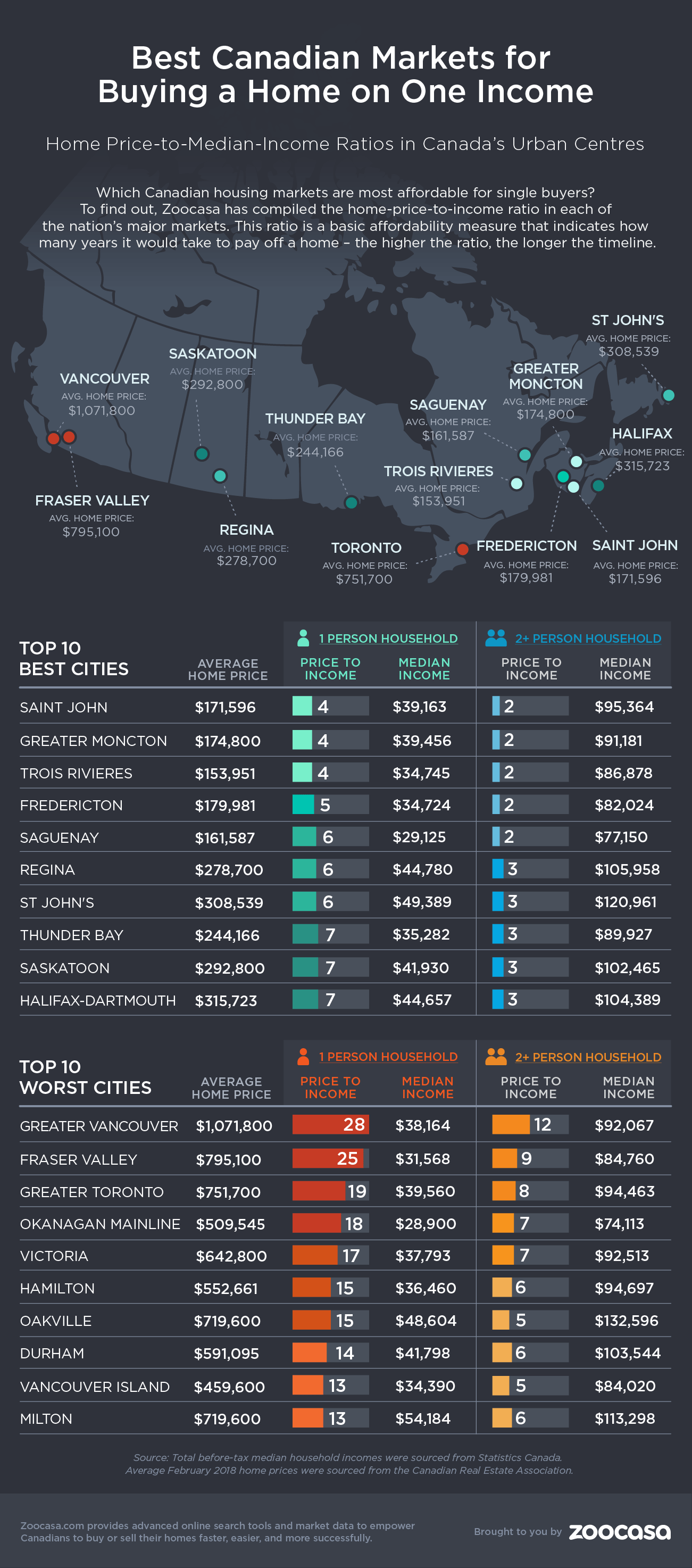
To determine the level of affordability in each market, the study determined the median home price-to-income ratio, based on regional home prices reported by the Canadian Real Estate Association, and median household incomes from Statistics Canada.

This ratio determines how many years it would take to pay off a home using 100 per cent of a household’s annual income:  the higher the ratio, the longer the timeline. And, while dual-income households have their fair share of affordability challenges in hot markets, the numbers paint an impossible picture for solo buyers.

For example, in Vancouver, where a single-income household brings in a median annual salary of $38,164, and the average home cost $1,071,800, homeownership outweighs incomes by multiple of 28. A home in the City of Toronto would set said buyer back 19 years for their home purchase.

Even most affordable markets too pricey for Singles

However, in a market as varied as Canada’s, affordability can change drastically by market, yet single-income households are still theoretically paying too much on homeownership in even the most affordable regions. Houses for sale in Hamilton, a popular secondary market to Toronto, still cost single buyers 15 times their income while in Saint John — the most affordable Canadian market — the average home price of $171,596 still outstrips the regional median income of $39,163 by four times.

Continue Reading…