General

Rekindling our inner creativity and frugality this Holiday season 

By Maria Weyman, creditcardGenius

Special to the Financial Independence Hub

Gifts, parties, drinks, and yes … food! Is there a more expensive time of year than … now?

Staying on the straight and narrow road of financial responsibility means we can’t go about our lives like a zombie (oh wait, wrong holiday )…

But how do we stay frugal (yes, I’m using the F word), and keep fun within arm’s reach?

It’s all about creativity

… not sacrifice.

So, don’t worry, I’m not going to ask you to create two separate lists for needs and wants. Instead, let’s stick with one master list: where you list your full holiday needs and wants.

Now, here’s the thing. At the bottom of your list, write the max dollar amount you plan on spending for everything. But before you write that single number down … a little research would help, like:

How much disposable money –- after your fixed expenses and savings goals –- do you have in the bank?

(No, your credit card limit doesn’t count.)

Working with that single number –- your maximum budget –- it’s time to break it down into chunks depending on what’s in your list. Now we’re cooking.

You’ll feel a little bit of tension. An internal struggle when you’re deciding how and where to allocate your holiday spend. Completely normal. That just means our brain is getting warm and prime to let our creative juices flow. Because here’s a not-so-obvious secret:

Constraints and limitations drive creativity.

Make it a game

Because games are fun. And at its core, aren’t games all about solving problems and overcoming specific challenges?

Even more fun when you get to save, indulge yourself, and spoil the people you love in the process. And here’s the best part:

You get to create the rules.

Here are some questions and suggestions:

Review your list

When you review your list…

  • Is there anything that you can get pre-loved (say hello to Kijiji, Craigslist, and even Facebook)?
  • Is there anything that you can create yourself (using a little help from Pinterest and YouTube)?
  • Is there anything that you can borrow from friends and family?
  • Is there something that you can replace with something that is just as good or better?
    • Example: if you’re thinking of getting your bff that beautiful warm $50 scarf, how about a) inviting her over for home-cooked dinner?, or b) volunteer to watch over the kid(s) for an afternoon so she can have a “me time”?

Anytime you can DIY [Do it Yourself], borrow, replace or get something pre-loved…write down how much you’re saving. Obviously, the bigger the number, the bigger the genius you are.

What’s at stake? Well, that’s for you to decide.

Free is fun

Let’s stop and think about all the free things we’re getting online; amazing isn’t it?

So, back to your list. Is there anything you’ve listed that is available for free? Some ideas …

  • Free local events: Check Eventbrite for current and upcoming local events, some have tickets for sale and some are free.
  • Free stuff. Browse Kijiji and Cragslist free stuff and see if there’s a match on what’s on your list.
  • Other freebies: like games, baby stuff, etc.

7 DIY gift ideas

Ideas from easy to advanced …

  1. Personalized christmas tree ornament: grab a box of blank-canvas ornaments from the dollar store, markers, and stickers … and have fun!
  2. Vanilla infused vodka for baking, etc.: Better alternative than that boring store-bought “vanilla extract” (cheap vodka is welcome).
  3. Chocolate spoon mixer like this one is delish.
  4. Ready-to-go hot cocoa and marshmallow in a jar: drool-worthy ideas here.
  5. Homemade chocolate and caramel dips: you can find glass bottles at the dollar store and recipes for chocolate and caramel dips are abundant.
  6. Decorated candle holder. You can go from simple elegance to elaborate, some ideas here.
  7. Festive painted glassware: Grab a (wine) glass (you guessed it, from the dollar store), enamel paint (specific for glasses), paint brushes, and … some inspiration! The best news? Sky’s the limit to your pattern and design.

These ideas are by no means exhaustive, but I hope it’s a good starting point to get you thinking of the possibilities.

The bottom line

Gifts, parties, drinks, and yes … food.

We’re entering a time where abundance and indulgence are celebrated. And while, no doubt, there are worse things in the world, over-indulgence only feels good for a moment.

So let’s make sure the reality we come back to after this holiday is a happy one for you and your wallet.

Maria Weyman is Co-Founder of creditcardGenius, the only tool that compares 50+ features of more than 150 Canadian credit cards using math-based ratings and rankings that respond to your needs, instantly. Follow on Twitter and Facebook.

 

Retired Money: the case for laddering Annuities

“The more bells and whistles, the lower the monthly income,” from annuities, says Caring for Clients’ Rona Birenbaum,

My latest MoneySense Retired Money column looks at the case for laddering annuities in order to avoid the problem of committing funds to annuities at interest rates that are only now coming off their historic lows. You can retrieve the whole article by clicking on the highlighted text: A low-risky annuity strategy to beef up your retirement cash flow.

Many investors are already acquainted with the concept of “laddering” guaranteed investment certificates (GICs), or bonds with different maturities. Maturity dates are staggered over (typically) one to five years, so each year some money comes due and can be reinvested at prevailing interest rates. This minimizes the likelihood of investing the whole amount at what may turn out to be rock-bottom interest rates, only to watch helplessly as rates steadily rise over time.

The same applies when it comes time for retirees or near-retirees to annuitize. At the end
of the year you turn 71 you must decide whether to convert your RRSP into a RRIF,
cash out and pay tax (few do this), or thirdly to annuitize.

Fortunately, annuitization isn’t an all-or-nothing decision. You can convert some of your RRSP to a RRIF and some to a registered annuity. You can take a leaf from the GIC laddering
concept and buy annuities gradually over five, ten or even more years. As regular Hub contributor Patrick McKeough observes in the piece, laddering annuities can reduce the potential downside: “You could buy one annuity a year for the next five years. That way, your returns will increase if interest rates rise, as is likely.”

Tally up how many annuities you may already have

Mind you, few observers believe in converting ALL your disposable funds into annuities. After all, as another Hub contributor — Adrian Mastracci — notes, you need to take inventory of the annuity-like vehicles you already may have, or expect to have: such as  employer-sponsored Defined Benefits, CPP or OAS. Some investors may have a high component of annuity-like income without realizing it, and many families may already have five or six such sources of annuity-like income.

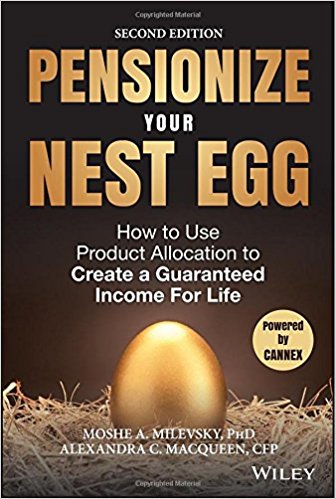
Certainly you need to consider both the benefits and drawbacks of annuities. The main benefit is they are a form of longevity insurance: making sure you never outlive your money no matter how long you live. There’s a case for having enough annuities that your basic “survival expenses” (shelter, food, heat, transport etc.) are taken care of no matter what. Finance professor Moshe Milevsky is also quoted in the article to the effect there are compelling financial and psychological reason to at least partly convert to annuities. And Milevsky is famous for making a distinction between “REAL” pensions (like DB pensions) that behave like annuities, as opposed to vehicles like RRSPs and TFSAs, which provide capital that only have the potential to be annuitized. Hence the title of Milevksy’s excellent book, Pensionize Your Nest Egg.

But annuities are not perfect. Apart from the common reluctance to commit to buying annuities at today’s still-low interest rates, there’s also the matter of the irreversible nature of the decision to convert some capital to an annuity. You’re handing over a large chunk of change to an insurance company and should you die earlier than expected, they in effect “win,” to the partial detriment of your estate. If on the other hand you live to 120, then YOU “win.”

Continue Reading…

How to graduate debt-free from College

By Steve Barker

(Sponsored Content)

Many high school students are faced with the prospect of going into tens of thousands of dollars in debt or foregoing higher education. Today’s young people are having to look at a college education as an investment and to weigh the value of that investment against potential returns.

There are ways to stay out of debt and still earn a college degree: it just requires a little planning and patience.

Advantages of Going to College

The cost of tuition is steadily rising without the accompanying rise in income. Although there are many paths to success, a college degree does greatly increase job options, teach valuable skills, and create lifelong networks of friends and colleagues. Here are some reasons why college is still worth the cost.

  •       Increased pay: Even though incomes aren’t rising with tuition costs, college graduates still tend to make more than their non-schooled friends. College grads earn an average of 56 per cent more than high school graduates.
  •       Higher rate of employment: The job market is extremely competitive. Anything that gives you an edge should be considered. Some studies show that only 3.8 per cent of college grads are unemployed compared to 12.2 per cent of individuals with only a high school diploma.
  •       Networking opportunities: You are likely to make a lot of valuable connections while attending school. You are introduced to people with new ideas who have the potential to inspire, encourage, and challenge you. Your professors and peers may become vital connections as you enter the workforce.

Staying Out of Debt

There is more than one way to earn a diploma. Taking out student loan debt is not the only way to finance your education. Continue Reading…

10 financial lessons to share with friends

The personal finance community can be a bit of an echo chamber, reinforcing and repeating the same ideas on how to save, invest, and spend our money. This sort of tribalism can be intimidating for outsiders who are eager to learn but afraid to ask questions or know where to start, especially when it comes to more complicated topics.

The truth is not all Canadians are financially savvy. In fact, a Tangerine survey last year found that only half of Canadians consider themselves knowledgeable when it comes to personal finances.

As personal finance enthusiasts it’s our duty to move beyond this little corner of the Internet and start talking to our friends and family about money.

It’s not easy to talk in real-life about what we do with money, how much we save, how much we spend, and the foolish mistakes we make. But these are crucial conversations to help each other deal with money and the complex decisions about it that we all face.

We can start by sharing the kinds of tips and tricks that helped us build lifelong financial habits and skills. It’s what financial literacy is all about, right?

That’s why I was excited to partner with Tangerine for Financial Literacy Month and list my top 10 financial lessons to share with friends:

1.) Avoid credit card debt like the plague

It’s impossible to go through life without incurring at least some debt. I’ve had student loans, credit card debt, a car loan, line of credit, and finally a mortgage.

Carrying a balance on my credit card was by far the most harmful to my finances. Making the minimum monthly payment hardly puts a dent into the balance, and 19 percent interest ensures that balance will continue to grow.

Tackle it with the debt avalanche or debt snowball method, and once it’s gone commit to never again paying one cent of credit card interest.

2.) Track your spending

To free up that additional cash flow you need to understand how much money comes in and how much goes out every month. There’s no other way around it – how else will you know what you can afford to save?

Whether you use a mobile app, budgeting tool, or good old-fashioned Excel spreadsheet, the point is to track every transaction until you can glean some insight into how you spend your money. Use this information to make informed decisions on which areas of your budget you can cut, and where you’d like to direct any additional savings.

Related: Track your habits, save money

3.) Automate your savings

The key to building a life-long habit of saving is to make your contributions automatic and as painless as possible. Pick a day that coincides with your paycheque and set up an automatic transfer into your RRSP, TFSA, savings account, or RESP.

It’s called paying yourself first. Start with as little as $25 and increase it annually, or as your budget allows. This powerful strategy works because it treats your savings goals as ‘mortgage-like’ fixed expenses that come out of your account on a specific day.

4.) Save a percentage of your income

One rule of thumb suggests saving 10 percent of your take home pay for retirement. I say save a percentage – any percentage – of your income as long as you start with something and make it automatic.

One cool trick I learned was to bump up that percentage in tandem with a salary increase each year. So, for example, let’s say you earn $50,000 and saved 5 percent of that amount ($2,500). Then you get a 4 percent raise in the New Year, so now you make $52,000. Well, don’t just continue saving $2,500 – bump that up to $2,600 to stay in-line with your 5 percent savings rate. Continue Reading…

Forced Early Retirement? 7 things you should do right now

By Michelle Arios

Special to the Financial Independence Hub

There are a lot of life situations that can lead someone to retire much earlier than they had initially anticipated. It could be illness, injury, the need to move quickly, an emergency family circumstance, or even a company closing its doors. Why you’re being forced to retire isn’t nearly as important as the silver lining you need to find in your situation, and what steps you’ll take to get there.

1.) Get a great Savings plan

Your normal savings account may not be enough to carry you through. It might help to change your current savings account to one that gives you a better interest rate, particularly if you’re going to consolidate your retirement accounts. It might also help to supplement your savings with some investments that will grow with time.

2.) Work out your new Budget

People in retirement often live on fixed incomes, especially if their spouse is also retired. You need to be sure your money can go as far as you need it to, and that might mean breaking apart your old budget and determining where and how you can best reduce costs while maintaining your quality of life. There are some easy-to-use smartphone apps that might help you do that.

3.) Downsize your Home

The expenses of maintaining a household are high. If you’re retired, you probably don’t need all the extra space anyway. Finding a roommate can help, and so can selling your previous home to purchase a smaller home that’s easier to maintain. Often times, utility bills will significantly go down on a smaller property. You’re also gaining some extra cash and a little more financial longevity.

4.) Find affordable alternatives

Monthly costs, like health insurance and cellular phone bills, can often add up to a lot of money. You might want to consider shopping around for a better deal. Continue Reading…