
General

Target-date funds hold hidden risks and conflicts of interest

Target-date funds are sold as offering great benefits for investors, but we don’t think you should accept the sales pitch.

Target-date funds go against one of TSI Network’s cardinal rules of successful investing. That is to invest mainly in simple, plain-vanilla investments. This rule limits your choices to two main categories: stocks and bonds (or ETFs that hold those investments). By confining yourself to these two investment categories, you still have all the investment choices you need. You also avoid the hidden risks and conflicts of interest that you’ll find in more complex products.

Target-date funds are mutual funds that take advantage of the widely held view that bonds are inherently safer than stocks, so you should gradually shift your investments out of stocks and into bonds as you near retirement. Target date funds do this for you automatically.

Complexity is not a benefit

The funny thing is that the promoters of complex investments describe the features of these investments as if they were benefits, disregarding the associated negatives. This marketing approach attracts investors who want to make a quick decision. These investors tend to accept the sales pitch at face value.

Continue Reading…

Retired Money: Retirement planning is about more than money

Meta at her 100th birthday party early in December

My latest MoneySense Retired Money column was published today. Click on the highlighted text for the full piece: Retirement planning is about more than money.

The piece is based on a recent Seniors’ Luncheon hosted by the Toronto church I attend and as you will read, I was struck by how the experiences of these seniors — who ranged in age from 82 to 100 — reinforced the theme of my recently released co-authored book, Victory Lap Retirement.

In short, every senior at the table believed in continuing to work in some fashion even in their looming old age. Including 100-year-old Meta, pictured. While I changed the names of the other seniors in the article, Meta is a real name and used there and here with her permission.

Here’s the thing. Until she suffered a hip injury earlier this year, Meta was still working one or two half-days a week at a nearby printing firm. And at her 100th birthday celebration earlier this month, this continued work connection meant several of the people celebrating with her were from work, as well as the church, neighbours and various other circles.

And now that the din over her 100th birthday milestone has subsided, Meta told me last week that she wanted to return to work one day a week, because she misses her co-workers and she likes to get out of the house (she lives in the top floor of a house overlooking Lake Ontario, and has been there since the 1960s. The last thing she would want would be to move to an institution catering to seniors.)

The danger of retiring “too soon”

As for the senior men I chatted with that day, one regretted having voluntarily retired “too soon” at the tender age of 58: Kevin (not his real name) said he did so because he had a good teacher’s pension but when his wife passed away soon after, found himself with too much time on his hands.

Continue Reading…

House shopping for Millennials

By Barney Whistance

Special to the Financial Independence Hub

In the wake of a new generation now growing up and planning to settle down, one of the biggest concerns for them is finding a place to live. Finding a house for you and your spouse to live in is one of the most important decisions that you will have to take. Therefore, it should not be taken lightly. There are a lot of factors for you to consider when you set out to purchase or get a house on mortgage.  You have to be certain about your choice as you will be the one living with it for a major part of your life.

Your financial situation is the biggest aspect you have to consider when making a decision like that. Once you know your financial point and how much you can afford, you must decide on where you want to live.  Planning everything step by step always gets the work done more smoothly and also makes your choice easier.

Finances

Talk about your finances with your partner, so in order to set a budget, you already know how much you both have. Once you have done the initial financial scrutiny, you can decide which plan you should be applying for. Continue Reading…

How an RESP offsets the cost of post-secondary Education

By Jo-Anne Wong

Special to the Financial Independence Hub

Post-secondary education is a necessity to get ahead in the new economy, but for many Canadians, attending university is out of reach due to rising tuition costs.

This why it’s now more important than ever for parents to start saving for their child’s education. Thankfully the Government of Canada offers one of the best ways to save for your child’s future through a Registered Education Savings Plan (RESP).

Rising Tuition Costs

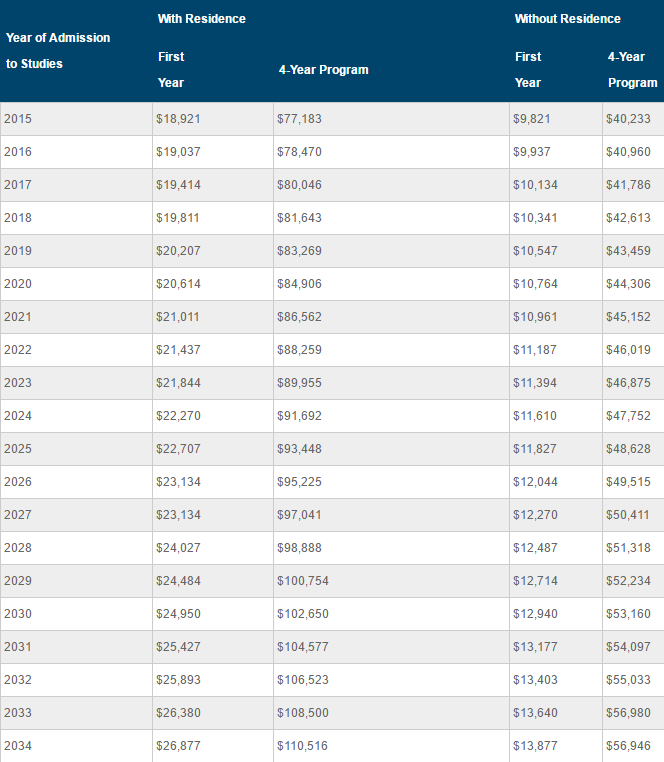
According to Statistics Canada, tuition costs have increased by 40 per cent in the last ten years, and between 2014-2015 and 2015-2016 school years it rose by almost three per cent. The news is worse for parents in Ontario where the average cost of tuition is $8,114: the highest in Canada. If your child chooses to study out-of-province or overseas, fees will be significantly higher. Knowledge First Financial’s Guide to Education Costs in Canada projected that tuition could climb to over $14,000 by 2034. These figures do not account for living expenses. For example, four years of tuition, room and board could add up to $90,000 at the University of British Columbia.

The cost of tuition has been rising steadily over the last ten years and continues to outpace inflation. Compared to last year, students paid on average 3.2% more in tuition compared with the previous year, while the Consumer Price Index was 1.3%. According to Statistics Canada, the national average for university costs in 2015/2016 was approximately $19,500 for students in residence, and $10,000 for Guide to Education Costs in Canada projects that first year tuition could climb to over $14,000 by 2034. These figures do not account for living expenses, students who lived at home or did not have to pay for residence and meals. Students in Ontario have the greatest challenge, where tuition is the highest in the country.

These high costs have resulted in a record-high number of students applying for loans, which is putting them in debt. According to the 2015 survey of 18,000+ graduating university students conducted by the Canadian University Survey Consortium, the average student owed $26,819. Costs are not limited to university degrees, with 37 per cent of Canadians with student loan debt being non-degree students, attending vocational schools or other certificate programs, says Stats Canada.


RESP from Ottawa

Continue Reading…

Baby sitting & RRSPs: a 9-year old’s rules for when to TFSA

9-year old Carlie Weinreb lectures financial bloggers on when to use TFSA or RRSP

By Carlie Weinreb

Special to the Financial Independence Hub

I lectured about RRSPs and TFSAs this November 3rd at the CPA Mastering for Money Conference for 45 minutes. I was a bit nervous because I knew that Former Prime Minister Paul Martin was also speaking. My example was very detailed with lots of Excel spreadsheets.

I then had a sleepover at my friends house the next weekend after dance class. My friend’s parents heard I lectured to over 400 Chartered Professional Accountants about RRSPs and TFSAs. They asked “OK what’s better?” I said “Well, it depends on your income and a couple of other things.” I knew they were not satisfied. I could tell they wanted like a 15 second answer.

The following week I was lecturing at the Canadian Personal Finance Conference presenting on RRSP and TFSAs again but they gave me only 20 minutes. And most recently, I presented on RRSPs versus TFSAs at Microsoft. They only gave me ten minutes.

3 quick rules

Continue Reading…