It has been almost two months since Russia invaded Ukraine. During this time, we have been witnessing the dramatic impact the war has had on global markets and economies. There is also concern with how these events will impact our portfolios and investments.
Economic Impact
Inflation numbers are expected to continue rising higher and this war will put more upward pressure on inflation. Russia is a large global oil exporter. Increased sanctions on Russia will undoubtedly cause a supply squeeze in the oil market, which will lead to higher oil prices. In addition, Russia and Ukraine both account for about 25% of total wheat exports, which will now be limited. This can drive up food costs on a global scale. The war will also continue to restrict supply chains. For example, planes are being diverted because Russian air space is closed to more than 35 countries. Having to go around Russia leads to longer travel, resulting in increased fuel consumption and trip costs. Continue Reading…
I recently posted a portfolio concept for the all-weather portfolio for 2022. The idea behind an all-weather portfolio is that it can prosper during periods of sun, rain, storms, hurricanes, earthquakes and tsunamis. Of course, in the above analogy weather serves as a proxy for the economic conditions that might arrive. The all-weather portfolio is ready for most anything.
On Seeking alpha I posted the all-weather portfolio for 2022. The portfolio is designed for U.S. investors, though Canadians can certainly mimic the approach or apply the greater concepts. The big idea of the all-weather portfolio is to hold assets in four buckets. It is an extension of the Permanent Portfolio.
There is a bucket of investment assets ready to thrive no matter what the weather offers (economic conditions). For example, for the last 40 years or so we’ve had favourable weather. Inflation has been low and economic growth has been modest, but positive. We’ve been in a disinflationary environment. Inflation has been low and mostly falling.
The weather has been nice
Stock markets and bond markets perform quite well during these disinflarionary periods.
Stocks have performed quite well over time. That said, investors needed to be armed with some very impressive umbrellas (and risk tolerance) to withstand the Great Financial Crisis (2008-2009) and the dot-com crash of the early 2000’s. Stock markets declined in spectacular fashion in both of these events.
Given that we were still in the midst of a mostly disinflationary period, bonds did the trick in lowering the volatility of the typical balanced portfolio. Bonds will mostly go up when stocks go down, offering that useful inverse relationship. We can think of bonds as portfolio shock absorbers.
These two major stock market corrections came and went, and we returned to our mostly fair-weather disinflationary times. Modest economic growth returned as well.
The comedy troupe was certainly different. And so is today’s economic environment. We have inflation, real inflation. It might even turn into stagflation when most everything fails for the investor. Stagflation is a period of persistent inflation that is accompanied by economic decline. The worst of all worlds you might say. Some nasty weather.
What works during stagflation or unexpected inflation (persistent inflation above those central bank 2-3% targets)? It’s not stock markets; it’s certainly not bonds. Oooops. That’s the traditional balanced portfolio. Continue Reading…
As we have written before, sentiment and emotions can have an outsized influence on investor psychology and investment decisions. Relatedly, there is a powerful inclination among investors to perceive markets that have outperformed as being less risky than those that have underperformed.
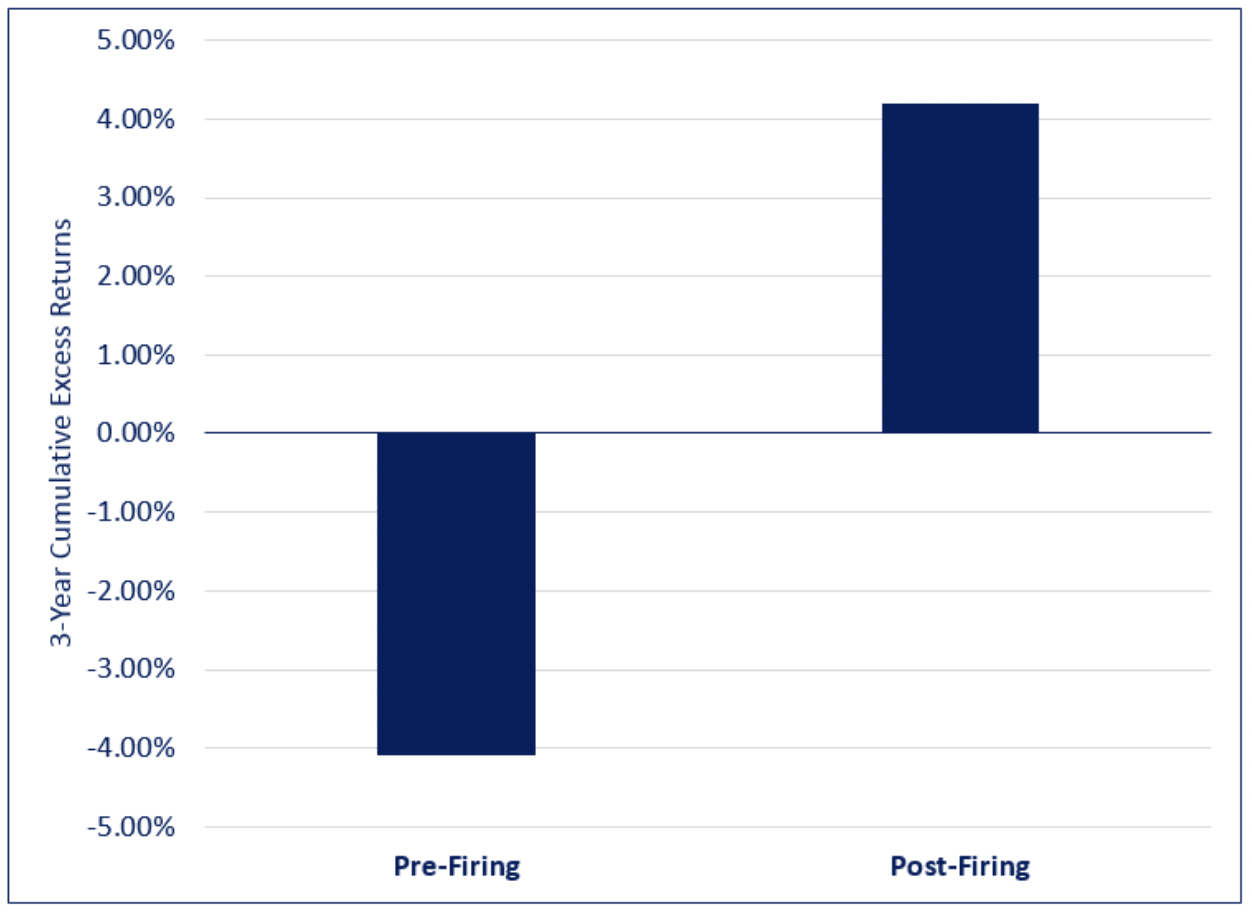
Interestingly, this tendency exists not just among individual investors, but is also prevalent in the professional investment community. A 2008 study by finance Professors Amit Goyal and Sunil Wahal explored the performance of investment managers who had been fired by institutional investors. The analysis compared the managers’ performance in the three years before being fired with their subsequent three-year performance. The results of the study are summarized in the following graph.
The Selection and Termination of Investment Management Firms by Plan Sponsors
On average, fired managers had poor performance in the three years preceding their termination, with average annual underperformance of 4.1% vs. their benchmarks. This figure should come as no surprise, as you wouldn’t expect that they were fired for knocking the lights out! However, what may be counter-intuitive to many is that these managers tended to subsequently outperform, with average annual outperformance of 4.2% over the three years following their termination.
Clearly, not only does looking in the rear-view mirror fail to prevent you from hitting something that is in front of you but may in fact cause it!
The other takeaway is that even seasoned, institutional investors can be swayed by short-term performance, which in turn can lead to decisions which are both ill-timed and economically perverse.
Beware the Mean Reversion Boogeyman
Last year saw a continuation of a long-established trend of U.S. stock outperformance, with the S&P 500 rising 28.7% as compared to 8.3% for the MSCI All Country World Index (ACWI) Ex-U.S. From the end of 2008 through the end of last year, the S&P 500 rose at an annualized rate of 16.0%, producing a cumulative return of 587.3%. In comparison, the ACWI Ex-U.S. Index rose at an annual rate of 8.6% and delivered a cumulative return of 190.7%.
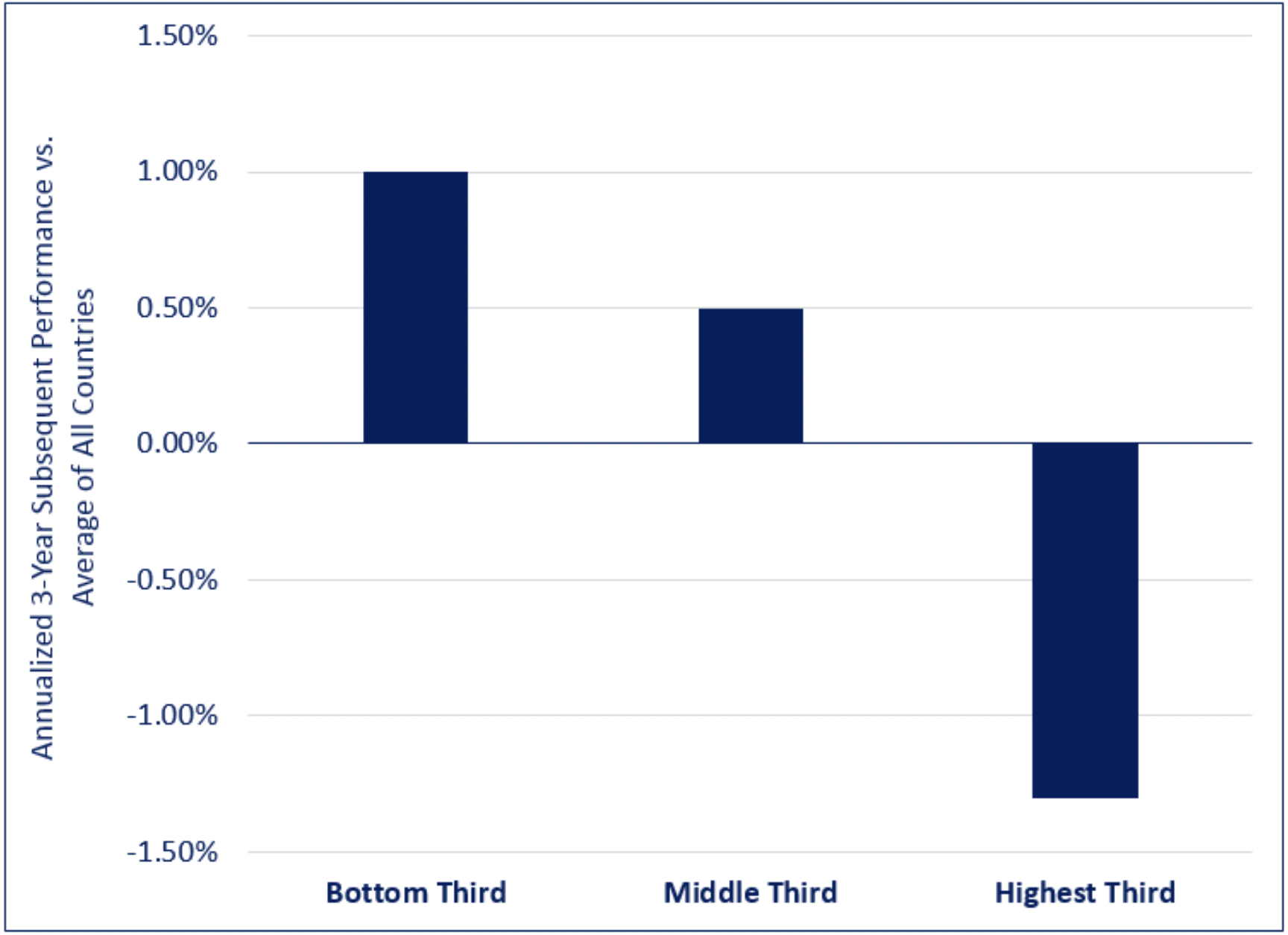
The outperformance of U.S. stocks argues for actively reducing U.S. exposure and increasing allocations to other regions, as the mean-reverting, contrarian nature of investment manager performance can also be applied at the country level. The following chart covers the period from 1970-2021 and includes the U.S., U.K., Germany, France, Australia, Japan, Hong Kong, and Canada. Specifically, it illustrates the results of investing every three years in a portfolio of country indexes based on their trailing returns over the previous three years.
3-Year Performance of Countries ranked by Trailing 3-Year Performance
The chart brings fresh perspective to the standard regulatory disclosure language in the marketing materials of investment funds, which states that “Past performance is no guarantee of future returns.”
Outperforming countries tend to become subsequent underperformers : those that have had superior returns over the past three years tend to produce relatively poor results over the next three years. Conversely, underperformers tend to subsequently outperform: those that have lagged over the past three years tend to outperform over the next three years. Continue Reading…
In a recent Questrade research study conducted by Leger¹, more than 8 in 10 Canadians (84%) expressed worry about the rising costs of inflation; two in five (39%) said they were very worried.
Rising inflation and the impact on mortgage costs have many worried, especially the younger demographic: approximately 45% of those polled.
The survey also found that Canadians aged 18 – 34 understand the importance of investing early and are much more likely to be investing more in their RRSPs to buy a home. Happily, this generation is committed to planning ahead, and will benefit from programs like the Home Buyer’s Plan when the opportunity is right.
Rebuilding the home ownership experience from the ground up
To ease current consumer anxiety, address pain points associated with home buying and mortgages, and help Canadians on their journey to financial independence, QuestMortgage®has been introduced as a direct-to- consumer mortgage offering to help make home ownership easy and affordable.
Designed as a simple, digital service for those looking to buy a first home or renew their mortgage, it is an alternative to traditional mortgages: available online 24/7, without the need to ever visit a branch. A QuestMortgage BetterRate™ offers low rates at the outset, with a team of dedicated mortgage advisors accessible to guide clients through the entire application process. The new service aims to change the status quo, making the process of home ownership straightforward, transparent and stress-free for Canadians of every age. Continue Reading…
Ottawa has just released its federal Budget 2022, which seems to validate the pre-release fears that a de facto Liberal NDP coalition would be a high-spending, high-taxing affair. You can find the full budget documents at the Department of Finance web site here. It is as expected “a typical NDP tax-and-spend budget,” as interim Conservative Leader Candice Bergen told the CBC.
Budget 2022 is unmemorably titled A Plan to Grow Our Economy and Make Life More Affordable, weighing in relatively slim by federal budget standards: just shy of 300 pages. Of course, the NDP is all over this document, which is why I call the de facto coalition the LibDP.
Naturally, the NDP’s pet priority is included, with $5.3 billion over 5 years for national dental care. As CTV reported, the program will offer dental care to families with annual incomes below $90,000, with no co-pays for those under $70,000 annually in income. The first phase in 2022 will offer dental care to children under 12.
Big focus on affordable housing
Of the $56 billion in projected new spending over six years, $10 billion is going to housing over five years, with a one-time $500 payment to those struggling with housing affordability. And as expected, foreign buyers will be shut out of the market for condos, apartments, and single residential units for the next two years.
They are also cracking down on home flippers, introducing new rules as of January 2023, such that if anyone sells a property held for less than 12 months it would be considered to a flip and be subject to full tax on their profits as business income (with some exceptions in certain special cases).
National Defence will get $8 billion over 5 years, There’s $500 million for military aid to Ukraine and $1 billion in loans.
Perhaps we should use CTV News’ phrase and describe the spending as “targeted”:
The budget proposes $9.5 billion in new spending for the 2022-23 fiscal year — with the biggest ticket items focused on housing supply, Indigenous reconciliation, addressing climate change, and national defence — while also set to take in more than $2 billion in revenue-generating efforts.
New “Minimum Tax Regime”
CTV reports that Budget 2022 “puts high earners on notice that the government thinks some high-income Canadians aren’t paying enough in personal income tax.” The Liberals say they will be examining “a new minimum tax regime, which will go further towards ensuring that all wealthy Canadians pay their fair share.”
Here is the Globe & Mail’s initial overview (paywall.) Or click this headline:
According to the Globe, the planned bank tax is different from the initial proposal from the Liberal’s 2021 election platform: rather than a three percentage point surtax on earnings over $1-billion, the budget announces a 1.5 percentage point increase on taxable income over $100 million. That brings the tax rate on those earnings from 15% to 16.5%.
In addition to $4-billion for cities to build 100,000 new homes, Ottawa will provide tax-free home savings accounts of up to $40,000. Future first time homebuyers will get an RRSP-style tax rebate when they contribute and the money can grow tax free. First-time homebuyers will also get a tax credit of $1,500 and a home renovation tax credit of up to $7,500 to help families add second suites for family members. Continue Reading…


 Posted By
  By Sa’ad Rana, Senior Associate – ETF Online Distribution, BMO ETFs




 Posted By