But not now. Not after Putin invaded Ukraine. It feels wrong to go about business as usual while most of us are asking important questions about this geopolitical crisis.
By no means do our financial concerns detract from the greater, human toll. That said, if I can help you remain resolute as the world justifiably severs Russia’s access to capital markets and the global economy, perhaps we can both do our part to restore justice in Ukraine.
So, let’s talk about geopolitics and investing during wartime. Here are my key takeaways:
Big picture, geopolitical events’ impact on financial markets are usually short-lived
To help you keep your financial wits about you, consider Vanguard’s historical perspective on how the U.S. stock market has responded to other geopolitical crises over the past six decades. As Vanguard’s chart depicts in the article Ukraine and the Changing market environment, the turmoil has typically translated into initial sell-offs. But markets have also exhibited remarkable resilience, delivering returns in line with long-term averages as soon as six months later. That’s not to predict the same outcome this time, but it reinforces the wisdom of betting for vs. against the market’s staying powers.
Credit: Vanguard – Ukraine and the changing market environment
“A new dimension of risk has entered the financial markets with heightened tensions in Ukraine …
We know this, however, about equity markets in the context of geopolitical risks: they’ve been resilient, much as markets have always been resilient in the face of various risks. We expect the markets to work themselves out, reaching new heights over time and at varying paces …
So now is not the time to give up your fortitude. Now is the time to take it all in with a deep breath, knowing that this day would come — and knowing that it will pass.”
Speaking of predictions, ignore those who claim to know what’s going to happen next
“People who generate better sound bites generate better media ratings, and that is what gets people promoted in the media business. So, there is a bit of a perverse inverse relationship between having the skills that go into being a good forecaster and having the skills that go into being an effective media presence.”
In other words, those forecasts you’re hearing are more likely to sound like sure (often scary) bets, and less likely to be reasoned reflections on the many ways any given event might play out. In fact, evidence suggests, the more certain an expert seems about their forecast, the more skeptical you should be about its worth.
Real-return bonds pay a return adjusted for inflation. But when you buy a real-return bond, you are only protecting yourself against unanticipated rises in inflation.
Real-return bonds pay you a rate of return that’s adjusted for inflation, but that’s not always as promising as it seems.
When a real-return bond is issued, the level of the consumer price index (CPI) on that date is applied to the bond. After that, both the principal and interest payments are typically adjusted every six months, upwards or downwards from that base level, to compensate for a rise or fall in the CPI.
Look at this theoretical example to understand how a real-return bond works
The Bank of Canada issues $400 million of 30-year bonds maturing on December 1, 2049. The bonds have a coupon, or interest rate, of 2%.
If after six months from the date of issue, the new CPI level is, say, 1% above the level of the CPI on the issue date, then each $1,000 of bond principal is adjusted to $1,010 of bond principal ($1,000 x 1.01). The semi-annual interest payment is then $10.10 ($1,010 x 2% / 2).
If after 12 months, the level is 2% higher, then the bond principal is adjusted to $1,020 ($1,000 x 1.02), and the interest payment rises to $10.20 ($1,020 x 2% / 2).
Consider these three important factors to realize benefits with real-return bonds
The price you pay for real-return bonds reflects the anticipated rate of inflation. In other words, if investors feel that inflation will rise 2% over the long term, the price of the bond will reflect that future inflation increase and its effect on the bond’s principal and interest payments. So, when you buy a real-return bond, you are only protecting yourself against unanticipated rises in inflation.
When the inflation rate falls over a six-month period, the principal and interest payments of a real-return bond fall. In times of deflation, the inflation rate turns negative. In a prolonged period of deflation, the principal of a real-return bond could fall below the purchase price. Interest payments would fall, as well.
As with regular bonds, holders of real-return bonds must pay tax on interest payments at the same rate as ordinary income. That income gets taxed at the investor’s marginal rate. In addition, holders of real-return bonds must also report the amount by which the inflation-adjusted principal rises each year, as interest income, even though you won’t receive that amount until the bond matures. That amount is added to the bond’s adjusted cost base.
If the CPI level falls, that reduces the inflation-adjusted principal. You deduct the amount of that reduction from your taxable interest income that year, and also subtract it from the adjusted cost base.
Find out how real-return bonds compare to regular bonds and if they make better additions to your portfolio
In simple terms, a bond is a form of lending whereby you lend money to a corporation or government. In return, a bond pays a fixed rate of interest during its life. Eventually, a bond matures, and holders get the bond’s face value—but nothing more. Receiving the fixed interest and face value at maturity is the best that can happen. Note, though, that in some cases, corporate bonds can go into default. As well, inflation can devastate the purchasing power of bonds and other fixed-return investments.
Furthermore, bonds also generate more commission fees and income for your broker, compared to stocks, especially if you buy them via bond funds and other investment products. Continue Reading…
Over time, most investment dealers have implemented misguided policies that will negatively affect their clients’ investment portfolios and their ability to achieve a secure retirement.
There are two main policies that have negative impacts on investors’ portfolios. One is restricting investments to a client’s original Risk Tolerance in the Know Your Client application form (KYC). When opening an account, the client will advise the dealer of their Risk Tolerance. Most clients will indicate that they are medium risk. On March 8, 2017, the Ontario Securities Commission (OSC) implemented risk rating rules that require all mutual funds to rate their fund according to 10-year standard deviation. In 2018, I published an article entitled New Mandatory Risk Rating is Misleading Canadian investors.
Prior to the OSC’s implementation of the risk rating rules, on December 13, 2013, the OSC issued CSA Notice 81-324 and Request to Comment – Proposed CSA Mutual Fund Risk Classification Methodologyfor Use in Fund Facts. My comments on this policy were submitted to the OSC on March 12, 2014, along with comments from 50 other industry experts.
A better, more accurate methodology would have used downside standard deviation or the Sharpe or Sortino ratios which measure risk adjusted returns. Nevertheless, the OSC implemented risk rating rules requiring all mutual funds to rate the risk of their funds according to 10 year standard deviation.
As a result, if investments in a client’s portfolio exceeded the risk tolerance as indicated in the original KYC, the client was forced to redeem those investments, by the advisor’s compliance department. A number of BMG’s clients were forced to redeem their positions since our funds had a medium-high risk rating according to the OSC formula, and the clients’ KYC indicated medium-risk tolerance. A number of clients wanted to change the KYC in order to allow them to maintain ownership of our funds but were advised that, unless there was a significant change in their financial circumstances, they could not change their KYC.Continue Reading…
Most investors do not like volatility. They do not like looking at their investment account balance observing that they’ve ‘lost money.’
Of course, you have not lost money until you buy an asset at a certain price and then sell at a lower price. You’ve then just realized your losses. You have not lost money when your portfolio value goes down. And in fact, swings in portfolio values are just par for the course. Stocks and bonds and real estate change in price (with wild swings at times) in regular fashion: it’s normal behaviour. If the stock markets have you spooked, there is a simple and timeless plan of action.
With this strategy, you can ‘win’ if stocks go up. You can win if stocks go down. It’s a strategy that worked during the worst period in stock market history: the Great Depression of the 1930s .
The answer of course is adding money on a regular schedule. In the investment world they call it dollar cost averaging; we can abbreviate that to DCA. There is no need to guess about which way the market is going to go today, next week, next month, next year, or even the next five years. We simply expect or hope that the markets will go up over longer periods, as they have throughout history.
Stock market history
U.S. stocks, S&P 500
You can see that there is lots of green on the board. Stocks mostly go up. It is those pink years (on the table) that usually trip up many investors
The key to long-term wealth building is being able to invest through those down years. And in fact, adding money in those years is quite beneficial as the stocks go on sale.
But keep in mind that stocks can stay under water for extended periods.
Dollar cost averaging
Now this is a consideration for those who have very little exposure to stocks, or who have been out of the markets for quite some time. That event is not as rare as you might think. Many investors have left the markets, though they recognize that they need to be invested to reach their financial goals and enjoy a prosperous retirement. They also want their wealth protected from inflation.
Here’s the demonstration: investing through the initial stages of the Great Depression.
In the above charts we see equal amounts invested, but the dollar cost averaging strategy still delivered positive returns in a vicious bear market. Buying at those lower prices was very beneficial. Now keep in mind for the above to work, the markets have to go up over time. They have to recover. And historically they have.
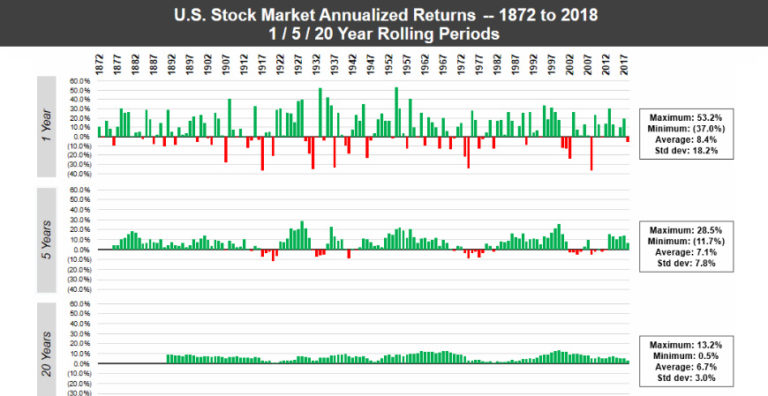
Time reduces risk
Here is a wonderful graphic that demonstrates the returns over various periods. Our odds increase as we lengthen the time period that we remain invested.
And a table that frames the probabilities of positive returns.
Charlie Bilello
Spread out that lump sum
If you are sitting on a large sum that you want to get invested you will have to have a plan. Over what time period should you get those monies into the market?
If you start investing and the markets keep going up, great. Mission accomplished. The money you’ve invested has increased in value. You are collecting dividends along the way.
But of course when we enter a stock market correction, your total portfolio value will decline. Though you might get enough of a head start so that your money invested remains in positive territory.
At that point when markets are declining, remember that lower prices are good. The stocks are going on sale. And of course, you do not have to invest in an all-equity portfolio. You can dollar cost average into a balanced portfolio.
I’d suggest that you spread the money out over 2 or 3 years. For example, If you are on the 2-year plan and have $100,000 to invest and you’re investing every month, you’d invest $4,167 per month.
You can’t time the markets
For those who already have substantial assets invested, you can’t move in and out of the markets. We don’t know when the corrections will occur. The most reasonable course of actions is still dollar cost averaging. That said, whenever you have money to invest, stock market history says get it invested. The sooner the better.
This is key. If you get scared and sell, you might lose money.
You might have to accept a lower-risk portfolio that is likely to earn less over time compared to a more aggressive stock-heavy portfolio or balanced portfolio. It’s also possible that you do not have the risk tolerance to invest (at all), even in a very conservative ETF portfolio. If that is the case you would have to stick with GICs and high-interest savings accounts. You might add to your real estate exposure for growth. In retirement, you might use annuities to boost your income.
For savings we use EQ Bank. 3-and 6-month GIC’s now 2.05%
To help gauge your risk tolerance level and the appropriate level of portfolio risk, please have a read of the core couch potato portfolios on MoneySense. You’ll find a table within that post that breaks it down.
If you are risk averse, you likely need a managed portfolio and advice. You might consider a Canadian Robo Advisor. These investment companies provide lower-fee portfolios at various risk levels. Advice is also included. A few of these firms also offer financial planning.
At Justwealth, you get access to advice and financial planning. In fact, you’ll have your own dedicated advisor.
They will do a risk evaluation to see if investing is right for you, and then you will be placed in the appropriate portfolio(s). And once again, you’ll be offered the greater financial plan as well.
Start investing
Preet [Banerjee] puts some of the above in video form [YouTube.com]. Preet also goes over how much you might market over various time frames, at different rates of return.
The key is to not be frozen on the sidelines. We might refer to that as ‘paralysis by analysis’.
Build wealth at your own comfort level, at your own pace. You will learn as you go. You can build up your comfort level for risk and volatility. It’s quite possible that you can increase your risk tolerance level over time. We develop risk callouses.
Thanks for reading. We’ll see you in the comment section. If you’re not sure what to do, feel free to flip me a note.
Dale Roberts is the Chief Disruptor at cutthecrapinvesting.com. A former ad guy and investment advisor, Dale now helps Canadians say goodbye to paying some of the highest investment fees in the world. This blog originally appeared on Dale’s site on Feb. 12, 2022 and is republished on the Hub with his permission.
Over the years, many close friends and family have come to me for guidance on how to become DIY (do-it-yourself) investors, and how to think about investing.
My knowledge and experience lead me to suggest that they manage a portfolio of a few low-fee, index-based ETFs, diversified by asset class and geography. Some family members were less adept at using a computer, let alone a spreadsheet, and so, after they became available, I would suggest they invest in a low-fee asset allocation ETF.
What would almost always happen several months later is that, as savings accumulated or distributions were paid, these friends and family would ask me how they should invest this new money. We’d look at how geographical weights may have changed, as well as their stock/bond mix, and invest accordingly. And for those in the asset allocation ETFs, there would inevitably be a discussion about transitioning to a lower risk fund.
DIY investors less comfortable with Asset Allocation
After a few years of doing this, I realized that although most of these friends and family were comfortable with the mechanics of DIY investing (opening a direct investing account, placing trades, etc.) they were much less comfortable with the asset allocation process. I also realized that, as good a sounding board as I was to help them, there were millions of Canadians who didn’t have easy access to someone like me who they could call at any time.
Clearly, there was a looming issue. How can someone looking to self-direct their investments, but with little training, be expected to sensibly invest for their retirement? What would be the consequences to them if they failed to do so? What would be the consequences for us as a society if thousands or even millions of Canadians failed to properly invest for retirement?
What are Target Date Funds?
The vast majority of Canadians need to save and invest for retirement. But most of these investors lack the time, interest, and expertise to construct a well-diversified and efficient portfolio with the appropriate level of risk over their entire life cycle. Target date funds were created specifically to address this issue: they are one-ticket product solutions that help investors achieve their retirement goals. This is why target date funds are one of the most common solutions implemented in employer sponsored plans, like group RRSPs (Registered Retirement Savings Plans).
Generally, most target date funds invest in some combination of stocks, bonds, and sometimes other asset classes, like gold and other commodities, or even inflation-linked bonds. Over time, these funds change their asset allocation, decreasing exposure to stocks and adding to bonds. This gradually changing asset allocation is commonly referred to as a glide path.
Glide paths ideal for Retirement investing
Glide paths are ideal for retirement investing because of two basic principles. First, in the long run, historically and theoretically in the future, stocks tend to outperform bonds – the so-called equity risk premium – which generally pays long-term equity investors higher returns than long-term bond investors in exchange for accepting greater short-term volatility (the uncertain up and down movements in returns). Second, precisely because of the greater short-term uncertainty of stock returns relative to bond returns, older investors who are less able to withstand short-term volatility should have less exposure to stocks and more in less risky asset classes like bonds than younger investors.Continue Reading…


 Posted By
  By Steve Lowrie, CFA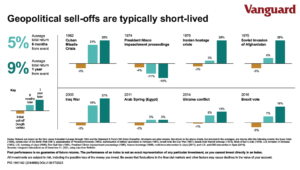
 Posted By