No doubt about it: at some point we’re neither semi-retired, findependent or fully retired. We’re out there in a retirement community or retirement home, and maybe for a few years near the end of this incarnation, some time to reflect on it all in a nursing home. Our Longevity & Aging category features our own unique blog posts, as well as blog feeds from Mark Venning’s ChangeRangers.com and other experts.
Happiness, longevity, health and money are all (as you might expect) intertwined. In his book, You Can Retire Sooner Than You Think (also reviewed here at the Hub), Wes Moss focuses on the five money secrets of the happiest retirees.
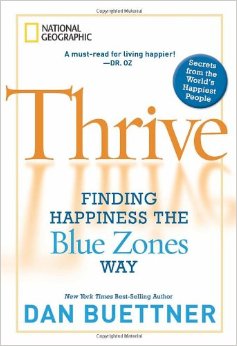
In the meantime, we’re going to look at Buettner’s followup book on happiness: Thrive: Finding Happiness the Blue Zones Way, originally published by National Geographic in 2010.
To research the book, Buettner travelled to four of the world’s allegedly happiest countries, two of which I’ve visited myself: Denmark and Mexico, and two I haven’t: Singapore and San Luis Obisco (in California). In each locale he contacts local elders known for their wisdom about happiness and how the city or country built its infrastructure to maximize it.
He then wraps it all up by summing up what these nations have in common with a chapter entitled Lessons in Thriving.
He concludes there are six “life domains” that can be shaped to boost one’s chances for happiness. These six “thrive centers” are: Continue Reading…
President Underwood wants to take away your Social Security
By Jonathan Chevreau
If you’ve been binge-watching the new third season of House of Cards on Netflix, you’ll know that the nefarious Frank Underwood — now the fictional president of the United States — has decided Social Security is a luxury the nation can no longer afford, as is Medicare and Medicaid.
Probably not, but there’s been a lot of online commentary on the very notion of killing the 80-year old Social Security program, given how many Americans have little retirement savings resources other than it. One is this piece from the Independent Women’s Forum, entitled House of Cards gets Social Security policy right, but messaging wrong.
If the prospect of losing Social Security doesn’t frighten you, maybe this will: New York Times reports that many Americans will run out of money in retirement unless at least two things happen: one, they need to save more, and two, what money they do need to save needs to be invested more wisely, which means avoiding high-fee mutual funds. It blames mutual fund expense ratios of 1.12% of assets and that’s in the United States. Canadian mutual fund MERs are roughly twice that high.
So the solution is to just keep working, perhaps in an Underwoodian variation of AmWorks? Not so fast! Personal finance author and columnist Helaine Olen writes an insightful piece in Slate on what she calls the “Semi-Retirement Myth.” As the online site puts it, “Don’t buy the tales of meaningful work into your 70s. Your retirement is inevitable — and bleaker than the last generation’s.”
Better hope for “Freedom Six Feet Under.” Unfortunately, as the Hub’s Longevity & Aging section continually reminds us, odds are we’re all going to be living longer and healthier than we once may have imagined. Perhaps the canary in the coal mine is Irving Kahn, who passed away last week at age 109. One of the world’s oldest active investors, Kahn was around to experience the crash of 1929. Here’s the obituary from the Telegraph.
On the same subject, sadly comes news of the death of Thomas Stanley, co-author of the groundbreaking bible of personal finance, The Millionaire Next Door. Here’s a good tribute on him from the New York Times.
Globe & Mail on Reforming Retirement
North of the border, the Globe & Mail has been running a series on reforming retirement. Last week it weighed in to the TFSA debate. Continue Reading…
Here’s my latest MoneySense blog, entitled Why you should re-think Early Retirement. This is a topic I’ve been researching for several months, going back to some blogs I wrote on Mark Venning’s ChangeRangers.com, which challenges readers to “envision the promise of longevity.” He also sensibly counsels that we should “plan for Longevity, not for Retirement.”
As you can see by clicking through to the blog (also reproduced below), some of this message was articulated in a speech delivered Wednesday evening at the Financial Show, and which I also gave Monday night at the Port Credit chapter of Toastmasters.
By Jonathan Chevreau
I recently delivered a talk about how longevity changes everything. I began by showing the front cover of the latest Bloomberg Business magazine, which shows a woman celebrating her 173rd birthday. Continue Reading…
Earlier this week there was extensive mass media coverage of the latest Sun Life “Unretirement” survey, which found more Canadians now expect to work full-time at age 66 than the number who are retired.
Given that the traditional retirement age has been 65, and remains the age many older investors think of collecting Old Age Security and the Canada Pension Plan, the general tone of this coverage was that the idea of working to such an “advanced” age is in itself scandalous.
Regular readers of the Hub will know what I’m about to say, and did say Wednesday night on a CTV item on the survey, which you can find here at Findependence.TV’s Video Hub. With rising trends to longevity, more and more people are choosing to work longer or feel financially compelled to do so. Indeed, governments around the world generally would love to see us all work longer and pay taxes longer, which is why the age of OAS onset is being bumped up to 67 for younger Canadians.
Plan for Longevity, not Retirement
I still love the positioning of Mark Venning at ChangeRangers.com, who says we should be planning not for Retirement, but for Longevity. Continue Reading…
Whether you are considering a move to an assisted living facility for yourself or an elderly member of the family, the options available and how much they cost may come as a surprise to you.
The rules vary considerably across Canada, but a series of informative bulletin from Sun Life Financial covering each province and territory describe the three main alternatives, how much they cost and the level of government subsidy, if any. In this blog I refer to the situation in Ontario, because that’s where I live. Generally care for seniors can take place in one of three settings:


 Posted By