Building Wealth

For the first 30 or so years of working, saving and investing, you’ll be first in the mode of getting out of the hole (paying down debt), and then building your net worth (that’s wealth accumulation.). But don’t forget, wealth accumulation isn’t the ultimate goal. Decumulation is! (a separate category here at the Hub).

Adding Canadian and international REIT ETFs to your portfolio

By Dale Roberts, Cutthecrapinvesting

Special to the Financial Independence Hub

You’ll notice that in the ETF Model Portfolio page on Cut The Crap Investing I first offer up the core portfolios with the traditional building blocks of Canadian, US and International stocks supported by a broad basket of Canadian bonds.

That’s a core approach embraced by many self-directed investors. You’ll even see that simple asset allocation embraced by Dan Bortolotti of Canadian Couch Potato. In fact, Dan will argue that any additions or ‘complications’ are not necessary.

Many will suggest that we do not need to spice things up much beyond that core ‘meat and potatoes’ asset allocation. A Canadian investor can certainly put together a sensible portfolio with those assets and that investor would have been rewarded with some very solid returns.

There are assets that can deliver the potential of greater returns and greater diversification. REITs and foreign bonds and emerging market equity funds would fall into that camp. You’ll see those holdings in the portfolios of many of the Canadian Robo Advisors. In the game-changing asset allocation portfolios from Vanguard you’ll find US bonds and emerging market stocks.

One Canadian Robo Advisor that employs REITs and foreign bonds is ModernAdvisor. I am a big fan of that firm and I am a fan of their asset allocation moves. Please have a read of ModernAdvisor. A Better Way For Canadians To Invest. The Canadian Robos can also be a great source of education by way of their blogs. Here’s a wonderful REIT primer from ModernAdvisor: Diversify With A REIT ETF.

In that post we’ll find the chart that strongly suggest why we should include REITs for greater portfolio diversification.

From that blog post …

In addition to the income aspect of REITs, real estate also provides strong diversification benefits for a portfolio already holds stocks and bonds. Since 2002, the 5-year correlation between the S&P/TSX Capped REIT Index with the S&P/TSX Composite Index has ranged between 0.23 and 0.76, averaging 0.55. The correlation with Canadian bonds is even more attractive, ranging between -0.02 and 0.34, and averaging 0.12.

Correlation of 1.0 indicates perfect positive correlation; that is, the two investments move in the same direction. Correlation of -1.0 indicates perfect negative correlation, that is, the two investments move in the opposite direction. Correlation of 0.0 indicates that there is no relationship between the two investments.

From the chart we can see that we do gain additional diversification.

Canadian REIT exposure is quite easy. The core Canadian REIT approach is covered by Vanguard with VRE, iShares with XRE and BMO offers ZRE.

  • For more on 2019 ETF performance including those REITs you can have a read of this recent post on Cut The Crap Investing.

US and International REIT exposure

Things get a little more tricky when we leave Canada due to withholding taxes and the potential of currency conversion charges. The go-to Canadian dollar International REIT is iShares CGR. That is a US and Global REIT.

Given that CGR is a Canadian dollar REIT ETF with US and International assets you will face those withholding taxes on income. On that, the folks at ModernAdvisor suggest that you hold that ETF in a taxable account whenever possible as you can claim the tax credit. That said, if you are only investing in registered accounts such as an RRSP and TFSA you might not let the tax considerations drive the bus. The additional diversification and potential of greater returns might rule the day for your portfolio.

Hold US REITs in a US Dollar Account

This is a good practice or portfolio approach for your entire equity assets. Continue Reading…

The vulnerable Euro

By Jeff Weniger, WisdomTree Investments

Special to the Financial Independence Hub

These are interesting times for the euro. Relative to the Canadian dollar, it may be nearing the end of its four-year uptrend (figure 1).

Figure 1: EURCAD


Figure 2 shows the most recent Wall Street forecasts for 2019 exchange rates. Despite the great unknown of what happens when European Central Bank (ECB) president Mario Draghi passes the sceptre to Christine Lagarde this winter, the median estimate for EURCAD is a miniscule weakening of the loonie from C$1.484 to C$1.49 at year-end.


Figure 2: Street Consensus, EURCAD

Street Consensus EURCAD

Meantime, the backdrop is a total currency war, with Canada among the weakest of the fighters, which is a good thing for CAD bulls. Like the Bank of Canada, the Federal Reserve is — by comparison with many other central banks — fighting the currency war meekly. The U.S. central bank’s balance sheet has declined from US$4.5 trillion to US$3.8 trillion in about four years. But at the ECB and the Bank of Japan (BoJ), crisis-style quantitative easing is at the top of the rumour mill.

And though the Fed may not be fighting hard in the currency war, Washington makes up for it. President Trump is clearly jawboning for a weak dollar. There’s also the matter of the federal fiscal situation in the world’s largest economy, which doesn’t matter until it matters. The U.S. budget deficit-to-GDP ratio of 4.3% is the reddest ink in the G10. In sharp contrast, the Street forecast for Ottawa is for roughly balanced budgets as far as the eye can see.

Canada the exception?

We could almost understand the “need” for currency wars 5 or 10 years ago, but today, with the S&P 500 Index just off recent highs of around 3,000? Hardly. Yet almost every country is fighting this war, with the arguable exception of Canada, sitting here with a largely responsible budget and a central bank that may do nothing this year.

Continue Reading…

Investing to make a difference in the world

By Rajan Bansi, RBC InvestEase

Special to the Financial Independence Hub 

It’s easy for Canadians to feel overwhelmed by all of the challenges we face in the world.  The strength, sustainability and security of our communities can feel threatened by the effects of climate change, the prevalence of some of the most powerful firearms mankind has created, and the long journey still ahead of us to create a fair and just society where everyone feels welcomed and included.

The silver lining to the challenges around us is that our collective awareness and desire to own the responsibility for affecting change has never been greater.

As Canadians, we clearly understand how the choices we make today will shape the world we live in tomorrow. These choices include important decisions we make on a daily basis with regards to our money.

Up until recently, impact with our dollars has been largely regarded only in a consumer context. Yet, the mindset we have about how we act as consumers can also be applied to how we invest. Canadians really can impact the world by choosing investments that reward companies who are the best stewards of our communities and planet.

An investment approach, like our RBC InvestEase responsible investing portfolio, integrates environmental, social and governance (ESG) factors, allows Canadians to have such an impact on the world. An ESG approach typically assesses all companies in an investable universe based on a broad range of factors.  These factors include environmental (e.g. carbon emissions, carbon footprint, raw material sourcing, emissions and waste), social (e.g. labour management, health and safety record, privacy and data security), and governance (e.g. board independence, executive compensation, tax transparency, anti-competitive practices) considerations that are relevant to the management team of every company. A robust approach, at the very least, reduces the weighting of those companies that score weakest through the assessment process, if not excluding them altogether.

Exclude tobacco, firearms and weapons

Of course, there are some industries that Canadians simply do not want to support.  The most tangible way to act on this is by choosing an investment approach that excludes such companies or industries from investment capital. Some of the industries that elicit the strongest preference for exclusion amongst Canadians are tobacco, firearms (manufacturing and distribution), and controversial weapons manufacturers (cluster bombs, landmines, and chemical and biological weapons).  A robust responsible investing approach takes these exclusions into consideration and combines them with an ESG approach to the remaining investable universe. Continue Reading…

How to prepare for a market meltdown

By Mark Seed

Special to the Financial Independence Hub

The mere thought of a stock market crash gets many investors riled up.

Maybe it shouldn’t, but don’t blame yourself or others.  That’s simply our lizard or caveman brains hard at work. The reality is, we’re naturally wired to be bad investors.

This is because the same area of our brain (the amygdala) that responds to fight or flight for the last 100,000 years sees financial losses as the same way as a big, mean, nasty grizzly bear running after us. So, whether this big bear (a big financial bear at that) is real or just perceived as being real, our brains do not discriminate.  Our hearts will race, our palms will get sweaty and we’re apt to click the keyboard and sell a stock or a bond or anything in between based on our fight or flight response.

Watching what goes up go down, way down

Watching your investment portfolio crash can and would likely be, devastating.  So, with our amygdala fully engaged, we’ll have higher levels of cortisol running through our bodies to fight the stress.

Our risk appetite will sink and during higher periods of market calamity, that means we’ll probably act in the opposite ways we should:

We’ll sell low instead of buying low or holding the line.

Needless to say, I think market volatility and watching your portfolio go down can have detrimental affects on the portfolio you’ve worked so hard to build.  If you’re an investor who might panic and react, when your investments drop in value, you might incur major long-term consequences.

Thanks to a reader question of late (adapted slightly below), I thought I’d highlight some things to consider (and what I think about and do) to prepare for a market meltdown.

Hi Mark,

With all the news of late, I’m really not sure how to prepare my portfolio for a market correction exactly.

Most of my stocks (I don’t have bonds or GICs or fixed-income-oriented ETFs) have unrealized gains. 

My TFSA is full of Canadian bank stocks and Enbridge.  My RRSP has some utilities.

Within my non-registered account, I have a mix of banks, insurance, utilities, CNR (Canadian National Railway), and telecom stocks, ALL with gains. I know if I sell anything in my non-registered account, I will pay tax on my capital gains. If I buy back some of the same stocks when the market dips during or after a correction, I will have a revised adjusted cost base (that I need to calculate).

I do have a cash wedge to use, to buy some stocks when the market corrects, but otherwise everything is tied up.  So, what can I do to help prepare for any correction?  What are you doing?

Great questions!  Boy, lots to unpack there.

In no particular order, here are some key things I would consider (and what I’m doing) to prepare yourself for any market meltdown.

1.) Review your risk tolerance

Will you make a portfolio change, including selling stocks and buying more bonds, when the equity market drops 10%?  20%?  30%?

I think knowing this answer or these answers is key.

The best time to put any plan in place is before you need it.  Financially or otherwise…

That means when it comes to investing, think about your risk tolerance today and identify what you might do in those situations above.  If you think you’ll sell assets when the market is down 10% or maybe 20% (or more!), you probably have too many equities as a % in your portfolio.  And that’s OK!  It simply means you need a more balanced stock-to-bond mix and/or you might need a more global, well-diversified portfolio that you could ride out.

Consider some of these low-cost, highly diversified ETFs to build your portfolio with.

What I am doing?

I’ve reviewed my financial plan a few times over in recent years and I’m rather confident I will not sell any of my Canadian dividend-paying stocks or my U.S. ETFs (disclosure:  I own U.S. dividend ETF VYM) when they are down 20% or even down 30% in price.

I have a plan to live off dividends – to some degree. 

Doing so helps me stick to an investing approach I thoroughly believe in.  Besides that belief, I would be absolutely shocked if some of these companies stopped paying all their dividends, in a prolonged market downturn, all at the same time.XIU August 2019

Image courtesy of iShares.  FYI:  A boring buy and hold strategy with XIU would have earned you ~ 7% over the last decade.  Basically, your money doubled in those last ten years.

2.) Embrace (and learn from) market history

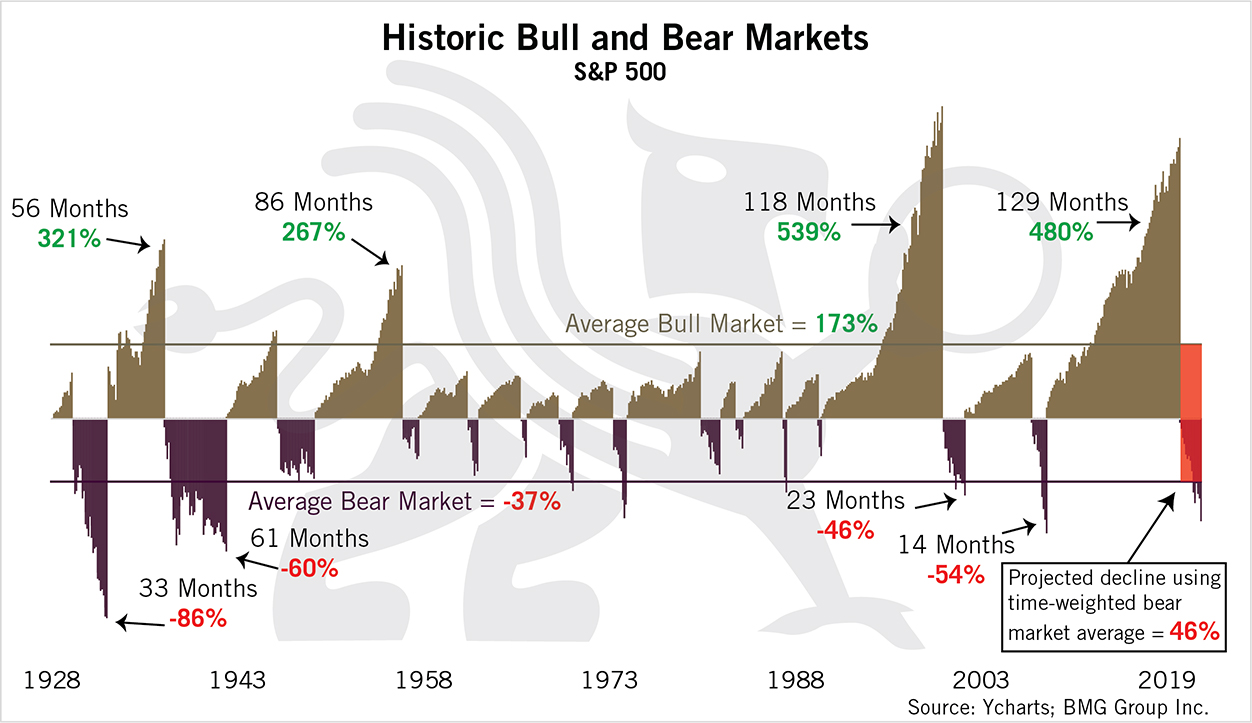
Rather than trying to time the market, beat the market, outsmart the market – the list goes on – I think it’s very helpful to remember that crashes have happened and consequently, they will happen again.

This was a great tweet I found recently – something to remind yourself about when it comes to market history: Continue Reading…

40 years after the stock market died

By Steve Lowrie, CFA

Special to the Financial Independence Hub

Legend has it, 19thcentury humorist Mark Twain once had to refute a rash of rumors swirling in the popular press about his alleged death.  “The report of my death was an exaggeration,” he wryly observed.

What about the stock market: how many times have popular pundits pronounced its demise? Clearly, all such predictions have been dead wrong so far.

One noteworthy example is a Business Week cover story that ran exactly 40 years ago, on August 13, 1979.  Advisor and blogger Barry Ritholtz has reprinted this now-infamous article here, for historical reference.  Its authors bemoaned, “this ‘death of equity’ can no longer be seen as something a stock market rally — however strong — will check. It has persisted for more than 10 years …”

My take:  This article, and plenty of others like it, are textbook examples of financial pornography. As Ritholtz observed in a separate piece, “One day, the world will indeed end.  The sun will run out of hydrogen fuel, turn into a red giant star, and expand until it engulfs the earth.  That is about 5 billion years in the future.  In the meantime, you can safely ignore all other forecasts.”

I couldn’t agree more, at least when it comes to market forecasts. There’s always something causing us to wonder whether the end is near.  A few years ago, it was Greece.  Now there’s trade wars.

Return-dampening concerns

These too shall pass, only to be replaced by new sources of return-dampening concern.  In the meantime, quietly, unexcitedly (and thus often without remark), the markets will almost certainly continue to inch upward over time.

Consider that 40 years is probably most peoples’ investment horizon.  As an exercise, I pulled some returns from various indexes, in Canadian dollars.  Since Business Week pronounced the death of equities, here’s what actually happened:

  • Inflation grew by 3.12% per year; so something that cost you a $1 in 1979 would roughly cost you $3.40 today, or more than three times as much.
  • If you kept your money in Canadian 30-day T-bills (a “risk-free” investment), the annual return was 5.53% per year.  In dollar terms, $1 would have grown to $8.58, or more than twice the inflation rate. As an aside, the vast majority of this return came during the high interest rates of the 1980s.  Since 2009, the return of 30-day T-bills has been lower than inflation by about 1% per year.
  • A basket of diversified global equities returned 9.84% per year; so a $1 investment grew to $42.42.  Put another way that is 42 times more than leaving your money in a mattress, which after reading this article might have seemed like a good idea at that time.  Not a bad return for something that was supposed to be “dead.” Continue Reading…