

Building Wealth
 Posted By
 The importance of diversification
 By Noah Solomon
Special to the Financial Independence Hub
Harry Markowitz, recipient of both the 1990 Nobel Memorial Prize in Economic Sciences and the 1989 John von Neumann Theory Prize, referred to diversification as “the only free lunch in finance.”
As most investors are aware, diversification is an essential element of any well-constructed portfolio. Diversification across different markets and individual securities can lower volatility, mitigate losses in declining markets and produce higher risk-adjusted returns over the long-term.
Easier said than done: the temptation to chase returns
Of course, during times when one asset class or country outperforms for an extended period, this can lead to feelings of regret. Looking in their rear-view mirrors, investors often wish that they had been less diversified and had an overweight position in the outperforming asset class. This regret can result in FOMO (fear of missing out), whereby investors pour capital into those areas of the markets which have been outperforming.
The U.S. stands alone
Since the post-financial crisis market bottom of March 2009, the U.S. stock market has dwarfed those of other markets in terms of performance. U.S. stocks have produced almost double the return of emerging markets stocks, which have been the second-best performer.
| Country | Annualized Return | Cumulative Return |
| U.S. | 15.1% | 381% |
| Emerging Markets | 7.5% | 199% |
| Europe | 6.9% | 189% |
| U.K. | 6.1% | 176% |
| Japan | 5.7% | 170% |
| Canada | 4.9% | 157% |
Sources: MSCI, Factset Research Systems
Unsurprisingly, the outperformance of U.S. stocks, reflected in the table below, indicates that the U.S. market currently stands as the most richly valued market as measured by its cyclically-adjusted Price/Earnings Ratio (CAPE).
| Country | Cyclically Adjusted P/E (CAPE) |
| U.S. | 32.1 |
| Japan | 27.2 |
| Canada | 22.0 |
| Europe | 19.4 |
| U.K. | 16.9 |
| Emerging Markets | 16.4 |
Source: www.starcapital.de
Punished for doing the right thing
The spectacular outperformance of the U.S. stock market means that portfolios that have been heavily concentrated in U.S. stocks have generated considerably higher returns than their more diversified counterparts. In other words, investors who have sacrificed diversification in favour of being overweight U.S. stocks have been handsomely rewarded. Continue Reading…
Using arithmetic to crush closet indexers and fee scalpers

by Jeff Weniger, CFA, WisdomTree Investments
Special to the Financial Independence Hub
What is the profile of a fund that has the odds stacked against it?
For starters, “beta” index trackers that cover market capitalization-weighted indexes such as the S&P 500 may often lag their underlying index because of their fees, even though most of their expense ratios are tiny. Nevertheless, such funds may offer a better prospect than many active managers, who can’t get out of the way of their operating costs.
Another fund manager who is against the wall is the “closet indexer”: the career risk manager. These strategists claim to be coming up with great investments, but when you look under the hood, their holdings look just like their competitors’ funds. Then there is the manager who actually has a lot of unique holdings but high fees.
There is a fourth kind of manager who is not a market capitalization-weighted index strategist, a closet indexer or an expensive active manager. They have truly different holdings at digestible fees and higher active share.
To put this in context, a cap-weighted strategy would target an active share figure of 0% because it is trying to be exactly like the S&P 500, MSCI EAFE or some other major index. A closet indexing strategy may clock in at 30% or 40%. One that is totally different, with no holdings in common with its asset class, would have 100% active share.
Now, put active share in the context of fees: Using simple arithmetic, we can calculate the “hurdle rate” — popularized by Martijn Cremers at Notre Dame — which quantifies how well the active selections need to perform to cover their expense ratios. This really matters in picking a fund or ETF.
Path 1 is the worst. Sadly, trillions still sit in closet index funds that have low active share and high fees. Avoid these: Their existence is only justified if they somehow get past High hurdle rates.
Path 2 isn’t much better. These money managers at least have high active share, so they have the courage of their convictions, but they trip over their high fees. Their hurdle rates are Average.
Path 3 is a different breed, but just as bad as Path 2. These managers have low fees because they got the memo that the jig is up on huge expense ratios. But they are still closet indexing, hoping investors won’t notice their low active share. Their hurdle rates are Average.
Path 4 is hard to find. These are strategies that have both high active share and low fees. Their hurdle rates are Low: the sweet spot. Chances are good that a Path 4 fund is an ETF.
I put this in visual form in figure 1.
Figure 1: Visualizing the Four Paths
Find the Low Hurdle
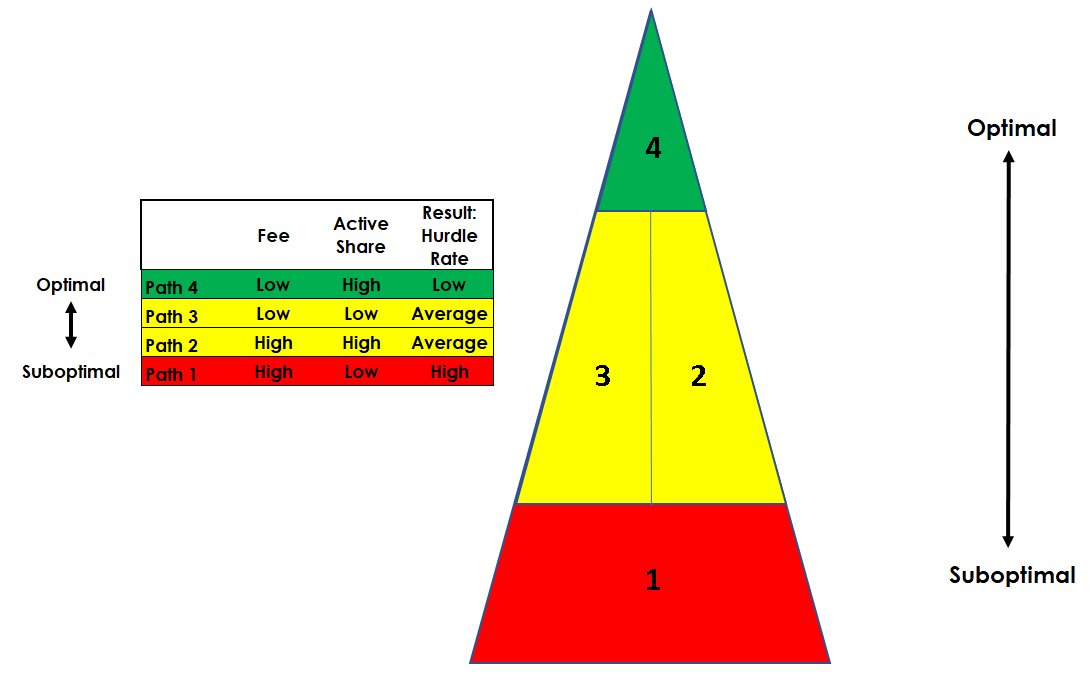
Figure 2 puts numbers to this concept, with hypothetical Path 1, 2 and 3 managers.
Start with the Path 1 closet indexer. It has 35% active share, meaning the other 65% of its holdings are found in the cap-weighted benchmark. It charges 0.80%, so the unique holdings need to outperform by 229 basis points (bps) to match the market’s performance. That figure is found by dividing the expense ratio by the active share. It’s a big hurdle rate. Continue Reading…
Smart ways to divvy up your tax refund
 Posted By
Situation: The income tax refund is a welcome sight for many taxpayers.
My View: Park it temporarily to reflect on its best use before allocating it.
Solution: Evaluate family needs and options that provide lasting benefits.
Income tax filing season is under way once again. Accordingly, I examine some smart ways to apply your tax refund. First, a little trivia:
For what year did Canadians last file a 1-page Federal income tax return?
It was the 1949 tax year.
I think of allocating the income tax refund loosely within these categories. For example, you can spend it, save it, invest it, reduce debt and help others.
Start by parking the refund into a saving account to resist impulse, say for 30 to 60 days. That provides you sufficient time to reflect and evaluate your needs and best options that apply.
Try your utmost to arrange lasting usefulness from this source of cash. Many of the allocations you will make are not reversible.
Everyone can reap benefits from these simple best practices. I summarize some sensible ideas in dealing with tax refunds:
Reduce debt
- Repaying credit card balances are top notch, risk-free allocations.
- Trimming a line of credit, mortgage or student loan is very desirable.
Invest it
- Contributing to the RRSP boosts the retirement nest egg.
- Adding to the TFSA generates tax-free investment income.
Help others
- Donating to a charity of your choice is a noble cause.
- Helping out someone less fortunate than you is generous.
- Making RESP deposits helps pay the rising costs of education.
- Funding the RDSP for a special needs family member is unselfish.
- Lending it at the prescribed rate to the lower tax bracket spouse.
- Assisting an adult child to purchase a vehicle or residence.
Save it
- Leaving it in your saving account is a worthy choice.
- Supplementing your family business capital is worthwhile.
- Adding to your investment plan is productive strategy.
- Improving your career or education fulfills goals and dreams.
- Rebuilding the family emergency account is beneficial.
- Setting funds aside for the next income tax instalment.
Spend it
- Replacing an aging vehicle and appliance helps.
- Paying an outstanding invoice is anxiety off the mind. Continue Reading…
3 Reasons to delay taking CPP until age 70
 Posted By
It might seem counterintuitive to spend down your own retirement savings while at the same time deferring government benefits such as CPP and OAS past age 65. But that’s precisely the type of strategy that can increase your income, save on taxes, and protect against outliving your money.
Here are three reasons to take CPP at age 70:
1.) Enhanced CPP Benefit – Get up to 42 per cent more!
The standard age to take your CPP benefits is at 65, but you can take your retirement pension as early as 60 or as late as age 70. It might sound like a good idea to take CPP as soon as you’re eligible but you should know that by doing so you’ll forfeit 7.2 per cent each year you receive it before age 65.
Indeed, you’ll get up to 36 per cent less CPP if you take it immediately at age 60 rather than waiting until age 65. That alone should give you pause before deciding to take CPP early. What about taking it later?
There’s a strong incentive for deferring your CPP benefits past age 65. You’ll receive 8.4 per cent more each year that you delay taking CPP (up to a maximum of 42 per cent more if you take CPP at age 70). Note there is no incentive to delay taking CPP after age 70.
Let’s show a quick example. The maximum monthly CPP payment one could receive at age 65 (in 2019) is $1,154.58. Most people don’t receive the maximum, however, so we’ll use the average amount for new beneficiaries, which is $664.41 per month. Now let’s convert that to an annual amount for this example = $7,973.
Suppose our retiree decides to take her CPP benefits at the earliest possible time (age 60). That annual amount will get reduced by 36 per cent, from $7,973 to $5,862: a loss of $2,111 per year.
Now suppose she waits until age 70 to take her CPP benefits. Her annual benefits will increase by 42 per cent, giving her a total of $11,322. That’s an increase of $3,349 per year for her lifetime (indexed to inflation).
2.) Save on taxes from mandatory RRSP withdrawals and OAS clawbacks
Mandatory minimum withdrawal schedules are a big bone of contention for retirees when they convert their RRSP to an RRIF. For larger RRIFs, the mandatory withdrawals can trigger OAS clawbacks and give the retiree more income than he or she needs in a given year.
The gradual increase in the percentage withdrawn also does not jive with our belief in the 4 per cent rule, which will help our money last a lifetime.
You can withdraw from an RRSP at anytime, however, and doing so may come in handy for those who retire early (say between age 55-64). That’s because you can begin modest drawdowns of your retirement savings to augment a workplace pension or other savings to tide you over until age 65 or older.
Tax problems and OAS clawbacks occur when all of your retirement income streams collide simultaneously. But with a delayed CPP approach your RRSP will be much smaller by the time you’re forced to convert it to a RRIF and make minimum mandatory withdrawals. Continue Reading…
