Building Wealth

For the first 30 or so years of working, saving and investing, you’ll be first in the mode of getting out of the hole (paying down debt), and then building your net worth (that’s wealth accumulation.). But don’t forget, wealth accumulation isn’t the ultimate goal. Decumulation is! (a separate category here at the Hub).

A growth-by-acquisition strategy could stunt growth of marijuana producers

Cannabis by the Numbers (TSINetwork.ca)

Expanding by acquisition can be risky in any business, but it carries even more risk in a new industry like marijuana production. Buyers could end up with companies whose revenues are completely dwarfed by their outsized market caps.

Many marijuana producers continue to grow quickly by acquisition.

Some are looking to diversify: either from medical marijuana into recreational cannabis, or into new areas like edibles. Most are/were simply looking to grab as much market share as possible before legalization on October 17, 2018. That’s because buying an existing grower is a much faster way to boost output than building a greenhouse from the ground up.

Canadian producers are also looking to expand internationally, including buying marijuana sellers overseas as medical marijuana becomes increasingly legal worldwide.

Higher chance of unpleasant surprises

In general, growth by acquisition is riskier than internal growth for a variety of reasons, but especially because acquisitions carry an above-average chance of unpleasant surprises. The buyer of something rarely knows as much about it as the seller. If a company makes enough acquisitions, it is bound to buy something with hidden problems. Eventually, those problems come out in the open and hurt the buyer’s earnings. Growth by acquisition in unrelated areas is especially risky.

That kind of expansion also tends to load up a company’s balance sheet with goodwill. Generally speaking, “goodwill” is the total price a company has paid for all acquisitions it has made over the years, minus the value of tangible assets that it acquired as part of its acquisitions. Goodwill is an intangible asset whose value can drop overnight if it turns out that the company made a bad acquisition.

The purchases that marijuana producers are making are particularly risky. That’s because they are mostly buying firms with huge market values: but with limited revenues and little chance of making a profit anytime soon.

Pat McKeough has been one of Canada’s most respected investment advisors for over three decades. He is the founder and senior editor of TSI Network and the founder of Successful Investor Wealth Management. He is also the author of several acclaimed investment books. This article was first published on Aug. 22, 2018 and has been republished on the Hub with permission.

Resilience in the face of Market Volatility

By Fritz Gilbert,

Special to the Financial Independence Hub

The market’s been a bit “wobbly” in the past few days, in case you haven’t noticed.

We shouldn’t be surprised, and we shouldn’t worry.

Today, I’ve chosen to talk about market volatility, and how we should think about volatility in terms of our overall retirement plans.

As I write these words, the S&P 500 was down another 2%, on top of a 3.3% decline yesterday.

Down 5% In Two Days.  Yep, that’s volatility.

Here’s the 5-day chart:

Down … down … down.

But, it’s no big deal

Funny thing about markets, they’re volatile.  As Ben Carlson wrote last Friday, the market has averaged a daily drop in excess of 3% three times per yearsince 1928.  So, we should expect “Big Down Days” on a regular basis, even if we haven’t seen too many of them lately.  One interesting note is that 80% of those “Big Down Days” occur during a market correction or bear market.  Makes sense, but it can and does happen during Bull markets, as well.

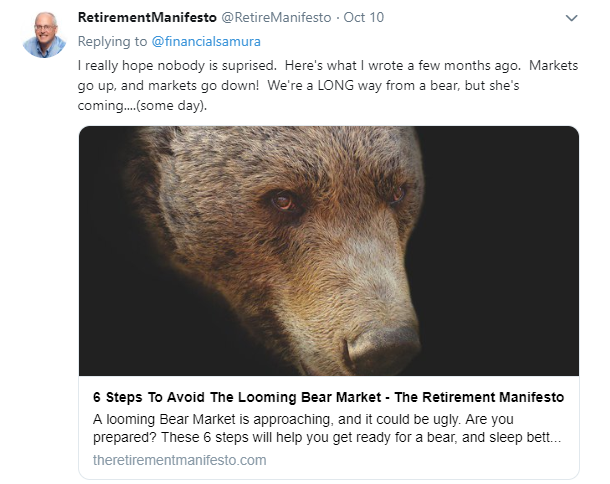
Here’s what I posted on Twitter after the Big Down Days last week:

I’ve no idea where things will go from here. In all honesty, I really don’t care.  I know markets will go up, and markets will go down, and we’d be naive to assume otherwise as we plan for our retirement.  I don’t check the market daily, and I don’t worry about daily volatility.

Markets Go Up, And Markets Go Down. Make sure you prepare for volatility as part of your retirement plan.

Let’s Be Real.  The CAPE ratio continues at abnormal highs, which increases the likelihood of subpar performance over the coming years.  I’m expecting it, and I’ve incorporated it into our retirement withdrawal strategy. As of October 16th, after two consecutive down days of 2%+ declines in the S&P 500, the CAPE ration remains at a level of 30.80, well above historical norms of 16.6, as shown below:

We’re being unrealistic if we expect the market to continue an uninterrupted upward trend, especially in light of today’s high valuations. Volatility is real, so make sure you incorporate it into your retirement plans.

One Day’s Decline = One Year Of Withdrawals

As I thought about the market’s move on October 10, I realized that the 3%+ move was equivalent to an entire year’s Safe Withdrawal Rate, and I sent the following Tweet:

Resilience In The Face of Market Volatility

Rather than worry about the volatility, Be Resilient.  Think about volatility before you retire, and incorporate your strategy for volatility into your retirement planning.

As part of our retirement planning, we have to be realistic to the fact that markets will face volatility.  They always have, and they always will.  It’s the way the world turns, and we’re well advised to plan accordingly.   It’s why I built my Bucket Strategy as my primary plan for Retirement Income, and it’s the reason I really don’t worry as the market ebbs and flows over any given day.  In fact, I don’t even watch the market dynamics on a day-to-day basis.

On a long-term basis, it doesn’t really matter.

I don’t watch the market on a day-to-day basis. I know our Bucket Strategy will cover all but the worst Bear Market. Click To Tweet

Markets will be volatile. 

It’s the nature of The Beast.  Plan for it, and have sufficient funds to absorb a significant market downturn should it happen in the early years of your retirement.

Best to plan for the worst, and hope for the best.

Fritz Gilbert is the Founder of The Retirement Manifesto, a Plutus Award winning blog dedicated to helping people Achieve A Great Retirement.  After 30+ years in Corporate America, most recently as a Commodity Trader, Fritz retired as planned in June 2018 at Age 55.  He and his wife are looking forward to extended travel and “giving back” to their community through charitable work in retirement. This blog was published on his website on Oct. 16, 2018 and is republished here with his permission. 

A great business + great planning = A great Retirement

By Mark Bertoli, IPC Securities Corporation

Special to the Financial Independence Hub

It has been estimated that over the next decade there will be approximately $1 trillion in personal wealth transferred from one generation to the next. A great portion of that wealth is currently tied up in equity within Canadian small businesses. A recent study conducted by IPC Private Wealth, a division of Investment Planning Counsel (IPC) revealed some startling statistics.

A full 42% of business owners are uncertain about their retirement and what is more alarming is that almost half of business owners (48%) do not plan to seek the advice of an advisor. Some of the existing plans of business owners consist of working until they are unable to do so (36%) or exiting when they have enough money (25%). One highlight is that 29% of business owners plan to run their business until their successor is ready.

How to maximize the value of a business

Start with a plan: it is a great strategy to start early. A 10-year plan is a good starting point. Seeking a financial advisor with experience in business transition is a great advantage. This may be the owner’s first business sale but the advisor may have navigated these waters many times and has the advantage of knowledge. The advisor may bring in specific expertise to increase the value of the business. If an advisor – who truly acts as a coach – is brought into the situation, one of the first projects would be to systemize the operation and create a turnkey situation. The business is then far less reliant on the owner and more valuable to a potential buyer or successor. With time on your side, many other strategies may be employed.

A family business or a liquidity event

When selling or transitioning a business, there are several steps that are critical to its future success, as well as the social continuity of the seller, buyer, or heir. Continue Reading…

Artificial Intelligence: Can a machine invest better than a human?

By Chris Nicola

(Sponsor Content)

Wouldn’t it be nice if we could just ask a computer, “what should I invest in?” In theory, sure. But given the current state of artificial intelligence, I wouldn’t bet your money on it just yet. Simpler, tried-and-true analysis tools help us to do this job without putting our client’s money on the line.

Now, you might think AI for investing is inevitable. After all, intelligent people are coming up with new uses for AI all the time. Diagnosing eye problems. Helping corporate boards hire with diversity in mind. We can make art with it, or use it to spot fake art. With self-driving cars, we’re literally putting AI in the driver’s seat. So, why not AI for investing? In fact, it’s already happening — through the “AI Powered Equity ETF (AEIQ), which invests in a variety of U.S.-based companies and seeks to beat the returns of the S&P 500.” The numbers in this report from July show the ETF was up 8 per cent this year, while the S&P 500 has gained about 1.5 per cent YTD.

Who knows what the future could hold for AI’s capabilities? Let’s take a deeper look.

Why I’ve got AI for investing on the brain right now

I recently spoke about AI at The Summit for Asset Management and I realized that the subject of investing using AI would probably also interest many of WealthBar’s own clients. So here’s what I spoke about and some of my thoughts on the role of AI in the future of automated investing.

Who am I? I’m WealthBar’s Co-Founder and Chief Technology Officer. At WealthBar, my team and I design and build our mobile and online experiences for clients. We also decide what technology solutions to use and how to use them.

AI is really cool right now. It gets a lot of attention and I’d be lying if I said I wasn’t excited by the potential. However, I also need to ensure we’re using the right tool for each job. So far, we have not been convinced that AI is the best solution for the kinds of the problems we currently solve for our clients. More importantly, the current understanding of AI today leads to far more questions and concerns than answers. The biggest of these questions is our inability to explain exactly how an AI algorithm learns and why it makes the decisions it does.

AI-powered? Don’t believe the hype

What is AI?

Artificial intelligence can learn without being explicitly programmed. 

That seems like a good definition that I would use, though what we think of when we say AI and what it really means can be two different things.

Some people will think of AI as a general intelligence: basically, a piece of software, machine or robot that thinks like a human, like in so many science fiction movies that have come out in the past few years (I, Robot, Ex Machina, Her, etc). We’re pretty far from that in real life. But for now, we’re using a definition of AI that’s more limited, precise utility — and one that could have some real applications in the investing world.

AI for investing. How does it work? And how could it work?

Right now, we use it to take on specific tasks. In theory, we could ask an AI “what should I invest in?”

Some financial firms are experimenting with this, or they say they are. But scratch the surface. You find that their process is just based around linear regression. They do some math, which has been around since long before computers. Linear regression is a quick and practical tool that the financial industry has been using for as long as there has been a financial industry. Continue Reading…

Motley Fool on Market Cycles: How worried should investors be?

Talk about strange timing! Last weekend, right before this week’s sharp market sell-off, the Motley Fool Money podcast featured an interview with Howard Marks, the influential money manager at Oaktree Capital. Marks has just released his second book, Mastering the Market Cycle, which I promptly bought and downloaded on Kindle and read over the (Canadian) Thanksgiving weekend.

Subtitled Getting the Odds on Your Side, the book is only Marks’s second, following the 2011 publication of The Most important Thing: Uncommon Sense for the Thoughtful Investor. What was clear about the podcast and the book is that Marks felt that the current market cycle is closer to a top than bottom. In fact, late in September Motley Fool Money’s lead podcaster Chris Hill titled a blog “How worried should we be about Howard Marks’ Market Caution Warning?”

Cautious Optimism

Maybe a little, it turns out, although at the time of that podcast Marks’ mood was one of “cautious optimism.” Since then the market seems to have shifted a bit more from optimism to caution. As it happens, Wednesday’s 800-plus plunge in the Dow occurred just two days after I personally started to rebalance our portfolios, partly inspired by my weekend reading, so the new book was quite relevant.

Book publishing being what it is, and with much of it largely written in 2017, Marks doesn’t come right out and declare that the market is near a top; authors tend to be aware that books need to stand up for a few years. However, a quick look at his web-based market commentaries underline his cautious approach. As Hill pointed out in his conversation with Tim Hanson, Marks’ memos may not be quite as well known as Warren Buffett’s, but he nevertheless has a strong following.

At age 72, Marks has seen more than his share of market cycles and claims to have been able to profit from most of the biggies: from the 1999 Tech Wreck to the 2007 Global Financial Crisis. In fact, he’s been around long enough to remember the famous Nifty 50, which were perhaps analogous to today’s mania for FANG stocks. Continue Reading…