Building Wealth

For the first 30 or so years of working, saving and investing, you’ll be first in the mode of getting out of the hole (paying down debt), and then building your net worth (that’s wealth accumulation.). But don’t forget, wealth accumulation isn’t the ultimate goal. Decumulation is! (a separate category here at the Hub).

U.S. Tax Reform: What’s in it for Canadian businesses?

By Dan Lundenberg, BDO Canada LLP

Special to the Financial Independence Hub

For Canadian businesses that have been wanting to explore their prospects south of the border, the United States’ recent tax reforms could provide that impetus to finally make that happen.

In mid-December, the U.S. Congress agreed to aggressively cut its corporate tax rates from a maximum of 35 per cent to 21 per cent.  In addition, the U.S/ reduced its top personal tax rate to 37 per cent and this can be reduced for certain owners of pass-through entities to 29.6 per cent.  These changes open the door for Canadian business owners to invest or set up a shop in the U.S. without fear of higher taxation.

The U.S. tax reform comes on the heels of the Trudeau government’s move to roll out proposed tax changes that would make it more difficult for Canadian businesses to use private corporations to be tax-efficient. After receiving backlash from small business and industry groups, Finance Minister Bill Morneau in October unveiled a gentler tax plan geared to target mainly high-income Canadians.

But still, the revised tax changes would constrain the ability of businesses to implement tax efficient structures through income “sprinkling” with family members. Using small business corporations as a vehicle for making passive investments would also be more cumbersome under proposed changes.

While Canada is making it harder for private corporations to reduce taxes on certain income, the U.S. just widely opened its door to slash taxes for private businesses. In Ontario alone, assuming profits are paid to its shareholders, an integrated top rate of 54 per cent would apply. In the U.S., the tax hit in a pass-through vehicle would only be roughly in the mid-30s, depending on the state where the business is conducted.

Winners and Losers

So, what does this new U.S. tax environment mean for Canada?

Continue Reading…

How to pass on Money values to your kids

By Matt Matheson

Special to the Financial Independence Hub

(Part 2)

When we had kids, both my wife and I discussed how to be intentional about teaching them about money. We’ve read books, articles, and looked at resources online.  We wanted to be sure that they knew what a healthy relationship with money looked like in the areas of faith, family, and work ethic. We wanted them to know what a truly wealthy life looks like.

Our plan to do this was to model handling our money responsibly. And we wanted to give them real-world opportunities where they could begin to make financial decisions on their own, at first in a supported environment, and later on, independently.

With our first child, our daughter Gemma who’s getting ready to turn 5, we’re in stage 1 of teaching her to be a wise manager of her money. She’s being supported, taught and encouraged to make good choices with her money. She’s also being given lots of opportunity to fail with money. Also known as non-catastrophic failure, it is an essential element to learning, and one many kids are being robbed of by overprotective parents.

So how are we doing it? By teaching her the basics of how to give, save and spend…in that order.

Give

Gemma has been on commission for about four months and it’s been going quite well.  Every Saturday she gets paid $1.50 in six quarters. Some people may think that’s cheap, but I prefer frugal. 

My wife decorated three old loose tea containers with fancy wrapping paper and glitter letters to store her bounty.

The first thing we do when she gets paid is put 25₵ in the Give container. As people of faith, we tithe a percentage of our income to our local church and other charities.  We want to instill the value of generosity and gratitude in our children, and so before we’ve spent or saved, this money goes into the Give fund.

Recently, we went out and used her money (she has stockpiled $4) to buy some gifts for an Operation Christmas Child shoebox. Before we went out I showed her a short video and we talked about how some kids don’t have much money, and how we can give to them.  It was awesome to see her picking out the items for the box and growing her giving muscles right before my eyes.

Save

The next place money goes is to her Save container.  It gets three quarters, the most of any jar.  Before she’s touched any cash to spend, this “invisible money” disappears into her saving fund so she doesn’t even miss it.

We want to impress upon her the value of delaying gratification. We want her to experience the joy you get from passing on the temporary good feeling of spending now, for the amazing feeling of satisfaction and self-control you have when you buy something you’ve been saving up for.

Right now, she’s not saving for a car, university, or a down payment on a house.  We’re not that crazy.  She saves for larger purchases that she wants but can’t buy on impulse and that we’re not going to cave in and get her on a whim.

A Teachable Moment

A few weekends ago, she and I were hanging out and she let me know that she had seen a Spirit Riding Free toy that she wanted to buy. (For those who don’t know, it’s a Netflix show, which is pretty solid for little kids. Continue Reading…

3 predictions for the future Retirement landscape

By Sia Hasan

Special to the Financial Independence Hub

Retirement should be a time everyone looks forward to embracing. Theoretically, everything becomes easier in time. A retiree doesn’t need to deal with all the pressures of a stressful full-time job. Days can be spent doing more of the things the retiree enjoys. Such imagery, however, may only reflect the most idealized version of retirement years. Relaxation in retirement remains heavily dependent on how much money has been saved for those golden years.

Saving for retirement has to be about more than just putting a set percentage of income away. Careful thinking and planning are required to make sure retirement assets become adequate enough to cover leisure and necessary expenses. The changing future landscape of retirement further necessitates better planning.

Longer Life Spans and Retirement Savings

Increased life spans definitely impact the way people save for retirement. Thanks to insights into healthier living and great strides in healthcare, a larger percentage of people live much longer. Living to the age of 100 may even be possible for a significant number of people. Better retirement planning definitely works to the benefit of someone who lives a very long life.

Working during early Retirement years

Upon retiring at age 70, maybe it would be wise to look for another job. Working a full-time job might not be necessary, but earning a small stream of income from a part-time job could prove very helpful. $10,000 earned from a part-time job covers $10,000 worth of expenses. Working a part-time job until age 75 leads to $50,000 in income. Earning additional money eliminates the need withdrawing an equitable amount of funds from a savings account or social security deposits.

Money saved may draw more interest and be set aside for use during very elder years. After looking at things from this perspective, making plans for a retirement job becomes an important priority.

Examine Annuity Income

Continue Reading…

Strapped for cash after holidays? How to make the RRSP deadline with no new money

How to beat the March 1st RRSP deadline without having to come up with new money is the subject of my latest MoneySense Retired Money column. You can access it by clicking on the highlighted headline: How to ‘find’ cash for your RRSP contribution.

As with the previous column involving doing the same thing for TFSAs, this involves a tricky procedure known as “transfers-in-kind,” which means you need some investments in your non-registered portfolio to pull it off. There can be tax pitfalls so you need to find investments that haven’t greatly appreciated in value, or find offsetting losers without falling afoul of the CRA’s superficial loss rules.

Seniors in particular likely have a good amount of money sitting in “open” or non-registered investment accounts, which means any securities can be “transferred in kind” to your RRSP, thereby generating the required receipt to generate a tax refund come tax filing time in April.

You don’t have to be a senior of course: any Canadian of any age can transfer-in-kind securities from their open accounts to their RRSPs; it’s just that many younger folks may not have a lot of money housed in non-registered accounts. Most tend to maximize the RRSP first and since 2009, the TFSA.

But beware the RRSP that gets “too big”

Of course, the kind of pre-retirees who read this column may want to consider whether their RRSP might become “too big” and eventually put you in a higher tax bracket once you start to RRIF after age 71. I looked at this “nice problem to have” in an FP column last May.

Continue Reading…

RRSP Strategies for 2018

“When you retire, think and act as if you were stil working. When you’re still working, think and act a bit as if you were already retired.”
— Author Unknown

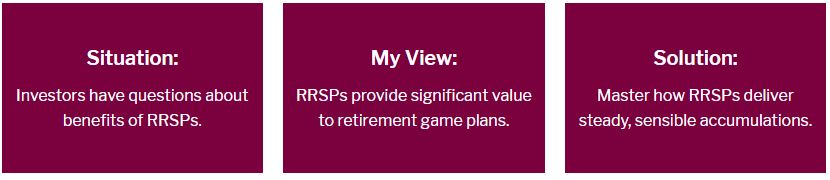
First, a few words about my overall approach: “I recommend growing the RRSP wisely and sensibly over the long haul. It delivers very well during the decades of retirement income needs. My 2018 strategies offer vital RRSP planning ideas for everyone.”

RRSPs have grown substantially, many exceeding values of $500,000 to $1,000,000 for a family unit. Also consider that various investors own the RRSP’s financial cousin, a flavour of the Locked-In Retirement Account (LIRA). Such a plan is typically created when the commuted value of an employer pension is transferred to a locked-in account. LIRA values can easily range from $200,000 to $400,000. Although, RRSP deposits cannot be made to a LIRA, the account needs to be invested alongside the rest of the nest egg.

Clear understanding of the RRSP regime is essential to guide the multi-year planning marathon.

RRSPs really fit two camps of investors like a glove: those without employer pension plans and the self-employed.

Some investors still shun RRSP deposits. However, my top reason for pursuing the RRSP continues to be long-term, tax-deferred investment growth. It means no income tax is paid until draws are made from the RRSP. This allows the plan to grow for years, often decades.

Stay focused on how the RRSP fits into your total game plan. The power of tax-deferred compounding really delivers. Keep your RRSP mission simple and treat it as a building block. Take every step that improves the money outlasting the family requirements.

I summarize the vital RRSP planning areas:

1.) Closing 2017

Your 2017 RRSP limit is 18% of your 2016 “earned income”, to a maximum of $26,010. This sum is reduced by your pension adjustment from the 2016 employment slip. The allowable RRSP contribution room includes carry-forwards from previous years.

RRSP deposits made by March 01, 2018 can be deducted in your 2017 income tax filing. There is no reason to wait until the last minute where funds are available. Your 2016 Canada Revenue notice of assessment (NOA) outlines the 2017 RRSP room. Continue Reading…