
Building Wealth

For the first 30 or so years of working, saving and investing, you’ll be first in the mode of getting out of the hole (paying down debt), and then building your net worth (that’s wealth accumulation.). But don’t forget, wealth accumulation isn’t the ultimate goal. Decumulation is! (a separate category here at the Hub).

Two notable books to guide your ‘Retirement’ journey

“Books are the bees which carry the quickening pollen from one to another mind.” — James Russell Lowell, poet and author

This week I highlight one of my best recommendations for Retirement. Invest in self-education with some quality reading. The critical factor is how to select just a couple of books.

Investors have a thirst for knowledge about their precious retirement journey. They seek detailed information to assist in navigating the capital accumulation process to achieve retirement. Then comes the desire of making that capital outlast the spending phase.

Walk into any well-stocked bookstore and the retirement section will seem like a maze. There are plenty of titles competing to become permanent occupants of your precious bookshelf space.

My two book selections provide insight and understanding into the design and management of the retirement nest egg. The authors are well known. The books complement one another.
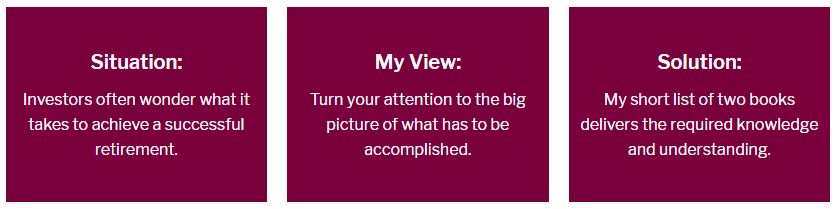
The emphasis is understanding long-term principles, policies and best practices that steer the family’s retirement goals from dreams to realities. Getting fully acquainted with these two books helps craft better decisions about retirement. Something for everyone’s retirement toolbox.
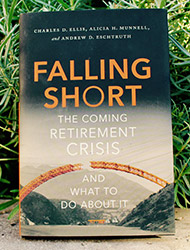
Photo: Kia Meiklejohn

Falling Short: The Coming Retirement Crisis and What To Do About It, by Charles D. Ellis, Alicia H. Munnel, and Andrew D. Eschtruth

This century has clearly shown that we are living longer, health costs are rising and employer pensions are diminishing. That is the big picture applicable to retirees in the USA. However, similar arguments also exist for the Canadian retirement landscape.

The good news is that what is seemingly a dire retirement situation can be easily rectified by implementing a few coordinated steps. This book makes you appreciate the scope of that big picture. Working a little longer, saving a bit more, judicious use of government benefits and being smart about portfolio draws are some of the key answers that deliver.

The message for every retiree is that a successful retirement is about being empowered to look after the personal situation. At age 60, it is not unusual for retirement to last into the 90’s for at least one spouse.

Yes, long term retirement that spans decades is expensive. Sensible and methodical decision making is sound advice for all ages. It renders the scope of the big picture into realistic solutions.

Paycheque to paycheque: the fate of half of Canada’s employees

Living paycheque to paycheque? You’re hardly alone. As my latest Financial Post blog reprises today, almost half of Canadian workers (47%) told the Canadian Payroll Association’s 2017 survey that they’d find it hard to meet their financial obligations if their pay cheque were delayed by even a single week.

You can find the full blog by clicking on the highlighted headline here: Nearly half of Canadians would face a financial crunch if paycheque delayed by even a week, survey shows. The  article also appears in the Thursday print edition, page FP5, under the headline Nearly half of Canadians walk financial tightrope.

As I point out at the end of the FP piece, there’s some irony in that the way out of this savings conundrum is to make an effort to save paycheque by paycheque: a strategy the CPA and other financial experts generally term “Pay Yourself First.”

That means using your financial institution’s pre-authorized chequing arrangements (PACs) to automatically divert 10% of net pay into savings the moment a paycheque hits your bank account. Just like income taxes taken off “at source,” the idea is that you won’t miss what you don’t actually receive.

Pay Yourself First

Continue Reading…

4 small-cap Tech Stocks to watch

By Sia Hasan

Special to the Financial Independence Hub

The small-cap technology stock sector is fascinating in that it’s comprised of companies that have the potential to grow fast. Small caps are considered riskier than large- or mid-caps, and this means they have a higher potential for making huge profits for investors.

However, this is not to say that you should invest in small-cap tech stocks blindly. With a little due diligence, you can accurately determine the winning companies that can overcome the risks to move higher and give you lucrative returns. Here are some of the top small-cap stocks that are already excelling in the stock market, and which you might consider for investment.

Oclaro Inc. (OCLR, Nasdaq)

Oclaro Inc. is an optical networking company that’s a serious player in optical networking for high-speed global networks. The company offers transmission products and modules to telecom firms, enterprise networks, and data centers. While OCLR is a small-cap company, it is in competition with some of the biggest players in networking, such as Cisco Systems. However, OCLR focuses on core markets and high-speed components, and this has given it the cutting edge in the industry.

The company has shown great potential for growth, especially after establishing a solid position in China. OCLR aims at modernizing and upgrading its computing and telecom speeds, an indication of impending growth for the company. This great potential makes it an ideal company to invest in as its stocks are bound to generate even better returns in the years to come.

Celestica Inc. (CLS, NYSE)

Celestica Inc. is a popular company in the electronic manufacturing services (EMS) industry. Based in Canada, it provides a broad range of products such as wireless networking, telecommunication equipment, smartphones, storage devices, and printer supplies to original equipment manufacturers. The company has consolidated its services, allowing clients to purchase various products from them. This gives Celestica the upper hand in the industry in case of instances of market contraction in the EMS industry.

In the past few years, Celestica has begun to focus more on becoming a niche market provider rather than on the consumer market. This is because a significant proportion of its revenue comes from industrial companies. Management projects that the net profit margin will continue to grow from the current 2.18 per cent, making the company an excellent choice for some investors.

Zillow Group (Z, Nasdaq)

Zillow Group is a small-cap company that operates one of the largest a real estate informational websites and a mobile phone application. Continue Reading…

Blending families and assets: How to make it easy

By Rowena Chan, TD Wealth

Special to the Financial Independence Hub

Finances can become challenging when adding — or removing — a new partner, stepchild or extended family member into a household. The instances of blended or multigenerational families are becoming more and more common in Canada as the number of multigenerational families has grown in the last 15 years – rising 37.5 per cent. In addition, 12.3% of families in Canada are stepfamilies, according to recently-released 2016 Canada Census data.

A recent TD survey found 66% of Canadians living in a blended family say they face financial challenges because of their household situation. Additionally, 47% find juggling these challenges stressful. The top three financial challenges they faced are determining who pays for ongoing household expenses (25%), having different views on managing the household budget (23%) and determining household saving priorities (21%). Take a look at this infographic here for more survey findings, tips and advice.

No matter your family situation, money matters can get tricky. To guide you through the process, there are some simple steps blended families can implement to help create a more stable financial future for everyone involved. Continue Reading…

How Modi is accelerating India’s growth

India Prime Minister Shri Narendra Modi chairing the ICT-based, multi-modal platform for Pro-Active Governance and Timely Implementation, in New Delhi on July 12, 2017.

By Caroline Grimont

(Sponsor Content)

The Narendra Modi government has made enormous strides in transforming project execution in India, enhancing the momentum of country’s growth.

Modi’s success is largely premised on his principle of “Minimum Government, Maximum Governance,” which has been the Prime Minister’s mantra for transforming project execution in India.[i]

Shortly after assuming power, Modi announced that India’s government systems suffered from two weaknesses: “They are complex. And they are slow.” He noted that this had to be changed and that government systems must be sharp, effective, fast and flexible.[ii]

Government has no business being in business

To do this, India needed a policy-driven state, with simplified processes in which the government needed to focus upon the things that are required of the state, which must in turn deliver on the things it sets out to do. He emphasized that government “has no business to be in business” and must instead focus on policy formulation and execution.” [iii]

Modi also noted that in 20 years of liberalization the government has not changed “its command-and-control mindset,”[iv] which is exactly what he set out to do in transforming project execution in India.

An earlier McKinsey report identified what Modi referred to. It stated: “Inefficiencies in implementing infrastructure projects in India occur at all stages. This includes awarding projects as per plan targets, securing financial closure, and executing projects within cost and time.”[v]

Cutting through red tape

In accelerating project execution Modi has personally taken on India’s notorious red tape to clear tens of billions of dollars in stalled public projects, hoping that his hands-on intervention can bend a vast, dysfunctional bureaucracy.

He has focused on improving governance and introducing changes to legislations, rules and procedures wherever necessary to make processes more efficient; and cut down on multiple clearances those choke investment.

To keep track of project execution Modi holds a meeting with top state and central bureaucrats once a month, to check why projects have not got off the ground: leading to the revival of tens of billion dollars in value of central government and state projects in a wide range of areas.[vi]

Central and state bureaucrats are linked by video to Modi’s office for the meeting, usually held on the fourth Wednesday of each month. They are typically from the finance, law, land, environment, transport and energy ministries whose clearances are needed for many projects. [vii]

The agenda is set the previous week and usually has about a dozen stalled projects, public grievances and other governance issues.

By empowering government officials to execute on project implementation and managing the process on a monthly basis, Modi has effectively been able to remove the policy paralysis that has plagued India for decades.

“Modi has won plaudits for the initiative that has chipped away at a $150 billion backlog of planned roads, ports, railways, power stations and other projects.”[viii]

He has also taken major steps to eliminate corruption and transparency that have in the past paralyzed project execution. Continue Reading…