For the first 30 or so years of working, saving and investing, you’ll be first in the mode of getting out of the hole (paying down debt), and then building your net worth (that’s wealth accumulation.). But don’t forget, wealth accumulation isn’t the ultimate goal. Decumulation is! (a separate category here at the Hub).
One of the core tenets of financial planning is to pay yourself first. Automating your savings is a painless way to save for retirement and, in all likelihood, you’ll barely notice that you’re living on less.
Most experts suggest putting away 10 per cent of your income for retirement, but that number might seem out of reach for many people today. The key to developing good savings habits, however, is that you need to start somewhere.
That’s why I suggest setting aside what you can afford, be it three or five per cent of your income, and try to increase that amount every year.
At last count, over 6 million Canadians are part of a registered pension plan. Unless you are one of the truly lucky few who have a defined benefit (DB) pension plan, you’re likely part of a defined contribution (DC) pension plan – which means you need to be a bit more proactive if you hope to reach your retirement goals.
A DB pension plan is what comes to mind when most people think of a pension. It pays you an income stream in retirement. A DC pension plan is more like an RRSP. You save to the plan, but do not know what the end result will be at retirement. Even though your plan may be a DC instead of a DB, with proper planning you can take advantage of this benefit and be a step ahead on the path to retirement.
Step One: Asset Mix
Your asset mix is the combination of equities, fixed income and cash that you hold in your account. What percentage you allocate to each area will have a significant impact on the long term performance of your portfolio and the volatility you experience while investing.
Generally speaking, when you are more than 10 years away from retirement, a growth mix of 75% equities and 25% fixed income is appropriate. Once you are closer than the 10-year mark, a shift to a balanced mix of 60% equities and 40% fixed income would be more suitable. In all cases, your equities should be diversified geographically with an equal allocation to Canada, the U.S. and international markets.
In our last piece, we described why most investors should ignore the never-ending onslaught of unpredictable financial news and tend to three strategies that can be much more readily managed – at least once you know they are there. Hidden in plain sight, these potent strategies include:
Being there
Managing for market risks
Controlling costs
Plain-Sight Strategy #2: Managing for Market Risks
Don’t take on more risk than you must.
There’s no getting around the fact the market does not deliver rewarding returns without periodically punishing us with realized risks. That’s why it’s so challenging for most investors to “be there,” consistently capturing available returns by remaining invested over time. It’s also why it’s vital to avoid taking on more risk than you must in pursuit of your personal goals. For this, we have two powerful tools at our disposal, best used in tandem: Continue Reading…
While stocks are viewed by most of the financial industry as the main ingredient for creating wealth, it’s well known that the price for higher expected returns is higher risk. The paradox is that in order to increase the odds of creating greater wealth, you have to be willing to lose some wealth at least in the short term.
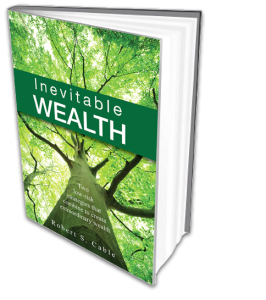
All of which makes Robert S. Cable’s newly published book (his second) of more than theoretical interest. Inevitable Wealth bears the subtitle Two low-risk strategies that combine to create extraordinary wealth.
We have touched on this book and its belief in the long-term power of equities in a recent review I did at the Financial Post, where I compared Inevitable Wealth to David Trahair’s Enough Bull. You can also find guest blogs by both authors here at the Hub, where the pair make the cases for mostly stocks in the first case, and mostly fixed income (i.e. GICs) in the second.
I had read both books earlier in the summer, well before the extreme market volatility of late August. Ironically, both books would have helped you preserve capital, depending on how you implemented the suggestions: Continue Reading…
Last month, we explored Jim Collins’ “Good to Great” suggestion that we would be well served by having a STOP-Doing List to pair with our To-Do Lists.
For starters, we advised investors to STOP reacting to market noise and start heeding the long-term evidence. Another worthy addition to your financial STOP-Doing List is to stop picking active money managers (or hiring someone else to try to do this for you).
As a reminder, my definition of an active money manager is someone who is engaging in some form of forecasting, whether it be picking stocks, timing markets or a combination of both.
Predicting the Unknowable
In our personal and financial lives alike, we worry about so many things that we cannot control. One of the greatest of these things is the future. When speaking with investors about the dangers of trying to accurately forecast the market’s or a stock’s pricing moves, many can accept that it’s difficult to succeed on their own. But the next leap is harder to make. Most investors want to believe that, while they may not personally have the time, energy or expertise to beat the market, they can still turn to well-heeled professional managers to do the forecasting for them.
Financial Services Attracts the Best and Brightest
In most pursuits in life, more practice and more experience makes perfect. So if someone is really good at some occupation or trade, it’s a safe assumption to assume he or she will continue to be good at it in the future.


 Posted By
  By Robb Engen, Boomer & Echo
 Posted By


 Posted By