For the first 30 or so years of working, saving and investing, you’ll be first in the mode of getting out of the hole (paying down debt), and then building your net worth (that’s wealth accumulation.). But don’t forget, wealth accumulation isn’t the ultimate goal. Decumulation is! (a separate category here at the Hub).
The all-virtual summit, now in its 7th year, features more than 35 speakers, including Yours Truly, as well as several other financial commentators pictured to the left: Ellen Roseman, Rob Carrick, Preet Banerjee, Ed Rempel, Lisa Hannam and many more.
Other familiar names that will be familiar to Hub readers include Dale Roberts, Jason Heath, Robb Engen, Kornel Szrejber and Barry Choi.
Here are some of the topics:
How to plan your own retirement at any age
How to save money on taxes by optimizing your RRSP to RRIF transition
Get Into Your First House with the New FHSA (First Time Home Savings Account)
Retirement Decumulation Strategies
Adjusting to the World of High Interest Rates
Using Annuities and Equities to Create a Retirement Paycheque
The Pension Paradox: Lump Sum vs Cash for Life
Plan your personalized combination of a DIY portfolio alongside an annuity for a customized stream of retirement asset growth + monthly income.
What Canadian real estate investments looks like in 2023
How to deal with inflation on your bills and in your investment portfolio
The best Canadian personal finance books of all time! (That’s my topic).
When to take your OAS and CPP
Travel for free with Canada’s loyalty rewards programs
The founder of the Summit is Kyle Prevost (pictured right), who is also a writer at Million Dollar Journey, and writes the weekly MoneySense Making Sense of the Markets column, among other things.
Kyle also is the creator of a multi-media course titled 4 Steps to a Worry-Free Retirement, which I’ll be featuring in my next MoneySense Retired Money column.
The All-Access pass costs $89 if you act quickly enough. Plus, there’s a no questions asked money-back guarantee for those who change their mind.
Prevost will be sending email updates most of the week. Here’s what Monday’s said (in part):
Every day, there are many companies experiencing significant price drops. There is a section on Yahoo Finance called “Day Losers” where the biggest losers of the day are highlighted.
Are those good buying opportunities?
Maybe.
All of our favorite Blue Chip stocks have been part of this list. Some of those stocks have recovered, while others continued their downward slide. The truth is that we never know for sure which stock will recover and which one will just disappear. Remember Nortel, Nokia, Kodak, BlackBerry, Blockbuster, RadioShack, Toys R Us? These were stock market leaders that never recovered.
On the other hand, for those investors who have bought the U.S. or Canadian index, they have always seen their money coming back after any major drop.
Instead of discussing the pros and cons of buying any individual stock, I think we should look at the big picture and talk about the difference between buying a basket of individual stocks when they are down versus buying the index.
The main difference between buying any individual stock and buying the index when they both go down is that, up until now, the index has always bounced back, while some of the blue-chip stocks that we have learned to love/trust might never recuperate. Kodak, Blockbuster and Nokia never recuperated. They slowly declined into the graveyard of market history.
Why? Because, unlike individual stocks, the S&P 500 is always changing.
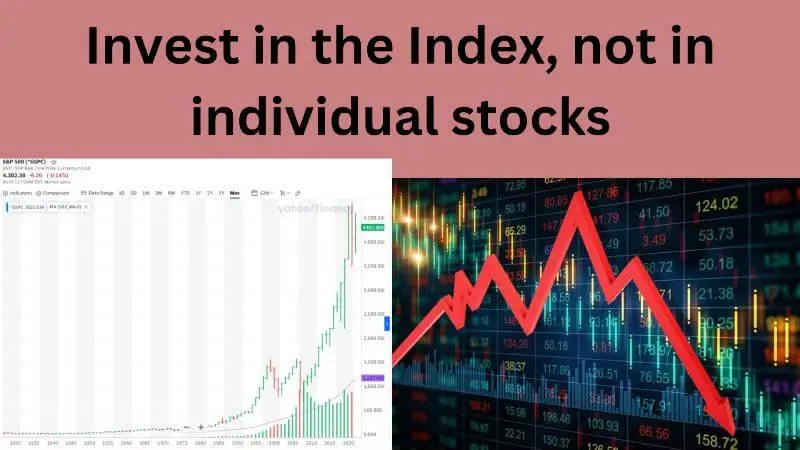
S&P 500 from 1927 to 2023 from 20 to 4,090; a 17,620% gain.
Looking at this graph, you might think that you could have invested $20 in the most popular stocks of 1927 and just waited to get rich. But it doesn’t work out that way. The companies that represented U.S. stocks in 1927 are very different from the companies that represent U.S. stocks in 2023. Most of the original companies composing the S&P 500 no longer exist, but the S&P is still going strong.
Regardless of how quickly companies are moving in and out of the index, you can see that owning an index is fundamentally different from owning a basket of individual stocks. While your basket of individual stocks might remain the same over time, the index will not.
There are many benefits provided to index investors.
We get the highest returns and pay the lowest fees. Hundreds of analysts go on a hunt for the best stocks; they spend their time, money, and energy crunching numbers, buying the stocks that are going up and selling the stocks that are going down, and we get to reap the rewards.
According to the SPIVA Report, the S&P 500 index has outperformed 92% of money manager professional over the past 15 years, and the cost to us is usually 0.05%/year. There is no better deal in town.
Alain Guillot is a part time event photographer, part time Salsa teacher, and part time personal finance blogger. He came to Quebec as an immigrant from Colombia. Due to his mediocre French he was never able to find a suitable job, so he opened a Salsa/Tango dance school and started his entrepreneurship journey. Entrepreneurship got him started into personal finance and eventually into blogging. Now he lives a Lean FIRE lifestyle and shares his thoughts in his blog AlainGuillot.com. This blog originally appeared on his blog on Oct. 9, 2023 and is republished here with permission.
This month, I explore how the relationship between risk and return forms the bedrock of sound (or poor) investment results. I will also demonstrate why the management of these two elements constitutes the essence of adding or destroying value for investors. Lastly, (reader beware), I include a rant about investor complacency and the detrimental effects it can have on one’s wealth.
Good is Not the Enemy of Great: It is Great
David VanBenschoten was the head of the General Mills pension fund. In each of his 14 years in this role, the fund’s return had never ranked above the 27th percentile or below the 47th percentile.
Using simple math, one might assume that over the entire period the fund would have stood in the 37th percentile, which is the midpoint of its lowest and highest ranks. However, despite never knocking the lights out in any given year, VanBenschoten managed to achieve top-tier results over the entire period. By consistently attaining 2nd quartile performance in each and every year, over the 14-year period the fund achieved an enviable 4th percentile ranking.
The Hippocratic Oath and Investing
The seemingly irreconcilable difference between the average of VanBenschoten’s rankings and his overall rank over the whole 14-year period stems as much from the performance of other funds as from his own results.
To achieve outstanding performance, one must deviate from the crowd. However, doing so is a proverbial double-edged sword, as it can lead to vastly superior or inferior results. The preceding rankings indicate that most of the managers who were at the top of the pack in some years also had a commensurate tendency to be near the bottom in others, thereby tarnishing their overall rankings over the entire period.
In contrast, the General Mills pension fund, by being consistently warm rather than intermittently hot or cold, managed to outperform most of its peers. Managers who aim for top decile performance often end up shooting themselves in the foot. The moral of the story is that when it comes to producing superior results over the long term, consistently avoiding underperformance tends to be more important than occasionally achieving outperformance. In this vein, managers should take the physicians’ Hippocratic Oath and pledge to “first do no harm.”
Robbing Peter to Pay Paul: The Bright and Dark Sides of Asymmetry
The Latin term Sine Que Non describes an action that is essential and indispensable. In the world of investing, the ability to produce asymmetrical results meets this definition. It is the ultimate determinant of skill.
A manager who delivers twice the returns of their benchmark but has also experienced twice the volatility neither creates nor destroys value. They have simply robbed Peter (higher volatility) to pay Paul (commensurately higher returns). Since markets tend to go up over time, clients may marvel at the manager’s superior long-term returns. However, this does not change the fact that no value has been created – clients have merely paid in full for higher returns in the form of higher volatility.
If this same manager delivered 1.5 times the benchmark returns while experiencing twice the volatility, not only would they have failed to add value but would have destroyed it – they would have simply robbed Peter by exposing him to higher volatility while paying Paul less in the form of excess returns. In contrast, if the manager had produced twice the returns of the benchmark while experiencing only 1.5 times its volatility, then they deserve a firm pat on the back. They would have achieved asymmetrically positive results by paying Paul far more in outperformance than what they stole from Peter in higher volatility.
The Efficient Market Hypothesis: Why bother?
The efficient-market hypothesis (EMH) states that asset prices reflect all available information, causing securities to always be priced correctly and making markets efficient. By extension, the EMH asserts that you cannot achieve higher returns without assuming a commensurate amount of incremental risk, nor can you reduce risk without sacrificing a commensurate amount of return. It argues that it is impossible to consistently “beat the market” on a risk-adjusted basis. When applied to the decision to hire an active manager rather than a passive index fund, the EMH can be neatly summarized as “why bother?”
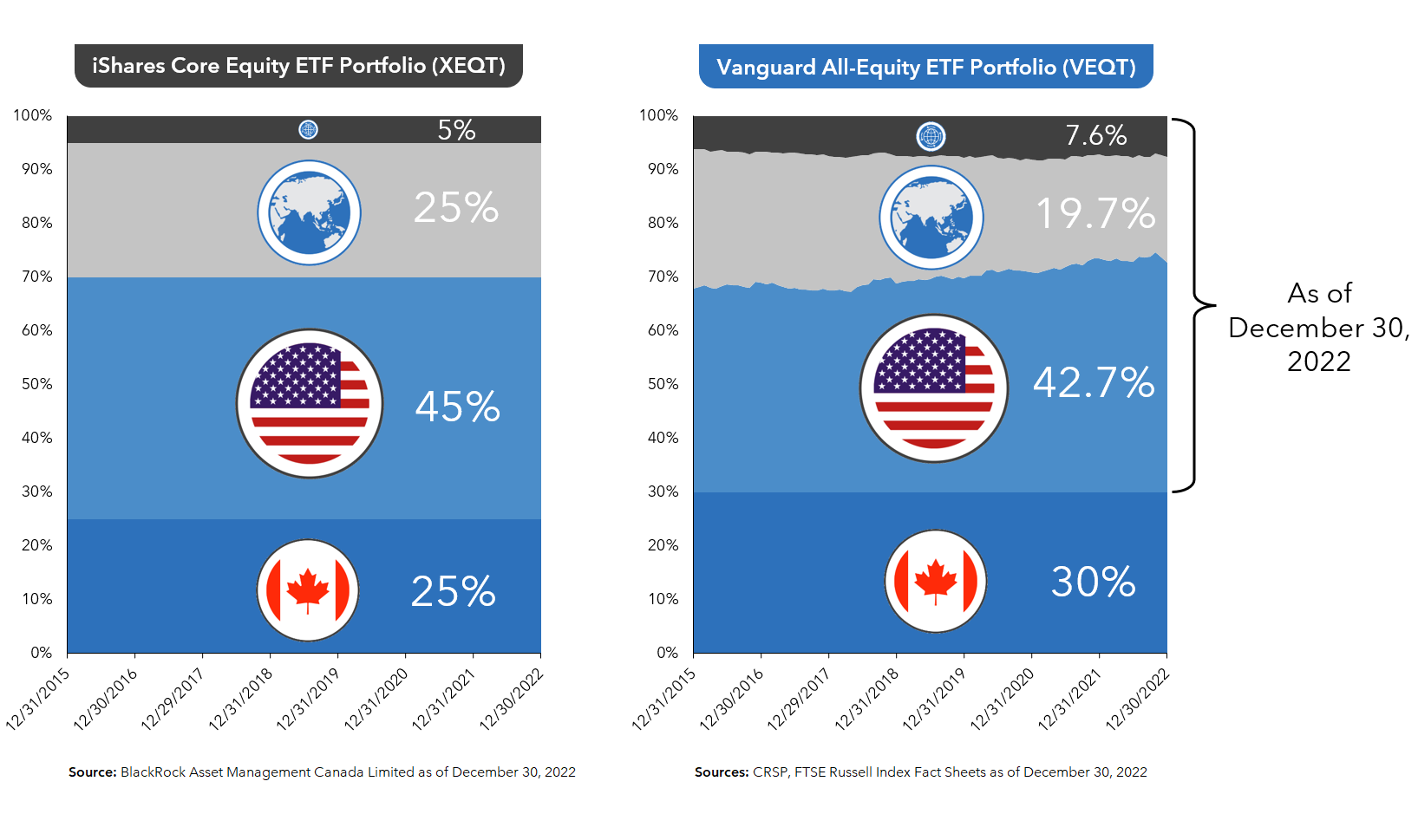
The 100% equity ETFs from iShares and Vanguard/Canadian Portfolio Manager
By Mark Seed, myownadvisor
Special to Financial Independence Hub
A reader recently asked me the following based on reading a few pages on my site:
Mark, does it make sense to have 100% of your portfolio in stocks? If so, at what age would you personally dial-back to own more cash or GICs or bonds? Thanks for your answer.
Great question. Love it. Let’s unpack that for us.
Members of Gen Z, which now includes the youngest adults able to invest (born in the late-1990s and early-2000s), represent a cohort that could be investing in the stock market for another 60 more years.
According to a chart I found on Ben Carlson’s site about stuff that might happen in 2023, over 60+ investing years in the S&P 500 (as an example) historical indexing performance would suggest you’d have a better chance of earning 20% returns or more in any given year than suffering an indexing loss. Pretty wild.
Source: A Wealth of Common Sense.
Shown another way as of early 2023:
Source: https://www.slickcharts.com
This implies younger investors, in my opinion, should at least consider going all-in on equities to take advantage of long-term stock market return power when they are younger given:
As you age, your human capital diminishes – your portfolio (beyond your home?) can become your greatest asset.
Younger investors can also benefit from asset accumulation from periodic price corrections – adding more assets in a bear market; allowing assets to further compound at lower prices when corrections or crashes occur (i.e., buying stocks on sale).
Things appear to be looking up for members of Defined Benefit [DB] pension plans in Canada, despite inflation and rising fears of a looming recession.
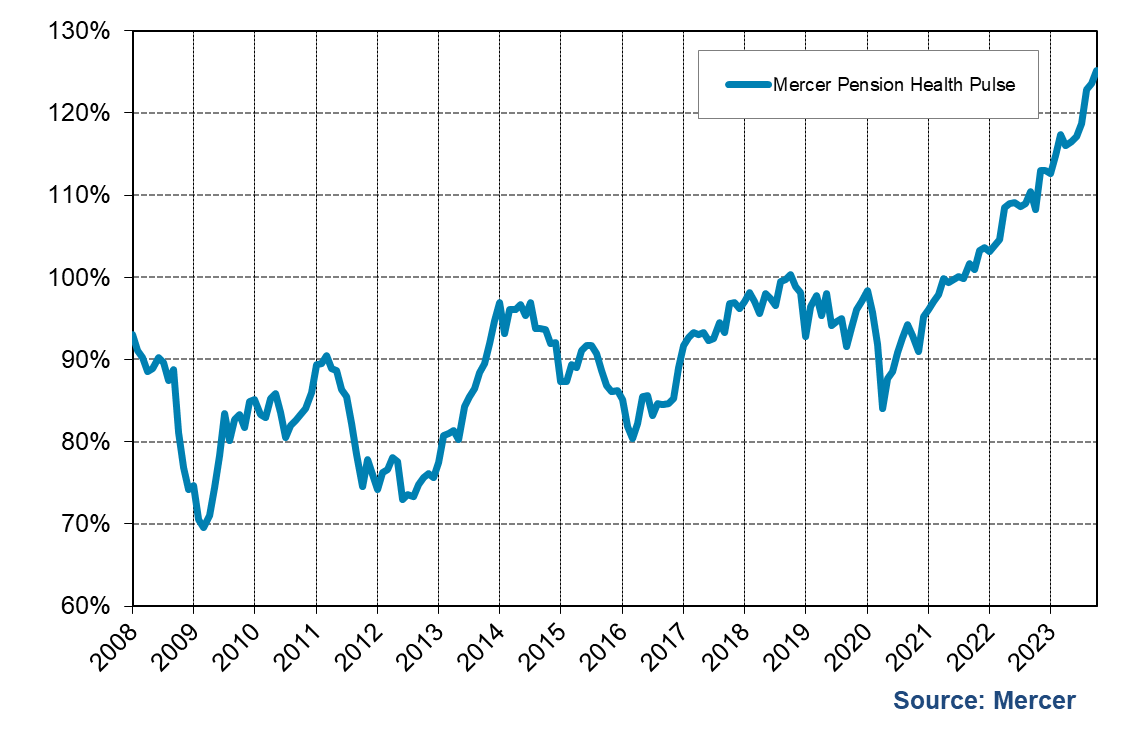
In the third quarter, Canadian defined benefit (DB) pension plans continued to improve, according to the Mercer Pension Health Pulse (MPHP), released on Monday.
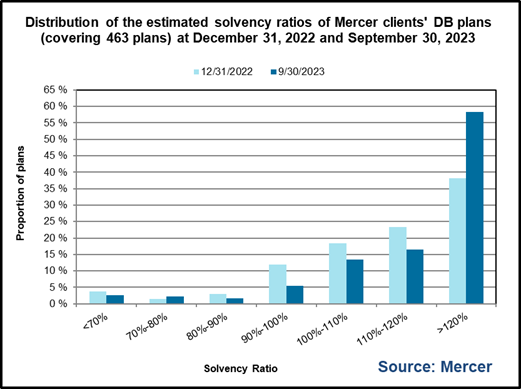
The MPHP, which tracks the median solvency ratio of DB pension plans in Mercer’s pension database, finished the third quarter at 125%, up from 119% last quarter. At the beginning of the year, the MPHP was at 113%, as shown in the chart above left.
This strengthening appears somewhat counterintuitive, as pension fund asset returns were mostly negative in the quarter, Mercer said in a news release. Over the quarter, bond yields increased, which decreases DB liabilities. This decrease, along with a fall in the estimated cost of buying annuities, “more than offset the effect of negative asset returns, leading to stronger overall funded positions.”
Plans that use leverage in the fixed-income component of their assets will not have seen this type of improvement, it added.
Of plans in its database, at the end of the third quarter 88% were estimated by Mercer to be in surplus positions on a solvency basis (vs. 85% at the end of Q2). About 5% are estimated to have solvency ratios between 90% and 100%, 2% have solvency ratios between 80% and 90%, and 5% are estimated to have solvency ratios less than 80%.
Ben Ukonga
“2023 so far has been good for DB pension plans’ financial positions,” said Ben Ukonga, Principal and leader of Mercer’s Wealth practice in Calgary [pictured on right],” “However, as we enter the fourth quarter, will the good news continue to the end of the year?”
The global economy is still on shaky grounds, Mercer says. “A recession is not completely off the table, despite continued low unemployment rates. Inflation remains high, potentially back on the rise, and outside central banks’ target ranges.”
Geopolitical tensions also remain high, reducing global trade and trust and fragmenting global supply chains – which further reduces global trade. And the war in Ukraine “shows no sign of ending – adding economic uncertainty atop a geo-political and humanitarian crisis.”
Mercer also questions whether recent labour disruptions at U.S. auto manufacturers will be resolved quickly, with Canadian workers expecting large wage increases, leading to further inflationary pressures.
Interest rates may stay at high levels
Mercer also worries that central banks globally may continue to keep benchmark interest rates at elevated levels.
“Given the delayed effect of the impact of interest rate changes on economies, care will be needed by central banks to ensure their adjustments (and quantitative tightening) do not tip the global economy into a deep recession, as the full effects of these actions will not be known immediately. As many market observers now believe, the amount of quantitative easing during the COVID-19 pandemic was more than was needed.”
Most Canadian DB pensions are in favourable financial positions, with many plans in surplus positions, the release says: “Sponsors who filed 2022 year-end valuations will have locked in their contribution requirements for the next few years, with many being in contribution holiday territory (for the first time in a long time).”
That said, it added, DB plan sponsors should not be complacent: “Markets can be volatile, and given that plans are in surplus positions, now more than ever is the time for action, such as de-risking, pension risk transfers, etc. These actions can now be done at little or no cost to the sponsor.”
Mercer also said DB plan sponsors should “remain cognizant of the passing of Bill C-228, which grants pension plan deficits super priority over other secured creditors during bankruptcy and insolvency proceedings.” Continue Reading…


 Posted By
 The founder of the Summit is Kyle Prevost (pictured right), who is also a writer at Million Dollar Journey, and writes the weekly MoneySense Making Sense of the Markets column, among other things.
 Posted By