Tag Archives: bonds

What a market decline looks like for a balanced investor


By Scott Ronalds

Special to the Financial Independence Hub

EDITOR’S NOTE: This blog was first published on the Steadyhand site in January and is being rerun today to provide some insights into this week’s severe market downturn.

I have no greater insights than you do on what the markets might do over the next several months. But it’s been a while since we’ve had any kind of meaningful pullback in stocks and we’re due at some point. It may not happen next quarter, next year or even this decade. But as I noted in my last post, declines and bear markets are a normal part of investing. Are you prepared?

I find the best way to test yourself is with real money. Let’s say you’re a balanced investor and your portfolio is worth $400,000, all invested in the Founders Fund. A modest decline in the markets might see the fund fall 3-4% over a few months. This doesn’t sound like much. Put it in dollar terms though, and it takes on a different meaning. $12,000 to $16,000 sounds much greater – and feels much worse – than 3-4%. Still, no big deal considering the gains you’ve likely seen over the last few years.

Now assume markets experience a sharper decline and the fund drops 6% over 6 months. Your portfolio is now down $24,000. What would you do?

Would you really sit tight if things got worse?

Let’s turn it up a notch. Investors have soured on stocks and markets are under severe pressure. We’re officially in bear market territory with stocks down over 20% and the fund is hypothetically down 12% over 10 months (the fixed income component is providing ballast). That’s $48,000. The media and financial pundits are calling for further losses. Your neighbour’s bragging about how he moved to cash a year ago and is telling you to get out of the market and buy gold. Again, what do you do? Continue Reading…

Italian Economics: Watch Salvini

By Jeff Weniger, CFA, WisdomTree Investments

Special to the Financial Independence Hub

In April, the Italian public was so incensed by the country’s broken government budget, endemic graft and unaffordable inward migration that half of the general election vote went to two protest parties. On the left, the Five Star Movement topped all, with 32% support, while the right-wing League party took 18%. Since then, the League has gathered even more support. Its leader, Matteo Salvini, may now be the most powerful person in Italy.

Salvini’s answer to the European Question

With a wave of migration from North Africa and the Middle East in recent years, Italy finds itself dealing with culture clashes and a scramble to find the money to house and feed the new arrivals.

But amid all the talk of the migrant crisis, what has gone largely unnoticed is that both Five Star and the League have some economic policies that are irrational at best, dangerous at worst. With the news cycle focused on cultural issues, we are wise to remember that Salvini, currently positioned as the champion of nativist Italy, has communist roots. His economic belief system has shifted with age, but this is no solace to EUR longs.

Key planks

The coalition government’s common ground includes overturning the Fornero Law, which increased retirement ages, and putting a universal basic income of €780 (C$1,193) per month on the table. However, the coalition does interestingly entertain the idea of a flat tax. All of these together would conspire to blow out Italy’s 2.3% budget deficit-to-GDP ratio.

Positive backdrop

Italy’s 1.4% GDP growth may be anemic, but it is above water, and high by Italian standards; the norm this century is +0.4%. The manufacturing purchasing managers’ index, at 52.7, has essentially been in nonstop expansion since the first quarter of 2015.1 Unemployment is down to a still-troubling 11.1%, but it was nearly 13% in 2014. Investors must ask: what odd fiscal and/or monetary policies will voters demand if conditions become recessionary?

Start with one such policy, which Brussels fears, that is haunting the bond market and EUR.

The specter of a parallel currency

A “New Lira,” side-by-side with the euro. The state will not come out and say it at the moment, but that’s what the proposal for “mini-BOTs” will mean. If Five Star and the League do go down this path, mini-BOTs would be short maturity debt instruments that can be used to state obligations. On the other side of the ledger, owners of the mini-BOTs could use them to pay taxes. This risk has been haunting the bond market and EUR since the idea entered the conversation in mid-May.

For this privilege 

Figure 1 highlights in green the few bonds that yield more than two-year Canadian sovereigns. Australia and the U.S. generally yield more across the board, but investors have to reach for seven-year bonds in Italy to exceed Ottawa’s 2020 maturities.

Figure 1: Sovereign Yields (Highlighted Green if > Canadian Two-Year Government Bond)

Figure 1_Sovereign Yields

December looms

The stated aim of the European Central Bank (ECB) is to “keep prices stable, thereby supporting economic growth and job creation.” But in the last decade, what mattered is its implicit mandate: keep Europe together. The combination of fuzzier European economic data and the potential for Italian mini-BOTs could cause a “dovish” surprise by the ECB’s Mario Draghi, who is set to end the central bank’s €30bn bond purchase program in December.  Perhaps the surprise is an extension of the bloc’s zero interest rate policy for another year or so. That could harm EUR bulls.

European banks not yet indicating Contagion

One way in which European systemic risks can be priced is via bank credit default swaps (CDS). Figure 2 shows current CDS levels along with the peak fear points of the last five years. Continue Reading…


Retired Money: How to avoid pre-retirement financial stress syndrome

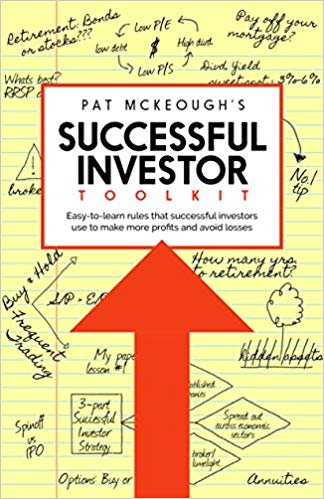
My latest MoneySense Retired Money column looks at how near-retirees can avoid what author Patrick McKeough calls “pre-retirement financial stress syndrome.”

That’s a syndrome he identifies in his new book, Pat McKeough’s Successful Investor Toolkit. McKeough is a regular contributor here at the Hub and you can find the full MoneySense review of his book by clicking on the highlighted text: Investing tips for retired Canadians.

The book is a distillation of McKeough’s long investment career, honed first at The Investment Reporter, and in recent years his own firm, The Successful Investor, and its stable of newsletters. As a member of his Inner Circle and TSI Network, I have long been a proponent of his common-sense approach to investing. He is remarkably consistent in his insistence that investors of any age rely mostly on a conservative portfolio of quality dividend-paying stocks spread among the five major economic sectors (Manufacturing & Industry, Resources, Finance, Utilities and Consumer). And, he never fails to remind you, steer clear of stocks in the crosshairs of what he calls the “broker/media limelight.”

His newsletters are focused variously on Canadian stocks and U.S. and international stocks, and in recent years he has increased his coverage of ETFs.

A cure for PRFSS: Work longer or refine your spending

So what is“pre-retirement financial stress syndrome,” or PRFSS? PRFSS strikes when mature investors realize they may not have enough savings to generate the stream of retirement income they’d been counting on. While some investors are searching for one last desperate “hail Mary” gamble, McKeough advises the opposite: aiming for safer investments.

And while it may not be what some may want to hear, he suggests those suffering from PRFSS adopt one or both of these two solutions: work longer and/or refine your spending. He challenges them to “turn frugality into a game.”

With his focus on stocks, it’s no surprise that McKeough is not keen on bonds, even for retirees and those on the cusp of it. Continue Reading…

How in sync are global Central Banks?


By Kevin Flanagan, WisdomTree Investments

Special to the Financial Independence Hub

Without much fanfare, the U.S. Federal Reserve (Fed) provided its policy guidance late in May. Although no rate hike was implemented [it raised its overnight lending rate by 0.25% at 2 pm today, June 13, at 2 pm: Editor]  the money and bond markets fully expect the U.S. central bank to continue on its tightening path for the remainder of 2018, if not beyond. While the lion’s share of the focus has been Fed-centric on this front, it seems like a good exercise to check in on what the expectations are for the developed world’s other key monetary policy makers.

Heading into 2018, optimism for ongoing global growth seemed to be the norm. Indeed, along with the outlook for continued global growth, discussions were arising on whether central banks would soon turn their attention to any potential increase in inflation. While we still have almost seven months to go in this calendar year, recent data appears to be suggesting a plateauing of sorts on the economic front.

One economic indicator that is widely watched for help discerning economic trends on a global basis are the various Purchasing Managers’ Indexes (PMI) on a country or regional basis. While the levels being posted in the developed world still point toward further expansion, they don’t necessarily indicate a pick-up in growth prospects on the immediate horizon. In fact, the readings for April on an aggregate basis were relatively flat, and in some cases — such as the eurozone, the UK and Canada — have actually slipped a bit from their recent peaks.

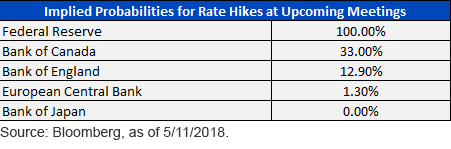
So, what should investors expect in near-term global central bank policy? As illustrated in the table above, expectations for the upcoming policy meetings certainly differ quite a bit. The overarching outlook is for the Fed to raise rates at its convocation on June 13, with the Fed Funds Futures implied probability being 100%, as of this writing. The remaining four developed world central banks — the European Central Bank (ECB), the Bank of England (BOE), the Bank of Canada (BOC) and the Bank of Japan (BOJ)  — all fall in the “no rate hike” camp. Continue Reading…

Rattled by the “Correction?” Diversification keeps your nest egg on the rails

“I know not what the future holds, but I know who holds the future.”
—Homer

We are all aware that portfolio winners rotate position from time to time. Leaders have a habit of becoming laggards. “Must own” darlings become “forgotten” names. Winners vacate the “winner’s circle.” As the timeless saying preaches, don’t put all your eggs in the same basket. Hopefully, this classic advice is being followed.

“Diversification strategies are essential, time-tested tools for every nest egg.”

The main goal of investment diversification is to contain the damages of market volatility from being inflicted on the nest egg. The importance of this is fundamental and always in fashion. I highlight some key observations on portfolio diversification:

  • Investment portfolios suffer from inadequate diversification.
  • Mutual funds we own often have the same, or similar, stocks.
  • Investors are not aware that they lack diversification.

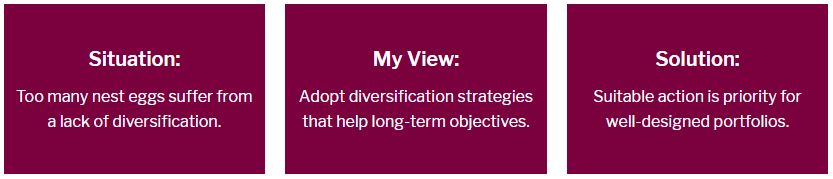
Diversification strategies are essential, time-tested tools for every nest egg. They improve your chances of achieving better consistency of long-term returns. It’s a focus for every investor to prioritize.

Basic diversification involves spreading your risks across different sectors of the economy. All within the asset allocation targets set by your investment plan of action. Make sure that you are comfortable with the approach so that you don’t have to dwell on regrets. Portfolios I review range from too concentrated to well over diversified.

Overall, diversification is a necessary safeguard. You don’t want problems arising in any asset class to ruin your well-designed portfolio. Especially the one that delivers the family’s retirement cash flow.

Develop sound habits

Diversification increases the odds of you being right more often than wrong. When some selections are suffering, others can step up and help cushion the rest of the portfolio.

Make it your habit to keep your nest egg from slipping off the rails. I summarize my top ways to achieve necessary portfolio diversification:

  • Asset Classes: Choosing different asset classes for the game plan is a sensible and prudent step. Stocks, bonds, cash, commodities and real estate are common picks.
  • Economic Regions: Portfolios may include selections from Canada and other regions around the world. Like the USA, Europe, Far East and emerging countries.
  • Time to Maturity: A portion of the portfolio could have a range of investment maturities. From as short as 30 days to as long as 30 years.
  • Foreign Currencies: Investment selections can be purchased in currencies other than Canadian funds. Such as US dollars, the Euro or hedged to our Loonie.
  • Investment Quality: High investment quality trumps reaching out for questionable yield. Trading quality for higher yields increases the potential to incur large losses.

Portfolios ought to contain a variety of investments that don’t all move in unison. However, seasoned investors know full well that is not always possible.

Broad brush

My table below is far from scientific. Look upon it as a broad brush view of portfolios that own Exchange Traded Funds (ETFs) and/or mutual funds as their primary investments in equities. Each investment selection is referenced as a “basket.” I divide the diversification landscape into three ballparks. Continue Reading…

Powered by the Financial Independence Hub.
© 2013-2026 All Rights Reserved.
Financial Independence Hub Logo

Sign up for our Daily Digest E-Mail!

Get daily updates from the FindependenceHub.com straight to your inbox.