Tag Archives: bonds

Retired Money: What to do about falling GIC rates

PWL Capital’s Ben Felix

My latest MoneySense Retired Money column has just been published. It looks at the reversal the past year in interest rates, which impacts seniors who had started to look forward to at least half-decent GIC rates near 3%. You can find the full piece by clicking on the highlighted headline: Are GICs right for retirees looking for Fixed Income? 

Short of embracing high-yielding dividend paying stocks, the more palatable alternative for conservative retirees might be fixed-income ETFs. The article focuses on a recent video by CFA Charterholder Benjamin Felix, an Ottawa-based portfolio manager for PWL Capital. Felix argues that at a minimum such investors should have a mix of both fixed-income ETFs and GIC ladders.

The latter let you sleep at night because they are invariably “in the green” in investment accounts. But while in the short term fixed-income ETFs can be in the red — just like equity ETFs — Felix makes a compelling argument for the higher potential returns of bond ETFs.

Felix believes that what really matters for investors is total return: “Holding a lower-rate GIC after a rate increase still results in an economic loss.” Bond returns consist of principal, interest payments and reinvested interest, so focusing only on return of principal misses the point. Individual bonds are not ideal for individual investors, as they require extensive research, are relatively expensive and tricky to trade.

Short-term GICs miss out on the term premium

But short-term GICs miss out on the term premium, which is substantial over time. Going back to 1985, Felix says short-term bonds returned 6.51% annualized versus 7.97% for the aggregate bond universe (which includes some short-term bonds).  This shows how much mid- and long-term bonds bring up the overall return. To be clear, this period captures one of the greatest bond markets in history but Felix says it is still reasonable to expect a relationship between riskier longer-term bonds and higher expected bond returns. Risk and return should be related.

GICs are also illiquid, so even if an investor chooses to include GICs in a portfolio, they will generally also include bond ETFs, which – like stock ETFs – can be sold any trading day. Nor do GICs provide exposure to global bonds.

Of course, a nice alternative are those asset allocation ETFs we have often discussed on this site. See for example this excellent overview by CutthecrapInvesting’s Dale Roberts: Which All-in-One, One-Ticket Portfolio is right for you? 

The Felix video can be found at his Common Sense Investing YouTube series here.

 

Motley Fool: How to move from Saving to Investing

What’s the difference between Saving and Investing and how do you move smoothly from the one to the other?  Motley Fool Canada has just published the second in a new series of articles by me about the basic steps towards Financial Independence, or what I call “Findependence.” You can find the first one, which ran early in June, here; and the new one by clicking on the highlighted text here: 2 critical steps toward Financial Independence.

The first article discussed how the journey to Findependence hasn’t even begun while you’re still in debt. To paraphrase one of the characters in my book Findependence Day, you can’t even begin to climb the tower of Wealth until you get out of the basement of debt.

It’s nice to be free of debt, whether high-interest credit card debt, student loans or even a mortgage. It’s a big step moving from negative net worth to being merely broke, where your assets and liabilities cancel themselves out. Being free of all debt is certainly a nice place to be if you’ve been anxious over being hounded by creditors. But it’s not financial independence either, which is the stage of life when all sources of income more than meet your monthly financial needs.

As the followup article summarizes, you want to move from Debt elimination to the intermediate step of Saving, and then from Saving to true investing. Saving is being a loaner — you lend money to a bank or other institution and receive a small amount of interest back as well as your principal upon maturity. But to be an investor you want to be an owner: a business owner, through stocks or equities, or more broadly through a diversified basket of equity ETFs.

The end of the piece references a piece by Investopedia about the difference between investing and saving. You can find their explanation here. It says saving is for emergencies and purchases, by which they mean immediate needs. Investing is about a longer-term horizon (defined as seven or more years) and entails more risk than saving. That’s why they refer to the “risk free” return of investing in cash, treasury bills and the like.

Investing is about Money begetting Money

The beauty about saving is that, once the process is begun, it sets the stage for when  money begins to beget still more money, a process that will ultimately happen even while you’re sleeping. So does investing: the difference is that saving is a kind of junior partner to investing: it works a bit for you, but nothing so hard as true investing for the long term. Saving begets small amounts of money; ultimately, investing begets huge amounts of money: eventually enough to live on whether or not you choose to work another day in your life. Continue Reading…

Positive if muted returns for most major asset classes in 2019, Franklin Templeton forecasts

Despite Tuesday’s 3% plunge in US stock markets, Franklin Templeton money managers are optimistic most major asset classes will deliver positive if muted returns in 2019.

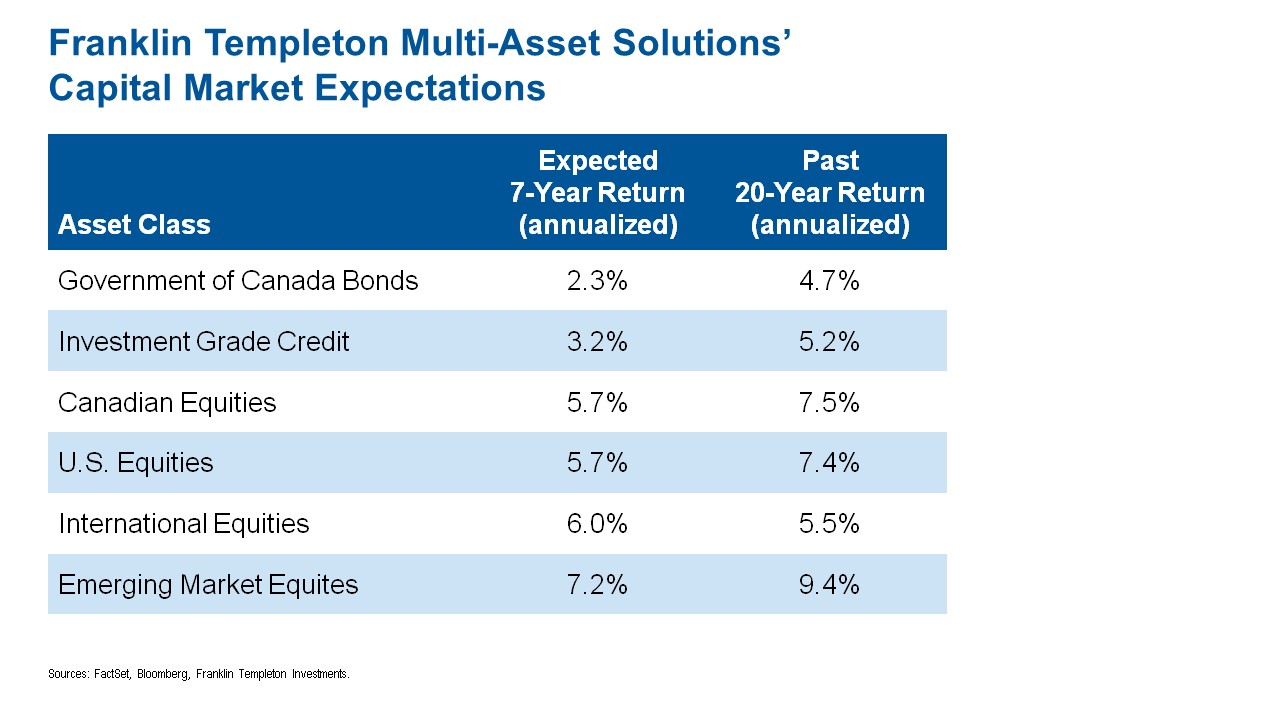
At the 2019 Global Market Outlook event in Toronto, William Yun, New York-based executive vice president for Franklin Templeton Multi-Asset Solutions, projected 7-year annualized returns for Canadian equities of 5.7%, compared to a 7.5% average the last 20 years [as shown in above chart]; 5.7% for U.S. equities (versus 7.4% historically), 6% for international equities (versus 5.5%), and 7.2 versus 9.4% for Emerging Markets. On the fixed income side, he is projecting 2.3% annualized 7-year returns for Government of Canada bonds (versus 4.7% historically the last 20 years), and 3.2% for investment grade corporate bonds (versus 5.2%).

All this is in an environment of continued desyncronized global growth (of 3%) and moderate inflation expectations. Long term, Yun is particularly optimistic about the long term growth of Emerging Markets equities, which at 5% is two-and-a-half times the 2% growth expectation for developed market equities. This optimism is based on positive population growth and labor productivity in Emerging Markets. Globally, inflation “remains muted” and “we don’t see many excesses in the global economy generally.” There are however, some excesses in the U.S. labor market.

More normalized interest rate environment

William Yun, Franklin Templeton Multi-Asset Solutions

Capital spending growth patterns are supportive and trending upwards since the 2016 US election, with the transition from very low interest rates post the financial crisis to a “more normalized interest rate environment.” The opportunity is to reinvest capital to more productive assets, as opposed to allocating to corporate share buybacks.

With respect to central bank balance sheets, markets are normalizing around the world, transitioning from excessive Quantitative Easing to Quantitative Tightening and shrinking balance sheets. Assets quadrupled at the Fed between US$1 trillion in 2008 to $4 trillion today as the Fed committed to buying bonds, with liquidity tapering off. He has similar expectations for the ECB, which has announced the ending of its QE programs, and it’s the same with Japan and China. “Central bankers are pulling back on Quantitative Easing.” There is a “restart of normalization in interest rate policy.”

Rising volatility 

Even as the Dow Jones Industrial Average was in the process of tanking almost 800 points Tuesday, Yun predicted rising volatility after a period of relative calm. In that environment, “investing passively [in index products] has been the way to go but we anticipate volatility returning.” With higher interest rates and more volatility, it may be a time for active management, Yun said, acknowledging his own firm’s expertise in active security management.

Emerging Markets gross domestic product (GDP) continues to rise relative to the rest of the world, from 40% in 1990 to 60% in 2017, and Yun expects that percentage to move higher still. The trend is driven by rising consumption growth for the middle class, which benefits industries like consumer staples and consumer discretionary stocks, technology and even investment management.

Emerging Markets are showing reduced reliance on developed markets, which are slowing. Whereas in 2007 eight of the top trade markets were with the United States, in 2017-2018 China has supplanted the US, with 8 of the top 14 destinations.

In short, Yun sees  a supportive global market for risk assets but lower returns: positive growth and moderate inflation, with increased volatility.

Ian Riach, Fiduciary Trust Canada

Ian Riach, Chief Investment Officer for Fiduciary Trust Canada and a senior vice president of Franklin Templeton Multi-Asset Solutions,  says it makes sense in this environment to make some “dynamic” (i.e. tactical) shifts to long-term Strategic Asset Allocation. Currently, the firm is underweight Canadian equities and Canadian bonds, because the loonie has been getting weaker and Canada is facing a number of challenges ranging from trade to energy to a shrinking manufacturing base, all of which “affects growth going forward.” In the short term, Riach expects short-term interest rates in the United States will be higher than in Canada, “given that they are growing more quickly than us.”

Flat yield curve

Even after the recent rate back-up, “we think Government of Canada bonds are expensive, Continue Reading…

Using bonds for retirement will hurt your retirement income

Senior couple trying to figure out tax declaration

As some investors near retirement, their advisors recommend switching to bonds and other fixed-income investments for their retirement investments instead of holding stocks or ETFs.

To some extent, this is an understandable retirement investing strategy, since bonds can provide steady income and a guarantee to repay their principal at maturity.

Bonds will lower the long-term returns that are key to successful retirement investing

Unfortunately, using bonds for retirement may not be the best strategy. Bond prices will likely fall over the next few years because interest rates are likely to rise. Bond prices and interest rates are inversely linked. When interest rates go up, bond prices go down, when interest rates go down, bond prices for up.

Bonds have been in a period of rising prices (a bull market) more or less since 1981. That year, long-term interest rates reached an historic turning point when long-term U.S. Treasury bond yields peaked near 15%. Ever since, interest rates have gone through wide fluctuations, but they have essentially headed downward.

Today, interest rates just don’t have that much further to fall. But under certain conditions, interest rates could go substantially higher. Remember, as mentioned, when interest rates go up, bond prices drop.

Even so, brokers continue to sell bonds to their clients. That’s partly because most of today’s brokers had not yet entered the investment business when the bull market in bonds began in 1980. All they know is that bonds do tend to reduce the volatility of your portfolio, since they tend to rise when stock prices fall. Of course, bonds also generate more commission fees and income for the broker, compared to stocks, especially if you buy them via bond funds and other investment products.

That’s why we continue to recommend that you invest only a small part of your portfolio—if any—in bonds and fixed-income investments. Instead, you should aim for a diversified portfolio of well-established companies with long histories of dividends, or ETFs that hold these stocks. We recommend a number of stocks and ETFs appropriate for retirement investing in our Canadian Wealth Advisornewsletter.

We recommend this retirement investing strategy because equities are bound to be more profitable than bonds for retirement over long periods. That’s because equity returns are related to business profits, while returns on fixed-return investments are related to business interest costs.

Bonds and other fixed-return investments can add stability

Returns on your stocks are sure to be more volatile than what you earn on fixed-return investments (that includes short-term bonds). That’s because returns on stocks are related to the part of gross profit that’s left over after a company pays its interest costs. Continue Reading…

Getting your investments into the green

By Dale Roberts

Special to the Financial Independence Hub 

I would get this question quite often when I was an adviser with Tangerine.

“Do you have any Green investments?”

Of course, when one offers broad-market index based portfolios the investment is environmentally agnostic. It makes no judgement on how the company operates or how it makes its profits. Company behaviour will be determined by the regulators and shareholders and the company’s board and management. And largely the demand for the products or services will be determined by the consumer: that’s you.

Now I would certainly direct clients to the green investment options in Canada, it’s not up to me to tell you to leave your values or principles at the door, but I would also suggest that one might have a greater chance to effect change by addressing the way they live compared to how they invest. Largely, lifestyle choices trump investment choices when it comes to having a positive impact on the environment. To be consistent and transparent, I still believe that to be true.

That said, there is an investment option that appears to fit the bill for enabling that change. That investment is the CoPower Green Bond.

Greenbond LogoYes, it’s a bond, and that means that an investor is loaning money that is used by developers to fund clean energy infrastructure. For that loan, an investor would be paid 4% annual for a 4-year bond and 5% annual for a 6-year bond. In today’s low-rate environment that’s a very good rate of return.

There are 3 types of projects that your monies (your loan) will fund.

CoPower Green Bond Portfolio Investments Table (Oct 2018)We might consider this a truly green investment because the at the core (geothermal pun intended) we have Canadians who are making a choice to ‘Go Green’, or their version of green. As an investor, you are enabling those projects. Your monies will fund projects that will reduce CO2 emissions, and perhaps reduce polluting particulates that are a by-product of traditional energy generation. You will be an ‘investor agent of change’.

These green projects are very successful and there is great demand from potential partners to start more geothermal, solar and LED bulb replacement projects. The demand is there, the projects simply need more funding. The more Green Bonds that can be issued, the more projects that can be funded. Quite simply, they need your monies, your loans.

If you look into the projects that are funded you’ll discover that they are more grass-roots and small-scale. Individual home geothermal conversion projects don’t attract interest and traditional loans from large financial institutions. These are individual Canadian homeowners who are largely being funded by individual Canadians (that’s you, potentially). What might be appealing to many is the small scale and clear transparency in where your monies are directed and how the effect can be measured.

How do you get your Green Bonds?

You can sign up through the CoPower website, where you would complete an online application. As part of the process you would also have a phone conversation with a CoPower investment representative to ensure suitability and to ensure that you do understand the investment and the associated risks.

You can also obtain the CoPower Green bonds with the discount brokerage Questrade and through Olympia Trust. Keep in mind that when you access the bonds through a third party, those institutions will charge fees. Ensure that your investment is large enough (the returns are large enough) to more than compensate for any fees that are applied. Through those third party options you can invest in RSP and TFSA and RIFF accounts.

How is CoPower different from a bond fund?

A SRI Socially Responsible Investment bond fund will hold dozens to hundreds of individual bonds. As a mutual fund it will change in price every day. There are management fees associated with mutual funds as well. The CoPower bonds are offered directly to you and carry no fees. You receive your interest payments and the effect of compound interest in full.

You will be owning an individual bond and you will be required to hold the bond to maturity. That means that if you purchase a 6-year bond, you will have to wait for 6 years to see that return of your initial investment amount. You may choose to have the bond pay you your interest payments ‘along the way’. Continue Reading…