Tag Archives: bonds

Gamechanger? Vanguard Canada launches 3 new Asset Allocation ETFs (plus my take)

Vanguard Investments Canada Inc. has announced the listing of three new low-cost Asset Allocation ETFs that give investors one-stop shopping to the firm’s globally diversified strategies. They began trading on the TSX today (February 1, 2018.)

Both investors and advisors are asking for “simple yet sophisticated single-ticket investment solutions that provide well-diversified global equity and bond exposure within a low-cost ETF structure,” says Atul Tiwari, managing director for Vanguard Canada. The new ETFs offer investors three different risk profiles and regular rebalancing.

In effect, each ETF is a fund of funds although Vanguard describes them as having an “ETF of ETFs structure.” Each holds seven existing core Vanguard index ETFs (which I list in the postscript below). Each new ETF of ETFs has a management Fee of 0.22%. Vanguard says that when one of its ETFs invests in underlying Vanguard funds, “there shall be no duplication of management fees.” Spokesman  Matthew Gierasimczuk said “There are no duplicate fees beyond the 0.22 management fee, other than a basis point or two for operating expense and the trading fee for buying or selling the ETF.”

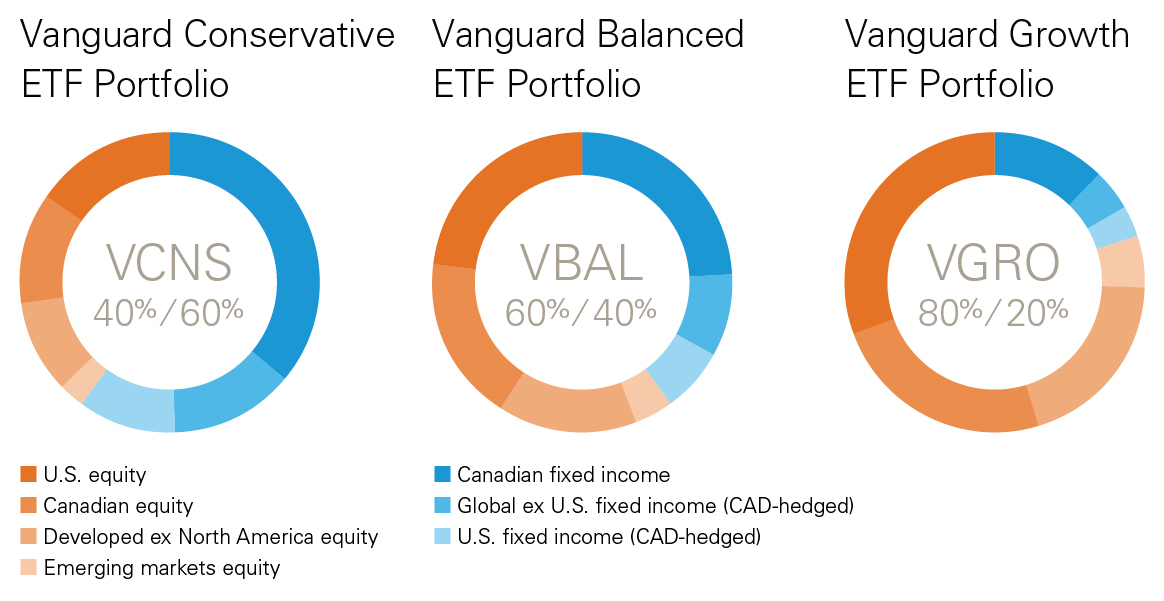
The three asset allocation ETFs cover the normal range from Conservative to Balanced to Growth, as reflected in the product names. Equity weights range from 40% for the Conservative offering, to 60% for the Balanced and 80% for the Growth.

Here are the 3 ETFs and their ticker symbols on the TSX:

Vanguard Conservative ETF Portfolio (VCNS) seeks to provide a combination of income and moderate long-term capital growth by investing in equity and fixed income securities with a strategic allocation of 40% equities and 60% fixed income.

Vanguard Balanced ETF Portfolio (VBAL) will provide long-term capital growth with a moderate level of income split 60% equities to 40% fixed income.

Vanguard Growth ETF Portfolio (VGRO) provides long-term capital growth by investing in equity and fixed income securities with 80% equities and 20% fixed income.

In a press release, Vanguard Canada head of product Tim Huver said the ETFs offer “a simplified and scalable solution for financial advisors, and a one-stop globally-diversified and transparent option for investors … Investors can rely on Vanguard’s global investment experts to continuously assess their portfolio’s exposure and rebalance it back to its intended risk level.” 

With the three new ETFs, Vanguard Canada now offers 36 ETFs, with C$14 billion in assets under management. Vanguard Investments Canada Inc. is a wholly owned indirect subsidiary of The Vanguard Group, Inc.

You can find more at Vanguard Canada’s website.

Postscript: My Take

After sleeping on this announcement, it strikes me as more significant than I had initially perceived. Continue Reading…

Don’t shun Bonds merely because of fear of rising Rates

Sources: Bloomberg and FactSet

By James Redpath and Curtis Elkington

Special to the Financial Independence Hub

Conversations about increasing interest rates and their impact on bond investments have recently spiked in Canada. Since bonds are traditionally viewed as an investment that provides a steady stream of income while acting as a safety net within an overall balanced portfolio, an environment of rising interest rates understandably causes unease: it can decrease the price of bonds and therefore can negatively impact performance.

While we share the same concern, we also think some of the prevailing discussions oversimplify the relationship between interest rates and bonds and require a bit more context. We may want to think twice about knee-jerk shunning of the asset class.

Right off the bat, what should be kept in mind is that the interest rate most commonly referred to in media articles is the overnight interest rate, which we will refer to here as simply ‘interest rate’. For anything longer than the overnight rate, we will use ‘yield’ and/or ‘yield curve’.

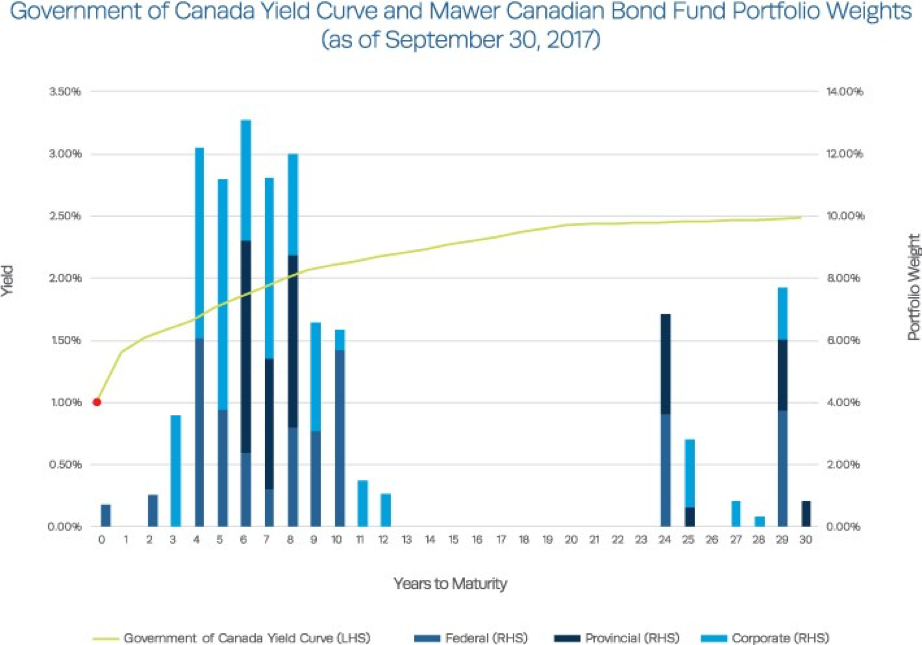
While the Bank of Canada controls the overnight interest rate (represented by the red dot in the graph above) and has some influence on the short end of the yield curve, medium to long-term yields are a different story. Medium and long-term yields tend to be driven by long-term factors outside the Bank of Canada’s direct control, such as potential economic growth and inflation dynamics, supply and demand, and global influences.

Thus, pinning too much importance and conversation onto that red dot doesn’t provide a holistic picture since the Fund has a diverse maturity structure and exposure to multiple sectors: all of which can have different influences on performance. While shifts higher in the yield curve over the short-run will likely negatively impact a bond portfolio, over a longer time horizon, the effects might be surprisingly positive.

In long run, rising yields are a positive

Why? Although it may seem counter-intuitive, if you have a long-term time horizon, an increase in bond yields is usually more beneficial than if yields remained lower as the performance of a bond fund is influenced by the level and slope of the yield curve over time. Another important factor is the pace yields rise relative to the time it takes to recover lost performance. While there could be short-term pain, maintaining a long-term horizon allows an investor to reinvest at a higher yield, which over time typically outweighs the negative short-term impact. Simply put, the higher yields are, the higher the income an investor receives when cash flows are re-invested.

Continue Reading…

Building Wealth: Human Capital vs. Financial Capital

Back in 2003, when I began my career as a young sales manager in the hospitality industry, I earned an annual salary of $26,000. Little did I know at the time that my human capital – as in, the present value of my expected future income throughout my working lifetime – would be worth nearly $3,000,000!

I did some back-of-the-napkin calculations and was surprised to learn I’ve already earned a million dollars over my 15-year career. I find that incredible, given that I’ve never earned a six-figure salary and, in fact, my wages have been stagnant for the past four years.

Projecting my income forward using a modest 3 per cent annual growth rate reveals the potential to earn another $2 million by the time I turn 55.

Human Capital vs. Financial Capital

Put in different terms, however, and you can see that my human capital is shrinking each year. That’s because the value of my human capital peaked the day I started my career (back in 2003) with my entire lifetime of earnings ahead of me. Since then I’ve steadily used up my earning power and the value of my human capital has gradually declined.

The idea of eroding capital doesn’t sit well with me, but that’s where the second form of wealth building – your financial capital – comes into play. See, I’ve been a diligent saver for most of my career, which means converting my human capital (earnings) into financial capital (investments). Continue Reading…

Is the Fixed Income Market buying what the Fed is Selling?


Fed’s Balance Sheet Normalization Guidelines (in billions)

By Kevin Flanagan , WisdomTree Investments

Special to the Financial Independence Hub

In the post-Federal Reserve (Fed)-meeting world of the money and bond markets, there seems to be a disconnect between what market participants are thinking and the Fed policy decisions actually being made. It is a case of the market not buying what the Fed is selling.

In other words, the term “policy mistake” has begun to enter the discussion, as the U.S. Treasury (UST) arena appears to be operating under the assumption that the Fed should perhaps ease up on its tightening campaign because

(a) inflation has been slowing in recent months, and

(b) economic growth has been lackluster. This line of reasoning concludes that the policy makers will go too far with their rate hike and balance sheet normalization plans, to the detriment of the economic setting.

Based on the Fed’s actions at the June FOMC meeting, the policy makers do not seem to be deterred in their “full steam ahead” outlook, as they envision yet another rate hike this year and expect “to begin implementing a balance sheet normalization program this year” as well. (On Wednesday, July 27, the Fed kept interest rates unchanged — Editor.)

So, let’s assume economic and financial conditions do live up to the Fed’s expectations, what then will their plan look like for phasing out their reinvestment program.

Continue Reading…

Bonds: Ain’t no cure for the summertime blues

U.S. 10-Year vs. 10-Year German Bund
By Kevin Flanagan , WisdomTree Investments
 
Special to the Financial Independence Hub

Since Election Day, the focus in the U.S. Treasury (UST) market has been essentially domestic-driven. In other words, market participants have been setting their sights on potential fiscal policy developments and, of course, the latest actions from the Federal Reserve (Fed).

However, as the calendar turned to summer, investors were greeted with a new twist for Treasuries: more-hawkish-than-expected rhetoric coming from other developed markets’ central banks, elevating global bond yields in the process. The question that lies ahead on the rate front is whether words become deeds; if so, the fixed income arena could be in for a case of summertime blues.

Two of the more noteworthy developments from the global central bank perspective involved the European Central Bank (ECB) and the Bank of Canada (BOC), each occurring in just the last few weeks. The genesis was at an ECB forum in Sintra, Portugal, where President Draghi made remarks that the bond market viewed as being on the hawkish side.

Although the ECB tried to walk back the comments, stating they were misinterpreted, the damage was done, and yields nevertheless finished higher. Interestingly, the FOMC minutes released early in July were a nonevent, but the ECB minutes were a different story, as the headlines stated that policy makers “discussed removing the easing biases in their policy communication,” specifically on their Quantitative Easing (QE) program. These news events were accompanied by earlier comments from BOC president Poloz that intimated that Canadian policy makers may be considering a rate hike at one of their upcoming meetings.

Unexpected shift in tone

Needless to say, the shift in tone was not expected in the global bond markets. Continue Reading…

Powered by the Financial Independence Hub.
© 2013-2026 All Rights Reserved.
Financial Independence Hub Logo

Sign up for our Daily Digest E-Mail!

Get daily updates from the FindependenceHub.com straight to your inbox.