
Tag Archives: bonds

How to set your Retirement savings target

How much to save for retirement depends on the type of lifestyle you’re   aiming for

How much to save for retirement varies for each investor. A fulfilling retirement is not simply a matter of accumulating sufficient wealth to give you peace of mind. It is equally a matter of knowing what you will do — in effect, ensuring that you will be as active and productive with your time as you were during your working days.

These days, more investors suffer from what you might call “pre-retirement financial stress syndrome.” That’s the malady that strikes when it dawns on you that you don’t have enough money saved to be able to earn the retirement income stream you were banking on.

To alleviate this worry, we recommend that you base your retirement planning on a sound financial plan. Here are the four key variables that your plan should address to ensure you have sufficient retirement income:

  • How much you expect to save prior to retirement;
  • The return you expect on your savings;
  • How much of that return you’ll have left after taxes;
  • How much retirement income you’ll need once you’ve left the workforce.

Consider taxes when determining how much to save for retirement

As for the tax structure, it keeps changing. But it’s safe to assume that you’ll pay a lower rate of tax on dividends and capital gains than on interest, and that you’ll generally pay taxes on capital gains only when you sell.

As for the return you expect, it’s best to aim low. If you invest in bonds, assume you will earn the current yield; don’t assume you can make money trading in bonds. For stocks, the market returned 10% or so yearly on average over the past 80 or so years. Aim lower — 8% a year, say — to allow for unforeseeable problems and setbacks.

Continue Reading…

U.S. Corporate Bonds: Taking all the credit

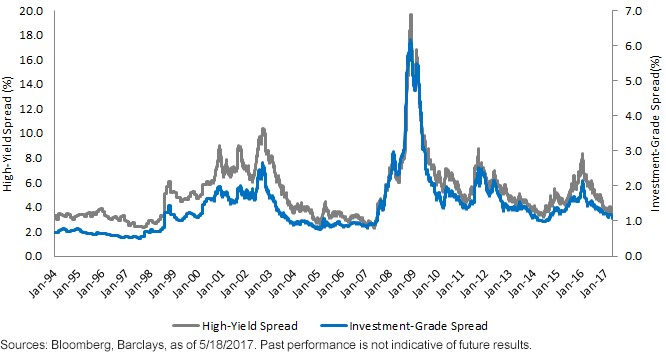
Investment-Grade Spread (RS) vs. High-Yield Spread (LS)

By Kevin Flanagan, WisdomTree Investments

Special to the Financial Independence Hub

Without a doubt, one of the better-performing sectors in the fixed-income arena over the last year or so has been the U.S. corporate bond market. Indeed, both the high-yield (HY) and investment-grade (IG) asset classes have enjoyed visibly positive returns both in 2016 and thus far in 2017, with HY registering specifically robust readings. Against this backdrop, questions have surfaced as to whether these types of performance can be sustained for the remainder of 2017.

And here we are, roughly five months into the calendar, and the question remains: Can the U.S. corporate bond market continue to produce positive outcomes? Oftentimes, market participants tend to focus on more recent trends, and in the process apply their findings to determine whether an asset could be overbought or oversold. In order to put recent developments in U.S. corporates into some perspective, we thought it would be a useful exercise to take a look at how HY and IG spreads have fared over a longer period (See chart at the top of this blog.)

So, where exactly are U.S. corporate bond spreads? According to the Bloomberg Barclays U.S. Aggregate Corporate Index, IG spreads have narrowed by 10 basis points (bps) since the end of the year, and stood at 113 bps as of this writing. This is the lowest level since the latter half of 2014. On the HY front, the Bloomberg Barclays U.S. Corporate High Yield Index shows the spread at 376 bps, a decline of 33 bps from the year-end 2016 tally, and also resides at levels last seen almost three years ago.

A slightly more dramatic way of looking at the current readings is to focus on how much these spreads have come in since the recent high watermarks were posted in February of last year. From this key risk-off period, IG spreads have declined by more than 100 bps, and an eye-popping 463 bps for HY. It is this combination of recent spread-narrowing and current levels that has prompted the aforementioned questions.

Some historical perspective

This is where some historical perspective is in order, specifically: Have we entered uncharted territory? Continue Reading…

How to create a winning retirement income strategy

A successful retirement begins with a successful retirement income strategy.

One of the things that investors of all ages fear is that they won’t have a good financial plan in place so that they have enough retirement income to live on once they’ve stopped working.

Here are some ways to ease that anxiety:

In retirement, try to even out (equalize) your income with your spouse’s income, to lower overall taxes. Here’s how:

1.) Have the higher income spouse pay the household bills

The easiest way to even out income between two spouses is to have the higher-income spouse pay the mortgage, grocery bills, medical costs, insurance and other non-deductible costs of family life.

2.) Set up a spousal RRSP

Registered retirement savings plans, or RRSPs, are a form of tax-deferred savings plan designed to help investors save for retirement. RRSP contributions are tax deductible, and the investments grow tax-free.

3.) Pay interest on your spouse’s investment loans

If the lower-income spouse takes out an investment loan from a third party, such as a bank, the higher-income spouse can pay the interest on that loan.

RRIFs are a great long-term retirement income strategy

Continue Reading…

Three myths about trading Fixed Income ETFs

michael-barrer-crop
Michael Barrer

By Michael Barrer, WisdomTree Capital Markets

Special to the Financial Independence Hub

Fixed income exchange-traded funds (ETFs) provide the investing world with transparency in an otherwise opaque asset class. Although launched in 2002, fixed income ETFs did not become mainstream until 2008, and today these funds are often considered the growth engine for the ETF industry. However, because of the over-the-counter nature of the fixed income market and the fact that ETFs with fixed income underlying securities were adopted later than their equity-based relatives, there are still myths around the trading and liquidity profiles of these funds. I want to address these myths and explain the realities of the fixed income ETF structure.

Myth 1: Fixed income ETFs are not liquid, and on-screen volume equals ETF liquidity

Reality: ETFs are just an exchange-traded wrapper around a basket of securities. The minimum liquidity available of the ETF is defined by the liquidity of the underlying securities. With equity ETFs, the volume of the underlying securities can be measured and tracked. Implied liquidity is an industry standard metric that quantifies basket liquidity in equity-based ETFs.

In the fixed income market, the over-the-counter trading nature and lack of centralized trade reporting make quantifying fixed income ETF liquidity more challenging. That being said, there is a basic industry practice that assumes 5% of an outstanding issue will turn over daily and a conservative estimate to avoid market impact is to not be more than 25% of that daily turnover.

We recently discussed this subject in a separate blog post, where we quantified the potential daily liquidity in our new “Smart Beta” fixed income strategies. The bottom line remains that fixed income ETFs are designed with liquidity in mind, so they can scale, and the minimum liquidity available will always be based on the liquidity of the underlying asset class. On-screen volume only acts as an additional layer to the overall liquidity profile of the ETF.

Myth 2: Fixed income ETFs have wide spreads

blog-see-more-fixed-incomeReality: The spread of an ETF is a representation of the spread in the underlying asset class, plus the costs and risks associated to the market maker. The exchange-traded and transparent nature of ETFs allows investors to see these spreads in real time. Whereas in a mutual fund, the portfolio spread would mirror that of an ETF with similar characteristics, however, the mutual fund structure does not allow for this level of intraday transparency.

Continue Reading…

7 tips for investing in the Trump era

Investors are inquiring how to invest their nest eggs after the U.S. election and the unexpected win by Donald Trump.” Let’s keep it very simple and explore a dose of reverse engineering. I highlight seven top tips for adoption:

USA presidential election donald trump, vector illustration, Editorial use only

1.) Ask where you want your nest egg to be in five, ten or twenty years.

2.) It’s imperative to always think and act logically, not emotionally.

3.) Accept that bond and stock market volatility is here to stay.

4.) Revisit your expectations as to goals, needs, objectives and plan of action.

5.) Implement, tweak and be patient with your long-term strategies.

6.) Cut to the chase and focus on managing your investing risks.

7.)  Keep cash available for buying opportunities during market sell-offs.

These straightforward, sensible tips can stickhandle your nest egg out of trouble most times.

AdrianAdrian Mastracci, MBA,  is president and portfolio manager for Vancouver-based KCM Wealth Management Inc., specializing in designing and stewarding retirement portfolios