Frederick Vettese has written good books for Canadians who are retired or near retirement. His latest, The Rule of 30, is for Canadians still more than a decade from retirement.
He observes that your ability to save for retirement varies over time, so it doesn’t make sense to try to save some fixed percentage of your income throughout your working life. He lays out a set of rules for how much you should save using what he calls “The Rule of 30.”
Vettese’s Rule of 30 is that Canadians should save 30% of their income toward retirement minus mortgage payments or rent and “extraordinary, short-term, necessary expenses, like daycare.” The idea is for young people to save less when they’re under the pressure of child care costs and housing payments. The author goes through a number of simulations to test how his rule would perform in different circumstances. He is careful to base these simulations on reasonable assumptions.
My approach is to count anything as savings if it increases net worth. So, student loan and mortgage payments would count to the extent that they reduce the inflation-adjusted loan balances. I count contributions into employer pensions and savings plans. I like to count CPP contributions and an estimate of OAS contributions made on my behalf as well. The main purpose of counting CPP and OAS is to take into account the fact that lower income people don’t need to save as high a percentage of their income as those with higher incomes because CPP and OAS will cover a higher percentage of their retirement needs. Continue Reading…
Investors follow the 60/40 rule because they are told bonds will protect capital while equities grow it. Why recent drops in bond prices should make us reconsider that rule.
By Paul MacDonald, CIO, Harvest ETFs
(Sponsor Content)
From the moment they start putting money in the market, investors are told to follow the 60/40 rule. It is the broadly accepted wisdom that, for an average retail investor, a 60% allocation to equities and a 40% allocation to bonds will result in a robust portfolio. Equities should deliver growth prospects in the long term while bonds will offset downsides in equities by delivering uncorrelated returns. Bonds preserve capital, and equities grow capital. That’s the accepted wisdom.
Countless investment fund issuers have packaged this logic into their balanced funds. These funds offer a specific allocation to equities and bonds, usually in line with the 60/40 rule, forming the core of a retail investor’s portfolio.
The problem with accepted wisdom is sometimes circumstances turn it upside down. In the past months we have seen volatility in equity markets and a significant drop in bond prices. That is because the investment landscape has changed.
Why are bond prices dropping?
After over a decade of historically low interest rates, followed by massive rate cuts by central banks at the onset of the COVID-19 pandemic, inflation has begun to set in. With rising inflation comes pressure on central banks to raise rates and market expectation that rates will rise, which is itself pushing interest rates higher. Continue Reading…
My latest MoneySense Retired Money column looks at a recent spate of media articles proclaiming the “Death of Bonds.” You can find the full column by clicking on the highlighted headline: Do bonds still make sense for retirement savings?
One of these articles was written by the veteran journalist and author, Gordon Pape, writing to the national audience of the Globe & Mail newspaper. So you have to figure a lot of retirees took note of the article when Pape — who is in his 80s — said he was personally “getting out of bonds.”
One of the other pieces, via a YouTube video, was by financial planner Ed Rempel, who similarly pronounced the death of bonds going forward the next 30 years or so and made the case for raising risk tolerance and embracing stocks. The column also passes on the views of respected financial advisors like TriDelta Financial’s Matthew Ardrey and PWL Capital’s Benjamin Felix.
However, there’s no need for those with risk tolerance, whether retired or not, to dump all their fixed-income holdings. While it’s true aggregate bond funds have been in a de facto bear market, short-term bond ETFs have only negligible losses. And as Pape says, and I agree, new cash can be deployed into 1-year GICs, which are generally paying just a tad under 3% a year; or at most 2-year GICs, which pay a bit more, often more than 3%.
One could also “park” in treasury bills or ultra short term money market ETFs (one suggested by MoneySense ETF panelist Yves Rebetez is HFR: the Horizons Ultra-Short Term Investment Grade Bond ETF.) It’s expected that the Fed and the Bank of Canada will again raise interest rates this summer, and possibly repeat this a few more times through the balance of 2022. If you stagger short-term funds every three months or so, you can gradually start deploying money into 1-year GICs. Then a year later, assuming most of the interest rate hikes have occurred, you can consider extending term to 3-year or even 5-year GICs, or returning to short-term bond ETFs or possibly aggregate bond ETFs. Watch for the next instalment of the MoneySense ETF All-stars, which addresses some of these issues.
Most investors understand or perhaps accept the fact that they are not able to time stock markets (sell out before they go down or buy in before they advance).
The simple rationale is that stock markets are forward looking by anticipating or “pricing in” future expectations.
While the screaming negative headlines may capture attention, stock markets are looking out to what may happen well into the future.
Timing bond markets is even harder than timing stock markets
When it comes to interest rates and inflation, my observation is that the opposite is true. Most investors seem to think they can zig or zag their bond investments ahead of interest rate changes. This is perplexing, as you can easily make the case based on evidence that trying to time bond markets is even more difficult than trying to time equity markets.
Another observation is that many investors tend to be slow to over-react. Reacting to today’s deafening headlines ignores that fact that all financial markets are extremely resilient. Whether good or bad economic news, good or bad geopolitical events, markets will work themselves out and march onto new highs, albeit sometimes punctuated by sharp and unnerving declines. Put another way, declines are temporary, whereas advances are permanent. And remember, this applies to both bond and stock markets.
It is easy to understand why we might be scared about the recent headline inflation numbers and concerned about rising interest. It is very important to keep this in context, which is what we will address today.
But as it relates to your immediate fixed income holdings we don’t recommend reacting to breaking news. A recent Dimensional Fund Advisors paper, “Considering Central Bank Influence on Yields,” helps us understand why this is so. Analyzing the relationship between U.S. Federal Reserve policies on short-term interest rates versus wider, long-term bond market rates, the authors found:
“History shows that short- and long-term rates do not move in lockstep. There have been periods when the Fed aggressively lifted the fed funds target rate — the short-term rate controlled by the central bank — while longer-term rates did not change or “stubbornly” declined.”
Steve Lowrie holds the CFA designation and has 25 years of experience dealing with individual investors. Before creating Lowrie Financial in 2009, he worked at various Bay Street brokerage firms both as an advisor and in management. “I help investors ignore the Wall and Bay Street hype and hysteria, and focus on what’s best for themselves.” This blog originally appeared on his site on March 7, 2022 and is republished here with permission.
By Duane Ledgister, vice president, Connor Clark & Lunn Private Capital
Special to the Financial Independence Hub
Inflation has moved to its highest level in decades, with higher prices resulting from strong economic growth led by pent-up demand for goods and record levels of government spending.
At the same time, strong demand is leading to supply shortages. When we look at the components of inflation, we see recent price increases are largest in industries hurt the most during the pandemic, such as energy. These industries are cyclical and are pulling inflation readings higher as prices recover after a period of decline.
Higher prices in the short term are expected to be tempered as supply adjusts and demand returns to more normal levels, and while policy actions such as higher spending and larger debt levels have increased short-term inflation, the same forces are deflationary long-term. This is because more money goes to paying down debt as opposed to future investment. The caveat is that higher debt levels encourage policymakers to allow inflation to move higher than it has been in recent cycles. Accordingly, inflation will be higher but not at the disruptive levels we saw in the 70s and 80s.
Impact of inflation on your investment allocation
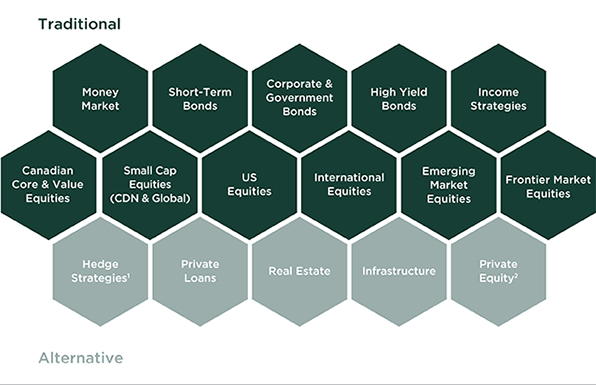
Now is a good time to consider its effect on different asset classes that make up a portfolio. Real diversification is much more involved today than you would have been told before.
Stocks can generally do well in a period of moderate inflation, whereas fixed income is hurt the most. Alternative asset classes — which most investors have little exposure to, and should begin evaluating — also have some natural protection from inflation.
Equities
Moderate inflation is a double-edged sword for stocks: increasing corporate cash flows while decreasing the real value of investment returns. Companies with high valuations tend to underperform as their valuations are based on future earnings growth long into the future. In a period of higher inflation, these future earnings are now worth less today. Companies with lower valuations, called value stocks, do better in a period of above-average inflation. Strategically it makes sense to hold both growth and value styles within your equity allocation.
Fixed Income
The bond allocation of a portfolio is the one that is hardest hit by inflation, because most bond coupon payments do not increase with inflation, and bond yields tend to rise when inflation is moving higher. The result is both a temporary decline in the price of bonds and lower long-term real return. The negative effects of rising inflation and yields can be managed by holding short-term bonds and higher coupon bonds. The former is less sensitive to changes in inflation and yields. This protects capital when inflation is rising. The latter have more income to offset price declines.
Having a view of the economic backdrop and managing a bond portfolio’s sensitivity to changes in yields and inflation is important to delivering risk-adjusted returns, particularly true when inflation is on the rise.
Alternatives
This is where real diversification can pay off. The alternative asset classes in a portfolio are attractive since they generate strong levels of income relative to traditional equities and bonds. They also tend to be the least sensitive to risks in the broader economy, including inflation. Private market investments (real estate, infrastructure, and private loans) should have natural inflation stabilizers. For real estate, rental income tends to rise with inflation and infrastructure contracts may have ongoing inflation adjustments. Finally, private loans income rises as yields and inflation move higher. Continue Reading…


 Posted By
  By Michael J. Wiener
 Posted By