Tag Archives: bonds

Ukraine invasion underlines investors’ need for super diversification

It’s scary times for everyone, investors included. As this site focuses on Financial Independence, I’ll try in this blog to direct readers to some useful sources of financial advice.

We’ll start with MoneySense, since in my role as Investing Editor at Large, I’m on top of much of the investing content there.

First, I’d point to Allan Small’s article that appeared over the weekend: The Meaning of market swings and why you should care. Allan recaps current trends in rising inflation and rising interest rates, noting that geopolitical uncertainties can create buying opportunities on certain stocks:

“The key is to make sure your portfolio is diversified. It’s the best — and cheapest — strategy to protect your portfolio in any environment. Balance it with different sectors of the economy.”

Second, Dale Robert’s weekly market wrap for MoneySense always has plenty of good insights into up-to-the-minute market action. His February 27th instalment of Making Sense of the Markets is particularly instructive. Hub readers will be familiar with Dale’s own site, Cutthecrapinvesting, as we regularly republish Dale’s blogs here on the Hub (with his kind permission, of course!).

Here’s Dale’s recent blog on the Ukraine situation. Here’s an excerpt:

“Even a few weeks ago it was easy to predict what would help investors make their portfolios more battle-hardened. Gold and energy certainly rose to the unfortunate occasion.”

Ever since Covid hit, Dale has been furnishing sound investment ideas, often ahead of the rest of the financial blogosphere. For example, he was one of the earliest to sound the alarm that Covid would be a serious problem for investors. He was also early in recommending energy plays like Eric Nuttall’s Nine Point Energy Fund (NNRG) and inflation-fighting recommendations like the Purpose Real Assets ETF (PRA.) That’s one reason why we included Dale as a panelist in MoneySense’s yearly ETF All-Stars feature: the 2022 edition will be out this spring, albeit under the direction of a new writer, Bryan Borzykowski.

No one ever made a dime panicking

How am I responding to the financial aspect of this crisis? Well, as Mad Money’s Jim Cramer often reminds readers in such times, “No one ever made a dime panicking.” Just yesterday, The Successful Investor publisher Patrick McKeough reminded Hub readers that short-term investment decisions all too often sabotage long term returns.

Patrick has been hugely consistent over the years with the following three-fold guidelines, which are as relevant during this Ukraine crisis as in they are in sunnier times:

1.) Invest mainly in well-established, dividend-paying companies;

2.) Spread your money out across most if not all of the five main economic sectors (Manufacturing & Industry; Resources & Commodities; Consumer; Finance; and Utilities);

3.) Downplay or avoid stocks in the broker/media limelight.

In his Inner Circle Advice bulletin issued after Tuesday’s market rout, McKeough titled one section “Putin goes for broke” while urging investors to stay the course if they adhere to the three points above:”In the past third of a century, Russia has gone from dictatorship to fledgling democracy and back to dictatorship. If his Ukraine venture goes awry, it could be the end of the Putin era and the start of a new try at western-style government for Russia.

“Meanwhile, we advise sticking with your portfolio if your investments are in tune with our Successful Investor directives. Now, though, is a good time to re-emphasize that recent IPOs tend to be a poor investment choice, on average. But that’s especially so in a market situation like this one, in which volatility is likely to be above average for some time.”

Some other newsletters to which I subscribe recapped historical market action in advance and during prior outbreaks of war and invasions; generally they found that investors who “bought the invasion” eventually did well.

On the other hand, in an article in the Globe & Mail this Monday, veteran commentator Gordon Pape suggested it wouldn’t hurt to raise cash where you have significant capital gains: while they’re still gains. You can find the article, albeit paywalled, by clicking on this highlighted headline: Investors should take these steps to protect their portfolios from  the Russia-Ukraine conflict.  Pape also warned, as have many pundits, that if Russia does get away with its Ukraine invasion, it may embolden China to make a similar move on Taiwan.  Continue Reading…

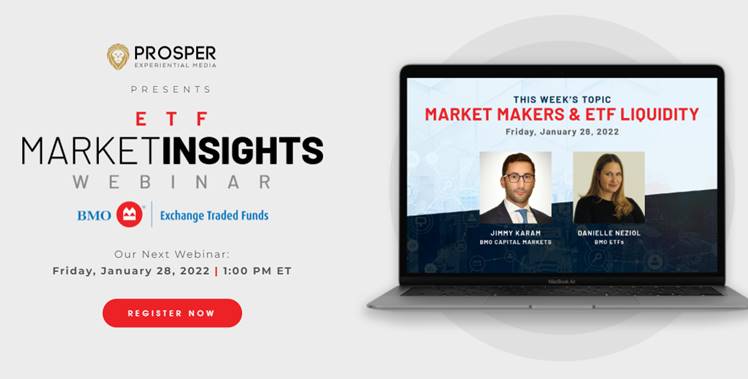
The True Liquidity of an ETF

By Danielle Neziol, Vice President, BMO ETFs

(Sponsor Content)

One of the most common questions we get from investors is, “If a certain ETF doesn’t trade often, or it has a low ETF trading volume, will I be able to sell the ETF when I need to?” The quick answer is yes you can, and I’ll explain why.

This liquidity concern makes sense when we think about trading stocks. A stock which is thinly traded will be much less liquid than a large cap, blue chip stock. Therefore, the less liquid stock could be difficult to sell if there is not demand for it.

However, ETFs work differently than stocks in this way. The true liquidity of an ETF has three layers. These three layers are something we can’t easily see. In fact, most volume data available to investors online is only showing the tip of the liquidity iceberg.

1.) Natural Liquidity: Buyer/Seller

The first layer that most investors are familiar with is between the natural buyer and the natural seller, who get matched on the exchange. Think of this like going to Facebook Marketplace or Kijjiji to sell your car. These marketplaces will match a buyer with a seller. Both will agree on a predetermined price and the transaction is made. This layer of liquidity is mostly present among the largest and most liquid ETFs in the market (usually those with a billion or more in assets).

2.) Market Makers: Buyer/Market Maker/Seller

The second layer of liquidity uses market makers. Marker makers are dealers or brokers who hold an inventory of ETFs and will either buy ETFs or sell ETFs depending on supply and demand. A market maker is trade agnostic which means they are always willing to buy and sell; they make their money in trading volumes (earning commissions on each trade). This trading strategy would be like going to a car dealership to buy or sell a car. The dealer acts as a market maker, who will buy your car and sell to someone else, and they usually earn a spread on this transaction. Market makers are often who you will “meet” on the other end of your ETF trades and they play a huge part in a healthy and liquid ETF ecosystem!

3.) Creations & Redemptions: ETF Provider/Buyer or Seller/ETF Provider

The third layer of liquidity is called the Creation and Redemption Process. ETFs have this ability because they are open-ended funds. The process occurs when there is an imbalance in supply or demand for a specific ETF. If demand is high, there will be more creations. This means the ETF provider (for example, BMO ETFs) will create more shares of an ETF to match demand. This is simply done by purchasing the stocks that the ETF holds, turning it into an ETF, and then passing it on to the buyer. If supply is high and demand is low, there will be more redemptions. This means that the seller will send their ETF back to the ETF provider, the provider will disassemble it and sell the underlying stocks in the market, sending cash back to the ETF seller. Think of this trading strategy like ordering a car directly from the auto manufacturer; they will go and buy all the parts for the vehicle, build it, and deliver you the car. A redemption would be the opposite where a car would be sold back to the auto plant and disassembled and sold off for parts (this is of course not how things are done in the auto world but a good example to visualize the process!). This last layer of liquidity is important to understand because it demonstrates that an ETF is as liquid as its underlying holdings of stocks or bonds.

Because of these three layers of liquidity, an ETF can sometimes be more liquid than its underlying holdings. We typically see this in less liquid asset classes such as preferred shares and fixed income, where the ETF will be easier to trade than the underlying holdings. Therefore, the increased liquidity of an ETF is just another of the many benefits of using ETFs in your portfolio!

To watch our webinar on ETF Liquidity and Market Makers please visit www.etfmarketinsights.com to register or catch the replay on our YouTube channel www.youtube.com/etfmarketinsights

Danielle Neziol has been part of the BMO ETF Team for over five years working in ETF product development, strategy, and most recently in ETF education for direct investors. In the past she has been engaged with with the exchanges, capital markets desks, index providers and portfolio managers to bring ETFs to market and today she is focused mostly on applying her expertise in the ETF business to support and educate investors.

Vanguard 2022 Outlook projects lower 10-year returns for 60/40 portfolios

Vanguard Global Economist Joe Davis: Vanguard.com

Returns on the traditional 60% stocks/40% bonds balanced portfolio are expected to be roughly half of what investors realized over the last decade, according to the Vanguard Group’s 2022 Economic and Market Outlook, which is being released today (Monday, Dec. 13).

Global stocks are expected to outperform U.S. stocks bonds significantly over the next ten years while US and global bonds will be in the range of 1.3% to 2.4% annualized ,

Here are Vanguard’s 10-year annualized return projections:

  • Global equities: 5.2% – 7.2%
  • U.S. equities: 2.3% – 4.3%
  • Global bonds: 1.3% – 2.3%
  • U.S. bonds: 1.4%– 2.4%

The report issued by Valley Forge, PA-based Vanguard is titled Striking a better balance: ironic given its projections for performance of balanced portfolios.

“The road ahead for investors promises to be a challenging one,” said Joe Davis, Vanguard’s global chief economist and co-author of the report. “Global markets will test investors’ discipline as they navigate the risks of unwinding monetary policy support, slower growth, and rising real rates.”

In an advance webinar aired last Thursday, Davis said: “Wage inflation will dictates the pace of rate hikes in 2022.” He said the US Federal reserve is likely to raise rates to at least 2.5% this cycle in order to maintain price stability. As for stocks, we are in an era of “high valuations and low rates,” which creates a “fragile backdrop for markets ….[which] will chip away at future returns.” Better valuations are in developed markets outside the US, small-caps and Value. More stretched valuations are in Emerging Markets, the US, Growth and Large-cap, Davis said.

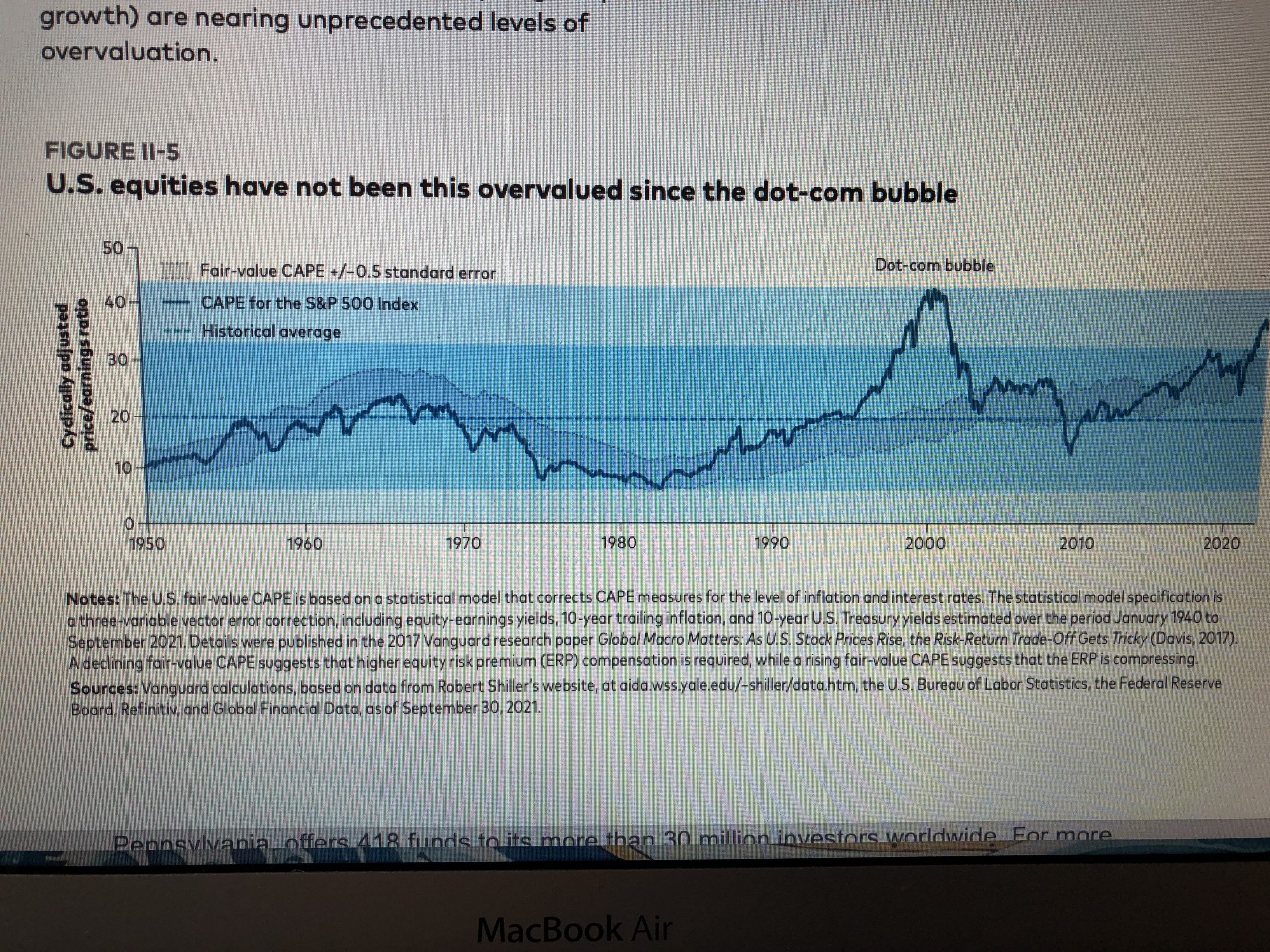
US equities have not been this overvalued since the dot-com bubble, Davis said, adding that a secular decline in rates has been three decades in the marking.

For Bond markets, best values is in TIPS and short-term treasuries. Most stretched are long-term treasuries, mortgage backed securities and international credit. In between are intermediate treasures and high-yield bonds.

Policy accommodations

In Monday’s press release, Vanguard said challenges are likely to be most evident with the unwind of monetary policy, a critical factor in 2022 as central bankers assess a rapidly evolving economic landscape. Inflationary pressures have sharpened the focus on monetary policymakers as these pressures may drive changes in central bank communications and actions. Vanguard projects that central banks will largely try to avoid sharp and unexpected shifts in the timing of policy changes, particularly of policy rate increases, but that conditions will force them to act in 2022 and quite possibly by more than markets are anticipating.

Economic outlook

With the global economic recovery expected to continue in 2022, Vanguard economists foresee the low-hanging fruit of rebounding activity to give way to slower growth, regardless of supply- chain dynamics. In both the U.S. and the Euro area, Vanguard expects economic growth to normalize to 4%. In the U.K., Vanguard expects growth of about 5.5%, and in China, expectations are that growth will fall to about 5%.

Inflation

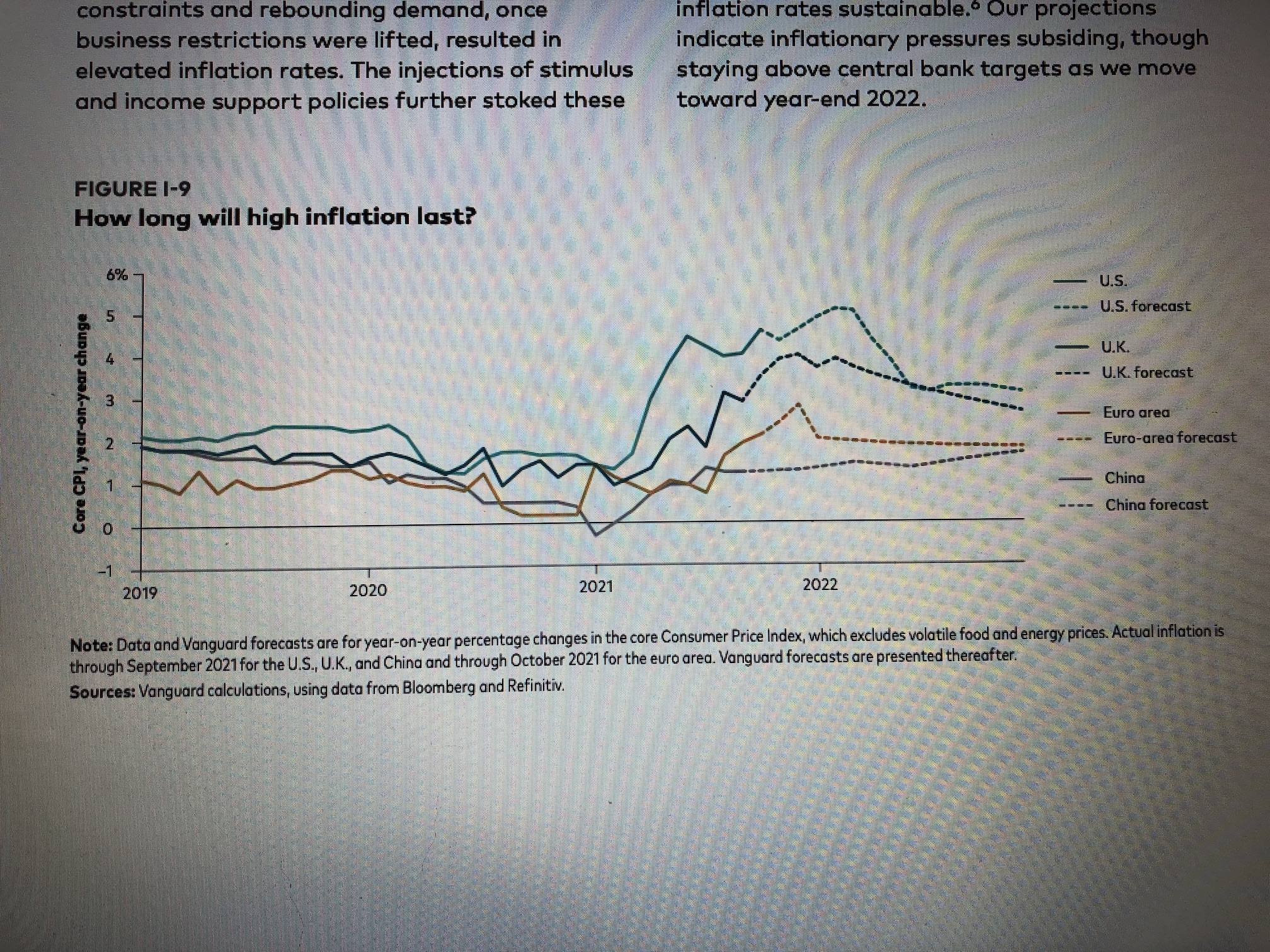
Vanguard expects labor markets will continue to tighten, with several major economies quickly approaching full employment. Vanguard estimates the cyclical effects of supply constraints will persist well into early 2022 and then normalize as the structural deflationary forces of technology and unemployment take hold again. These factors contribute to expectations that inflation will trend higher for some time before slowing in the second half of 2022.

Don’t fear a “lost decade” for US stocks but a lower-return one

Vanguard’s long-term outlook for global asset returns for 2022 and beyond remains guarded, particularly for equities where valuations are high and low real interest rates continue to act as a strong gravitational pull on future returns. Investors should not fear a “lost decade” for U.S. stocks, but rather, a lower-return one, it says. For fixed income, low interest rates mean investors should expect lower returns. However, because rates have risen modestly since 2020, Vanguard’s outlook is commensurately higher.

International equities will outperform US in coming decades

Given the differences in valuations between the U.S. and non-U.S. developed markets, Vanguard projects international equities will outperform U.S. equities in the coming decades and value stocks will outperform growth in the U.S.

It says investors are best served in a broadly-diversified portfolio, including international equities.

“While the economic recovery is expected to continue through 2022, easy gains in growth from rebounding activity are behind us, and policy will replace health as the leading consideration for investors,” Davis said, “Despite a potential low-return environment, we are still expecting a positive premium for bearing equity risk. Investors should continue to focus on what they can control, and if they have the patience to weather potential periods of underperformance, we believe accepting some active risk offers the opportunity to offset low future returns.”

Inflation: Transitory with a Twist

At the advance webinar, Vanguard America’s Senior Economist Roger Aliaga-Diaz projects inflation to be “Transitory with a Twist.” He foresees only a modest decline in inflation in 2022. Central banks, including the Fed, will have to normalize sooner than later. “We may see next week [i.e. this week: Dec. 13 to Dec 17] accelerating tapering but not likely to hike rates.” He expects “one or two” hikes in the second half of 2022. Inflation will be around 5% early in 2022 but this should be in the low 3s by the end of 2022. Continue Reading…

Stocks expected to keep outperforming bonds next 10 years: Franklin Templeton


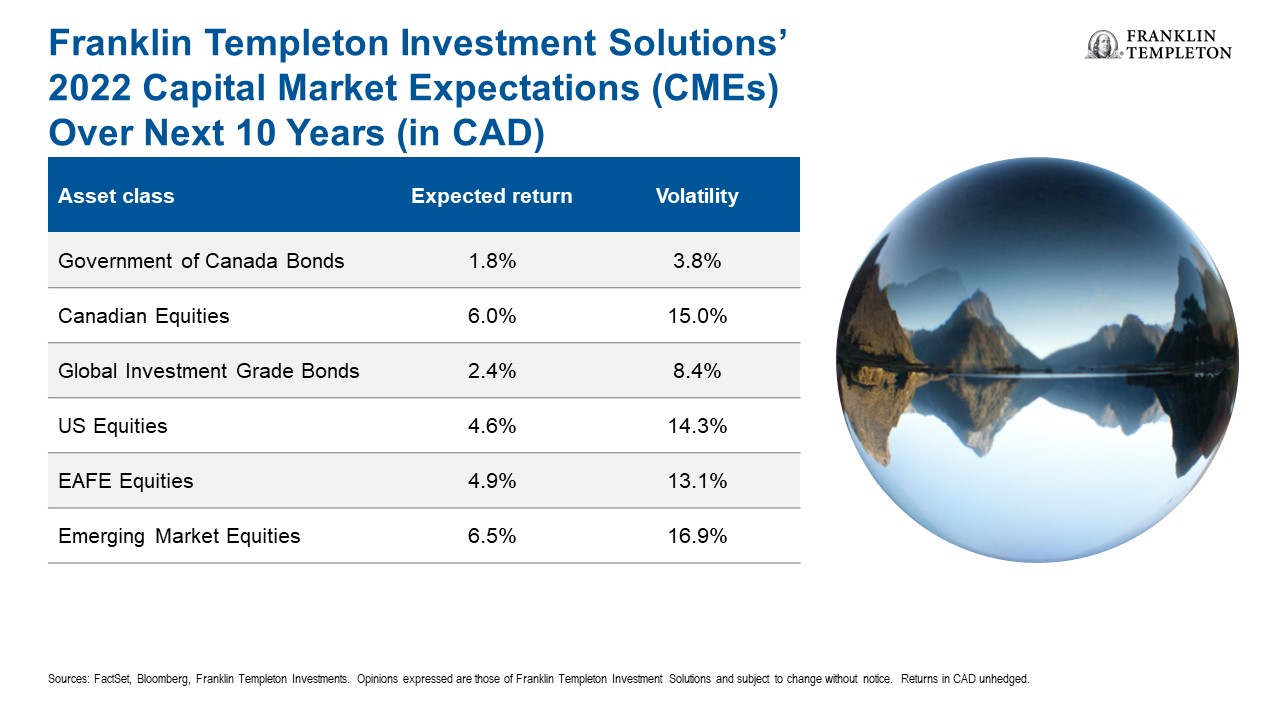
Investors should expect North American and international equities to continue to outperform bonds over the next ten years, according to senior portfolio managers for Franklin Templeton Investment Solutions. As the accompanying chart illustrates, expected returns for equities the next 10 years range from a 4.6% for US stocks to a high of 6.5% for Emerging Markets stocks. Canadian stocks are expected to do almost as well, at 6%, and EAFE equities will also outperform US stocks, with retiring expectations of 4.9%.

Returns for bonds are more modest: Franklin Templeton projects 1.8% return for Government of Canada Bonds and 2.4% for Global Investment Grade Bonds. The chart shows the volatility, topped by Emerging Markets at 16.9% and Canadian equities at 15%.

The forecasts were provided Tuesday at a virtual webinar at the Franklin Templeton 2022 Global Investment Outlook.

3% Global Growth should keep pace with Inflation

Over the next 7 to 10 years, the firm expects 3% annual global growth, roughly keeping up with inflation, said CFA William Yun, executive vice president for Franklin Templeton Investment Solutions. Over that time, equities should outperform fixed income and non-US equities should outperform US equities, he said.

Looking to Canada, Canadian stocks should have slightly higher expected returns, albeit with greater volatility, said Senior Vice President Ian Riach. The outperformance will be because of lower  “more reasonable” valuations for Canadian stocks, he added. “We are quite positive on the Energy and Financial Services sectors.”
Continue Reading…

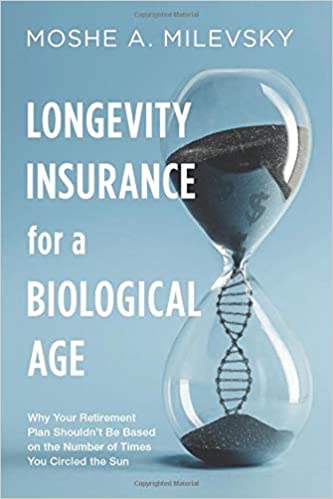
Moshe Milevsky Q&A part 2: Longevity Insurance for a Biological Age

Amazon.ca

On Friday, the Hub republished the first part of a two-part Question-and-Answer session between finance professor and author Dr. Moshe Milevsky and Gordon Wiebe of The Capital Partner [TCP]. This is the second and final instalment:

TCP: I wanted to turn to your Book, Longevity Insurance for a Biological Age. Your thesis is that we should be  looking at our biological age and using that to calculate and project our income and how much we should be drawing from our savings.

M.M.  And, more importantly than that, making decisions in our personal finances, right?

You know, somebody is trying to figure out at what age they should take C.P.P. Should I take it at 60? 65? 70?I don’t think they should use their chronological age to do that.

Trying to figure out when to retire? Stop using your chronological age.

I mean there’s a whole host of decisions that you have to make based on age and I’m saying we’re using the wrong age metric. It should be based on your biological age.

Now, at this point, biological age sounds like this funny number that comes out of some website, but sooner or later we’ll all have it. And, it’s going to be faster than you think. Your watch will tell you your biological age. And, then in a couple of years, people will stop associating themselves with their chronological age.

They will just stop using it.

And you’re going to sit down with your antiquated compliance driven forms that say, “I need to know my client’s age. Oh, you’re 62.”

And, the client says, “Ha, ha. That’s chronological age. We don’t use that anymore, buddy. I use biological age. Sixty-two, that’s not my age.”

It’s about preparing people for the world in which age is not the number of times we circle the sun.

TCP: What metrics do you think we’ll lean towards to measure biological age? Telemeres? Others?

M.M. There’s a whole bunch of bio-markers that can be used. Some people use telomeres or something called “DNA methylation” or epigenetic clocks. There are about fifty of them, but eventually they’ll all coalesce into a number called “biological age.”

There will be a consensus on how to measure it and you’ll go to your doctor and your doctor will say, “your chronological age is 50, but your biological age is 62.” You’re doing something wrong.

Then a financial advisor will use that information differently when you build a retirement plan.

TCP: That makes sense, but trying to achieve a consensus and getting everyone to use the same metrics from a compliance standpoint or trying to get pension plans and policy makers to agree would be a challenge, wouldn’t it?

MM: It would be. In fact, that’s exactly where I’m headed now. I’m giving a speech in Madrid and that’s exactly what regulators from a number of different countries want me to talk about.

They want to know, “is this feasible? We want to implement this in our pension system. We don’t want wealthy people retiring at the age of 65, they’re going to live forever and bankrupt our system. We want people to retire at a biological age.”

TCP: Let’s talk about that a little more. Advisors typically use a 4% draw on savings as a benchmark withdrawal rate. But, if we use our biological age, there would then be a range. I assume somewhere between 3-6%?

Adjusting the 4% Rule

M.M. You’re absolutely right. That’s where I would go with this. You have to use your biological age and the 4% rule has to be adjusted.

But, what I’m saying is more than that. That rule has to change. It’s not just about the number or percentage. It’s how the rule is applied.

I really don’t like the idea of fixing a spending rate today and sticking to it for the rest of your life no matter what happens. Your spending rate has to be adaptable.

What you have to tell people is, “look, this year we can pull out 6.2%. Next year, it really depends on how markets  behave. If markets go down, we may have to cut back. If markets go up, we can give you a bit more.”

I think the 4 per cent rule is really what I call a one-dimensional rule. It’s not that four is one dimensional. Any one number is one dimensional: just telling them a per cent.

It’s got to be at least two dimensional. Meaning, this is what it is now, but next year if this is what happens we’ll do that. ..

Three dimensional is to go beyond that is to go beyond that and say let’s take a look at what other income and assets you have.

“Oh! You’ve got a lot more income from guaranteed sources, you can afford more than four per cent, this year.”

TCP: It’s a dynamic scenario, a moving target.

M.M. That’s the key word, dynamic versus static.

The threat of rising Interest Rates

TCP: Canadian investors currently have over two trillion invested in mutual funds. Over half is invested in balanced funds or fixed income and we’re in a horrible position where fixed income is concerned. We’ve had declining rates for the past forty years. At best, bonds will stay flat. At worst, bonds could lose up to thirty per cent of their value.

You talk about the importance of the sequence of returns and how that affects income potential. Have you or your students run scenarios with higher interest rates and the impact it could possibly have?

M.M.  I haven’t thought about it beyond what you’re noting. The obvious scenario is as interest rates move up, these things are going to take a big hit.

And, retirees who feel they’ve been playing it safe by putting funds in bonds will suddenly realize there’s nothing safe about bonds in a rising interest rate environment.

I think they’re confusing liquidity and safety with interest rate risk. It’s liquid and its safe. Government is not going to default but boy, can it lose its value.

We’ve become accustomed to this declining pattern. Anybody who is younger than forty doesn’t even understand what higher interest rates means. It’s never happened in their lifetime. They don’t believe it. Understand it. Never felt it. You show them graphs going back to the 1970s. That’s not how to convince them. They’re empiricists. They’ve never lived it themselves, they don’t believe you. Continue Reading…