Tag Archives: bonds

Looking to start Investing? 5 tips for Beginners

By Charles Qi, CFA

Special to the Financial Independence Hub

Many of us are familiar with the benefits of investing. Whether you’re looking to save for retirement, earn money in the stock market, or achieve some other financial goal, investing — when done well — can help you build your financial future. But if you’re not professionally trained in the stock market, starting out can be daunting.

Whatever the reason someone has for dipping their toes in the investing waters, starting out can be daunting. There’s a lot of math involved, tricky rules, and an entire lexicon of investing terms to remember. Those who are not scared away may be wondering where to start.

Despite these fears and uncertainties, though, leaping off the investing cliff can help build a foundation toward financial freedom. Here are five tips for new investors looking to get started in the stock market.

1. Set an Investment Budget

It can help to make investment contributions part of a normal household budget. By setting aside a predetermined amount of funds to funnel into investment accounts each month or pay period, one can rest assured that their accounts are being regularly funded, even as the market rises and falls. A good investment goal is typically between 10% to 15% of your income. If one is enrolled in an employer sponsored retirement plan, their match counts towards that percentage goal.

2. Start Investing as Early as Possible

Finances can be tight when someone is just beginning to invest, even with a job that pays their bills. However, once you’re able to allocate a portion of your monthly income to investing in the stock market, it’s beneficial to start investing as soon as possible.

The earlier one begins to invest, the longer they can allow compound interest to accumulate. Compound interest is how your investments grow. For example, if you have an account that pays 1% interest per year and you deposit $1,000 into that account, you would earn $10 on that money in one year. Average rates of return can fluctuate year by year, so make sure that you check out the rate of return on any stock or money market account you may be interested in.

3. Learn Basic Investing Terminology

While those just beginning to invest don’t need to know everything off the bat, there are a few terms they will need to familiarize themselves with to help them make smart investment decisions. For example, what is a money market account, anyway? How about an IRA? Continue Reading…

5 Reasons why the 60/40 Portfolio is NOT Dead

By Bilal Hasanjee, Senior Investment Strategist, Vanguard Canada

Special to the Financial Independence Hub

In the current record-breaking inflation and rising interest rate environment across all major markets, stocks and bonds have declined in values simultaneously.

As a result, many analysts and commentators have speculated on the death of the 60% stock/40% bond portfolios. But we have seen this before. Based on Vanguard’s research, balanced portfolios have proved critics wrong before and we believe they will prove them wrong, again. Here are five reasons why a 60% stock/40% bond portfolio is NOT dead.

Reason 1: Stock-bonds simultaneous decline is not long lasting

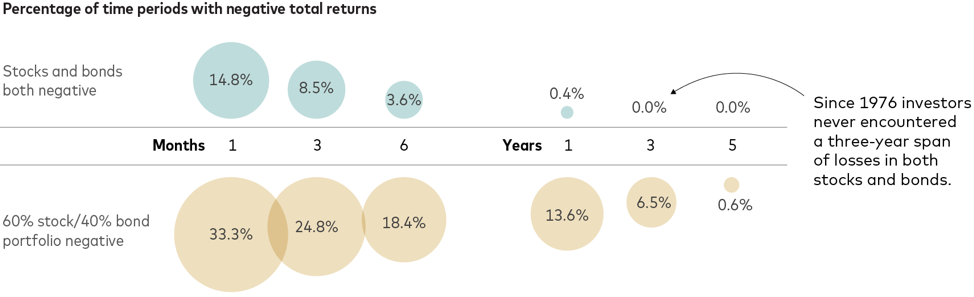
A simultaneous decline or positive correlation in stocks and bonds has typically not lasted long and the phenomenon has never occurred over a three-year span. A similar trend is visible on a 60/40 (stocks/bonds) portfolio.

Drawdowns in 60/40 portfolios have occurred more regularly than simultaneous declines in stocks and bonds; however, their frequency of occurrence also declines over longer periods. More regular occurrence is due to the far-higher volatility of stocks and their greater weight in that asset mix. One-month total returns were negative one-third of the time over the last 46 years. The one-year returns of such portfolios were negative about 14% of the time, or once every seven years or so, on average.

Figure 1

Source: Vanguard

Data reflect rolling period total returns for the periods shown and are based on underlying monthly total returns for the period from February 1976 through April 2022. The S&P 500 Index and the Bloomberg US Aggregate Bond Index were used as proxies for stocks and bonds.

Past performance is no guarantee of future returns. The performance of an index is not an exact representation of any particular investment, as you cannot invest directly in an index.

Stock-Bonds correlation remains negative in the long term

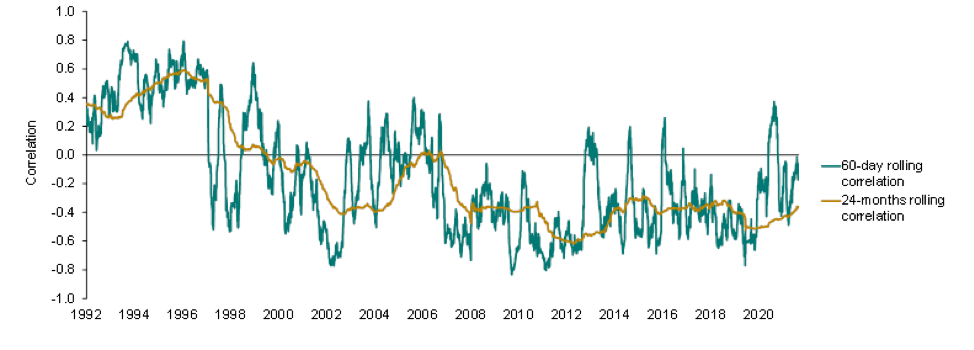
Our study of 60-day and 24-month stock-bonds rolling correlations from 1992 to 2022 suggests that over a long-term, correlation between stocks and bonds remains negative. That said, long-term inflation is one of the determinants of correlation between the two asset classes

Figure 2: Long-term correlations expected to remain negative

Notes: Rolling correlations are calculated on total returns of the S&P 500 Index and the S&P U.S. Treasury Bond Current 10-year Index, using daily return data for the period between 1989 and May 31, 2022.

Sources: Vanguard, using data from Refinitiv, as of May 31, 2022. Past performance is no guarantee of future returns.

The performance of an index is not an exact representation of any particular investment, as you cannot invest directly in an index.

Reason 2: Long-term expected returns from 60/40 are still achievable

The goal of a 60/40 portfolio is to achieve long-term annualized returns of roughly 7%. This is meant to be achieved over time and on average, and not every year. The annualized return of 60% U.S. stock and 40% U.S. bond portfolio from January 1, 1926, through December 31, 2021, was 8.8%.1 On a forward-looking basis, Vanguard Capital Markets Model (VCMM) projects the long-term average return to be around 7% for the 60/40 portfolio, over the next 10 years. Market volatility means diversified portfolio returns will always remain uneven, comprising periods of higher or lower: and, yes, even negative returns.

The average return we expect can still be achieved if periods of negative returns (like this year) follow periods of high returns. During the three previous years (2019–2021), a 60/40 portfolio delivered an annualized 14.3% return, so losses of up to –12% for all of 2022 would just bring the four-year annualized return to 7%, back in line with historical norms.

Our forecast points to improved stocks and bond returns

On the flip side, the math of average returns suggests that periods of negative returns must be followed by years with higher-than-average returns. Indeed, with the painful market adjustments year-to-date, the return outlook for the 60/40 portfolio has improved, not declined. Driven by lower equity valuations and higher bond yields, our 10-year annualized average return outlook for the 60/40 is now higher by 1.3 percentage points than before the recent market adjustment.

Reason 3: Selling bonds in a rising rate environment is like selling low and buying high (in short, don’t try to time the market)

Chasing performance and reacting to headlines are doomed to fail as a timing strategy every time, since it amounts to buying high and selling low. Far from abandoning balanced portfolios, investors should keep their investment programs on track, adding to them in a disciplined way over time. Continue Reading…

Real-Return Bonds and How They Compare to Regular Bonds

Real-Return Bonds Pay A Return Adjusted For Inflation. But When You Buy A Real-Return Bond, You Are Only Protecting Yourself Against Unanticipated Rises In Inflation.

Real-return bonds pay you a rate of return that’s adjusted for inflation, but that’s not always as promising as it seems.

When a real-return bond is issued, the level of the consumer price index (CPI) on that date is applied to the bond. After that, both the principal and interest payments are typically adjusted every six months, upwards or downwards from that base level, to compensate for a rise or fall in the CPI. In general, Government of Canada real-return bonds pay interest semi-annually, on June 1 and December 1.

Look at this theoretical example to understand how a real-return bond works

The Bank of Canada issues $400 million of 30-year bonds maturing on December 1, 2049. The bonds have a coupon, or interest rate, of 2%.

If after six months from the date of issue, the new CPI level is, say, 1% above the level of the CPI on the issue date, then each $1,000 of bond principal is adjusted to $1,010 of bond principal ($1,000 x 1.01). The semi-annual interest payment is then $10.10 ($1,010 x 2% / 2).

If after 12 months, the level is 2% higher, then the bond principal is adjusted to $1,020 ($1,000 x 1.02), and the interest payment rises to $10.20 ($1,020 x 2% / 2).

Consider these three important factors to realize benefits with real-return bonds

  1. The price you pay for real-return bonds reflects the anticipated rate of inflation. In other words, if investors feel that inflation will rise 2% over the long term, the price of the bond will reflect that future inflation increase and its effect on the bond’s principal and interest payments. So, when you buy a real-return bond, you are only protecting yourself against unanticipated rises in inflation.
  2. When the inflation rate falls over a six-month period, the principal and interest payments of a real-return bond fall. In times of deflation, the inflation rate turns negative. In a prolonged period of deflation, the principal of a real-return bond could fall below the purchase price. Interest payments would fall, as well.
  3. As with regular bonds, holders of real-return bonds must pay tax on interest payments at the same rate as ordinary income. That income gets taxed at the investor’s marginal rate. In addition, holders of real-return bonds must also report the amount by which the inflation-adjusted principal rises each year, as interest income, even though you won’t receive that amount until the bond matures. That amount is added to the bond’s adjusted cost base.

Continue Reading…

MoneySense ETF All-Stars 2022

MoneySense has just published its annual feature, the ETF All-Stars 2022. For the first time in several years, I was not the lead writer on this package although I was involved in my role as Investing Editor at Large. We passed the writing reins to veteran financial freelance writer Bryan Borzykowski, who has previously written MoneySense’s annual Robo-advisor feature and is currently writing a new book to be titled ETFs for Canadians for Dummies.

As I point out in another MoneySense column, there is another ETF book published in 2021 that makes a good complement to the All-Stars package.  Reboot Your Portfolio is written by Dan Bortolotti of PWL Capital. Dan was the lead writer of the first edition of the ETF All-stars and served as a panelist for several subsequent years, along with his PWL colleague Justin Bender. In recent years, PWL advisors Ben Felix and Cameron Passmore have served as some of the panelists responsible for selecting the All-stars. The team of 8 panelists is unchanged from last year.

You can find the new edition of the All-stars by clicking here: Best ETFs in Canada for 2022.

As Bryan points out in his overview, by design, the panel didn’t make that many changes from previous years. The idea all along has been to provide a bunch of core low-cost, broadly diversified ETFs that don’t need to be changed every year. Certainly, the panel has never felt obliged to recommend brand new “theme” ETFs just for the sake of change.

Here’s my summary of the main changes:

Canadian Equities

No changes to last year’s lineup.

US Equities

The panel dropped the list of US equity ETFs from ten last year to seven this year.

International Equities

Last year’s picks return, plus the panel added three Emerging Markets ETFs: XEC, ZEM and EMXC.

Fixed Income

While Fixed Income has been a languishing asset class in recent months, the panel didn’t view this as alarming. Its previous lineup of Bond ETFs returns largely intact, with just one casualty: the panel decided to remove the Vanguard Global Bond ETF (VGAB.) For those who are nervous about more losses from rising interest rates, it continues to emphasize short-term bond ETFs like VSB and XSB

Note that in my recent MoneySense Retired Money column on the alleged Death of Bonds, I quote panelist Ben Felix, who still sees a role for fixed income in diversified portfolios. My column suggests those worried by rising rates can either park in treasury bills and wait for further interest rate hikes later this year, or ladder 1- and 2-year GICs every few months. Several 1-year GICs now pay close to 3%. That may be below the rate of inflation of late but at least  its beats losses of near 10% sustained by aggregate bond ETFs. Continue Reading…

Why this portfolio manager isn’t buying Bonds, and hasn’t for decades

Recently a friend asked, “Pat, I see that several prominent Canadian investor advisors recently wrote articles that said it’s a bad time to buy bonds right now. Do you agree?”

He was surprised when I told him I haven’t bought any bonds for myself since the 1990s. I haven’t bought any for clients in the last couple of decades, except on client request.

In the 1990s, I used to buy “strip bonds” for myself and my clients, as RRSP and RRIF investments. This was the Golden Age of bond investing. Back then, high-quality bonds yielded almost as much, pre-tax, as the historical returns on stocks. In addition, they provided fixed income that simplified financial planning.

Bonds have tax disadvantages, of course. But you can neutralize those disadvantages by holding your bonds in RRSPs and other registered plans.

The big difference back then was that bond yields and interest rates were much higher than usual. That’s because we were still coming out of (or “cleaning up after,” you might say) the inflationary bulge of the 1970s and 1980s.

In the 1980s, government policies pushed up interest rates and took other measures to hobble inflation, and it worked. But interest rates stayed high for a long time after the government polices broke the back of inflation: kind of like finishing the antibiotic after the infection goes away.

High-quality stocks vastly superior to Bonds

Long-time readers know my general view on the stocks-versus-bonds dilemma. When interest rates are as low as they have been in recent decades, high-quality stocks on the whole are vastly superior to bonds. (See below for a further explanation). However, you have to understand the differences between the two. For one thing, stocks are more volatile than bonds. But volatility and safety are two different things.

Volatility refers to sharp price fluctuations, often due to short-term uncertainty and the randomness of short-term market movements. Safety refers to the risk of permanent loss. Continue Reading…