Tag Archives: bonds

Short and Steady wins the race: The case for Short-term bonds

Franklin Templeton/Getty Images

By Adrienne Young, CFA

Portfolio Manager, Director of Credit Research, Franklin Bissett Investment Management

(Sponsor Content)

The phrase “hunt for yield” is by now a well-worn cliché among fixed income investors. Persistently low yields have led many investors to take on additional risk, and some have considered abandoning fixed income altogether.

We think this is a mistake. Even amid fluctuating yields, inflation jitters and pandemic-driven economic upheaval, fixed income can help maintain stability and preserve capital: if you know where to look.

Why Short-term now

For increasing numbers of investors, the short end of the yield curve is the place to be in the current environment. Short-term rates reflect central bank policy actions. Since the pandemic first took hold early in 2020, central banks have taken extraordinary measures to keep liquidity pumping into the marketplace, all without raising rates. Both the Bank of Canada and the U.S. Federal Reserve have so far left their overnight lending rates unchanged and have indicated their intent to continue along this path well into next year, and possibly longer. This predictability has stabilized, or anchored, short-term rates. In contrast, longer maturities have been prone to volatility as the stop-and-go nature of the pandemic has influenced economic reopening, inflation expectations and financial markets.

Franklin Bissett Short Duration Bond Fund is active in short-term maturities, with an average duration of 2-3 years. About 30% of the portfolio is held in federal and provincial bonds; most of the remaining 70% is invested in investment-grade corporate bonds.

Beyond stability, investments need to make money for investors. In this fund, duration and corporate credit are important sources for generating returns. Historically, the fund has provided investors with better returns than the FTSE Canada Short Term Bond Index1  or money market funds, and with comparatively little volatility.

In It for the Duration

Duration is a measure of a bond’s sensitivity to interest rate movements. Imagine the yield curve as a diving board, with the front end of the curve, where short-term rates reside, anchored to the platform. Like a diver’s body weight, pandemic-driven economic forces have placed increasing pressure further out along the curve. The greatest movement ― expressed as volatility ― has been at the long end, especially in 30-year government bonds. Currently, the fund has no exposure to these bonds.

Cushioned by Corporates

Corporate debt provides a cushion against interest rate volatility, and a portfolio that includes carefully selected corporate securities as well as government debt can therefore be a bit more protective. In addition, the spread between corporate and government bonds can provide excess returns.

We believe it is not unreasonable to anticipate stronger Canadian economic and corporate fundamentals in 2021 and 2022, as well as continued demand for bonds from yield-hungry international investors. These conditions support a continuation of the current trend of a slow grind tighter in spreads, with higher-risk (BBB-rated) credits outperforming safer (A and AA-rated) credits.

Credit Quality is Fundamental

In keeping with Franklin Bissett’s active management style, in-house fundamental credit analysis is a key element of our investment process for the fund. Unless we are amply compensated for both credit and liquidity risk (particularly in the growing BBB space), at this stage of the economic cycle we prefer higher-quality credit. We look for strong balance sheets, good management teams, excellent liquidity, clear business strategy and larger, more liquid issues. Continue Reading…

A look at BMO Asset Allocation ETFs

This article has been sponsored by BMO Canada. All opinions are my own.

I’m on record to say that the vast majority of self-directed investors should simply use a single asset allocation ETF to build their investment portfolios.

What’s not to like about asset allocation ETFs? Investors get a low cost, risk appropriate, globally diversified portfolio in one easy to use product. It’s a fresh take on an old idea – the global balanced mutual fund – updated for the 2020’s using low-cost ETFs.

Investors don’t even have to worry about rebalancing their portfolio when they add or withdraw money, or when markets move up and down. Asset allocation ETFs automatically rebalance themselves regularly to maintain their original target asset mix.

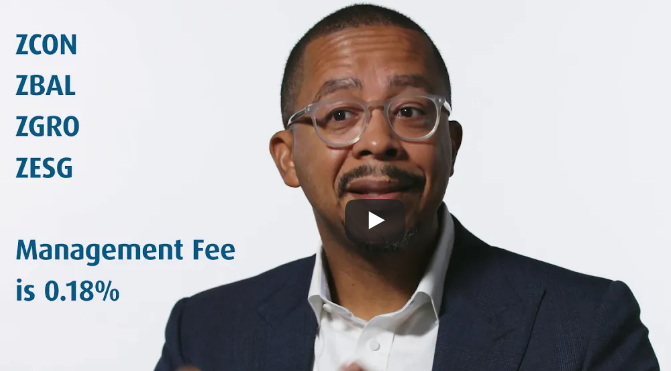
This article looks at BMO’s line-up of asset allocation ETFs, which include a conservative (ZCON: 40/60), balanced (ZBAL: 60/40), growth (ZGRO: 80/20), and balanced ESG (ZESG: 60/40) option.

For a YouTube video about these ETFs, click here.

These BMO asset allocation ETFs are available for self-directed investors to purchase through their online brokerage account. Notably, these ETFs can be traded commission-free through BMO InvestorLine and Wealthsimple Trade.

What’s inside BMO’s Asset Allocation ETFs?

Launched in February 2019, BMO’s core asset allocation ETFs are made up of seven underlying ETFs representing various asset classes and geographic regions.

On the equity side we have:

  • ZCN – BMO S&P/TSX Capped Composite Index ETF
  • ZSP – BMO S&P 500 Index ETF
  • ZEA – BMO MSCI EAFE Index ETF
  • ZEM – BMO MSCI Emerging Markets Index ETF

While on the fixed income side we have:

  • ZAG – BMO Aggregate Bond Index ETF
  • ZGB – BMO Government Bond Index ETF
  • ZMU – BMO Mid-Term US IG Corp Bond Hedged to CAD Index ETF

Altogether these seven ETFs represent nearly 5,000 individual stock and bond holdings from around the world.

In terms of geographic equity allocation, the BMO asset allocation ETFs hold 25% in Canadian stocks, 25% in international stocks, 40% to 41.25% in US stocks, and 8.75% to 10% in emerging market stocks.

BMO reviews their portfolios quarterly and will rebalance any fund that is more or less than 2.5% off from its target weight. In reality, these funds are rebalanced regularly with new cashflows from new investors.

BMO’s Balanced ESG ETF (ZESG) is made up of six underlying ETFs, including:

  • ESGY – BMO MSCI USA ESG Leaders Index ETF
  • ZGB – BMO Government Bond Index ETF
  • ESGA – BMO MSCI Canada ESG Leaders Index ETF
  • ESGE – BMO MSCI EAFE ESG Leaders Index ETF
  • ESGB – BMO ESG Corporate Bond Index ETF
  • ESGF – BMO ESG US Corporate Bond Hedged To CAD Index ETF

The management expense ratio for each of the BMO asset allocation ETFs is 0.20%. There is no duplication of fees or additional charges for the underlying ETFs. Continue Reading…

Why would anyone own bonds now?


By Mark Seed, myownadvisor

Special to the Financial Independence Hub

Many investors have been saying for years that rates can only go up from here, rates can only go one direction, rates will eventually go up. Will they? This begs a question I get from readers from time to time given bonds pay such lousy interest:

Why would anyone own bonds now?

Today’s post shares a few reasons to own bonds including some counter-arguments why I don’t own any – at least right now.

Why own bonds?

Personally, I believe the main role of fixed income in your portfolio is essentially safety – not the investment returns and certainly not the cash flow needs. In other words, if all else fails per se, if/when stocks crash, then bonds should historically speaking offer a flight to safety for preserving principal.

So, they are there for diversification purposes.

As Andrew Hallam, Millionaire Teacher has so kindly put it over the years: when stocks fall hard, bonds act like parachutes for your portfolio. Bonds might not always rise when the equity markets drop. But broad bond market indexes don’t crash like stocks do.

Is that enough to own bonds in your portfolio? Maybe.

Here are a few reasons to own bonds in no particular order.

1. Bonds as a hedge for stock market volatility.

Call them parachutes or anchors or use any other metaphor you wish but bonds tend to do their jobs when stock markets tank. More importantly maybe, they provide a psychological edge to avoid tinkering with your portfolio and selling any stocks/equities when stock markets correct.

Many investors, dare I say most investors (?), have a hard time with market volatility. I’m certainly not immune to it. The ups and downs, especially the big market downs, can be gut-wrenching to live through. Owning bonds in your portfolio can help bring the overall portfolio volatility down a few notches through prudent asset allocation. It is however not always necessary to own bonds.

When you own bonds, my experience has been for the last 20+ years you are trading away long-term, more positive, generous equity returns for accepting less risk and less long-term returns.

If you don’t want to take my word for it, check out this page courtesy of Vanguard when it comes to long-term returns. Check out the “worst year” stats as well.

Why would anyone own bonds - bias to bonds Vanguard Canada

Sure, a 40/60 stock/bond portfolio has hardly done poorly for the last century. But overall, you are absolutely giving up (historically speaking) returns on the table when you own more fixed income in your portfolio. Will the future be the same?

Why would anyone own bonds - bias to stocks Vanguard Canada

Personally, I’ve tried to learn to live with stocks as much as possible for as long as possible. Depending on your goals, taking into account long-term potential reward against short-term price fluctuations, some investors may not be comfortable with a 100% equity or near-equity portfolio. That’s A-OK. If that’s your case, some bonds in your asset accumulation years could be right for you.

2. Bonds can be used to rebalance your portfolio. 

Even though I’m not a huge fan of bonds myself, this might be one of the most compelling reasons to own bonds at any age.

When the stock market sells off, that’s ideally the time you want to dive in and buy your stocks on sale. However, unless you are very comfortable with leveraged investing – you need money to buy such stocks on sale. That can come from cash savings for sure but for many investors, that can also come from bonds within your portfolio.

Mind you, some levels of diversification don’t work very well if you don’t have any asset allocation targets in mind. The process of rebalancing is a systematic way to buy low and sell high; sell your bonds when markets are tanking and sell-off some stocks when markets are euphoric.

In our portfolio, because we’ve largely learned to live with stocks, we tend to buy more stocks when they come on sale and/or we buy stocks periodically during the year to increase our equity holdings. More specifically, to help me gravitate away from my bias to Canadian dividend paying stocks for income we’re owning more low-cost U.S. ETFs for extra growth over time.

Check out some changes I’ve made to our portfolio to increase equity diversification.

Instead of selling bonds to buy our stocks, I use cash savings. I tend to save up cash during the year and make a few lump-sum stock or equity ETF purchases instead.

I will continue to use cash savings to make more equity purchases as I enter semi-retirement.

Consider keeping this much cash on hand yourself – in your asset accumulation years or retirement years.

3. Bonds can be used to spend cash when essential. 

Can you have too much money saved? Too much money in your RRSP?

For most people, I highly doubt it.  Continue Reading…

Overlooked retirement income and planning considerations

By Mark Seed, MyOwnAdvisor

Special to the Financial Independence Hub

I’ve updated this retirement income planning post to reflect some current thoughts. Check it out!

I’ve mentioned this a few times on my site: there is a wealth of information about asset accumulation, how to save within your registered and non-registered accounts to plan for retirement. There is far less information about asset decumulation including approaches to earn income in retirement.

Thankfully there are a few great resources available to aspiring retirees and those in retirement – some of those resources I’ve written about before.

Retirement income and planning articles on my site:

One of my favourite books about generating retirement income is one by Daryl Diamond, The Retirement Income Blueprint

An article about creating a cash wedge as you open up the investment taps.

A review about The Real Retirement.

These are six big mistakes in retirement to avoid.

A review of how to generate Retirement Income for Life.

This is my bucket approach to earning income in retirement.

Here are 4 simple ways to generate more retirement income.

Can you have too much dividend income? (I doubt it!)

Other resources and drawdown ideas:

Instead of focusing on the 4% rule, you can drawdown your portfolio via Variable Percentage Withdrawal (VPW).

A reminder the 4% rule doesn’t work for everyone. Some people ignore the 4% rule altogether.

Getting older but my planning approach stays the same

As I get older, I’m gravitating more and more this aforementioned “bucket approach” for retirement income purposes. This bucket approach consists of three key buckets in our personal portfolio to address our needs:

  • a bucket of cash savings
  • a bucket of dividend paying stocks
  • a bucket of a few equity Exchange Traded Funds (ETFs).

My Own Advisor Bucket Approach May 2019

How the Asset Allocation in your ETF can help drive Returns  


By Kevin Prins, BMO ETFs

(Sponsor Content)

“Diversification” is a word that gets thrown around a lot these days: and for good reason. A diverse and balanced portfolio can help provide more consistent returns versus individual securities. The asset allocation of your exchange traded funds (ETFs) is of paramount importance to help provide more consistent returns and targeting an appropriate portfolio risk level.

The good news is that ETF providers have provided choice in a range of all-in-one portfolios that are delivered as an ETF on the exchange. Now you can choose from a diverse mix of both domestic and foreign equities and fixed income.

Coupled with your specific investment goals and tolerance for risk, you can rather easily determine which ETF is a good fit for you by considering its strategic asset allocation relative to your needs.

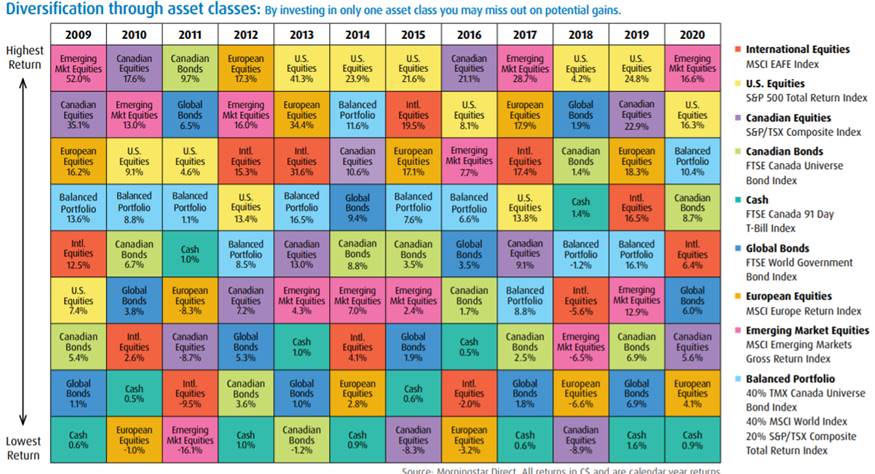
Strategic Asset Allocation vs. Chasing the Asset Class with the highest return

Predicting the top performing asset class year to year is extremely difficult and, when poorly executed, can lead to disappointing results for your portfolio.

But with a diversified Asset Allocation ETF, you can take all the guesswork out of investing.

In other words, your portfolio’s fortunes aren’t tied to a single asset class, making it far more resilient, while simultaneously increasing your chance of having exposure to markets when they have bull runs.

Many investors who try to do it themselves will rely on friends, market research, or maybe even an investment blog to help them pick the securities that will comprise their portfolio.

But this can be time-consuming and risky. Not to mention that these portfolios tend to be under diversified.

You’ll gain exposure to both fixed income and equities with a balanced asset allocation ETF. What’s more, you can avoid one of the common pratfalls of overweighing your portfolio with Canadian securities and instead take a global approach, again helping improve your portfolio’s balance.1

You’ll also be exposed to both cyclical and defensive sectors, ensuring that your portfolio is designed to perform well in a variety of economic conditions.

The fixed income/equity balance is of importance, as this has the potential to bolster your portfolio with both security and reliable income, while also adding growth potential and inflation protection.


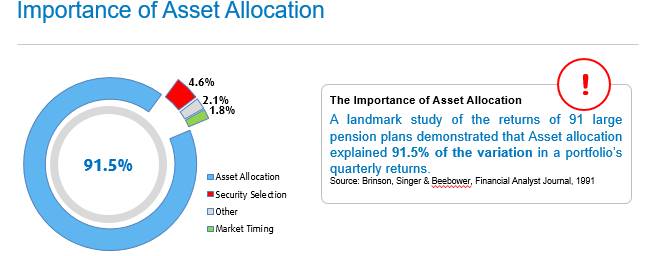
It’s worth stating that a portfolio’s strategic asset allocation will more than likely have a higher impact on its performance than even the individual stock selection, as the graphic above indicates. 2

That’s because opting for a conservative, balanced, and or growth portfolio and investing in asset classes based on your preferences will play the determining role in how to allocate your investment.

Whatever your investment goals, an approach predicated on strategic asset allocation can help you reach them.

8 Reasons to look at Asset Allocation ETFs 

  1. Simplified Investing: An all-in-one investment solution that provides instant market exposure
  2. Broad Diversification: Holds a basket of ETFs that in themselves hold many securities
  3. Professionally Constructed: Leverage the asset allocation experience of industry professionals
  4. Automatic Rebalancing: This keeps one’s investment portfolio on track to risk and return objectives Continue Reading…