
Tag Archives: debt

5 common senior financial traps and how to avoid them

Scott Terrio’s Twitter feed (@CooperTrustee) reads like a financial horror story. Terrio, an insolvency expert at Cooper & Co. in Toronto, uses the 140-character medium to share the multitude of ways seemingly well-off Canadians end up buried in debt and turning to debt consolidation, consumer proposals, and even bankruptcy.

Canada’s record household debt levels have been a cause for concern for years, but Terrio sees a new problem on the horizon. Canadian seniors are the demographic increasing debt at the fastest rate.

Take Dorothy, an 81-year-old widow who owns a home with a 1st mortgage from a secondary lender. She refinanced a couple of years ago to do house repairs ($18,000), assist her son with divorce legal fees ($37,000), and to help her grandson with tuition ($8,500).

When her partner died she was no longer able to make the mortgage payments. A friend from church referred her to a mortgage broker.

The broker suggested a reverse mortgage,  which would let her stay in her house without the monthly mortgage payment. But the money from the reverse mortgage wasn’t enough to pay out the 1st mortgage after fees and penalties. She needed a private 2nd mortgage at 12 per cent to pay the balance.

Dorothy co-signed a $26,000 car loan for her nephew and co-signed with her son for funeral expenses ($12,000) for her partner. Her son stopped paying, so Dorothy was pursued (100 per cent).

She then ran into tax trouble by not having tax on her OAS & CPP deducted for the first few years. She owes $21,000 in tax, much of it penalties and interest.

This scenario is becoming more common among seniors today.

“Many are in a unique quandary. They’re asset-rich, but cash-poor. Cash flow is tight. Pensions are fixed, and many have underestimated retirement costs,” said Terrio.

So what do they do? Many seniors cash out assets to make ends meet. Others raid their home equity and take out lines of credit. All have financial consequences.

We asked Terrio to share the top financial traps seniors fall into and how to avoid them:

1.) Tax problems

Most seniors were used to being paid by their employers in after-tax dollars. At pension time, many don’t have taxes deducted to offset their Old Age Security and Canada Pension Plan income and therefore end up spending taxable pension income.

Continue Reading…

Retired Money: Cashing RRSP to pay off debt is a poor strategy

Should you cash in your RRSP to pay off debt? While some prospective retirees may be tempted to do so, this is one of a score of damaging financial myths, according to insolvency trustee and author Doug Hoyes.

I mention this in my latest MoneySense Retired Money column, which has just been published. You can retrieve it by clicking on the highlighted headline here: The wrong way to pay off Debt.

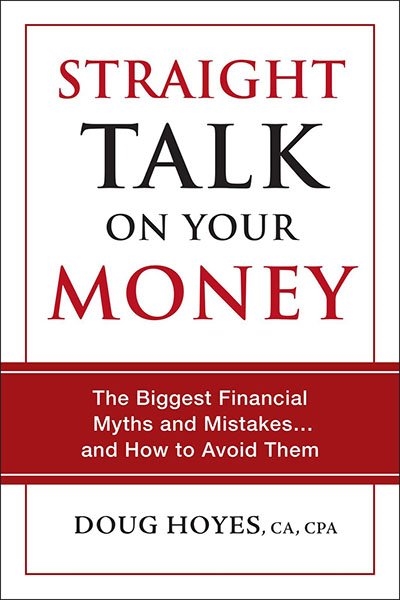
As I say in the article, Cashing in your RRSP to pay off debt is Myth #9 of 22 common financial misconceptions outlined in Hoyes’ new book, Straight Talk on Your Money (cover shown adjacent: we share a common publisher.)

Hoyes is particularly concerned about senior debt in Canada and how these myths can affect their retirement. Myth #10 often afflicts retired seniors: that Payday Loans are a Short-term Fix for a Temporary Problem.

Seniors racking up debt faster than other age groups

Earlier this week in the Financial Post, columnist Garry Marr reported that Seniors in Canada are racking up debt faster than the rest of the population. Over the past year, senior debt grew by 4.3%, according to a survey published Tuesday by Atlanta-based Equifax Inc. Continue Reading…

Paycheque to paycheque: the fate of half of Canada’s employees

Living paycheque to paycheque? You’re hardly alone. As my latest Financial Post blog reprises today, almost half of Canadian workers (47%) told the Canadian Payroll Association’s 2017 survey that they’d find it hard to meet their financial obligations if their pay cheque were delayed by even a single week.

You can find the full blog by clicking on the highlighted headline here: Nearly half of Canadians would face a financial crunch if paycheque delayed by even a week, survey shows. The  article also appears in the Thursday print edition, page FP5, under the headline Nearly half of Canadians walk financial tightrope.

As I point out at the end of the FP piece, there’s some irony in that the way out of this savings conundrum is to make an effort to save paycheque by paycheque: a strategy the CPA and other financial experts generally term “Pay Yourself First.”

That means using your financial institution’s pre-authorized chequing arrangements (PACs) to automatically divert 10% of net pay into savings the moment a paycheque hits your bank account. Just like income taxes taken off “at source,” the idea is that you won’t miss what you don’t actually receive.

Pay Yourself First

Continue Reading…

Avoid the Credit Card minimum payment trap

Somewhere on your credit card statement there is a note saying if you only make the minimum monthly payment each month, it will take you a certain number of years and months to pay off the balance – BUT ONLY IF YOU NEVER ADD ANY MORE CHARGES TO THAT CARD AGAIN!

Your credit card agreement will specify the minimum payment that is due every month. This amount is generally a certain percentage of the balance owed. This percentage can often be based on factors such as your credit score and the limit on your card.

Basing it on a percentage instead of a fixed amount (like a consumer loan, for example) works in the credit-card company’s favour because the minimum monthly payment reduces as your balance reduces. It will take decades to get out of debt and cost you hundreds, if not thousands, of dollars in interest.

At one time, minimum payments were 5% of your balance, but they have gradually reduced to an average of 2%. My personal Capital One MasterCard requires only 1.45%.

According to a recent TransUnion survey of Canadian credit-card holders, 44% of respondents pay their credit card balance in full each month, and 9% just pay the minimum. Interestingly, it varies by province, with consumers from Ontario (27%) and British Columbia (20%) most likely to pay the minimum.

Avoid this financial trap

Jacob moved into his first apartment. His first stop was the local furniture store to buy some living room furniture. He put $5,000 on his new credit card (18.9% interest). The first minimum payment was $200 (4%). If he maintains this payment, it will take him 11 years and 5 months to pay the entire balance and, by the time he has made his final payment he will have paid $8,109 for his furniture. That’s a lot of money for something that will drop in value year by year, assuming he will still own it in 11 years. Continue Reading…

A Millennial’s Jump Start on Personal Finance

By Trevor McDonald

Special to the Financial Independence Hub

Most millennials aren’t taught personal finance beyond the few who soaked up “lessons” from having an allowance or chores while growing up. Given the increasing use of digital currency, from tapping phones together to send money, depending on Venmo and utilizing bitcoins, ask a millennial how to write a check or balance a bank account and few can give a succinct answer: but does that even matter? Has personal finance changed so much in the past few decades that its definition is due for an overhaul?

Financial literacy and well-being is and always will be vital. How it’s defined and its best practices evolve as we do. Just like any type of “health,” financial health requires setting a strong foundation, teaching and practice. It’s strange that we have an entire generation in full-fledged adult categories without a clue of how to handle their finances.

Consider this the starter kit for millennials:

1.) Credit score management

 The importance of credit scores isn’t going anywhere. In fact, they’re more important than ever with some employers using credit scores to narrow down job candidates. Make sure to monitor your credit score, check your credit report regularly for errors, and make your payments on time. This will help ensure you maintain a healthy score. There are other ways improve your credit score that you might not know, too, such as snagging a tradeline where you’re added onto a person’s credit account who already has a solid score. A tradeline company can manage this, linking paying customers to a tradeline account so any messiness of blending finances with personal relationships is avoided.

2.) Buffering that nest egg

Having at least three months’ worth of living expenses in “liquid cash” that’s easily accessible is a reasonable starting point. Some financial experts recommend one year, but a year’s salary can sound very overwhelming. Start socking away funds in an emergency account by using an app that rounds up purchases and siphons funds to this account so you don’t even notice.

3.) If possible, entrepreneurs and business owners should seek out life in specific states or overseas

Millennials are the generation of entrepreneurs, and this makes personal finance even stickier. Where you live plays a huge role in your ability to build wealth. Obviously some regions have higher costs of living than others, but every state also has a different income tax. There are seven states, including highly desirable ones like Florida, that boast a zero per cent income tax rate. Moving abroad often allows for foreign earned income exemption in which you don’t pay any state income tax (of course) but also no federal taxes except social security and Medicare.

4.) Budget, budget, budget

Continue Reading…