Tag Archives: Financial Independence

The new Weekly Wrap: Brighter Life’s top retirement writers; reflections on Encore Careers

By Jonathan Chevreau

dNEcyrhc_400x400It’s always nice to be recognized, so the Hub is happy to pass on Friday’s announcement by BrighterLife.ca of some of the Top Retirement writers for 2014.

The list includes me and via my Twitter feed, a nod to the Financial Independence Hub. It also notes my affiliation with MoneySense.ca, for whom I am Editor-at-Large.

Last week, Sun Life Financial also announced its list of top Money writers for 2014, which includes the Globe & Mail’s Rob Carrick, and the Toronto Star’s Ellen Roseman.

I’m not sure what exactly the distinction is between Money and Retirement, but I suppose it’s the kind of fine distinction I myself make between Retirement and Financial Independence.

As I remarked on Twitter, there is a little irony about being categorized as a retirement writer, since this site labours to make a distinction between the traditional concept of Retirement and the evolving one of Financial Independence, or Findependence.

Thus far, however, I don’t believe Sun Life has a category for Top Findependence Writers, and I suppose the Hub should take that on itself. We already do in a way: click on our Best Blogs tab for a list of the Plutus award winners. Continue Reading…
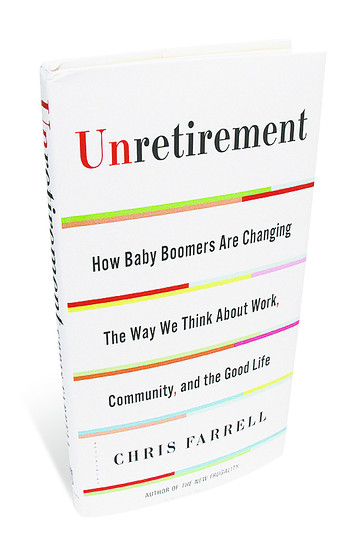

Will “Unretirement” launch your Encore Act?

BN-ER243_bkrvun_GV_20140923135029By Jonathan Chevreau

Unretirement is a concept not unlike Findependence or Financial Independence; it’s also the title of a recently published book by Chris Farrell, Bloomberg Businessweek columnist and senior economics contributor for American Public Media’s syndicated radio show, Marketplace.

I’ve also seen the term Unretirement used by Sun Life Financial in Canada but that seems to be more a marketing term the company uses to promote its surveys on traditional retirement. That survey has been going for six years now, which certainly predates the publication of Farrell’s Unretirement Continue Reading…

Two ways to downsize

downsizing home to a smaller oneOnce you hit the Decumulation years, a common option new retirees consider is Downsizing from a large urban home. Friends of ours on our street are about to put their home up for sale in order to move to a small town an hour away. The difference in the home values will constitute a major nest egg to supplement meagre government pensions and part-time work.

Wednesday’s Financial Post has two articles on this theme. In the RRSP Special Report (I also contributed an article on a different topic), Garry Marr describes the strategy of finding lower-priced homes in small towns:

The small-town appeal is a huge factor for retirees because it can allow them to sell their house in a large city and extract the equity, which they can then live off for their remaining years.

Top reasons to rent during retirement

Continue Reading…

Reflections From The Early Days of Spending In Retirement, Part 1

patgass
Patricia Gass

By Patricia Gass, CPA, CFA

Special to the Financial Independence Hub

I need to get this right. I’ve only got one chance.

Running out of money in retirement is NOT an option, especially for the “conservative accountant” in me. I refuse to be a burden to my children (or anyone else for that matter)!

It’s been 10 months since my husband and I received our last “official” corporate paycheque. Early retirement has been a true blessing: complete control over our life, time and money. We know there will be bumps in the road but so far so good. We are both happier than we’ve ever been. Life is great! Continue Reading…

Managing Inflation in Retirement

wohlnerpic
Roger Wohlner, The Chicago Financial Planner

By Roger Wohlner,

Special to the Financial Independence Hub 

Inflation may seem like a tame or even non-existent threat. We are actually witnessing deflation in the price of oil and other commodities as I write this. Even so, it’s highly unlikely that inflation is dead. The U.S. economy continues to recover from the financial crisis and times of economic recovery are often a trigger for higher inflation.

An annual inflation rate of 2 per cent or 3 per cent over a period of years can seriously erode the purchasing power of your retirement nest egg.  At 2.5 per cent inflation, US$1 today will be worth approximately 78 cents in 10 years, 61 cents in 20 years, and 48 cents in 30 years. This could have a major impact on those entering retirement and those already in retirement.

Managing inflation in retirement is crucial;  here are some thoughts you need to consider. Continue Reading…