Tag Archives: Financial Independence

Income Needs and Wants in Retirement

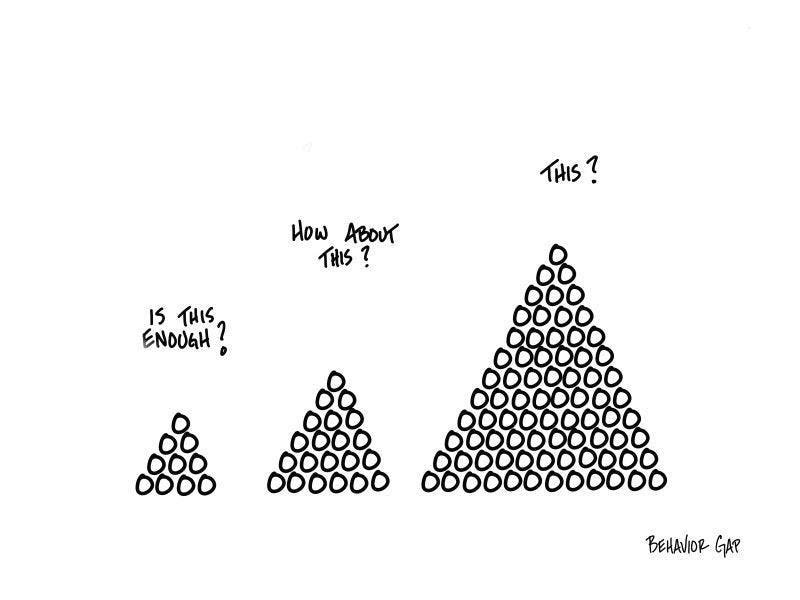
Source: The Behavior Gap

By Mark Seed, myownadvisor

Special to Financial Independence Hub

Some time ago on this site I wrote one of the biggest retirement questions is: how much is enough?

What might be our income sources, needs and wants be in retirement?

The answer to such questions are usually: it depends.

This updated post will share those details and outline how such needs and wants might be funded in our upcoming semi-retirement days – planned for sometime in 2024.

Read on and let me know your thoughts, questions or comments!

What are your income needs and wants in retirement?

It largely depends on what you’ll spend in retirement.

That’s always been step #1 in our book.

Whether you’re 35, 45 or 55, I believe it’s essential to figure out what retirement might look like to you.

Here are a few questions we’ve been working through:

1. When do we want to retire or semi-retire?

Math is helpful but I also believe we want to retire to something.

Both of my parents stopped all form of work around age 60. That may or may not work for me – literally. I like to be busy and instead of stopping work cold-turkey per se I would rather glide into semi-retirement/work on own terms and then slowly ease off the gas pedal per se whenever I want. At least that is my thinking now …

Sure, math helps: the later you retire from full time work, the longer you have to accumulate that retirement nest egg. But I believe there is also the work-optional option of part-time work in our 50s when the debt is gone and most of the assets needed for full-on retirement spending have already been accumulated.

Your mileage may vary. :-)

2. Where do we want to live in retirement or semi-retirement?

Likely Ottawa, as a home base still.

Our family is here. Most of our good friends are here or in the immediate area.

We don’t aspire to own a second home in the sunny south – too many liabilities.

We do however want to travel more/live some time abroad.

Our thinking could always change but it will be nice to have our condo bought and paid for without any debt on the books very soon and maintain it as a home base.

This means all income we do intend to make, including during semi-retirement, is for us to spend as we please.

3. What will our expenses be?

The general wisdom is that you will need somewhere between 70-80% of your current salary for living expensses in retirement. That means, if you make $100,000 combined per year, you should plan to have $70,000 to $80,000 in combined retirement income spending, as an example.

This general wisdom includes the logic that you are likely to spend less as a retiree – since you’re not commuting to work, you might have downsized your home, and/or you’re not supporting dependents.

I think these rules of thumb (like the 4% safe withdrawal rate/rule while valuable to a point) don’t make much sense when you dig further into your personal details, needs and wants. Rules of thumb are a starting point – only.

I far prefer to calculate what our fixed expenses will continue to be, during retirement, including inflationary spending, adding in some variable spending needs and wants as well.

Here is a snapshot on the former:

Key expenses Monthly Annually Semi-retirement comments ~ end of 2024???
Mortgage $2,240 $26,880 We anticipate the mortgage “dead” before the end of 2024.
Groceries/food $800 $9,600 Although can vary month-to-month!
Dining/takeout $100 $1,200
Home maintenance/expenses $700 $8,400 Represents 1% home value per year, increasing by inflation.
Home property taxes $500 $6,000 Ottawa is not cheap, increasing by inflation or more.
Home utilities + internet/TV/cell phones, subscriptions, etc. $400 $4,800
Transportation – x1 car (gas, maintenance, licensing) $150 $1,800 May or may not own a car long-term!
Insurance, including term life $250 $3,000 Term life ends in 2030, will self-insure after that without life insurance.
Totals with Mortgage $5,140 $61,680
Totals without Mortgage $2,900 $34,800 As you can see, once the debt is gone, we’ll be in a much better place for financial independence!

Add in other spending/miscellaneous spending to the tune of $1,000 per month and that’s our base budget. Continue Reading…

Re-examining our plans for Financial Independence

By Bob Lai, Tawcan

Special to the Financial Independence Hub


When we started our financial independence journey back in 2011, we didn’t set a specific FI date or number. In our minds, we do not doubt whether we could become financially independent or not. We knew we’d become financially independent in the future. It was just a question of time. We simply needed to have patience and let our investments compound over time.

A few years into our FI journey, our FI plan started to evolve. Rather than having a specific liquid net worth and utilizing the 4% safe withdrawal rule, we decided to have enough dividend income to cover our expenses. Looking at the calendar, we randomly set a target of reaching this milestone by 2025 or earlier.

It’s funny how ten years seemed to have gone by in the blink of an eye. At the same time, a lot has happened in our lives…

  • Getting engaged and married
  • Having two kids
  • Moving from an apartment in Vancouver to a house in the suburb
  • Me having different job titles, going from engineering to project managing to product marketing to engineering
  • Mrs. T starting her holistic doula practice
  • Starting my photography business ( I’ve been on a bit of break the last few years)
  • Starting this blog, writing articles, learning new things, and connecting with other like-minded people

One thing I’ve realized is that life is never static. It’s always dynamic. Although we can do as many projections and make as many plans as we possibly can, projections and plans do and will change. Therefore, with three years to go before 2025, I thought it would be a good time to re-examine our financial independence plans and see if we need to make any adjustments.

Our FI numbers 

Since starting our FI journey, we have tracked our expenses meticulously. Here are our annual expenses since 2012:

Total Necessities Total Annual Spending
2012 $26,210.52 $44,603.76
2013 $26,343.00 $45,260.88
2014 $29,058.96 $47,391.96
2015 $31,256.88 $47,270.16
2016 $29,831.40 $47,566.96
2017 $33,887.68 $51,144.77
2018 $31,840.75 $57,231.99
2019 $33,199.98 $54,906.02
2020 $35,511.60 $48,908.74
2021 $38,950.66 $71,852.02

Necessities cover core expenses like food, insurance, housing, clothing, utilities, car, etc. Other expenses are considered as non-core expenses which include things like dining out, skiing, camping, travel, charitable donations, gifts, etc.

The last two years have been abnormal in terms of spending. Due to the pandemic, our spending was much lower than usual in 2020. Then last year we had unplanned expenses of around $16,500 on our cat and our house. If we take this amount out, it’d put our 2021 annual spending to around $55,000.

Based on our historical spending trend, I would estimate that we need somewhere between $50,000 to $60,000 in dividend income annually to cover our expenses. To be on the safe side, I’d use $60,000 annual spending for any FI plans because we need to have inherent built-in flexibility on variables outside of our control, like major purchases, emergencies, etc.

The $60k annual spending estimate, of course, assumes that we continue to live in Vancouver and do not have many significant changes in our spending habits.

One thing to keep in mind is our spending can drastically come down if we decide to geo-arbitrage by moving to a smaller Canadian town or somewhere in South East Asia with a lower cost of living than Vancouver. On the flip side, the spending number can increase if we move to Denmark and live there for a few years (I’m ignoring the tax consequences for now).

How much do we need in our dividend portfolio?

How much do we need in our dividend portfolio to generate $60,000 in dividend income? Let’s do a quick math exercise, shall we?

For $60,000 dividend income per year, at 3% dividend yield, we’d need a dividend portfolio worth $2 million; at 4% dividend yield, we’d need a dividend portfolio worth $1.5 million. In other words, we need a portfolio valued between $1.5 million to $2 million. That’s certainly not a small chunk of change.

Now, if we take a middle-of-the-road approach and use a portfolio dividend yield of 3.5%, that means a portfolio value of around $1.714 million.

One thing is clear – we need to continue to save and invest money in our dividend portfolio. We also need to find the right mix between high-yield low-dividend growth stocks and low-yield high-dividend growth stocks.

With three years remaining in our FI timeline, it might be tempting to start buying more very-high-yield dividend stocks to make sure we can reach our FI target. But it is very important to make sure our dividend income is safe and remains sustainable over time. We definitely don’t want to hit $60,000 in dividend income one year only to see that amount slashed by 20% or more the next year.

The stability of our dividend income is extremely vital.

We also want to make sure the portfolio value continues to appreciate over time. The rationale is simple – total returns matter. Having a stable and safe dividend income and a portfolio that increases value over time will give us more options.

By 2025, both Mrs. T and I will be in our early 40s. With decades ahead of us, we need to ensure our dividend income can grow organically over time and inflation doesn’t eat into our dividend income’s buying power. It will be necessary to have some low-yield high-dividend growth stocks in our portfolio to allow for organic dividend growth.

The plan of living off dividends 

Living off dividends is an amazing idea. Based on my dividend income projection, we should receive $51,000 in dividend income in 2025. However, when we compare that number with the $60,000 annual spending target, it doesn’t take a rocket scientist to realize that we are short by several thousand dollars. Continue Reading…

14 things you didn’t know Personal Capital® can do for you

Personal Capital is a financial technology company that provides a range of financial services, including investment management, retirement planning, and financial planning through its website and mobile app. The company also provides personalized financial advice from certified financial advisors. But what exactly can Personal Capital do for YOU? 

We reached out to 14 Personal Capital clients and asked them this question –  “What are the most helpful things you didn’t know Personal Capital could do for you?” From how easy it is to plan retirement to getting multiple credit lines, here are 14 helpful things that Personal Capital can do for you: 

  • Easily Plan Retirement
  • Create and Manage a Budget
  • Provide Educational Resources
  • Guidance for Investment Portfolio Management 
  • Clearly Describe Your Asset Allocation
  • Track Spending
  • Analyze Investment Fees
  • Help to Maximize Retirement Savings
  • Breakdown Your Holdings Accurately
  • Generate a Tax-Optimized Investment Plan
  • Earn a 3.85% APY
  • Show Debt Paydown Progress
  • Monitor Student Loans
  • Grant Access to Two Lines of Credit

Easily Plan Retirement

Using Personal Capital has been of enormous help. I did not know I could plan or budget for my retirement until I read a post that said, “I am a retiree, and I can say that Personal Capital has made this retirement journey smooth for me as I began planning my retirement with the app seven years before I retired.” 

After reading this post, I started making my retirement plans using Personal Capital, which has been very pleasant and put me at ease. Personal Capital is an excellent tool for planning your retirement because it provides a retirement calculator that helps you track your long-term saving goals, an investment checkup tool that will tell how well your portfolio is performing, and a fee analyzer to track if your investment account loses money to hidden fees. 

Overall, I would say that the platform is very comprehensive, well thought out, and intuitive to use, making it even more appealing. Peter Bryla, Community Manager, ResumeLab

Create and Manage a Budget

Personal Capital can help you create and manage a budget. With just a few clicks, you can quickly set up your budget categories, track and monitor your spending, and make adjustments as needed. You’ll be able to see where your money is going, how much you’re making each month, and what areas of your life could use improvement. 

Plus, you can set up reminders to ensure you stick to your budget, as well as get alerts if you exceed it. This way, you’ll have a better understanding of your overall financial picture and be able to make informed decisions about where to allocate your resources. Amira Irfan, Founder & CEO, A Self Guru

Provide Educational Resources

An added benefit of the Personal Capital system is the immense library of resources on personal finance. Financial literacy is one of the few things you don’t get to learn about in school, but it applies to everyone. 

Even with very little knowledge about personal finance, you can learn through Personal Capital’s resources. You can find articles on retirement planning, understanding 401K plans, investment metrics, and more. This is a great tool for people who don’t know how to manage their finances but are looking to learn. David Ring, Sr. Marketing Manager, MCT

Guidance for Investment Portfolio Management 

One thing that I recently learned about Personal Capital is that they offer investment portfolio management services

I think this is a really helpful feature for those who may not have a lot of experience with investing or who want professional guidance in managing their portfolio. With Personal Capital, you’ve got a team of advisors and some fancy technology on your side, helping you make informed decisions about your investments. And on top of that, they offer personalized recommendations based on individual goals and risk tolerance.

So in my opinion, it’s a great resource for anyone looking to make the most of their money. Tiffany Homan, COO, Texas Divorce Laws

Clearly Describe your Asset Allocation

The analysis provided by Personal Capital on my asset allocation is far more thorough and precise. Did you realize, for instance, that VTSAX comprises 3% to 4% REITs? When I looked at Personal Capital’s blocky breakdown of what I actually invested in, I learned this. 

This tool not only examines broad categories but also allows you to click on any specific block to view a breakdown of that category. The US stock market now comprises a large-cap core, mid-cap growth, small-cap value, etc. Your overseas allocation is broken down similarly, and it will change daily based on your present holdings and the changing holdings of those holdings. Steve Pogson, Founder & E-Commerce Strategy Lead, First Pier

Track Spending

Personal Capital is a useful tool that can track all of your spending in one place. I didn’t know this at first, but it makes sense. It syncs all of your checking account and credit card data in one place, so you have easy access to all of your financial information. 

Tracking your spending is a vital part of achieving financial stability and independence. Once you know your normal spending habits, you’ll be able to change them to achieve your financial goals, such as making a large purchase or going on that vacation you’ve always wanted. You can even create your own categories for expenditures if you don’t find a predetermined category that matches your needs. Dustin Ray, Co-CEO & Chief Growth Officer, Incfile

Analyze Investment Fees

Personal Capital is a tool with many capabilities. The ability to analyze investment fees is one of the most surprising benefits of this tool. People don’t always think about the investment fees that they’ll need to pay when they’re looking into expanding their portfolios. 

Personal Capital has a built-in fee analyzer so you can get more out of your returns. It’s estimated that, on average, approximately 1% of returns are lost to fees. Personal Capital can ensure that you minimize that loss so that you can get the most out of your investments. This tool can analyze many investment accounts, from 401(k)s to Roth IRAs. Alex Mastin, CEO & Founder, Home Grounds

Help to Maximize Retirement Savings

One thing that Personal Capital can do for me I didn’t know is that it can help me optimize my 401(k) plan. Personal Capital’s 401(k) Fee Analyzer tool suggests ways to reduce fees and improve returns. This can be useful if you have an employer-sponsored 401(k) plan and are looking to maximize your retirement savings. 

I recently learned that Personal Capital offers a retirement planner that helps users determine how much they need to save for retirement and provides recommendations for investments and saving strategies. — Karen Cate Agustin, Business Analyst, Investors Club

Breakdown your Holdings Accurately

Compared to using a spreadsheet, Personal Capital’s breakdown is much more thorough and accurate. This tool not only examines broad categories but also allows you to click on any specific block to view a detailed breakdown of such a category.  Connie Glover, General Manager, Product & Market Development, BFX Furniture

Generate a Tax-Optimized Investment Plan

Personal Capital can help you create and manage an investment portfolio tailored to your individual goals and risk profile. The technology uses sophisticated algorithms to identify the best investments for your situation, taking into consideration your current savings rate, expected returns, taxes, fees, and more.  Continue Reading…

Learn why you should Buy This, Not That

By Mark Seed, myownadvisor

Special to the Financial Independence Hub

Let’s face it, saving and investing should be simple.

  1. Save, automate your savings to buy stocks.
  2. Invest in stocks and/or low-cost products that invest in stocks to avoid mutual fund salespeople.
  3. Disaster-proof your life by having some cash stashed.
  4. Rinse and repeat.

But simple is not easy.

All too often, we humans love to make things far more complex than things need to be.

We’re wired that way unfortunately. Egos often get in the way. 

Given many people continue to struggle with personal finance, every day, there are tens of thousands of books published out there on this subject – building and maintaining a responsible investment portfolio is only part of the personal finance success equation…

Learn why you should Buy This, Not That

Sam Dogen (aka Financial Samurai) knows a thing or two about personal finance success.

Sam founded FinancialSamurai.com in July 2009 during the depths of the global financial crisis.

Sam’s goal through that site was to deliver and share a cathartic way to make sense of the chaos at the time. Fast forward to today, more than 90 million people have visited Financial Samurai, and tens of millions more have read his work on publications such as CNBC, Yahoo Finance, and Business Insider.

Sam was previously at Goldman Sachs and Credit Suisse for 13 years – but he’ll share more details below!

When Sam is not writing or playing with his kids, you can find him on a tennis court or softball field in San Francisco, or on My Own Advisor giving away a book!

Sam is a graduate of The College of William & Mary and received his MBA from UC Berkeley.

I got a chance to chat with Sam recently about his new book: Buy This, Not That – How to Spend Money Your Way to Wealth and Freedom.

Here is our interview below before Sam:

Sam, welcome to the site – I know you’ve left a few comments over the years and nice to see you back!

Mark, a pleasure. I enjoy reading about your personal finance independence journey in Canada and seeing you help others with their journeys at the same time as well!

Sam, maybe not everyone is aware of your financial journey and Financial Samurai beginnings. Can you share a bit of your bio with my readers? Where do you live, what have you invested in, and “how did you get here” to writing this book?

Sure thing, Mark.

I grew up in The Philippines, Zambia, Japan, Taiwan, and Malaysia before coming to America for high school and college at William & Mary. My parents were in the U.S. foreign service.

After college, I joined Goldman Sachs in NYC in their international equities department. It was a dream job, except for the fact I had to get in at 5:30 am and often leave after 7 pm! As a result, I decided to save and invest 50% of my after-tax paycheck so I could one day have options to escape.

In July 2009, I started Financial Samurai and helped kickstart the modern-day FIRE movement. It’s been great to see so many people embrace their financial independence journey since then. My definition of financial independence is having enough passive investment income to pay for your basic living expenses.

I decided to write Buy This, Not That because I felt it had to be written. When I started Financial Samurai, there weren’t a lot of personal finance bloggers with finance backgrounds. I noticed when I first got my book offer in early 2020, there weren’t many finance authors with finance backgrounds either! So, I decided to fill this hole and provide my perspective.

Instead of scratching the surface, I decided to go deep into many financial topics. I then tackled some of life’s biggest dilemmas many of us all face.

Learn why you should Buy This, Not That! Sam Dogen

Great stuff.

Sam, in your book, you wrote:

“My first hope with Buy This, Not That is to help you let go of the fear of making a wrong financial choice. Let that sink in: there are no wrong money choices, just as there are no perfect choices, only optimal or suboptimal.”

Talk to me about your investing and wealth-building journey. What mistakes did you make? What successes did you have? What did this teach you and what do you hope to pass along to others in the book?

Mark, I made the suboptimal choice of buying a vacation property I didn’t need in 2007. I got it for 15% off, but it ended up declining by another 40% during the financial crisis! Luckily, most of its value has recovered and I’ve been taking my kids there since 2018.

Not extrapolating my income into the future was my biggest lesson learned. I was paid very well in 2007 and thought my income was just going to go higher. Life is full of ups and downs. Therefore, please be conservative with your income and return forecasts.

One of the key takeaways from the book is to encourage readers to think in probabilities, not absolutes. Don’t think you need 100% certainty to make a choice. Otherwise, you’re going to miss out on a lot of great opportunities.

In The Psychology of Money, Morgan Housel wrote effectively:

You don’t have to be a perfect investor. Getting wealthy and staying wealthy is “about consistently not screwing up.”

I agree with this/have always agreed with this and this aligns nicely to your 70/30 decision making philosophy. Can you explain that for readers and why is that framework so important to you to convey in the book when it comes to investing and wealth-building?

Use my 70-30 decision-making framework to build wealth and make more optimal choices. The framework states that if you believe there’s a 70% probability or greater your choice is the correct one, go for it, while having the humility knowing that 30% of the time, you’re going to get it wrong. And when you do, you will learn from your mistakes and get better.

Once you start approaching everything with a probability matrix in mind, you’re going to gain a tremendous competitive advantage compared to those who don’t.

I like that.

Sam, I personally equate the definition of Financial Independence (FI) as your investments generate enough passive income to cover your day to day living expenses. I’m not into this Barista FIRE, etc. What’s your take? Agree? Disagree? Why?

Yes, since 2009, I’ve stated that being financially independent means having enough investment income to cover your basic living expenses. However, I think Barista FIRE is a reasonable stop gap where you can earn extra income and receive subsidized health care while working a traditionally lower-wage job.

But at the end of the day, don’t fool yourself. If you still need to work, then you are probably not financially independent.

When I left work in 2012 at age 34, I had about $80,000 a year in passive investment income. I knew I wouldn’t starve, but I also wasn’t 100% confident I was doing the right thing. Therefore, I had my wife, who is three years younger than me, keep on working until age 34. If everything worked out with my new adventure, she could join me. In 2015, she was also able to negotiate a nice severance and hasn’t been back to work since.

So, when did you realize FI (Financial Independence)?

In 2012 when I was 34. At the time, I had a net worth of about $3 million that generated about $80,000 a year in passive income. But the biggest catalyst was negotiating a severance that paid for 5-6 years’ worth of regular living expenses. My severance paid all my deferred cash and stock compensation over the next three years. I also had a private investment made in 2010 that wouldn’t come due until 2017 that was fully paid out. Continue Reading…

The 5 most important factors In your Decision to Retire

By Fritz Gilbert, TheRetirementManifesto

Special to the Financial Independence Hub

A few years ago, I was working through my decision to retire. I was pretty obsessive about it and documented the many factors I was evaluating on this blog (stored in chronological order for your convenience).  After doing my homework, I decided to make the jump in June 2018.

In the four years since I’ve never regretted my decision.

The decision to retire is complicated and there are many factors to consider.  Consider them you must, however, so I’m listing the factors I consider most important and one which I consider essentially irrelevant.  To make your best decision on when to retire, it’s important to recognize all of the things that matter, as well as those that don’t.  Under each factor, I’ve included links to relevant posts for those of you who’d like to dig deeper.


The Most Important Factors

1.) Do you have Enough Money?

The first thing most people think about when they’re making the decision to retire is whether they have enough money to last for the rest of their lifetime.  Fair enough, and I’ll concede it’s way up on the list.  I’d warn, however, that having enough money is a necessary factor, but far from sufficient.

I’ve written many articles on evaluating whether you have enough money to retire.  Below are four that I’d recommend:


2.) Are you Mentally Prepared for Retirement?

Almost everyone thinks about money when they’re making the decision to retire, but far too few consider the non-financial factors.  If I were to choose one point to make from all the things I’ve learned in the 7 years of writing this blog, it’s that the non-financial factors are the most important for putting yourself on track for a great retirement. Important enough that I wrote an entire book on the topic.

If you’re thinking about retirement, the best advice I can give you is to spend time thinking about what you want your life to be in retirement.  Think about it at least as much as you think about the “money stuff.”  Once you’ve retired, I suspect you’ll realize #2 is actually the more critical factor.

If you’re married, have you and your spouse talked about your mutual expectations for your life in retirement?  How are you addressing any misalignments?  Trust me, you have some.  Take the time to find them now, and discuss how you’re going to work together to live the best years for both of you in retirement.

What Purpose is going to fill your days when you no longer have a boss telling you what to do?  Where are you going to live?  What are you going to do?  Important stuff, all, and a topic on which I’ve dedicated thousands of words.  If you’re still working, do yourself a favor and take a “mini-retirement” to think about the things that really matter before you take the plunge.

3.) Have you made a Realistic Spending Estimate?

In its rawest form, the decision to retire is a simple math problem.  Multiply your assets times a safe withdrawal rate, add any expected income, and see if the total covers your expected level of spending.  Given the importance of getting the correct answer to that formula, it’s critical that you spend some time developing a realistic spending estimate for your retirement years.  Since you’ve thought about what you’re going to be doing in retirement (#2), it’s a necessary exercise to track your pre-retirement spending for as long as feasible (I did 11 months), then make any adjustments for how you think it will change post-retirement.  Too many people “take a swag” on this one, but I strongly encourage you to resist that temptation and give it a lot of focus as you’re making your decision to retire.