Tag Archives: Financial Independence

How one Tawcan reader lives on $360,000 a year of dividends almost tax-free


By Bob Lai, Tawcan

Special to the Financial Independence Hub

Long time readers will know that my wife and I are deploying a hybrid investing strategy – we invest in both dividend paying stocks and index ETFs. It is our goal to have our portfolio generating enough dividend income to cover our expenses. When this happens, we can call ourselves financially independent and live off dividends. By constructing our portfolio and selecting stocks that grow dividends each year organically, we believe our dividend income will continue to grow organically and keep up with inflation so we don’t have to ever touch our principal.

In the past, I have done a few simulations showing that living of dividends is possible and that dividend income is very tax-efficient in Canada. But simulations are full of assumptions and the numbers can change. Wouldn’t it be nice to showcase someone that is living off dividends already?

As luck would have it, Reader B, a fellow Canadian, recently mentioned that he retired in 2004 at age 55 and has been living off dividends since. I was very intrigued by B’s story when he told me that he worked as a civil engineer and his wife worked as an administrator.

I fell off the chair when he told me that he and his wife started investing with $10,000 and have amassed a dividend portfolio that generates over $360,000 in dividends each year! 

That’s $30,000 a month! Holy cow! 

While working, they had above average salary (B made ~$110k and B’s wife made ~$90k in today’s money). The high household income has certainly helped them build the dividend portfolio. But I believe a lot of it is due to B and his wife’s living modestly – not a lavish lifestyle but not penny pinching either.

After a bit of emailing exchanges, he agreed to answer my questions about his experience with living off dividends (it took a bit of convincing haha!). I truly believe B’s knowledge will help a lot of dividend growth investors.

Note: B’s original reply was over 11,000 words not including my comments (our email exchanges were very long too). I went through his answers and edited some parts out. For ease of reading, I have decided to split the post into two posts.

I hope you’ll enjoy this Q&A as much as I did.

Living off dividends – How I’m receiving $360k dividends a year and paying almost no taxes

Q1:  First of all, B, thank you for participating. It’s wonderful to learn that you and your wife have been retired since 2004 and have been dividend investors for over 36 years.

A: Thank you, Bob, for giving me the opportunity to share my 36 plus years of dividend investing experience and results with you and your readers. After following your blog, I realized that we and many others were on the same dividend investing path. The only difference being that I was a few more years along in the investing journey. I felt others might benefit from my experience with dividend investing.

You’re on the right path, Bob, and given your rate of progress to date by the time you reach my age (72) you will certainly attain your dividend income goals and likely well beyond. So I wanted to encourage you to continue along the dividend investing path. It’s a very sound and profitable strategy.

I’m more than happy to share with others a few of my ideas on dividend investing and how it can be done in a tax-effective manner.

Q2:  How long have you been investing in dividend paying stocks?

A: I started investing in stocks in 1985. After the initial period of learning the ropes and finding my way in the investing and stock market world, it was only in 1990 after subscribing to a weekly investing newsletter that I finally saw the investing light and found that dividend investing was right for us.

So I guess you could say I’ve been traveling along the dividend paying stock road for some 31 years now. And we’ve been comfortably supplementing our lifestyle with an ever increasing stream of dividends since we retired in 2004 to the present day.

Diving into the dividend portfolio

Q3:  How much dividend income are you getting each year? Can you provide a detailed breakdown across non-registered and registered accounts? 

A: As of April 30, 2021, my wife and I are receiving $360,000 in combined pre-tax dividend income annually – that’s $30,000 per month – and still growing.

Our combined assets are distributed as follows:

  • RRIFs: 8.2%
  • TFSAs: 1.9%
  • Non-Reg Dividend Income Accounts: 85.5%
  • Other Short-Term Liquid Assets: 4.4%

So the amount we have in registered tax-sheltered plans totals 10.1% and is decreasing annually in compliance with RRIF mandatory withdrawal requirements.

These figures illustrate a problem that can develop gradually over time – a severe imbalance between registered and non-registered  accounts caused by the low contribution limits governing registered savings plans. Allowable contributions to registered plans are capped.

If one’s savings levels exceed the cap limits by a significant amount, then the balance between registered and non-registered accounts can tilt heavily towards the latter. The effect is that registered plans then become less and less significant in the overall account mix. This unbalanced effect means that we now have only 10.1% of our assets in tax sheltered accounts while 85.5% is held in “unsheltered” non-registered accounts.

So that makes it critical to find ways to ensure that holdings in non-registered accounts are as tax efficient as possible. The most optimum way to achieve tax-efficiency under such conditions is to focus on buying and holding Canadian dividend paying stocks in non-registered accounts.

We will continue to shift portions of our “other” assets toward Canadian dividend income as we go forward.

Our non-registered accounts are producing the entire $360K dividend income stream referenced above. The annual yield on market value is 4.2%. The actual yield on cost is much higher than the market yield. Our portfolio has returned nicely over the years.

Our annual mandatory RRIF withdrawals are the minimum required by age and proceeds are immediately re-invested in more dividend stocks and held in our non-registered accounts. We do not touch our TFSAs and contribute the maximum allowable amount each year.

Tawcan: My jaw dropped when you told me about your $360k a year dividend income. That is absolutely amazing! 

At 4.2% yield that means the market value of your portfolio is over $8.5M! Obviously your yield on cost would be much higher than that given you have invested over 30 years. Regardless, I’m betting that the cost basis of your non-registered portfolio is in the multi-million dollars range. It is very impressive considering you and your wife only made around $200k a year in today’s money.  

The Dividend Investing Philosophy

Q4:  Can you give us an idea of your general approach to dividend investing?

A: My dividend investment philosophy can be summed up as: “To buy gradually over time, high-quality Canadian tax-efficient dividend paying stocks and hold them indefinitely.”

I buy stocks gradually in roughly equal amounts and spread the purchases over time. I never invest large lump sums all at once. I’ll take an initial position in a stock, usually in the $10K value range, and then return again at an opportune price point and buy some more (i.e. dollar cost-averaging).

High quality stocks are selected – conservative large cap stocks – most often dividend aristocrats – minimum 2% yield with the odd exception for superior growth stocks or those with growth potential. Great focus is placed on buying dividend aristocrats and stocks in the TSX Composite 60 Index with a nod toward following the Beat the TSX strategy.

Tawcan: Funny B mentioned the BTSX strategy. Check out Matt, the brain behind Beating the TSX strategy, and his family’s amazing story about traveling the world with 4 kids. 

I exclusively buy only Canadian stocks – no USA stocks – none – no exceptions. The only US stocks I would consider are those that have a TSX listing and can be purchased in Canadian dollars for tax efficiency reasons.

Tawcan: It’s interesting that you only hold top Canadian dividend stocks and no US or international dividend paying stocks or ETFs. 

All our stock buys must be held in non-registered accounts – contributions can not be made to RRIFs and our TFSA contribution room is maxed out. My wife and I also invest in REITs and they require special attention (more on that later).

All stocks we buy must pay a dividend. As mentioned, I usually insist on a 2% yield or higher – but not too high. One never wants to over-reach for yield, which is often the warning sign for an impending dividend cut. If a stock does eliminate its dividend, then it’s automatically gone from our portfolios and we move on to another stock that does pay a reliable dividend.

On very rare occasions, it may be advisable/necessary to sell a stock for the following reasons:

  1. When a stock’s prospects have taken a downward turn.
  2. In the event of a takeover bid – friendly or otherwise – one often has little choice but to sell.
  3. For tax-loss selling purposes. We seldom pay any capital gains income tax at all. When we do realize a capital gain from a stock sale, then we’ll sell another stock (or partially sell) to realize an offsetting capital loss. But tax-loss selling is not usually done at year-end along with “the herd.” After waiting the mandatory 30 days and if the stock remains a solid investment, then we will often buy the stock back – hopefully at a lower price.

Under a buy and hold strategy, there is not a lot of opportunity for capital gains. By not selling, no capital gain is realized and so capital gains tax can be deferred indefinitely.

On the other hand, dividend income can be extremely tax efficient when you are income splitting between two people. We’ll get into the specifics a bit later.

Q5:  You mentioned that REITs require special attention. What did you mean by that?

A: Not all REITs are equal in terms of tax efficiency when held in a non-registered account where taxes on REIT distributions can vary from 0% to 53.53% (in Ontario). Therefore, the most tax-efficient place to hold a REIT is in a registered account. Continue Reading…


Millennials want to FIRE at age 50

By Mark Seed, MyOwnAdvisor

Special to the Financial Independence Hub

Whether you agree with the FIRE (Financial Independence, Retire Early) movement or not – it’s a big thing.

Personally, I’m a huge believer in clear goals. If FIRE at age 50 is your goal, go for it.

Goals can be positive, purposeful and motivating. I think goals are great because they force you into choices.

Pursuing financial Independence is a choice.

That said, I’ve learned to let go a bit. Spend a bit. Relax a bit. Enjoy things just a bit more. 

In case you missed it, some people can work too hard, too long and save too much for retirement.

Make FI a goal but not life’s final destination

I make financial goals like these every year to help me/us stay focused on our choices.

Whether you are in your 20s, 30s, 40s or 50s aspiring for some form of earlier retirement than most – if that’s your choice – just consider what you’ll do with your time when you get there. FI is a great goal, just don’t make it a final destination.

Millennial FIRE at age 50 case study

I’ve been fortunate to receive emails from dozens, if not hundreds of readers in recent years asking me what it takes to build a 7-figure portfolio, can I retire with X amount of money, and what would a world of living off dividends and distributions could be like.

Well, I will tell you my goal to live off dividends and distributions remains alive and well!

I will continue to answer those questions from readers as much as possible – so keep them coming.

But given those questions, I figured I’d share yet another case study for a reader/lurker on my site.

Before we get to that new case study, a reminder you can check out these previous posts about folks striving to retire or semi-retire earlier than most AND what that takes:

Here is one proven path to retirement ignoring any 4% rule.

Karla and Toby are 54 and 56. Can they retire soon with $1.2 million in the bank and no company pensions?

Mike and Julie want to spend $50,000 per year in retirement starting in their 50s…how much do they need?

This 50-something couple wants to FIRE at 52. How much can they spend?

Millennials want to FIRE at age 50 – can they do it?

A reader of the site emailed me to discuss their early retirement dreams. Let’s look at their case study and find out what it takes to FIRE at age 50.

Here is their profile and what they told me:

  • Judy (F), and Shane (M), aged 35.
  • Judy is currently pregnant, and they are expecting their first child later this year.
  • They live in Kingston, ON.
  • They both work full-time for now.

“Mark, can we FIRE at 50?” If so, “what will our assets look like at age 50 assuming we try and max out contributions to our TFSAs at minimum every single year?”

To help answer these questions, I once again enlisted some help. Welcome back Owen Winkelmolen (no affiliation) who is a fee-for-service financial planner (QAFP) and founder of PlanEasy.ca. Owen specializes in budgeting, cashflow, taxes & benefits, and retirement planning – working with both individuals and young families to help them with comprehensive financial plans from today to age 100.

Owen, thoughts for Judy and Shane?

Thanks Mark and glad to be back on your site. I love these case studies!

First, before we share the results, let’s provide some inputs and background data for context. Based on their information to you, we’ve included this information below in their projections with some assumptions as well:

  • Judy works full-time, for now, making a solid $95,000 per year as engineer with performance bonus opportunities at work of up to 15% (although the latter is never expected).
  • Shane is an HVAC mechanic making up to $80,000 per year.
  • They have a sizeable mortgage: $350,000. They hope to have it paid off in 10 years and as of now, with a child on the way, they have no plans to move.
  • For the most part, they’ve been quite smart – owning both cars/vehicles. They plan to replace Shane’s truck in another 5-7 years so they have established a “car fund”. They have $15,000 saved up already!
  • They’ve read your site Mark (about your emergency fund and have gone well beyond that with a child on the way) and keep about $25,000 in cash as an emergency fund. 

Mark to Owen: we did it – why we have an emergency fund.

  • They’ve worked hard and investing wisely. Mark told me they have about $100,000 invested inside each of their TFSAs – contributions are now maxed out since they’ve been contributing to their TFSAs since account inception.
  • RRSPs are not yet maxed out – there is only so much money to go around. Judy has an RRSP value of $110,000; Shane about $90,000.
  • They have also told Mark they intend to start contributing to a Registered Education Savings Plan (RESP) in the coming years for their child.
  • Neither Judy nor Shane have any workplace pension.

We’re going to make a few assumptions based on the information they also provided:

  • That their home has a value of $500,000 now and they will pay off the mortgage as planned as best they can.
  • Their interest rate is about 2.3%, with payments estimated to be about $2,200 per month.
  • They have no other debt – no credit cards, nothing.
  • We’re not sure if they plan to have other children so we won’t make any assumptions there!
  • We’ll also assume Judy sticks to her plan and stays at home for a bit but will return to work/work form home after about 6 months have passed. Shane also wants to be at home a bit. For daycare, they are lucky, they told Mark they have some help!

Owen: here is what the FIRE at 50 math says!

Judy and Shane have done an excellent job setting themselves up for financial independence and early retirement. Their plan is very robust and includes lots of flexibility. That flexibility will allow them to choose to spend more in the future and find a better balance between saving and spending or retire earlier than they planned. Continue Reading…

Was the F.I.R.E. movement doused by the pandemic?

Cutthecrapinvesting: Image by Mohamed Hassan via Pixabay

By Dale Roberts

Special to the Financial Independence Hub

Retiring at 50: How achievable is it?

By Emily Roberts

For the Financial Independence Hub

Most of us dream about and count down the days until our retirement, picturing ourselves at the beach, enjoying a cocktail while laughing about the days we spent slogging away at the office. These thoughts can be what get some of us through the workday, and even if you love your job and could never picture doing anything else, retirement is still the end goal for all of us so that we can enjoy our later years in peace and tranquillity.

Yet some of us go one step further and think about early retirement. While this may seem like an unachievable dream for many, it can in fact become a reality if executed properly. Retiring at 50 isn’t impossible, but it isn’t easy, either. Typically, people will retire between 65 and 67. This can seem like an age if you dislike your job or simply wish to slow down.

If you are wondering how you could retire early but also the benefits of retiring all together, read the following guide. Not only will it explain the advantages of retirement, but it will also list of the best ways to increase your chances of an early retirement as well as the signs that you may not be ready to retire just yet.

Good reasons to retire

There are many good reasons to retire. For starters, you may be unable to complete your typical day-to-day duties at work as you age. This is especially true for those who work in a physically demanding role such as construction or mining. Your body will be unable to keep up with this labour-intensive work and you are more prone to injuries.

However, retirement is a time for you to slow down and enjoy life. Rather than worrying about getting up and making it to the office in time, you can live your life at your own leisurely pace. While this may seem odd at first, the time you usually spend at work is now yours to do with it as you wish. If you’ve always wanted to focus on your art, then retirement can be the perfect time for you to focus on this hobby and passion of yours. Furthermore, if you have a family, retirement can provide you with the free time to focus on reconnecting with your family (and friends!) and make long-lasting memories with them. This is especially valuable for those who have grandchildren.

Other benefits of retiring include being able to look after your mental and physical well-being. Having a career and being so focused on your job can cause you to forget about what is important: your health. We neglect healthy, balanced meals with those that are quick and typically full of saturated fats. We also lose track of time or are simply too tired to head to the gym even though working out consistently is essential. What’s more, some of us simply need to focus on our mental health more than others and heading to work and working specific hours can be harmful to our mental well-being.

Why Early Retirement can be beneficial

There are numerous benefits associated with retirement; however, there are even more linked to early retirement. For instance, when you retire early, you are able to focus on yourself and the hobbies you have longed to invest time in but was never able to before. With the free time and extra drive you have to spend on your hobbies, you could even consider turning your hobbies into a means of making extra money. For example, if you love to paint or draw, then you could always sell your artwork either online and through a website such as Etsy, or you can make a day of it and sell your work at a local market or yard sale. While you will want to have the mindset of this being a hobby that could potentially bring in some income, this can be a great way to bring you purpose while you’re retired. Continue Reading…

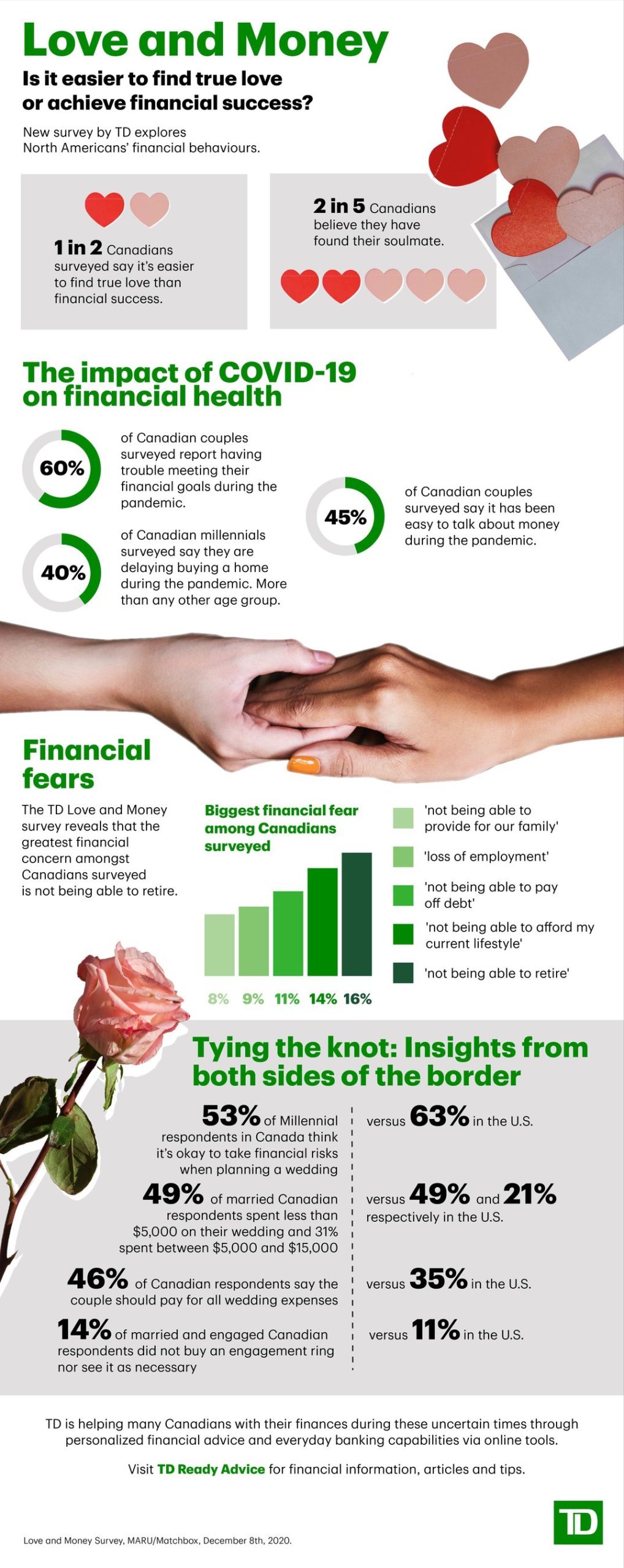
Valentines Day: Is it easier to find true love or achieve financial independence?

According to Love and Money – a survey from TD exploring the financial behaviours of more than 3,000 married, in-a-relationship or divorced North Americans – half of Canadians surveyed (49%) believe it’s easier to find true love than financial success.

However, that’s not to say those Canadian couples surveyed aren’t feeling cautiously optimistic about their future financial goals.

Despite challenges from the pandemic, nearly nine in ten (88%) respondents are currently saving for something. For those already in committed relationships, the survey also reveals that for most couples (45%) it has been easy to talk about money during COVID-19.

Nearly half (49%) say the pandemic has led to more open and constructive conversations about their finances, including the need to adjust spending habits by reducing spending on non-essential items (62%) and delaying larger purchases (36%).

With Love and Money revealing that six out of ten (60%) couples surveyed are having trouble meeting their financial goals during the COVID pandemic, it’s clear that having conversations about money are critical. In fact, “not talking about money with my partner on a regular basis” is the top financial mistake noted amongst Canadian respondents.

Fortunately:

  • 77% of Canadian couples surveyed say they typically open up about their finances within the first year of their relationship: including 56% who get very candid within the first six months.
  • Among Canadian married couples and those in a committed relationship, 85% say they talk about money every month.

But even though it seems most Canadians aren’t shying away from the (financial) “talk,” the TD Love and Money survey also shows that some Canadian respondents may be more likely to ask for forgiveness than permission.

  • Among the 8% of who admit to keeping financial secrets from their partner, 62% don’t ever plan to disclose them. Canadian couples surveyed admit to hiding a secret bank account (29%) or significant credit-card debt (22%).
  • Only 53% of Canadian Millennials say they agree with their partner on what expenses constitute a ‘want’ or a ‘need’.
  • 81% of Millennials admit to making unreasonable financial decisions, and one quarter (25%) say excessive and frivolous spending was one of them.

Tying the knot: Insights from both sides of the border

As expected, walking down the aisle looks very different during the pandemic, as many North American couples deal with the impact of lockdowns, gathering restrictions and reduced income. Consequently, Love and Money reveals that of the engaged Canadian couples surveyed whose wedding planning was impacted by the pandemic, more than half (56%) either postponed or downsized their nuptials.

When it comes to the big day, the TD survey also shows:

  • 53% of Millennial respondents in Canada think it’s okay to take financial risks when planning a wedding, versus 63% in the U.S.
  • 46% of Canadian respondents say the couple should pay for all wedding expenses, versus 35% in the U.S.
  • 49% of married Canadian respondents spent less than $5,000 on their wedding and 31% spent between $5,000 and $15,000, versus 49% and 20% respectively in the U.S.
  • 14% of married and engaged Canadians and 11% of their U.S. counterparts did not buy an engagement ring nor see it as necessary.

Biggest concern is not being able to retire

In terms of financial worries, the TD Love and Money survey also reveals that the greatest financial concern among Canadians is the fear of not being able to retire. Despite this concern, only one third (32%) of Canadians say they meet with a financial advisor on an annual basis. Continue Reading…