Tag Archives: Financial Independence

How annuities can help fund a full lifestyle in retirement

By Jean Salvadore, Director, Wealth Insurance, RBC Insurance

(Sponsored Content)

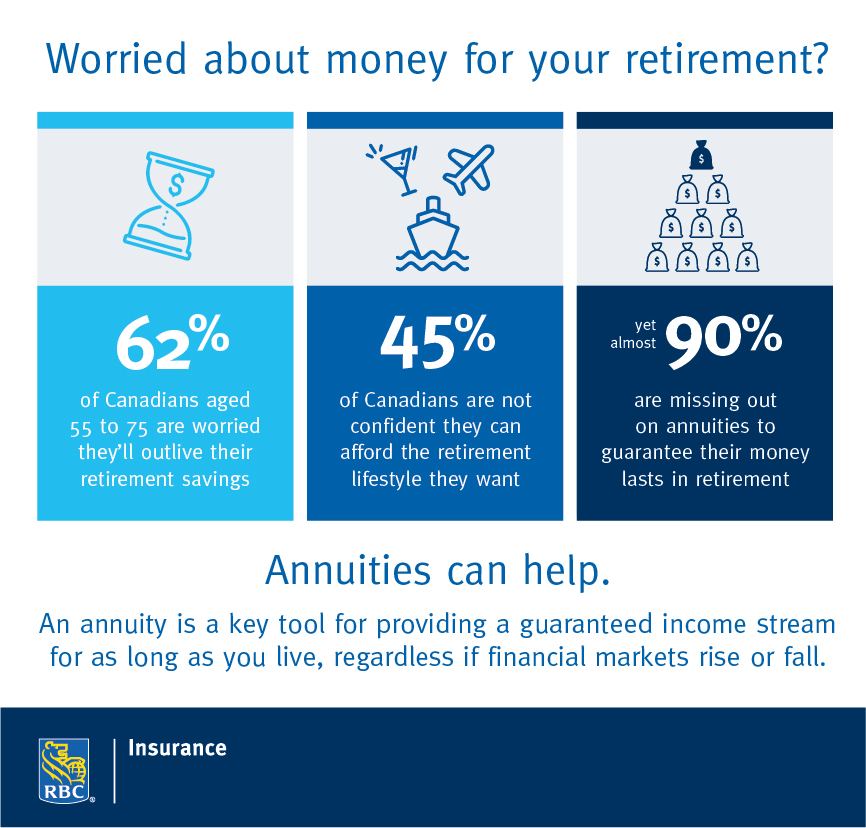
Summary: While Canadians want to live a full lifestyle in their retirement, a majority (62 per cent) are worried about outliving their retirement savings. The majority are missing annuities in their portfolio that can help guarantee an income stream in their retirement. 

If you’re like most Canadians, your vision for retirement includes a full roster of activities such as travel, dining out and shopping for the things you want. But while many of us look to our retirement years as a time to enjoy life to the fullest, having enough money to support that lifestyle is a real concern. Canadians are living longer than ever before and, according to a recent survey by Ipsos for RBC Insurance, the majority (62 per cent) are worried that they’ll outlive their retirement savings.

In fact, even with various financial tools in place such as RRSPs and TFSAs, almost half of Canadians are still not confident that they will be able to afford the lifestyle they want. And perhaps not surprisingly, what’s most important to that lifestyle is keeping a sense of independence. Among those between the ages of 55 to 75, eight out of ten want to live at home for as long as they can and 72 per cent say it’s important to own a car. On top of that, almost three-quarters (68 per cent) would like to be able to travel at least once a year, shop for the things they want (62 per cent), and go out for lunch or dinner a few times a week (53 per cent). Continue Reading…


3 predictions for the future Retirement landscape

By Sia Hasan

Special to the Financial Independence Hub

Retirement should be a time everyone looks forward to embracing. Theoretically, everything becomes easier in time. A retiree doesn’t need to deal with all the pressures of a stressful full-time job. Days can be spent doing more of the things the retiree enjoys. Such imagery, however, may only reflect the most idealized version of retirement years. Relaxation in retirement remains heavily dependent on how much money has been saved for those golden years.

Saving for retirement has to be about more than just putting a set percentage of income away. Careful thinking and planning are required to make sure retirement assets become adequate enough to cover leisure and necessary expenses. The changing future landscape of retirement further necessitates better planning.

Longer Life Spans and Retirement Savings

Increased life spans definitely impact the way people save for retirement. Thanks to insights into healthier living and great strides in healthcare, a larger percentage of people live much longer. Living to the age of 100 may even be possible for a significant number of people. Better retirement planning definitely works to the benefit of someone who lives a very long life.

Working during early Retirement years

Upon retiring at age 70, maybe it would be wise to look for another job. Working a full-time job might not be necessary, but earning a small stream of income from a part-time job could prove very helpful. $10,000 earned from a part-time job covers $10,000 worth of expenses. Working a part-time job until age 75 leads to $50,000 in income. Earning additional money eliminates the need withdrawing an equitable amount of funds from a savings account or social security deposits.

Money saved may draw more interest and be set aside for use during very elder years. After looking at things from this perspective, making plans for a retirement job becomes an important priority.

Examine Annuity Income

Continue Reading…

January is a great time for these 4 financial planning action items

January rings in the New Year, a sign of optimism, and the annual promise of something new: adopting resolutions, setting goals and looking ahead. It’s also a time to reflect on the previous year. Making resolutions is common for many, but less than 40% will actually achieve what they set out to do.

Nevertheless, for those looking for improvement in their financial health, here are some good habits to follow at the beginning of each year.

January is a good month to…

1. ) Calculate your net worth

You know how to do this. Total up all your wealth building assets – home, investments – subtract your debts – mortgage, credit cards, car loan, and voila – the resulting total is your net worth, or in other words, the current picture of your financial standing.

There are lots of online calculators that help you do this, but don’t stop there. Redo the calculation at least once a year. Create your own spreadsheet so you can compare several years. It will help you see if you’re moving in the right direction. Otherwise, how can you know if you’re getting ahead?

Also read: Your financial plan is a compass

Focus on what you can do to improve your finances, and if you find yourself getting off track, do some course corrections and carry on.

2.) Revisit your goals

January is also a good time to review your goals. If you have a spouse or partner, set aside some quiet time this month to have the money talk. Have an honest discussion about your short-term and long-term goals and check to see whether you are still on track to meet them.

Or, maybe your situation or priorities have changed, and you need to reassess. If something is not working, go back and modify. Since you can’t know what the future holds for you, a period of five years is a manageable target.

Also read: Create your own financial plan with these eight steps

Map out a few steps for the current year that will see you heading towards a better financial situation. Continue Reading…

Saving to Retire

I see too much pessimism on whether it’s possible to achieve a comfortable retirement.

Hence, I highlight three observations on saving for retirement:

  • Surveys frequently remind investors that they don’t save enough for retirement.
  • Investors are keen to know what it takes financially to achieve a comfortable retirement.
  • This is a good time to start the optimistic retirement math discussion.

The number often mentioned is rounding up financial assets of $1,000,000 by age 65. However, accumulating that sum of money may be a tall order for some.

It can be done, but it is not always easy. So, I propose meeting halfway, say at $500,000.

Typical sources of income and capital are the registered accounts, saving accounts, stocks and bonds. Perhaps, income real estate, employer pensions and a family business also fit.

Adding regular savings to your investing plan is simply a must to reach retirement goals. Your degree of financial success has a lifetime of implications.

Assume you begin saving at age 30, 40 or 50 and have no other retirement assets. Here are some annual saving targets to reach $500,000 by age 65 (figures rounded):

Annual Returns to Age 65 Your annual saving targets starting at:
Age 30 Age 40 Age 50
8% $2,900 $6,800 $18,400
7% $3,600 $7,900 $19,900
6% $4,500 $9,100 $21,500
5% $5,600 $10,500 $23,200
4% $6,800 $12,000 $25,000

Say you are age 40, you will need to save $10,500/year to age 65 with 5% returns. That saving target reduces to $7,900/year to your age 65 with 7% returns.

If your aim is to accumulate $250,000, divide the above annual saving targets by two. For the $1,000,000 goal, multiply the above saving targets by two. Continue Reading…

Retired Money: How TFSAs can give seniors more tax-free retirement funds

If you’re a senior, the holy grail in retirement is to have as much tax-free retirement funds as possible.

My latest MoneySense Retired Money column looks at this goal: Click on the highlighted text to access the full piece:  How Seniors can use TFSAs to have more in retirement.

This site has always been a strong proponent of Tax-free Savings Accounts (TFSAs) for young people. Starting at age 18, TFSAs are great vehicles for accumulating short-term savings for goals like saving a down payment for a home, buying a new car, or even going on to post-graduate studies or starting a business. And unlike RRSPs, the $5500 annual contribution room for TFSAs does not require having earned income the previous year. So as of next week, with the arrival of 2018, it’s highly advisable to add another $5,500 to your TFSAs. But not just if you’re young!

The MoneySense column makes the point that TFSAs are equally desirable for seniors in retirement, or for those in semi-retirement who are preparing for full retirement.

Why? First, unlike the RRIFs that many RRSPs become, and which generate taxable income, TFSAs generate no taxable income: neither on the withdrawals nor the investment income (whether dividends, capital gains or interest). In addition, TFSAs do not trigger clawbacks of means-tested government retirement income programs like Old Age Security or the Guaranteed Income Supplement.

But there’s another big benefit TFSAs confer on seniors and retirees: ongoing tax-sheltering of investment income well beyond age 71. In contrast, you can no longer contribute to RRSPs after the year you turn 71 and cannot contribute new money to RRIFs: they’re strictly vehicles that shelter what you’ve got until the next forced annual withdrawal limit, which escalates over time from 5.28% at 71 to 20% a year once you reach 95.

Unlike RRSPs and RRIFs, seniors can continue to add to their TFSAs each and every year even after age 71. Even if you live past 100, as my friend Meta has (and who, as the column relates, continues to use the TFSA herself!)

Two ways seniors can get money for TFSAs without having to find “new” money

Continue Reading…