Tag Archives: Financial Independence

A Simple Way To Boost Your Retirement Savings

pay yourself first, a reminder of personal finance strategy - stack of colorful sticky notes on a cork bulletin boardBy Robb Engen, Boomer & Echo

Special to the Financial Independence Hub 

One of the core tenets of financial planning is to pay yourself first.  Automating your savings is a painless way to save for retirement and, in all likelihood, you’ll barely notice that you’re living on less.

Most experts suggest putting away 10 per cent of your income for retirement, but that number might seem out of reach for many people today.  The key to developing good savings habits, however, is that you need to start somewhere.

That’s why I suggest setting aside what you can afford, be it three or five per cent of your income, and try to increase that amount every year.

Small changes lead to big improvements

Continue Reading…

Weekly Wrap: The Market’s near-death experience, magazine reverse indicators, the options of frugality

screen shot 2015-08-27 at 9.14.03 amThe 1,000+ point drop in the Dow Jones Industrial Average Monday morning will long be remembered by investors but, unless you sold everything at market prices in a panic that morning, those that just sat it out (or meditated, as we suggested that morning) were fine by week’s end. You can find a nice recap of the market’s near-death experience in this WSJ article, complete with charts:   U.S. stock swings don’t shake investors.

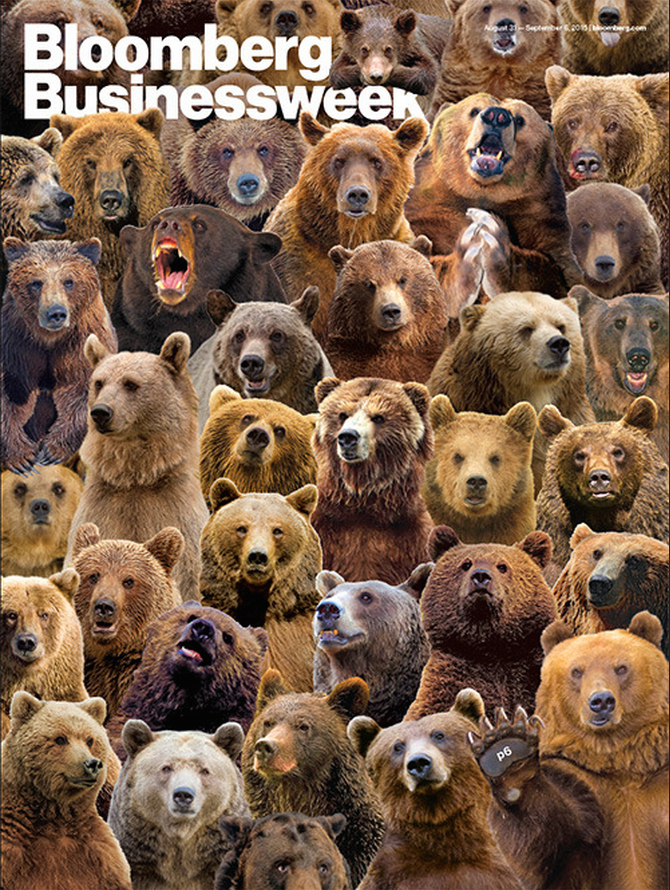
Still, the scary start to the week was enough for one magazine to create the cover shown to the left. In what some bulls interpreted as a “reverse indicator,” the current cover story of  Bloomberg Businessweek features not just one but several bears on its cover.

In a commentary on that phenomenon, Business Insider’s Myles Udland noted that the market often does the opposite of what magazine cover indicators may be suggesting, which would make a bear cover bullish. Remember, Business Week famously proclaimed The Death of Equities in a cover in 1979, triggering a multi-year bull run.

China & other submerging markets

Mid-week rallies aside, one reason for the continued bearishness is China and other Emerging(“Submerging?”) Markets. One of Bloomberg BusinessWeek’s accompanying stories was entitled Will the Next Recession be Made in China? It noted that after Monday morning’s 1,000 point-plus drop, all markets seemed to be correlated: that “the world suddenly seemed like a very small place.” Continue Reading…

Investor Toolkit: The right way to calculate your retirement income

1
Patrick McKeough, TSInetwork.ca

By Patrick McKeough, TSInetwork.ca

Special to the Financial Independence Hub

Tip of the week: “When you work out a plan for your retirement, make sure that you aren’t basing your future income on over-optimistic calculations that will end up leaving you short.”

Every year as RRSP season heats up, many investors are confident they are taking concrete steps toward a secure retirement. But are those steps based on realistic calculations?

Let’s say you’re 50 and you want to retire at 65. You have $200,000 in your RRSP, and you expect to add $15,000 in each of the next 15 years. To determine if this is enough to retire on, you need to make assumptions about investment returns and income needs.

• What you can expect

Long-term studies show that the stock market as a whole generally produces total pre-tax annual returns of 8% to 10%, or around 6% after inflation. For purposes of this retirement plan, we’ll assume a 6% yearly return, and disregard inflation. Continue Reading…

Three key investment strategies hidden in plain sight; #1 — Being There

paul_2-1500x994
Paul Philip CLI, CFP

By Paul Philip, CLU, CFP Financial Wealth Builders Securities

Special to the Financial Independence Hub

If you’ve ever dabbled in graphic design, you’re familiar with the concept of white space. When viewing an illustration, we typically pay the most attention to the visible ink on the page, such as a paragraph of text, a bar chart or an entertaining illustration. White space is the essential empty areas in between that are hidden in plain sight. We barely notice them … until they’re not there:

Pretty cheerful girl pointing white space over hands
Where’s the white space? (Deposit Photos)

When making investment decisions, most people likewise assume that the most eye-catching ink matters the most: an alarming economic forecast, an exciting Initial Public Offering, hot trading tips. But there’s a catch. This evident assumption does not hold up under evidence-based scrutiny. In reality, you have little or no control over how the most obvious news impacts your investments. The most exciting action has already been priced into any trade you might make well before you decide to make it.

Stop fixating on headlines

Instead of fixating on the headline news, consider that liberating financial white space. There, hidden in plain sight, you’ll find a number of powerful investment strategies that are freely available and far more within our control. In this series, we’ll introduce three of our favorite “plain sight” investment strategies:

  1. Being there
  2. Managing for market risks
  3. Controlling costs

Continue Reading…

Retirement – Heaven or Hell?

Jesus Christ in blue sky with clouds, bright light from heaven, burning doorway in dark red sky, road to hell, way to hell, heaven and hellby Michael Drak

Special to the Financial Independence Hub

Recently, while reading an article relating to the risks of boredom in retirement, I was reminded of a TV show that I had seen more than 40 years ago. I’m always amazed at how something can trigger a memory and we can recall it with such clarity as if we just viewed it yesterday.

The show was a Twilight Zone segment entitled “A Nice Place to Visit.” In it, the main character is Rocky Valentine, a small time thief who is shot during a robbery and passes out. He wakes up and at some point he realizes that he’s in fact dead, but by some mistake he’s in heaven and has been assigned a guardian angel by the name of Mr Pip.

Life for Rocky is great for a while as all his wishes are catered to: there are beautiful women, an expensive penthouse, fancy clothes and all the money he desires. In fact every time he goes to the casino, no matter what game he plays he wins: he can’t lose. But eventually Rocky gets bored of the predictability of his life, the excitement is gone and with that all of the fun.

Finally Rocky pleads with Mr Pip to send him to the other place where he belongs and that he doesn’t deserve to be in heaven. At this point Mr Pip’s says “Whatever gave you the idea that you were in heaven? This is the other place!”

I love the punch line and the lesson here is that Rocky goes crazy because there are no challenges in his life, there is no effort required and there’s nothing to hope for because it all exists as soon as he wants it.

The boredom of endless leisure

Continue Reading…