Tag Archives: TFSA

5 financial tips for Back-to-School season

By Aaron Hector, Private Wealth Advisor, CWB Wealth

Special to Financial Independence Hub

Back-to-school season can raise tough conversations about financial responsibility. For many, it causes students and families to re-evaluate both short and long-term goals in the pursuit of a post-secondary education.

The good news is that creating a plan to manage school expenses doesn’t have to be difficult:  it just requires students and families to look ahead and be realistic with budget, goals and expectations. In other words, this isn’t a process to “wing it.” Using a scenario in which you have a student enrolled or planning to enrol in a post-secondary program, here are five tips that will can help keep your finances on track this year.

Work smarter, not harder: Develop your school savings plan

It’s never too early to start saving for your child’s education. If you are a first-time education saver and starting to put money away, be sure to learn about opportunities that fit your needs and goals: whether that is saving smaller amounts over longer periods of time or leveraging options like a Tax-Free Savings Account (TFSA) or a Registered education savings plan (RESP).

For example, all new parents should start a RESP, which is a tax-sheltered investment vehicle that provides access to government grants which provide a 20% match on your contributions (up to certain limits). The first step is to speak to your advisor to learn about your options. The options are vast and more flexible than most people assume!

Leverage your resources: find out how your bank and school can help you save

To ease the burden of pricey tuition, it pays to do a bit of research on the programs, grants, or scholarships you or your child might be eligible for through your financial and post-secondary institution. The resources are out there, but it can be tough to know all that exists or how to apply for them. A good advisor can help with this part – in fact, you should be able to count on their help and resourcefulness for your entire financial journey.

Do your homework: Build a budget

Between school supplies, courses, commuting and school fees, a back-to-school shopping list can feel daunting, endless and expensive. Find savings by teaming up with your kids to identify which costs are needs versus luxuries, and then prioritize or cut as need be. Use what you’ve spent in previous years as a baseline to create a budget for the current year, adjusting for any new or increased costs you expect to come up. Because budgets can be quickly impacted for unexpected costs, consider a back-up fund. Tracking your spending, spreading out purchases, buying in bulk, reusing items and investing in supplies that are quality (not just trendy) will help you properly manage that budget for years to come.

It’s your (financial) responsibility: Manage your money with the proper mindset 

For many, there are at least two life pivotal transitions that take place after graduating high school: entering the world of post-secondary education, and (more importantly) taking on a more mature financial mindset. This is a great time to encourage kids to open their own TFSA, or even a First Home Savings Account (FHSA). While the TFSA can be used for shorter term financial goals, the FHSA should really only be used for money that is being set aside for a housing purchase within the next 15 years. Encouraging your children to form good financial habits today will prove to be very powerful over the long term.

Knock. Knock: Don’t forget to check in

You’re already likely to keep tabs on your children throughout the year to make sure they are staying on top of their laundry and homework, but some parents might forget to check-in with their own financial advisor. Meeting regularly with your advisor helps to:

  • Manage budget changes in real-time as your family’s expenses and priorities shift
  • Keep your finances on track by reviewing whether you are staying on target you’re your financial goals

The cost to attend a post-secondary institution can be massive, and the price tag can become even harder to cover without the right plan. So start early. Save for the long-term. And lean on the advice and tools that only a good financial advisor can provide. You – and your future student – will be thankful for being proactive.

To learn more about setting you and your kids up for financial success visit www.cwbwealth.com

Aaron Hector is a Private Wealth Advisor with CWB Wealth where he has been for the past 16 years. In his position he works with clients in a financial planning capacity. The majority of his clients are of an ongoing long-term nature, but he also prepares financial plans on a fee for service basis for those who are more interested in a one-time financial planning engagement. He is the Symposium Chair and board member for the Institute of Advanced Financial Planners (IAFP) and a member of the Financial Planning Association of Canada (FPAC).


More on the FHSA [Tax-free First Home Savings Account]

The FHSA and reasons why younger Canadians should really opt in to opening this account with any intention to buy their first home over time …

By Mark Seed, myownadvisor
Special to Financial Independence Hub

The New Tax-Free First Home Savings Account (FHSA) Facts:

  • Think of the FHSA as a hybrid of the Registered Retirement Savings Plan (RRSP) / Home Buyers’ Plan and Tax-Free Savings Account (TFSA): FHSA contributions are tax-deductible like the RRSP and qualifying withdrawals out of the account are not taxed just like the TFSA.
  • To be eligible to open and contribute to your FHSA you must be:
    • A Canadian resident + 18 years or older + *a first-time home buyer. (Meaning, existing homeowners AND folks that owned a home in the *last four preceding years of trying to open the FHSA won’t qualify to open this account).

*An individual is considered to be a first-time home buyer if at any time in the part of the calendar year before the account is opened or at any time in the preceding four years they did not live in a qualifying home (or what would be a qualifying home if located in Canada) that either (i) they owned or (ii) their spouse or common-law partner owned (if they have a spouse or common-law partner at the time the account is opened).

  • The FHSA can hold stocks and bonds and ETFs just like the TFSA and RRSP.

FHSA Contributions and Tax Deductions:

  1. Individuals would be able to claim an income tax deduction for FHSA contributions made in a particular taxation year; contributions currently capped at $8,000 per year up to a $40,000 lifetime contribution limit. So, a solid 5-years of striving to max-out the account for tax-free withdrawals.
  2. Like the TFSA, your unused FHSA contribution room can be carried forward to the following year but only up to a maximum of $8,000.

FHSA Holding Period and Withdrawals:

The account can stay open for 15 years OR until the end of the year you turn 71 (not very likely???) OR until the end of the year following the year in which you make a qualifying withdrawal from an FHSA for the first home purchase, whichever comes first.

FHSA worst-case? What if you open an account and you don’t purchase a home??

Any savings not used to purchase a qualifying home could be transferred to an RRSP or RRIF (Registered Retirement Income Fund) on a non-taxable transfer basis, subject to applicable rules. Of course, funds transferred to an RRSP or RRIF will be taxed upon withdrawal.

All that and more, is highlighted in this comparison graphic below via @AaronHectorCFP and more details from Cut The Crap Investing with even more Q&A.

Weekend Reading - The New Tax-Free First Home Savings Account (FHSA)

Reference/Source: https://cutthecrapinvesting.com/2023/03/01/the-tax-free-first-home-savings-account-in-canada-fhsa/

My FHSA Thesis

Overall, pretty great stuff with the FHSA and a major opportunity for younger investors who are really trying to find ways to sock away more money for their very first home.

Continue Reading…

Re-examining our plans for Financial Independence

By Bob Lai, Tawcan

Special to the Financial Independence Hub


When we started our financial independence journey back in 2011, we didn’t set a specific FI date or number. In our minds, we do not doubt whether we could become financially independent or not. We knew we’d become financially independent in the future. It was just a question of time. We simply needed to have patience and let our investments compound over time.

A few years into our FI journey, our FI plan started to evolve. Rather than having a specific liquid net worth and utilizing the 4% safe withdrawal rule, we decided to have enough dividend income to cover our expenses. Looking at the calendar, we randomly set a target of reaching this milestone by 2025 or earlier.

It’s funny how ten years seemed to have gone by in the blink of an eye. At the same time, a lot has happened in our lives…

  • Getting engaged and married
  • Having two kids
  • Moving from an apartment in Vancouver to a house in the suburb
  • Me having different job titles, going from engineering to project managing to product marketing to engineering
  • Mrs. T starting her holistic doula practice
  • Starting my photography business ( I’ve been on a bit of break the last few years)
  • Starting this blog, writing articles, learning new things, and connecting with other like-minded people

One thing I’ve realized is that life is never static. It’s always dynamic. Although we can do as many projections and make as many plans as we possibly can, projections and plans do and will change. Therefore, with three years to go before 2025, I thought it would be a good time to re-examine our financial independence plans and see if we need to make any adjustments.

Our FI numbers 

Since starting our FI journey, we have tracked our expenses meticulously. Here are our annual expenses since 2012:

Total Necessities Total Annual Spending
2012 $26,210.52 $44,603.76
2013 $26,343.00 $45,260.88
2014 $29,058.96 $47,391.96
2015 $31,256.88 $47,270.16
2016 $29,831.40 $47,566.96
2017 $33,887.68 $51,144.77
2018 $31,840.75 $57,231.99
2019 $33,199.98 $54,906.02
2020 $35,511.60 $48,908.74
2021 $38,950.66 $71,852.02

Necessities cover core expenses like food, insurance, housing, clothing, utilities, car, etc. Other expenses are considered as non-core expenses which include things like dining out, skiing, camping, travel, charitable donations, gifts, etc.

The last two years have been abnormal in terms of spending. Due to the pandemic, our spending was much lower than usual in 2020. Then last year we had unplanned expenses of around $16,500 on our cat and our house. If we take this amount out, it’d put our 2021 annual spending to around $55,000.

Based on our historical spending trend, I would estimate that we need somewhere between $50,000 to $60,000 in dividend income annually to cover our expenses. To be on the safe side, I’d use $60,000 annual spending for any FI plans because we need to have inherent built-in flexibility on variables outside of our control, like major purchases, emergencies, etc.

The $60k annual spending estimate, of course, assumes that we continue to live in Vancouver and do not have many significant changes in our spending habits.

One thing to keep in mind is our spending can drastically come down if we decide to geo-arbitrage by moving to a smaller Canadian town or somewhere in South East Asia with a lower cost of living than Vancouver. On the flip side, the spending number can increase if we move to Denmark and live there for a few years (I’m ignoring the tax consequences for now).

How much do we need in our dividend portfolio?

How much do we need in our dividend portfolio to generate $60,000 in dividend income? Let’s do a quick math exercise, shall we?

For $60,000 dividend income per year, at 3% dividend yield, we’d need a dividend portfolio worth $2 million; at 4% dividend yield, we’d need a dividend portfolio worth $1.5 million. In other words, we need a portfolio valued between $1.5 million to $2 million. That’s certainly not a small chunk of change.

Now, if we take a middle-of-the-road approach and use a portfolio dividend yield of 3.5%, that means a portfolio value of around $1.714 million.

One thing is clear – we need to continue to save and invest money in our dividend portfolio. We also need to find the right mix between high-yield low-dividend growth stocks and low-yield high-dividend growth stocks.

With three years remaining in our FI timeline, it might be tempting to start buying more very-high-yield dividend stocks to make sure we can reach our FI target. But it is very important to make sure our dividend income is safe and remains sustainable over time. We definitely don’t want to hit $60,000 in dividend income one year only to see that amount slashed by 20% or more the next year.

The stability of our dividend income is extremely vital.

We also want to make sure the portfolio value continues to appreciate over time. The rationale is simple – total returns matter. Having a stable and safe dividend income and a portfolio that increases value over time will give us more options.

By 2025, both Mrs. T and I will be in our early 40s. With decades ahead of us, we need to ensure our dividend income can grow organically over time and inflation doesn’t eat into our dividend income’s buying power. It will be necessary to have some low-yield high-dividend growth stocks in our portfolio to allow for organic dividend growth.

The plan of living off dividends 

Living off dividends is an amazing idea. Based on my dividend income projection, we should receive $51,000 in dividend income in 2025. However, when we compare that number with the $60,000 annual spending target, it doesn’t take a rocket scientist to realize that we are short by several thousand dollars. Continue Reading…

How to take advantage of rising interest rates

By Bob Lai, Tawcan

Special to the Findependence Hub

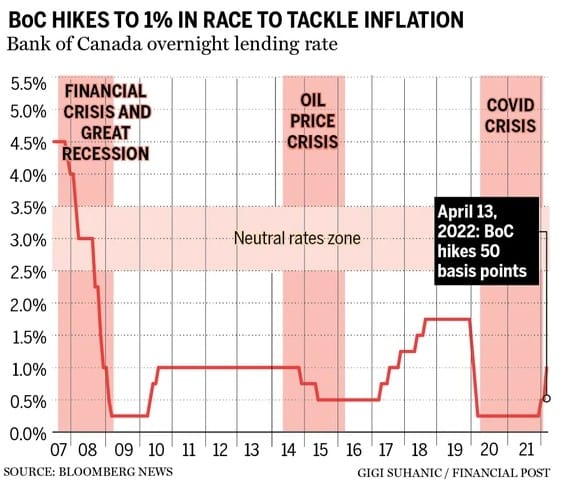
Lately, the talk of the town seems to be rising interest rates. In April, the Bank of Canada raised the benchmark interest rate by a whopping 0.5% to 1%, making it the biggest rate hike since 2000. Given the high inflation rate, it is almost a given that these rate hikes will continue throughout 2022 and beyond. [On July 13, 2022, the BOC hiked a further 1%: editor.]

But before you freak out, let’s step back and look at the big picture. At 1%, the benchmark interest rate is still relatively low compared to the past interest rates.

I still remember years ago before the financial crisis, being able to get GIC rates at around 5%. And some people may remember +10% interest rates in the 80s or early 90s. Back then, interest rates were much much higher than measly below 1% rates we’ve been seeing the last decade.

Historical BoC overnight rates
What’s going to happen to the stock market? Well the general rule is that when Bank of Canada or the Federal Reserve cuts interest rates, the stock market goes up. When Bank of Canada or the Federal Reserve raises interest rates, the stock market goes down.

Continue Reading…