By Ryan Crowther, Portfolio Manager, Franklin Bissett Investment Management
and Yan Lager, Portfolio Manager, Equity Research Analyst, Franklin Equity Group
(Sponsor Content)
For well over a decade, investors have focused on growth stocks: shares of companies expected to grow faster than the market average. But in recent months, the calculus has changed. Market volatility, driven by ongoing COVID-19 concerns, Russia’s invasion of Ukraine, rising interest rates and inflation, has led to a noticeable shift to value stocks. As investors focus on companies with strong fundamentals and comparatively lower-cost shares, do growth stocks still have a place in a diversified portfolio?
Financial Independence Hub: How would you describe the current landscape for growth stocks?
Yan Lager: We’ve been witnessing one of the most pronounced rotations from growth to value stocks in decades. In retrospect, following a multi-year run for growth-oriented equities that were clear beneficiaries of ultra-low interest rates, a rotation to value stocks as interest rates increase is not surprising to us.
Ryan Crowther: Looking at growth stocks generally, the terrain has become much more challenging in recent months, both in terms of the outlook for business fundamentals and a more discerning investor sentiment.
Have all growth stocks been hit equally hard?
Ryan Crowther: This is an important question, because when there’s a broad sell-off and a significant number of stocks drop sharply, they might all be considered “growth” stocks; but do they really share the same fundamentals? What risk versus return is the share price truly discounting? That’s where our GARP approach (growth at a reasonable price) has proven powerful for over 40 years, as it helps avoid focusing too much on whether a stock sits in the growth or value basket.
Which stocks have been most affected by the recent pullback in equity markets?
Yan Lager: Companies that benefited from the pandemic shift to working from home and the broader adoption of e-commerce, or persistently low interest rates, have seen their shares pull back due to profit-taking or concerns that future earnings performance may fall short of pandemic-high levels. Harder-hit stocks have included earlier-stage companies in the information technology sector, which have seen significant price and valuations fluctuations. We’re constantly reassessing the fundamental, longer-term investment theses and strategic merits of our investments.
What types of companies do you look for?
Yan Lager: In managing a global growth fund, we believe that owning a diversified portfolio of high-quality companies with strong secular growth drivers, unique competitive positions and capable management teams can deliver attractive returns, as ultimately share prices follow fundamentals. This is particularly the case if you’re investing for the long term, which we believe you should be if you’re investing in equities.
Ryan Crowther: We look for businesses with strong, consistent earnings and growing cash flow—attributes that will hopefully work to offset some of the factors that can challenge growth in the near term. In addition, a company’s valuations must also be attractive. We focus on combing through our investment opportunity set to find stocks offering a good risk-adjusted return profile over the course of an economic cycle.
Where are you finding opportunities these days?
Ryan Crowther: Focusing on mid- to large-cap Canadian companies, we’ve been active in securities that sold off as part of the broad weakness in growth stocks. We took advantage of that weakness to add new, quality companies at an attractive entry point. The shift — from the largely complacent and speculative equity market generally experienced throughout the pandemic — to the less forgiving market, characterized by a more rational mindset thus far in 2022, has created opportunities for us. Continue Reading…
To reduce future tax bills, now is the time to start planning
By Rob Cordasco
Special to the Financial Independence Hub (American Content)
With this year’s income-tax-filing deadline finally past, you may have sat back with a sigh of relief, happy to forget about taxes for another year. But that’s a mistake because it’s already time to start thinking about taxes for next year if you hope to lower the amount you ultimately will owe, says Rob Cordasco (www.cordasco.cpa), a CPA and author of A Framework for Growth: Smart Financial and Tax Planning Strategies Throughout the Entrepreneurial Life Cycle.
“People often make the error of only worrying about taxes when it’s time to file,” Cordasco says. “By then, your taxes are pretty much locked in. Although you can’t avoid taxes, you can take steps to minimize them. But this requires proactive planning – estimating your tax liability, looking for ways to reduce it and taking timely action.”
And timely, he says, isn’t waiting until the week before the filing deadline. The real deadline for taxes in the United States – at least for taking action that could save you money – is Dec. 31 of the tax year, he says. (One exception is that you may be able to make a tax-deductible IRA contribution right up to the filing deadline if you meet certain criteria.)
Cordasco says some things to consider that can help you reduce the tax bill you will owe come April 2023, include:
“Bunch” charitable donations
Many people take the standard deduction when they file their taxes because that’s higher than their total itemized deductions. But Cordasco says you might benefit from “bunching” your charitable donations in alternating years, raising the amount you could itemize every other year. Here’s how that would work: If you make a large donation on Jan. 1 and another on Dec. 31, those donations are essentially a year apart, but they fall within the same tax year for itemizing purposes. In effect, you make two years worth of charitable donations in one tax year. Continue Reading…
Warren Buffett of Berkshire Hathaway, which just held its first live annual meeting since Covid hit.
By Akshay Singh
Special to the Financial Independence Hub
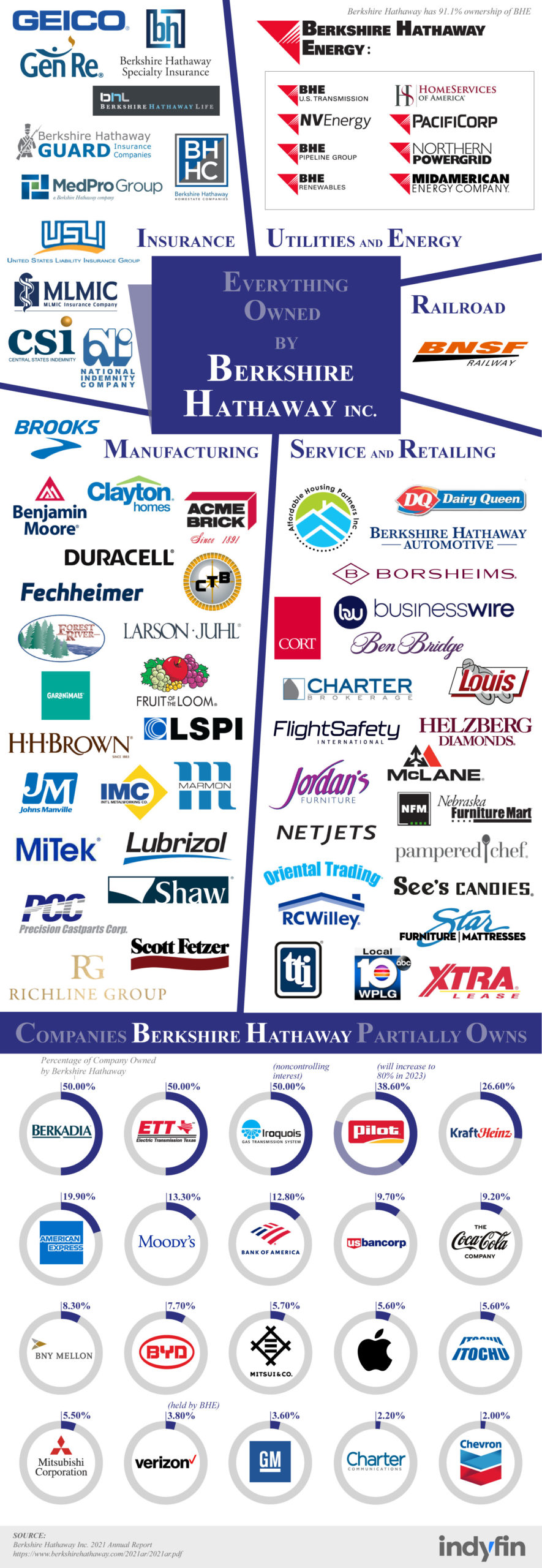
You’ve probably heard of the multi-billion dollar company Berkshire Hathaway, owned by mega-billionaire and philanthropist Warren Buffett, but what does Berkshire Hathaway do exactly?
Berkshire Hathaway Inc. is a conglomerate holding company, meaning it does not produce goods or services and instead has a controlling interest in and owns shares of other companies to form a single corporate group.
That leads us to our next question: What companies does Berkshire Hathaway own to make it one of the most valuable companies on the planet? The team at Indyfin turned to the 2021 Berkshire Hathaway annual report to create this compendium of all of the Berkshire Hathaway companies. The holding company has a controlling interest in more than 60 companies and partially owns another 20 on top of that. You’ll recognize a lot of brand names from a wide variety of industries that make up the impressive Berkshire Hathaway portfolio.
Does Berkshire Hathaway own one of your favorite or most-used brands? Check out this roundup of Berkshire Hathaway companies from Indyfin to find out.
What Is Berkshire Hathaway?
Berkshire Hathaway is an American conglomerate holding company with a market cap of US$774.24 billion, making it the seventh most valuable company in the world. What is a conglomerate? A conglomerate is a combination of businesses from a variety of different industries that operate as a single economic entity under one corporate group. Conglomerates are usually large and multinational and generally include a parent company and many subsidiaries. The “conglomerate fad” was big in the 1960s due to low interest rates, rising prices, and a decline in the stock market, which led to large corporate conglomerates like Berkshire Hathaway forming. The parent company in this scenario is also referred to as the holding company, as it holds a controlling interest in the securities of all of the other companies. Holding companies do not produce goods or services; instead, they own shares of other companies to form a single corporate group. Holding companies are beneficial because they reduce risk for shareholders and can hold and protect assets like trade secrets or intellectual property.
Investors follow the 60/40 rule because they are told bonds will protect capital while equities grow it. Why recent drops in bond prices should make us reconsider that rule.
By Paul MacDonald, CIO, Harvest ETFs
(Sponsor Content)
From the moment they start putting money in the market, investors are told to follow the 60/40 rule. It is the broadly accepted wisdom that, for an average retail investor, a 60% allocation to equities and a 40% allocation to bonds will result in a robust portfolio. Equities should deliver growth prospects in the long term while bonds will offset downsides in equities by delivering uncorrelated returns. Bonds preserve capital, and equities grow capital. That’s the accepted wisdom.
Countless investment fund issuers have packaged this logic into their balanced funds. These funds offer a specific allocation to equities and bonds, usually in line with the 60/40 rule, forming the core of a retail investor’s portfolio.
The problem with accepted wisdom is sometimes circumstances turn it upside down. In the past months we have seen volatility in equity markets and a significant drop in bond prices. That is because the investment landscape has changed.
Why are bond prices dropping?
After over a decade of historically low interest rates, followed by massive rate cuts by central banks at the onset of the COVID-19 pandemic, inflation has begun to set in. With rising inflation comes pressure on central banks to raise rates and market expectation that rates will rise, which is itself pushing interest rates higher. Continue Reading…
While various government programs have helped many individuals and
businesses during the pandemic, the looming tax filing deadline of April
30th has Canadians facing the harsh truth about how much income they really generate, how much they spend and how much they owe in taxes in a year.
If you are concerned about the prospects of a rising tax bill and want to stay ahead of the curve, we highlight some tax strategies that may help.
4 Strategies for optimizing your taxes
Effective tax planning is highly dependent on your personal situation, so there is no one-size-fits-all solution. However, here are four strategies that may be useful in optimizing your tax situation:
Estate freeze
An estate freeze can be used to defer the realization of taxable capital gains in the value of a family business. After a properly structured freeze, any further growth in the company’s value will accrue not to the owner, but rather to their successors or to a discretionary trust set up as part of the freeze.
Estate freezes have many potential benefits, including locking in probate tax liabilities, locking in a purchase price for a business, providing retirement income and strengthening creditor protection.
Capital losses
Stock markets around the world have plunged during the pandemic, and despite some strong rebounds, many investors have stock portfolios with unrealized losses. In some situations, it can be beneficial from a tax perspective to sell holdings and trigger capital losses to offset capital gains.
Capital losses can be applied retroactively up to three years and carried forward indefinitely. However, there are restrictions on how such losses can be applied, so any decisions should be made with advice from a tax professional.
Prescribed rate loan
A prescribed rate loan allows individuals with high marginal tax rates to transfer investment income to family members with low marginal tax rates. Under this strategy, the high-income earner makes a loan to a family member or a family trust, which invests the money and earns investment income. The high-income earner receives interest payments at a rate prescribed by CRA (currently 1%) while the remaining investment income can be distributed to the family member(s) and will be taxed at their lower tax rate.
Spreading corporate losses
Owners with multiple businesses are not allowed to directly consolidate their profits and losses across their corporate group to minimize their overall tax bill. However, there are permissible tax strategies that can be used to spread at least some corporate losses and achieve similar outcomes. Management fees are one example, although there are restrictions on how this strategy can be applied. Continue Reading…


 Posted By