 Posted By
  By Marie Howes & Suzanne Cook, PlanetLongevity.com
Special to the Financial Independence Hub

 By Marie Howes & Suzanne Cook, PlanetLongevity.com
Special to the Financial Independence Hub
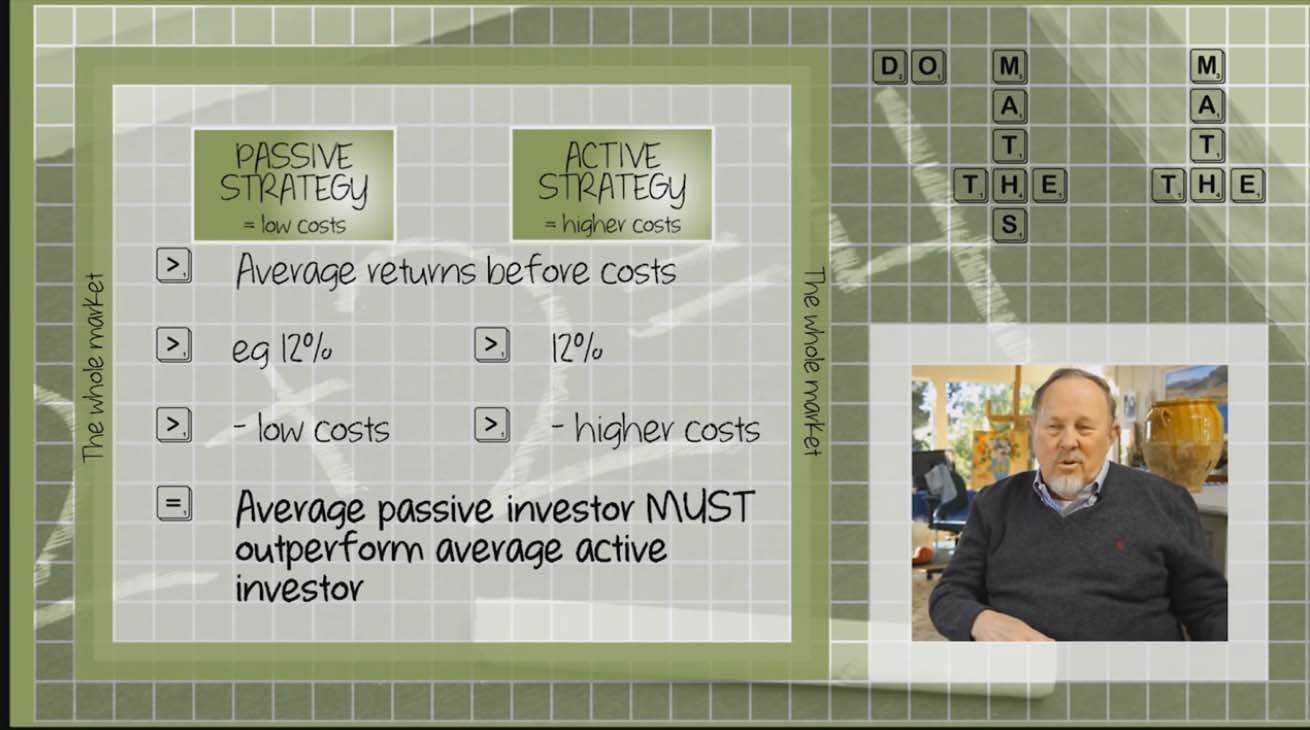 The latest video instalment of How to Win the Loser’s Game (Part 6) has been posted at SensibleInvesting.TV and will also be housed shortly at Findependence.TV.
The fund management industry won’t tell you this, but all the evidence points to the humble index fund being the most appropriate investment vehicle for the vast majority of people. And there are few advocates of indexing as staunch as Warren Buffett — the most famous active stockpicker of all. The video includes the following quote from Buffett:
“When the dumb investor realizes how dumb he is and buys an index fund, he becomes smarter than the smartest investors.”
In fact (although this isn’t in the video) even former hedge fund manager and TV personality Jim Cramer often tells his Mad Money audience that the first $10,000 of young peoples’ portfolio should go in an S&P500 index fund or ETF before venturing into picking individual stocks. Continue Reading…

By Aman Raina, Sage Investors
Special to the Financial Independence Hub
In a previous post on my series on Behaviorial Finance, I reviewed Richard Thaler’s concept of Loss Aversion behaviour. [the Hub version ran here last week.]
The concept states that people will feel more hurt emotionally with a loss than an equivalent gain gives pleasure.
Consequently, we will be more prone to take excessive risks to eliminate that loss.
Thaler also observed this phenomenon in reverse: specifically, in how people behave when they are making successful financial/investment decisions.
Thaler said this behavior gains critical mass in periods that would be described as financial bubbles, in which people are enjoying repetitive excessive gains in their investments. Using the stock market euphoria of the late ’90s as an example, Thaler comments:
“… in the 1990s individual investors were steadily increasing the proportion of their retirement fund contributions towards stocks than bonds, meaning that the portion of their new investments that was allocated to stocks was rising. Part of the reasoning seems to be that they had made so much money in recent years that even if the market fell, they would only lose those newer gains. Of course the fact that some of your money has been made recently should not diminish the sense of loss if that money goes up in smoke. The same thinking that pervaded the views of speculative investors in the boom housing market years later. People who had been flipping properties in Miami, Vegas had a psychological cushion of house money that lured them into thinking that at worst they would be back to where they started. Of course when the market turned down suddenly, those investors who were highly leveraged lost much more than house money. They lost their homes…”
Conventional thinking has been (and I’ve practiced this myself) that when you have gains in a stock you should take some money off the table and sell the equivalent amount you initially invested in and the then hold the profit amount.
Playing with the House’s money
At that point, you are essentially playing with the house’s or in this case the stock market’s money. If we were to lose all that “profit” or house money, we wouldn’t feel we really haven’t lost any money.
However according to Thaler’s observations about Loss Aversion, we will likely take more aggressive, and riskier decisions when the House Money is reduced, which perpetuates the bubble factor. We will either double down on the investment, continue to hold because we feel it is still a high quality investment compared to other investments (Endowment Effect) or engage in other high risk investment opportunities to regain that House Money. During bubble or bull markets periods, it will work for awhile, however at some point that excessive risk will bite back and ultimately that House Money will likely be gone along with part or all of the initial investment they originally put down.
I had a faced a situation that demonstrates this house money behaviour. I had owned a position in NeuLion. It was a very good investment decision, as it was up nearly 90 per cent so I had made a lot of money on paper. Unfortunately, the stock crashed but I was still up 25%. I decided to sell enough stock to cover my initial investment. The remaing stock I had was therefore House Money. At the time I decided to do this because in my mind I could rationalize and live with the fact that I didn’t really lose money even though the stock tanked royally.
The question that I faced was should I buy more stock at the lower price if the fundamentals of company were still strong or sell the remainder of my position if it fell below my loss threshold, which is 20 per cent. Under the Loss Aversion behaviour that Thaler described, I would buy more stock even if the company has experienced a negative game changer moment and is a riskier prospect.
With awareness of these types of behaviours, I decided to not buy additional stock and instead decided to ride the position out to see if the company could turn it around. If it couldn’t and the position fell another 20 per cent, I would sell the remainder of the position.
It’s interesting as normally one of my disciplines I have built up is to sell positions when they cross a minimum return threshold that I am seeking. Normally for me that is in the 20 per cent range but this time, I decided to hold onto the stock for longer, more so for practice as in the past I have realized that I tend to sell shares earlier and in many cases left money on the table. In this example I strayed away from my discipline and while I didn’t lose money, it could have easily gone the other way.
Managing your Greed
Greed ultimately drives this level of behaviour. The theme from this observation is that as much as it’s important to manage your losses, it is equally important to manage your gains, or more plainly, manage your greed. When you make investment decisions, you need to establish a minimum return you are seeking and when you reach that threshold you should re-evaluate the investment to determine if there is still upside or if it makes sense to bank the profit and move on to better opportunities.
Greed gets the better of us in most cases, but again developing a discipline and avoiding the false sense of security that the House Money Effect offers can allow you a greater chance to maximize the profits and benefits of your successful investment decisions.
Aman Raina, MBA is an Investment Coach and founder of Sage Investors, an independent practice specializing in investment coaching and portfolio analysis services. This blog was originally published on his web site and is reproduced here with permission.

By Adrian Mastracci, KCM Wealth
Special to the Financial Independence Hub
Understanding the RRSP regime makes it easier to stickhandle your retirement marathon. This workhorse has been delivering on retirements since its introduction in 1957.
It really fits two groups of investors like a glove.
Those without employer pension plans and the self-employed.
Some investors still shun RRSP deposits but three solid reasons to pursue RRSP accumulations stand out for me:
• Long-term, tax deferred investment growth.
• Future withdrawals, ideally at lower tax rates.
• Contributions provide immediate tax savings.
Stay focused on how the RRSP dovetails into your total game plan.
The power of compounding really delivers.
Your RRSP mission is three-fold:
• Keep it simple.
• Treat it as a building block.
• The journey lasts a lifetime.
I summarize six vital “back to basics” RRSP areas for your review:
1.) Setting saving targets Continue Reading…

By Kara Lilly, CFA
Special to the Financial Independence Hub
Stock markets have been jittery lately.
After improved sentiment last quarter, investors now appear to have heightened concerns. Not only have fears around China resurfaced, stoked in part by downbeat economic data and circuit breaker sell-offs, but weak global commodity prices also continue to elicit concern. Oil now sits below $30 per barrel, while the VIX index, a measure of volatility in the S&P 500, remains at an elevated level (approximately 29).
A lot has been going on in the global economy…enough that some shops have issued dire warnings of the days ahead. But while recent events do appear negative—insofar as they represent bad cards that have come up—they are not wholly surprising; the risks around China and weak commodity prices have been known for some time. Moreover, they warrant neither a kneejerk reaction nor panic.
Investor apprehension in this environment is both understandable and natural —and we must ensure it does not hijack us.
Markets are always volatile and unpredictable
