Hub Blogs

Hub Blogs contains fresh contributions written by Financial Independence Hub staff or contributors that have not appeared elsewhere first, or have been modified or customized for the Hub by the original blogger. In contrast, Top Blogs shows links to the best external financial blogs around the world.

Retired Money: the glut of books about Trump and prospects for Boomers’ retirements

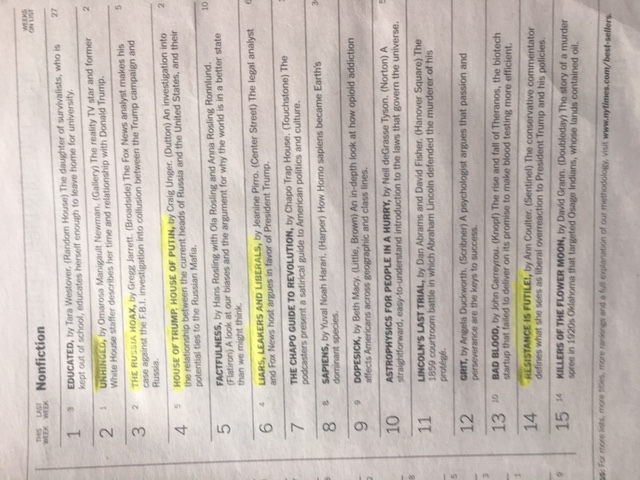
As the yellow highlights show, books about Donald Trump now dominate the New York Times’ non-fiction bestseller lists

As my latest MoneySense Retired Money column recaps in depth, roughly half of the top ten New York Times bestselling non-fiction books are about the Donald Trump presidency. You can access the full column by clicking on the highlighted headline here: How Trump’s policies are affecting my investment choices.

Soon after the 2016 election that brought Trump to power, my financial advisor and I would exchange emails about the latest books: initially biographies and warnings and then in the last year the current glut of books about the actual presidency and the administration.

I’m normally a fan of biographies and love him or hate him, it’s hard to ignore the life of Donald Trump, considering that everything he says or tweets can impact us all. Yes, he may or may not be a threat to the looming Retirement of the baby boom generation of which he is on the leading edge, but his hair-trigger temper and proximity to the nuclear codes gives us something more to fear than merely our financial survival.

Some of the books I mention do give some insights into the implications of this presidency for the global economy and stock markets. Others are mere political diatribes from the left or the right, while still others are more salacious tell-alls. Stormy Daniels, I’m looking at you! (The book is titled Full Disclosure.)

As the column mentions, there are a number of books written by rabid left-wingers who are convinced Trump is a serial liar and a treasonous sellout to Russia president Vladimir Putin, but there are also several written by conservatives and republicans who are more sanguine about it all. In the latter camp I’d include Conrad Black, Ann Coulter and David Frum, plus a few titles from FOX news personalities who are obviously sympathetic with “The President,” as they like to refer to him.

Crazy crazy or Crazy like a fox?  Continue Reading…

Have you considered Shared Housing during Retirement?


By Steve Barker

(Sponsored Content)

Anyone who is approaching the age of retirement or planning for their eventual retirement is likely to give a lot of thought to just how much they’ll need to enjoy their golden years. While affordable life insurance policies are something else to add to the retirement list, so, too, is whether it would be a good idea to look into living with other people in shared housing: not only to reduce living expenses, but for a host of other reasons as well. Ready to learn more?

High cost of living combined with diminished resources

No matter where you live, chances are good that the cost of living has gone up in the past couple of years, a trend that is likely to continue. While you can control how much you save for retirement, you cannot control how expensive everything from food to medication will be when you’re ready to retire. Additionally, there may not be government or federal financial resources available when you reach the age of retirement, cutting off another source of income. Living with roommates can help immensely in cutting down the cost of living without the need for you to go to great financial and personal lengths to make your living situation work.

You have a built-In social circle

Many seniors grow lonely as they age because they aren’t able to get up and about as much as they used to when they were younger. When you live with people you get along with, being social is as easy as walking down the hall. Elderly individuals who have mobility issues don’t have to worry about making special transportation arrangements to spend time with other people, and being social can be mentally and emotionally beneficial for everyone, no matter their age or health.

Share common house chores

Keeping an entire house clean can be quite a task even for married seniors. Rather than hiring house cleaning services, which can drain your retirement funds, you may find it’s better to divide the chores between the people you live with. Besides saving money, chores allow you to move around and keep somewhat active, which senior citizens need to remain healthy. Continue Reading…

5 ways Real Estate boosts Financial Independence

By Sia Hasan

Special to the Financial Independence Hub

Gaining financial independence is one of the most difficult propositions. Life is expensive, particularly if you live in a metro area, which is where most of the higher paying jobs are located. As a result, most people save only small amounts of their paychecks or none at all. Clearly, this is not the path to financial independence (aka “Findependence.”).

Thankfully, you don’t have to make a massive salary to become financially independent. There are several methods for building wealth, including starting a business, investing in securities, and investing in real estate. Even if you do the first two already, you need to consider these five ways of increasing your financial independence through real estate.

Real estate investment offers the highest returns for the lowest risk when compared to starting a business or investing in stocks. The reason is that real estate offers five surefire ways to grow your money, known by the acronym IDEAL. By setting a long-term plan to benefit from these five methods of making money in real estate, you are on your way to financial independence.

The IDEAL investment

IDEAL stands for income, depreciation, equity growth, appreciation, and leverage. To succeed in making real estate work as an investment, you need to look beyond your principal residence. Though owning your own home provides appreciation and tax benefits, most people can’t produce income from their principal residence, owners of duplexes and people who rent out spare rooms aside.

1.) Income

When you purchase a rental property, you generate income, provided that you collect enough rent to exceed expenses. With a cash purchase, this is easy. If you finance the purchase, you need to analyze the numbers carefully. Provided you finance the right rental property, you earn a much higher rate of return on the financed property than if you purchased it with cash.

2.) Depreciation

To increase your rental income profits, you need to bone up on the IRS depreciation rules. Because the property is a business investment, you get to deduct all depreciation off of your profits. This saves thousands of dollars in income taxes every year. Continue Reading…

Vanguard: The hidden $1.3 trillion player in active management

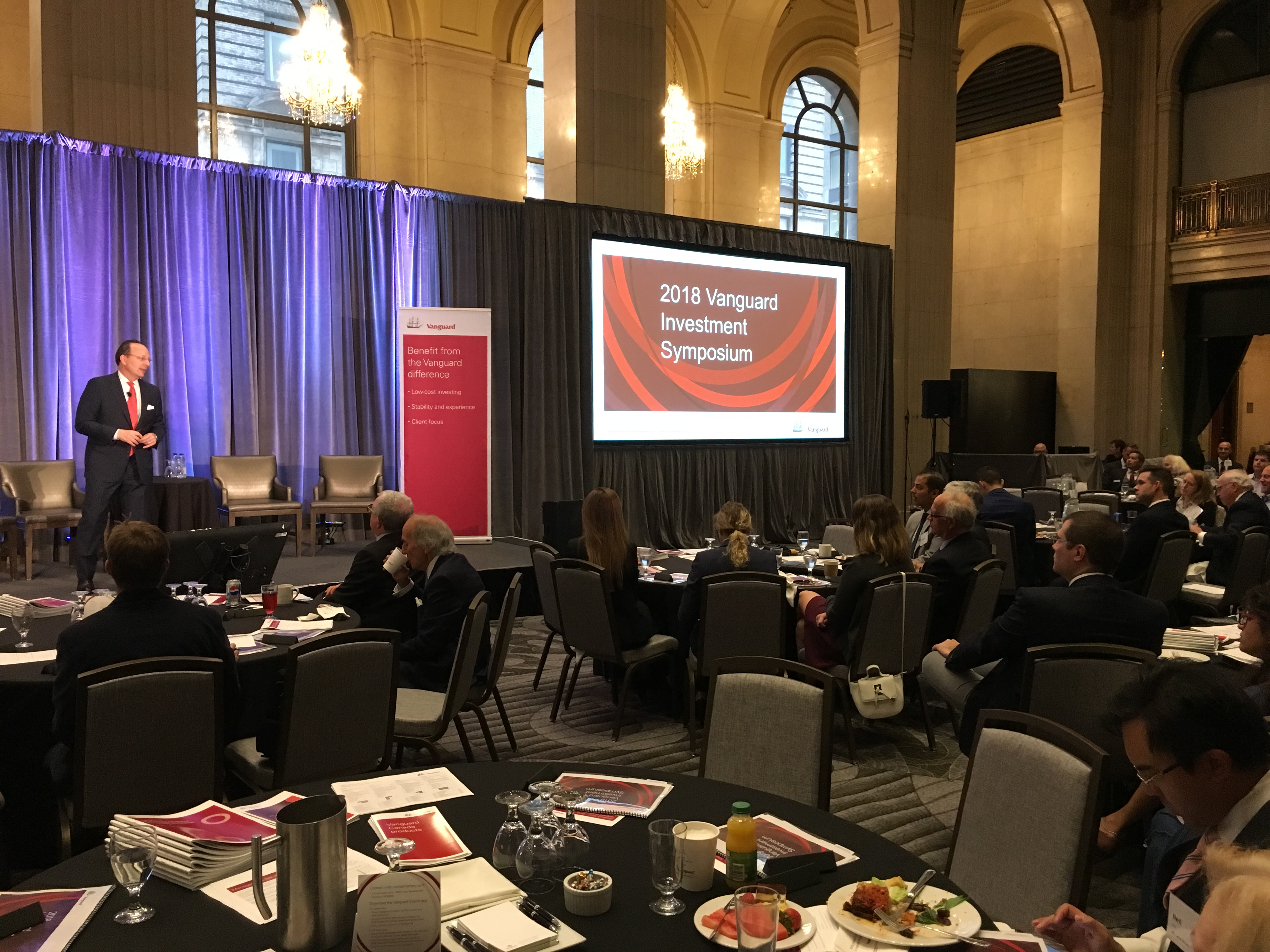
Vanguard’s Daniel Wallick addresses financial advisors at 2018 Vanguard Investment Symposium

While the Vanguard Group is best known for being a pioneer of index mutual funds and exchange-traded funds, it also happens to be one of the world’s largest practitioners of active management. In a presentation Tuesday in Toronto that is taking place across the country, Vanguard executives said the US$5 trillion of money it manages worldwide includes $1.3 trillion in active management.

Vanguard Investment Strategy Group’s Head of Multi-Asset Portfolios, Daniel W. Wallick, presented financial advisors with a framework for constructing portfolios that combine active and passive approaches to investing. The heart of Vanguard’s approach remains broad cap-weighted indexes (or so-called Beta), which is what Vanguard says it means when it uses the term “indexing.”

For many investors, the broad diversification, low costs and tax efficiency of its mainstream index funds and ETFs may suffice.

But, depending on the desired complexity, Vanguard can incorporate “factors” like momentum, value, or liquidity, all factors that have shown a persistency for generating alpha (outperformance) over long periods of time. Beta and Tilts (to for example, overweighting the home country or large market caps) can be combined for the single most important task of Strategic Asset Allocation but overlaying this can be the addition of potential “Alpha” sources like Security Selection and Timing.

“Strategic asset allocation through market-cap-weighted indexes makes for a powerful tool,” Wallick said. And over 10-year periods, asset allocation policy continues to be the biggest source of variations in returns. Asset allocation explains 86% of return variation in 303 Canadian balanced funds tracked by Vanguard, 91.1% of 709 balanced funds in the U.S., 80.5% of 743 balanced funds in the UK and 89.1% of 580 balanced funds in Australia.

Cost trumps talent, patience is crucial

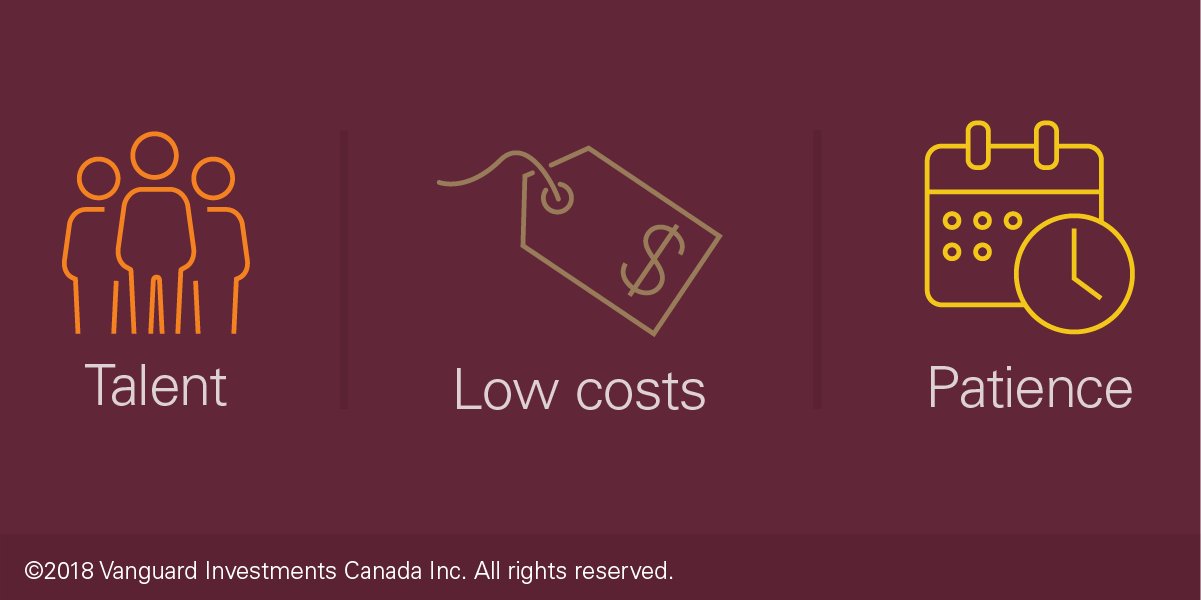
The 3 keys to successful active management = long-term performance

Vanguard sees three keys to successful active management: Cost, Talent and Patience. Wallick described the in-depth process Vanguard uses to select subadvisors for its actively managed funds but hiring talent has to be within strict cost-control parameters.

“Cost is a powerful indicator of future alpha.” But once the talent has been identified and hired, patience is required: Vanguard research over 15 years found that of 2,200 initial funds, 22% survived and outperformed, 24% survived but underperformed, and 54% did not survive. But even among the 22% that survived and performed, 98% of them underperformed in at least four years.

By focusing on both low costs and rigorously overseeing actively managed subadvisors, Vanguard multi manager funds have outperformed their Lipper peer-group averages by various percentages: 78% of them over 1 year, 83% of them over 3 years, 76% of them over 5 years and a whopping 100% over 10 years.

Factor-based funds vs traditional active funds

There is a half-way position between traditional beta-based Style index funds and ETFs and traditional active funds. The former (Beta) provide low cost, low turnover and lower tracking error while traditional active funds provide the opportunity to add alpha, albeit at a higher cost, potentially greater volatility, and less transparency and control. Between these are factor-based funds and ETFs, which provide consistent targeted exposure as well as low cost, but may have higher tracking error and potentially higher turnover. Continue Reading…

Thinking about retirement? Here are 2 two key income sources to expect

By Scott Ronalds

Special to the Financial Independence Hub

If you’re at the point where you’re starting to think seriously about retirement, you’re probably wondering how much money you’re going to need to enjoy life after work, and where it’s going to come from.

Everybody’s wants and needs are different, so there’s no magic number as to how much you should have saved by a certain age. Plus, the face of retirement has changed significantly, with many people working part-time into their seventies and eighties, and others hanging it up in their fifties.

That said, by making a few assumptions, we can give you a rough estimate of what you can expect from government sources and your portfolio when you decide to retire.

The basics

To keep it simple, we’ll use a scenario which assumes you’re 65 and plan to fully retire from your job this year. A few other assumptions:

  • You don’t have a pension plan with your employer.
  • You’re eligible for full Canada Pension Plan (CPP) and Old Age Security (OAS) benefits.
  • You have an RSP that you plan to convert to a RIF this year, and you plan to take the minimum required payments (which will start next year) from your account. (Note: you aren’t required to convert your RSP to a RIF until the calendar year you turn 71, but you can convert at any age before 71 if you choose).
  • You don’t have any other investments or sources of income.

First off, let’s look at what you’ll get from the government. You can expect monthly CPP payments of roughly $1,114 ($13,370/year) and OAS payments of about $578 ($6,936/year). In total, you can plan on collecting about $1,690 a month, or just over $20,000 a year. These amounts are indexed to inflation. You can decide to defer taking CPP benefits until you’re older, or take them earlier, in which case your benefits will be increased or decreased, respectively. You can also defer taking OAS to receive a larger monthly benefit.

More than likely, this isn’t going to cover your living expenses or fund the lifestyle you want in retirement. So you’re going to need to rely on your portfolio to cover the shortfall.

RIFing it

Converting your RSP to a RIF means your minimum withdrawal next year will be equivalent to 4.0% of your portfolio’s year-end market value. This figure is based on your age, 65, at the end of the current calendar year. Continue Reading…