Hub Blogs

Hub Blogs contains fresh contributions written by Financial Independence Hub staff or contributors that have not appeared elsewhere first, or have been modified or customized for the Hub by the original blogger. In contrast, Top Blogs shows links to the best external financial blogs around the world.

The downsizing dilemma: 39% of homeowners skeptical it will save money

By Joyce Wayne

Special to the Financial Independence Hub

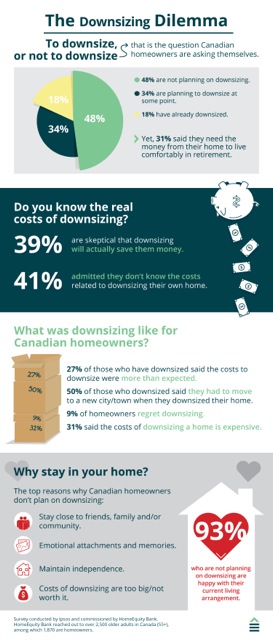
For older Canadians considering selling a home to retire to a smaller living space or a more affordable community, downsizing might sound like a financial bargain, but in a recent Ipsos survey commissioned by HomeEquity Bank, 39 per cent of current homeowners are skeptical that downsizing will actually save them money.

More than a decade ago, I faced the downsizing dilemma and I now wish I’d been as skeptical as these savvy consumers. I put a considerable down payment on a condo in downtown Toronto, purchasing it from builder’s plans. At the time, I wished to retire from my long-time position as a college professor to launch a new career as a writer.  Selling my home, cashing in on the equity I’d accumulated, while moving to smaller digs, made sense to me.

Yet as 27 per cent of downsizers shared with the Ipsos survey, the costs were more than expected. Expenses from downsizing can add up quickly.

Originally I was attracted by the lure of improving my cash flow to support a new career, but downsizing didn’t net out that way after factoring in all the closing costs and moving expenses along with the disruption to my lifestyle.

Moving away felt like starting all over again: this time in my sixties. The weight of condo living took its toll.

After living in my condo for two years, facing unexpected changes to the original building plan, loud nocturnal noise from other condo dwellers, endless fire drills and my terrace furniture burning up with cigarette butts dropped on my balcony from above, I put the unit on the market.  Once again I was faced with real estate and closing costs. When I purchased a home in my former neighbourhood, I was forced to negotiate a mortgage.

According to an earlier Ipsos survey commissioned by HomeEquity Bank in July 2018, half (51 per cent) of those aged 75+ say it’s important to stay in their current home because they want to keep close to family, friends or their community, while four in ten (40 per cent) say emotional attachment and memories are what’s behind the importance of staying put in their current home during retirement.

What I’d do differently if considering downsizing: Continue Reading…

6 smart ways to clear Credit Card Debt as quickly as possible

By Shiv Nanda

Special to the Financial Independence Hub 

Credit cards can be a saving grace in time of financial need, but if abused can ruin your financial health. Most Americans have a love-hate relationship with their credit cards and the stats seem to agree.

Total US credit card debt is over $830 Billion.

 Of the more than $1 Trillion of revolving debts, Americans are carrying the vast majority of debt in 2018.

 Let’s break down these troubling credit card debt statistics by category:

Studies have found an average of 39% of credit cardholders pay their credit balances in full. And only 29% make low or minimum payments. This is an alarming finding because cardholders who make the minimum payments 20% of the time are the ones with a credit score of 800 and above. While cardholders with credit score of 700 and above are more likely to make full payments towards their credit-card balance. However, there are other factors that contribute to the credit card payment pattern:

1.) Income and Employment

 It is quite surprising that high income doesn’t guarantee freedom from debt. Ironically, the debt seems to be increasing with increase in annual income. And the highest credit card balances are seen with people with the highest income.

2.) Age and Gender

Studies reveal that older customers are more likely to pay their credit-card balance in full whereas middle-aged consumers may pay in full or pay the minimum amount due. Middle-aged consumers have high home expenses as they have dependents to take care of. Gender of the consumer is also a contributing factor of credit card debt. Data shows that men and women have a revolving debt of 29.9% with women having 3.7% less than their male counterparts.

3.) Region

Location has proved to be an interesting influence on credit-card debt. The Midwest and the Great Lakes regions seem to have responsible credit cardholders. They have the highest average credit score and lowest average credit card debts: while Alaska seems to have the highest credit card debt and average credit score stuck somewhere in between the high and the low.

6 smart ways to clear credit-card debt ASAP

1.) Have a plan and stick with it

It is essential that you take a stock of the situation. Continue Reading…

Marketing for your Side Hustle

By Christina Sanders

Special to the Financial Independence Hub

You may be running a small business on the side to achieve financial independence. These side hustles can be anything from lawn mowing to website design. No matter what your side hustle is, you’ll need marketing to gain new customers. It doesn’t have to cost you an arm and a leg either. There are plenty of options and methods for promoting your business through cheap, yet effective means.

1.) Focus on local markets

In marketing, there is a constant focus on target markets. These are the people that you want to buy your product or service. They’re the people most likely to buy your product because it solves a problem they have or they trust it to improve their life. This comes down to not only geographics, but also demographic data focused on income level, family size, interests, gender, and age. All these factors will help you to hone in on who you should spend your marketing efforts on.

For a small business, it’s likely best to focus on your surrounding geographic area. Utilizing a local market is usually less expensive and you have a competitive edge by being based in the same region as your customers. That geographic intimacy provides a better understanding of local culture, including common pain points and values. Use that to speak to your potential customers on a more personable level.

2.) Design distributables

You’ll likely want to make some business cards and flyers for your business. Digital marketing is crowded, often difficult, and can be expensive. Physical distributables are very effective, especially in local markets. They can be passed for referrals, posted on community boards, and distributed through mail. If you’re unsure about how your design should look, check out some flyer examples and look at what other businesses have done. There are simple and free online programs for designing flyers, brochures, and posters. Simply do a Google search to find one that works for you.

Having a personal brand in your advertisements goes a long way. You can build trust and confidence with your potential customers by having high-quality designs and messaging. Your brand should represent what values you and your customer both deem important. Having brand consistency will be important for becoming recognizable and memorable in your community. So don’t ever settle for less than high quality, because your brand defines what people will think of your service.

3.) Create a website

People may hear about your business and then wonder more. Where will they likely go? The internet. You need a webpage that answers questions they will likely be wondering and that drives further interest.

This doesn’t have to be difficult. Sites like Wix.com make it easier than ever to build your own website based on beautifully designed templates. Make sure you choose a website design that values ease of use over anything else. Make it incredibly simple for your customers to understand exactly what you do and any other information that would be valuable to them. This is called UX, which you can research online for a more in-depth understanding. Continue Reading…

How to add value to your home before selling

By Emily Roberts

(Sponsored Content)

Over time, the value of your home can be expected to gradually increase in value, unlike most consumer purchases (like cars), which depreciate from the moment they are acquired.

As long as you’re living in the home, this price appreciation is seldom a gain you can pocket, and in fact, your property taxes may rise as a result. But eventually it should be able to be sold at a solid profit.

When you do decide to finally sell, you will want to get as much money for your home as possible. You will want to get a return on your investment and be able to afford your new home. In this article, we are going to give you some ideas on how you can improve the value of your home before selling. Keep reading if you’d like to find out more.

Build an extension

If you have a lot of space on your property, then you might find that adding an extension to the kitchen or the side of your home might actually make a huge difference to the overall value. Think about how much this could cost you and how much more you might be able to make on your house when you are selling it. People love to have extra space but don’t sacrifice a garden completely for a slightly bigger kitchen.

Add Insulation

If your home is not totally insulated, then you are not saving as much money on monthly bills as you could be. Many people forget to insulate their attics and their sheds, which can consume a lot of energy. Not only will you save yourself money on the bills, but you will also save the new buyer in the long run. Make sure to insulate your home and mention it to potential buyers when they are viewing your home.

Add an outdoor building

If you have some extra space in your garden you should think about investing in an outdoor building, which you can learn more about at Armstrong Steel: one of the most renowned providers. The buildings they provide come pre-made and so all you have to do is assemble them. When you have put it together, you can choose to do whatever you want with it. Continue Reading…

Aging business owners need to tackle estate planning

By Andre Guillemette

Special to the Financial Independence Hub

Did you know that more than 50% of medium sized enterprises in Canada are controlled by an owner between the age of 50 and 64? Additionally, about 75% of Canadian business owners plan to exit their business before 2022. However, according to the Canadian Federation of Business, only half of Canadian business owners have a proper succession plan in place. If you are a business owner, you need to think about the future of your company, no matter your age.

When a family’s assets and income are linked to a business, if the business owner passes away, both estate and succession planning will ensure that the family is taken care of and the company remains viable. If a person passes away without a will, provincial wills and estate law will determine how their assets are dispersed. Without any kind of estate planning in place, their heirs could be hit with a hefty tax bill, and unexpected fees and administrative costs.

There are many steps to effective estate planning and whether they all apply to you will depend on your personal circumstances. Some of them include:

  • ensuring your will is up-to-date
  • appointing an appropriate executor
  • establishing an Enduring Power of Attorney (EPOA)
  • providing an income for your spouse and family in the event of your unexpected disability or death
  • developing a plan for equitable and tax-efficient distribution of your assets
  • creating an emergency business plan
  • writing shareholder/partnership buy-sell agreements if applicable
  • planning for succession

To accommodate the above, there are several financial strategies at your disposal to help you meet your goals. As a business owner you should investigate:

1.) Looking at insurance as a way to shelter assets for the next generation.

Permanent cash value life insurance policies, such as participating whole life and universal life, are attractive to corporations for the potential tax-free death benefit and the tax-preferred cash accumulation benefits they offer. These insurance policies provide the corporation with valuable life insurance protection on a key person or shareholder. Another benefit is they allow for tax efficient growth and access to policy values tax-free immediately or in the future. By using life insurance, the estate value available for future generations can be significantly increased by the tax-free death benefit. Continue Reading…