Hub Blogs

Hub Blogs contains fresh contributions written by Financial Independence Hub staff or contributors that have not appeared elsewhere first, or have been modified or customized for the Hub by the original blogger. In contrast, Top Blogs shows links to the best external financial blogs around the world.

Nasdaq 100: Exposure to the Modern Economy

Image via Pixels/Anna Nekrashevich

By Sa’ad Rana, Senior Associate – ETF Online Distribution, BMO ETFs 

(Sponsor Content)

Indexed investing, when done properly can be an efficient and low-cost way of gaining exposure to various markets. Investment vehicles such as exchange-traded funds (ETFs), make it possible for individuals to invest in these indexes, i.e., the Nasdaq-100 index.

Nasdaq-100 & Exposures

Launched in 1985, the Nasdaq-100 is one of the world’s most well-known large-cap growth indexes. The companies in the Nasdaq-100 include over 100 of the largest domestic and international non-financial companies listed on the Nasdaq Stock Market based on market capitalization. It is mainly comprised of technology, consumer, and health companies – with a slight exposure to industrials and telecom.

When looking at what is powering economic growth in the 21st century, we look to those new economy sectors that are highly digital. These are disproportionately tech or consumer companies like Amazon, Microsoft, and Google. This index gives you exposure to the biggest Nasdaq-listed names, along with others that follow closely behind these leaders in technology.

Nasdaq-100 vs S&P 500 Volatility & Performance

When looking at volatility, one may think of the Nasdaq as being a more growth-oriented index, and if looking at returns alone, these have certainly shown to be significant over the years. Investors may assume that the indexes’ higher performance leads to higher volatility compared to other leading indexes. However, if we take a look at the chart below, which is more of a longer-term picture, you are getting a pretty significant consistent volatility range. Of course, if you look at this year in comparison inflation has been at the forefront of headlines, growth-oriented companies have been taking a harder hit than more cash-up-front companies: you see more volatility in the Nasdaq this year vs the S&P 500.

Both the Nasdaq-100 and the S&P 500 have had very similar volatility over last 15+ years

Index returns do not reflect transactions costs or the deduction of other fees and expenses and it is not possible to invest directly in an Index. Past performance is not indicative of future results.

The big story for everyone is the performance of the Nasdaq-100 vs. the S&P 500. The long-term performance of the Nasdaq-100 shows an upward trend. If we look at post-2008, generally monetary policy had been very supportive of market growth, and companies had been able to invest in research, helping them grow over time. You see this reflected in the Nasdaq-100, where thanks to the underlying companies in this index, there is outperformance. The chart below showcases this quite well. It tells us that the Nasdaq-100 is a valuable holding in a portfolio based on performance.

Index returns do not reflect transactions costs or the deduction of other fees and expenses and it is not possible to invest directly in an Index. Past performance is not indicative of future results.

Market Considerations: Performance vs Interest Rates

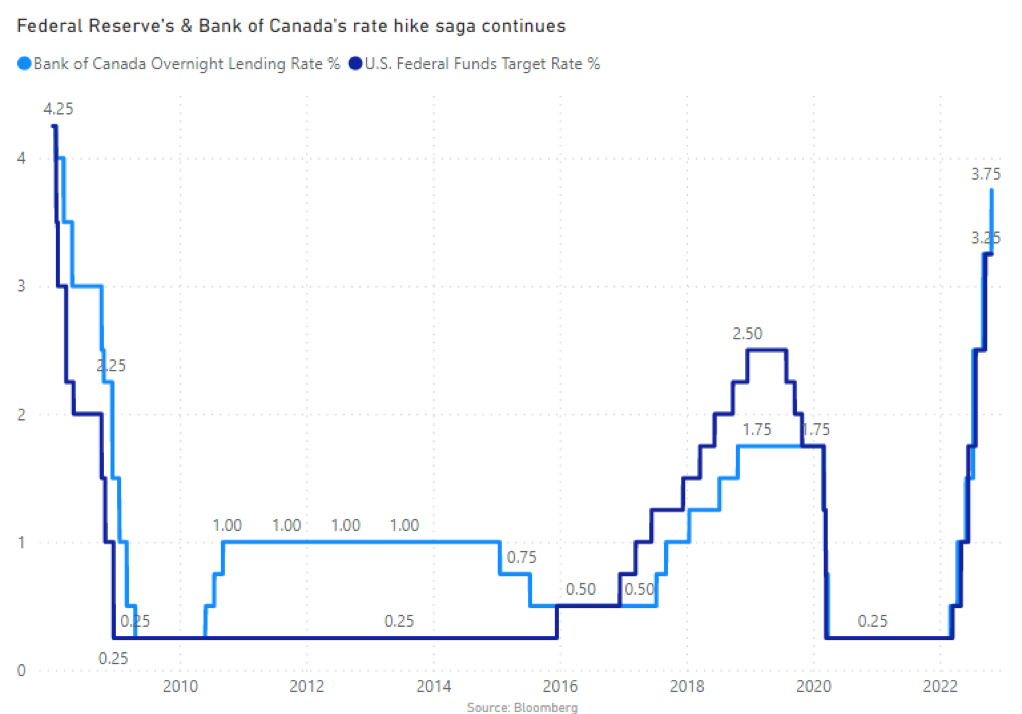
The chart below shows what happened the last time rates went up by a similar amount. You can see a gradual stairway up from almost 0% to about 2.5%. You can see the dip in the NDX price (grey line), which looks like a blip, almost not noticeable (but it was 23%). This isn’t very far from the drawdown this year to date. Albeit the Fed is raising rates much faster.

Based on experience, the Fed may keep rates high until inflation gets under control into that sort of two to three per cent range. The question for investors is, what happens to stocks if rates get to 3%, 4% or maybe 5% and perhaps stay at that level for a few years? This is where it is imperative to look at the amount of debt these companies have on their balance sheet, how much the interest costs will go up and what their earnings power looks like. Will they be able to remain competitive with the price of everything rising? Will consumers continue to pay for these products vs. downsizing or even substituting for cheaper alternatives? Continue Reading…

MoneySense Retired Money feature on Canada’s new “Tontine” Retirement solutions

My latest MoneySense Retired Money column looks at the revolutionary “Tontine” type Retire Solution announced by Guardian Capital and finance professor Moshe Milevsky earlier this month. My initial take was here on the Hub and the more in-depth MoneySense feature story can be viewed by clicking on this highlighted headline: Tontines in Canada — Moving from Theory to Practice as a solution to our Retirement Crisis.

We’ve illustrated this blog with financial projections of one of the three new Guardian Capital Retirement solutions developed in partnership with Milevsky. Some of the ideas were adapted from Milevsky’s latest book: How to Build a Modern Tontine. The theory behind this book is a driving force for Guardian Capital’s efforts to commercize these concepts and put them in the hands of retirees and would-be retirees worried about outliving their money. Nobel Laureate Economist William Sharpe has described this as “the nastiest, hardest problem in finance.”

Milvesky’s book is certainly aimed at industry practitioners and sophisticated financial advisors and investors, and contains a lot of mathematics that may beyond the reach of average investors or retirees. So rather than attempt to review it, we’ll move on to the efforts to bring these ideas to the market. What Milevsky calls “tontine thinking” is belatedly showing up in the marketplace in Canada, starting last year with Purpose Investments’ and now with three different solutions from Guardian Capital. Hub readers also can read an excerpt of the book which ran earlier Wednesday: Longevity Insurance vs Credits — a Primer.

All this has been a long time coming. MoneySense readers may recall two of my Retired Money columns about Milevsky and the future of tontines published in 2015: Part one is here and part two here. Also see my 2018 column that explains tontines in detail: Why Ottawa needs to push for tontine-like annuities.

Last June (2021), Purpose got the tontine ball rolling in Canada with its Purpose Longevity Fund. Here’s my MoneySense take on that one: Is the Longevity Pension Fund a cure for Retirement Income Worries? 

As the MoneySense feature explains, Milevsky is Guardian Capital’s Chief Retirement Architect. It sums up the original 2021 launch of Purpose Longevity Fund, and how it compares to Guardian’s three solutions.

Think of Purpose’s product as a lower-case tontine, and Guardian Capital’s as a Tontine with a capital T.

Guardian Capital’s Modern Tontine  

Guardian Capital’s September 7th press release uses the term “Modern Tontine.” There, Guardian Capital Managing Director and Head of Canadian Retail Asset Management Barry Gordon said “With our modern tontine, investors concerned about outliving their nest egg pool their assets and are entitled to their share of the pool as it winds up 20 years from now … Over that 20-year period, we seek to grow the invested capital as much as possible to maximize the longevity payout.”

 Along the way, investors who redeem early or pass away leave a portion of their assets in the pool to the benefit of surviving unitholders, boosting the rate of return. “All surviving unitholders in 20 years will participate in any growth in the tontine’s assets, generated from compound growth and the pooling of survivorship credits. This payout can be used to fund their later years of life as they see fit, and aims to ensure that investors don’t outlive their investment portfolio.” Continue Reading…

Longevity Insurance vs. Credits: A Primer

This guest blog is excerpted from Moshe Milevsky’s recently published book, How to Build a Modern Tontine

By Prof. Moshe A. Milevsky, Ph.D.

Special to the Financial Independence Hub

I have been asked about the difference between a tontine – be it modern or medieval – and a conventional life annuity, purchased from a regulated life insurance company. Both might appear to perform similar tasks at first glance, but the differences are subtle and important and get to the essence of the distinction between longevity insurance versus longevity (or survivorship) credits.

One aspect of the life annuity story is the financial benefit of risk pooling, and the other is the insurance benefit and comfort from having a guaranteed income that you can’t outlive. Allow me to elaborate with a statement that some readers might find shocking. If you are 75 years old with $100,000 in your RRIF and would like to guarantee a fixed annual income for the rest of your life, there is absolutely no need to purchase a life annuity from an insurance company to achieve that goal. There are other options.

This might sound like something odd for a long-term annuity advocate to say. But the fact is that a non-insurance financial advisor can design a lovely portfolio of zero-coupon strip bonds that will do the job. That collection of bonds will generate $4,000 per year for the rest of your life, even if you reach the grand old age of 115. Ok, financial advisors need to eat too, so they may not do it for $100,000, but I’m sure that a lump sum of $1,000,000 will pique their interest and in exchange you will get $40,000 per year.

Moreover, with these strips, if you don’t make it all the way to the astonishing age of 115, they will continue to send those $4,000 (or $40K) to your spouse, children or favourite charity until the date you would have reached 115, if you had been alive. This collection of strips would be completely liquid, tradeable and fully reversable, although subject to the vagaries of bond market rates. For this I have assumed a conservative, safe and constant 2.5% discount rate across the entire yield curve, which isn’t entirely unreasonable in today’s increasing environment.

Stated technically, the present value of the $4,000 annual payments, for the 40 years between your current age 75 and your maximum age 115, is exactly equal to $100,000 when discounted at 2.5%. Yes, those numbers and ages were deliberately selected so my numerical example rhymes with the infamous 4% rule of retirement planning but has absolutely nothing to do with it.

Now, I’m sure you must now be thinking (or even yelling) “Moshe, but what if you live beyond age 115, eh? You will run out of money!”

Touché. Let’s unpack that common knee-jerk reaction to non-insurance solutions for a moment. To start with, the probability of reaching age 115 is ridiculously and unquantifiably low. If you do happen to be the one in a 100 million (or perhaps billion) that reaches age 115, I suspect you will have other things on your murky mind. Personally and post-covid, there is a very long list of hazards that worries me more than hitting 115.

Nobody really “runs out of money” in this century

Second and more importantly, nobody really “runs out of money” in retirement in the 21st century. That is plain utter fear-mongering nonsense. With CPP, OAS/GIS, the elderly will continue to receive some income for as long as they live even if they have completely emptied every piggy bank on their personal balance sheet. In fact, with tax-based means-testing you might get more benefits if you actually do empty your bank accounts.

Ok, so back to my prior claim and the supporting numbers, if you want a guaranteed (liquid, reversable, bequeathable) income for the rest of your life, you can exchange your $100,000 for a bunch of strip bonds and voila, you have created a sort of pension plan. My point here is that the primary objective isn’t a guaranteed lifetime of income: which anyone can create with a simple discount brokerage account and a DIY instruction manual. Continue Reading…

Geopolitics revitalizing Canada’s Natural Resource industries

Franklin Templeton/iStock


By Kim Catechis, Investment Strategist, Franklin Templeton Institute

and Andrew Buntain, Institutional Portfolio Manager, 

Franklin Bissett Investment Management                                

(Sponsor Content)

The world is living in volatile times.

East-West geopolitical tensions, which had been building even before the COVID-19 pandemic upended the lives of millions around the globe, have exploded into war in Europe. The Russia/Ukraine conflict is now well into its sixth month, with no end in sight. Severe sanctions disconnecting Russia from the West are structural and unlikely to be removed even after the conflict is resolved.

There are real consequences for the world from this conflict. Ukraine’s economy has been ravaged. Europe is back to having a militarized border. NATO has grown stronger and is spending on defence; more than 2% of Gross Domestic Product (GDP) is expected to be allocated to military expenses by member nations. Supply chain disruptions have been exacerbated by the upheaval, with an energy crisis in Europe, fears of famine in Africa, shortages of critical products in many industries and the highest inflation levels in over 40 years.

Growth expectations are falling on the growing realization that central banks are not well placed to deal with food price and energy inflation, despite aggressive policy rate hikes. In many countries, including Canada, fears of recession have replaced fears of overheated economies.

Higher commodity prices a boon for producer nations

Prices for the world’s basic commodities — energy, food, metals and minerals, forest products  — soared in the first half of the year. In recent months, they have fallen somewhat but remain high, and this situation is likely to continue. Trade patterns in place for 49 years have been destroyed, and new alliances and infrastructure take time to build. As with any change, there will be winners and losers. For commodity producers like Canada, the evolving dynamics open doors to new opportunities.

Energy hits critical mass

Europe has gone on a buyers’ strike against Russia. In response, Russia is turning off the fossil fuel taps. While not a huge obstacle to oil procurement (there is plenty of oil in the world), natural gas is another matter. Russia controls 30% of the world’s natural gas reserves, and all but one of its gas pipelines go to western Europe.

Filling the huge supply gap left by Russia presents a once-in-a-lifetime opportunity for other producers to capture market share in one of the world’s most profitable regions; however, the lack of pipelines to other natural gas-producing regions means that liquid natural gas (LNG) must be transported by ship.

Largely because of transport costs, nearby producers with spare capacity like Qatar, Algeria, and Nigeria, will likely be the winners rather than Canada. In any case, Canada still benefits from the cascading effect of higher fuel prices. In the meantime, close to 20 projects have been proposed in Canada to export LNG through both coasts. Without doubt, there will be other opportunities.

“E” is for environmental backlash

As winter approaches and energy concerns grow, concerns have arisen that attractive prices and the renewed drive to obtain reliable fossil fuel supplies will set back efforts to combat climate change. For Europeans, there is no alternative to ESG; the “green deal” already in place prior to the war has been accelerated. Concurrently, however, a strong view is building that the definition of ESG needs to evolve, with many preferring “sustainability” and a focus on inclusion, rather than the exclusion often associated with ESG.

Overall, Canada’s oil and gas extraction and refining methods are considered very environmentally friendly. One example is a long-time holding in the Franklin Bissett portfolios, ARC Resources Ltd. Rather than pay others to dispose of wastewater from the drilling process, the company’s Montney operation recycles and reuses the water.

The other two letters in ESG — “S” for social and “G” for governance — should not be ignored. In an era where enormous value is being placed on reliability, a stable workforce and good corporate governance have become at least as important as efficiency. Under these criteria as well, Canada performs better than most; the Canadian oil and gas industry is recognized globally for strong social progress and governance metrics.

Agriculture: food for thought

The global response to threats of food shortages has been to advocate opening up more land for crops, but the planet has a limited amount of cropland. Significantly, almost half of the grains produced worldwide are used for animal feed, which people then consume indirectly by eating meat. In Europe, we are seeing an increase in vegetarianism; if meat consumption were to decline further because of the current situation, it could potentially lead to new patterns of behaviour that imply lower demand for animal feed. Elsewhere, food insecurity is growing, especially across Africa.

Ukraine is a major producer of sunflower oils, barley and maize (corn). Grain prices peaked in June as the United Nations struck a deal to allow some Ukraine grain shipments from Mariupol, but there is no guarantee it will continue. In countries most at risk of shortages from the disruptions, such as Nigeria and Bangladesh, people already tend to pay the largest proportion of their budgets for food. Turkey and Egypt are also very exposed to Russian wheat and have little reserve stock. Continue Reading…

New retirement: Case study with Cascades Financial Solutions

Photo by Gustavo Fring

By Ian Moyer

(Sponsor Content)

A Canadian couple living in Nova Scotia are approaching retirement. Carlos is 64 and his wife Arlene is 61. They have one adult adopted child who lives on their own with the couple’s three grandchildren. Carlos and Arlene live close to their daughter and help with the grandchildren often, so being able to stay in their home is important.

After two extended careers in the public sector with a combined annual income of $180,000, Carlos and his wife Arlene decided it was time to retire beginning March of the following year.

Managing the family finances Carlos and Arlene were able to save the following for retirement:

Carlos

  • $250,000 Registered Retirement Savings Plan (RRSP), contributing $5500 annually until retirement
  • $31,500 annually from a Defined benefit pension
  • $ 21,000 in A Tax-Free Savings Account (TFSA), contributing $1500 annually

Arlene

  • $290,000 Registered Retirement Savings Plan (RRSP), contributing $5500 annually until retirement
  • $33,600 annually from a Defined benefit pension
  • $ 30,000 in A Tax-Free Savings Account (TFSA), contributing $1500 annually

Carlos and Arlene dream of traveling to various countries and plan to take 3 trips a year and assume they would need a total of $15,000 annually to do so for 8 years. After traveling they would like to contribute to Registered Education Savings Plans (RESP) for each of their grandchildren totalling $3000 a year.

More recently, when the market experienced volatility, Carlos’ portfolio took a big hit. Making adjustments to spending, Carlos was able to recuperate most of his losses and is now back on track with his goals.

“The more you learn, the more you earn.”
— Warren Buffett

A key consideration in Cascades is to take a look at the retirement budget: using their employment income as a starting point to determine how much retirement income they require. It is well known and generally accepted that you will require less income in your retirement years, but how much less? In making this determination the couple can consider they no longer have employment income deductions like CPP and employment insurance, retirement savings, costs related to traveling to work, retirement income tax credits, etc. Carlos used their employment income after these deductions, taxes, and employment expenses and compare that with the projected retirement income. Carlos assumes he would need approximately $120,000 annually.

Carlos believes he has a good understanding of financial planning strategies, but he finds decumulation a bit overwhelming and wanted to learn more to personalize his retirement income based on their needs: using Cascades Financial Solutions retirement Income planning software and to plan for his retirement.

After entering his data into Cascades Financial Solutions Carlos’ report determined the best retirement decumulation strategy would only allow him to receive an after-tax amount of $116,945 per year.

The couple has a few options to offset the$3,055 retirement income shortage.

Life Annuity option: The couple can consider allocating some of their savings to a life annuity that could help achieve a higher sustainable retirement income. These vehicles are a great way the shift the burden of making their money last forever and can often have attractive capital payout ratios throughout the retirement years due to their “mortality credits.” Continue Reading…