Reviews

We review books that deal with everything from financial independence topics to politics, and anything in between. We may sometimes stray into films and music if there is a “Findependence” angle.

Wealthsimple Trade review: Canada’s only Zero-commission trading platform

Wealthsimple Trade is Canada’s first and only zero-commission trading platform. In this Wealthsimple Trade review I’ll explain how you can buy AND sell from among the thousands of stocks and ETFs listed on North American exchanges without paying any fees.

I first heard about Wealthsimple Trade in 2018 when it was announced as a new self-directed investing platform that lets investors buy and sell stocks and ETFs with no trading commissions. They invited users to join a wait list and, once they attained a critical mass (130,000 participants), rolled out a beta version for users to test the platform and offer feedback.

Wealthsimple Trade officially launched in March 2019 and at that time only supported non-registered trading accounts. Later that year, the platform added RRSP and TFSA account types to its lineup. That’s when I became interested in the platform for my own self-directed investing needs.

Get a $10 cash bonus and commission-free trades when you open a Wealthsimple Trade account and deposit and trade at least $100 worth of stock.

Why I switched to Wealthsimple Trade

I’ve held my investments at TD Direct Investing since 2009. It was out of convenience, more than anything, since I had banked with TD since I was a teenager. Back then trades disgustingly cost $29 per transaction. Today, they’re still a painful $9.99 per trade. I had enough when I noticed I paid a total of $190 in trading commissions with TD last year. No more.

I opened a Wealthsimple Trade account on January 13 2020, with the goal to bring my trading commissions down to zero. That same day, I initiated the transfer of my entire RRSP and TFSA account balances. Both of these accounts were invested in Vanguard’s all-equity balanced portfolio – VEQT – and so I requested an in-kind transfer which simply transferred the shares from TD to Wealthsimple Trade without first having to sell them.

An email from Wealthsimple suggested an expected wait time of up to five weeks to complete a transfer request with TD. But to my surprise I noticed the funds in my Wealthsimple Trade account on January 21 2020: just seven business days later.

Now that you have the back story, let’s take a look at the platform.

About Wealthsimple Trade

As mentioned, Wealthsimple Trade launched in March 2019 as Canada’s first and only zero-commission trading platform. It’s a separate, yet complementary service to Wealthsimple’s main business as Canada’s top robo advisor. With offices in Canada, the U.S., and the U.K., Wealthsimple manages more than $5 billion in assets worldwide.

Related: How to transfer your RRSP to Wealthsimple

Automated investing through a robo-advisor isn’t for everyone. Some investors want to take the reins themselves, build their own custom portfolio, and make trades in their own self-directed account. Enter Wealthsimple Trade.

While most online brokerages charge $9.99 per trade, Wealthsimple Trade doesn’t charge anything to buy and sell stocks or ETFs. It doesn’t charge account fees or have any account minimums to get started.

To get the costs down to the bare minimum (zero) the platform strips out all of the expensive bells and whistles. You won’t find cutting edge research or real-time quotes (there’s a 15-minute lag). Wealthsimple Trade also started out as a mobile app – on your smart-phone or tablet – with no desktop platform access. That, thankfully, has changed and Wealthsimple Trade now offers desktop access (January 2021):

But for self-directed investors who want to build a simple low-cost portfolio of index ETFs, and who want to contribute frequently without getting dinged each time they buy or sell, Wealthsimple Trade is the perfect platform.

Signing up and opening an account

How do you open an account? Easy. Download the Wealthsimple Trade app on your Apple or Android device and select ‘Get Started’. From there, follow the prompts to enter your information and agree to your account documents.

Note that even though the Wealthsimple Trade app is NOT connected at all to the Wealthsimple robo advisor platform: existing Wealthsimple clients can skip some of the preliminary questions.

Here’s what you’ll need to get started:

  • Full Name, Email, Mailing Address, Phone number, Date of Birth
  • Social Insurance Number
  • Employment information

There are no account minimums or fees associated with opening the account. To fund it, though, you’ll need to link a chequing or savings account.

Transferring investments to Wealthsimple Trade

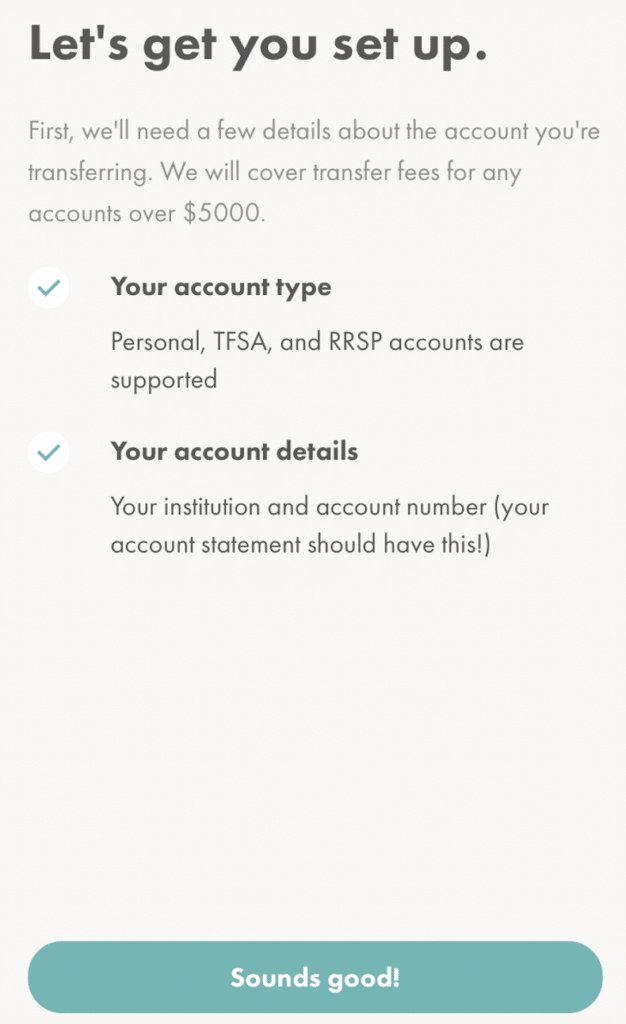
Transferring my existing investments to Wealthsimple Trade couldn’t have been easier. As mentioned, I initiated the transfer on January 13, 2020. I entered a few details about the accounts I was transferring, selected the institution (TD) from a list of choices, and snapped a picture of my account statements.

WS Trade covers transfer fees

WS Trade Uploading your Account Statement

Next, I indicated how I wanted the transfer to take place. Typically, you can choose to transfer funds in cash, meaning your institution sells your current holdings and then moves the money. If you go this route, you may incur DSC or trading fees. Note that your contribution room or taxes won’t be affected when you transfer a non-taxable account like an RRSP or TFSA.

Instead, I chose to transfer my account in-kind or “as-is.” This means your institution transfers your entire account. Note that Wealthsimple Trade only accepts the transfer of stocks and ETFs. You’ll have the option to sell non-eligible assets like mutual funds, bonds, or options, or leave them with your institution.

As I said earlier, the entire transfer process took just seven business days. Your mileage may vary.

Using Wealthsimple Trade

Wealthsimple Trade works like any other online brokerage, with the exception that it’s a mobile-only platform. There’s no desktop support. Continue Reading…

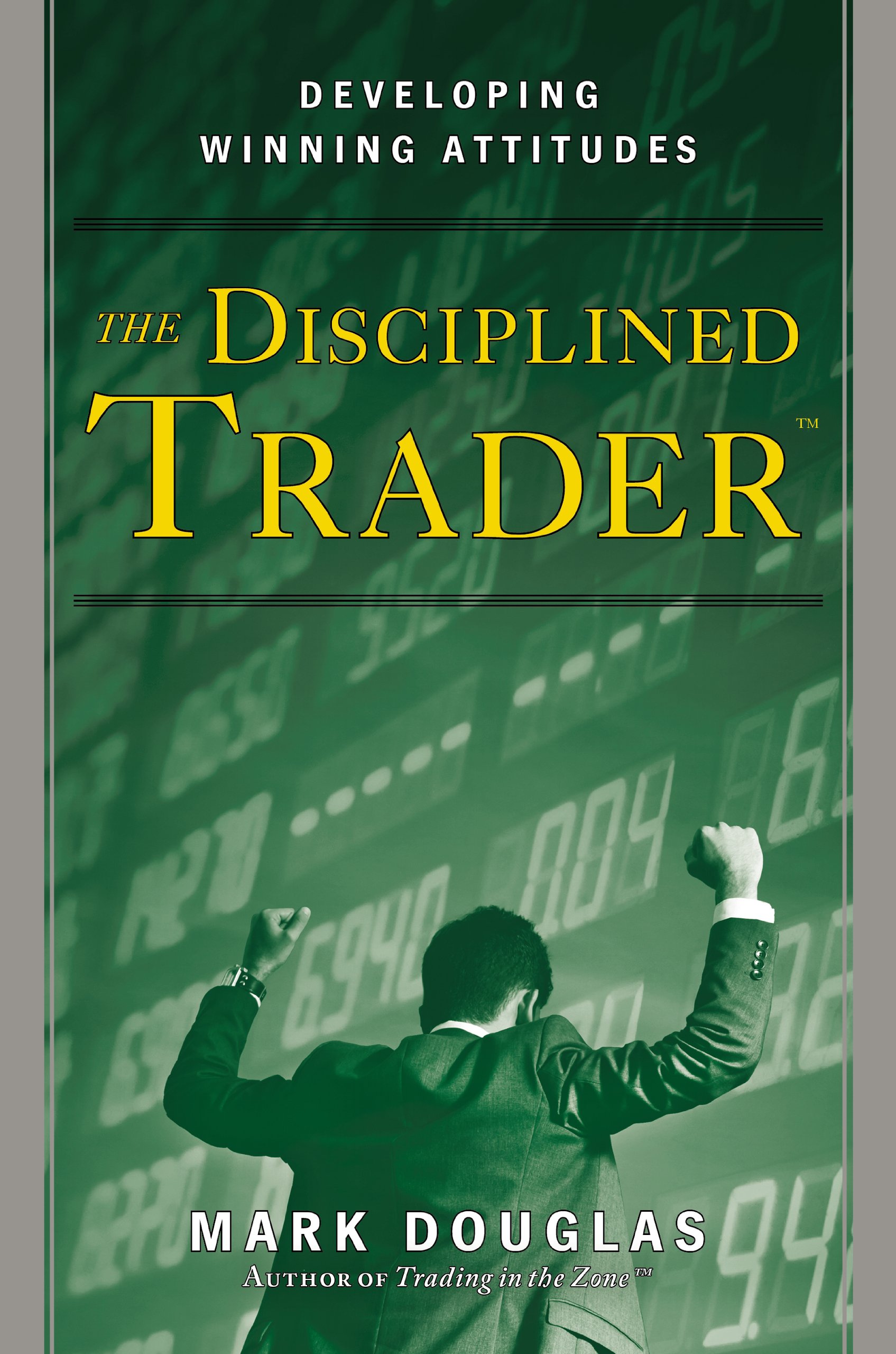
Review: The Disciplined Trader

81o4jz+QTgLI am not and never will be a “trader,” in the sense of a full-time stock-picker/market-timer.

However, on the suggestion of my financial advisor, I recently ordered and read a copy of a classic trading book called The Disciplined Trader, by Mark Douglas (New York Institute of Finance, 1990).

Personally, my main interest in the topic involves hedging downside risk:  taking actions that limit some downside, at the expense of some potential upside. What surprised me about this book — which bears the subtitle Developing Winning Attitudes — is how much space was allocated to psychology and mental attitudes. In fact, fully all of the third of the four major sections is devoted to what I would call “softer” topics like understanding the nature of the mental environment, how memories, associations and beliefs manage environmental information, managing mental energy and similar topics. Continue Reading…

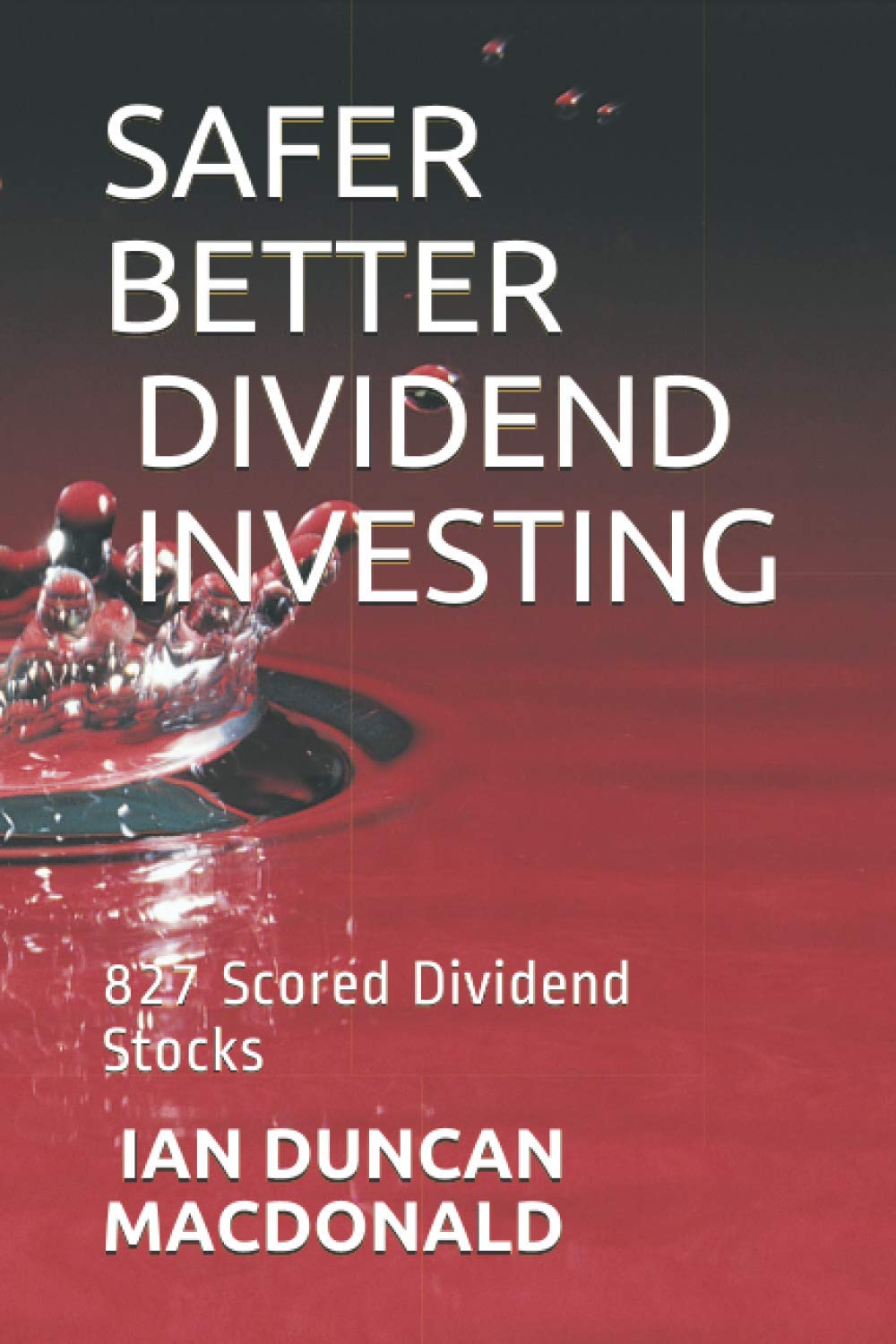
The ideal Stock

By Ian Duncan MacDonald

Special to the Financial Independence

The “good” dividends of financially strong companies provide a reliable income and increase the odds for an ever-rising share price.

There are 14,982 corporations in North America with common shares for purchase. For a strong, diversified portfolio you need only find 20 corporations whose shares come closest to matching the following “ideal criteria.”

(1) A stock price greater than $100
(2) A stock price that was greater than $100 four years ago
(3) A stock price that is now 99.50% greater than it was 4 years ago
(4) A stock with a book value greater than $100
(5) A current stock price greater than 49.5% of the book value
(6) Five or more analysts rating the stock a “buy”
(7) Five or more analysts rating the stock a “strong buy”
(8) A dividend yield percent between 7.50% and 10.49%.
(9) An operating margin greater than 79.50%
(10) An average daily volume of shares traded greater than 2,000,000
(11) A stock’s price-to-earnings ratio between 0.1x to 5.49x

In 20 years of reviewing thousands of stocks I have never found a stock that met all eleven criteria. Therefore, since the ideal stock does not exist it means you must sort through those 14,982 stocks to find those 20 that come closest to matching the 11 criteria.

To help identify the best dividend stocks, I score stocks using the above 11 criteria (my background was in commercial risk systems with Dun & Bradstreet, Equifax, etc). When the 11 scores are added they have the potential to reach a total of 100. After scoring thousands of stocks the highest score I have ever calculated is 78; the lowest score is 8. I avoid buying stocks scoring under 50.

Why dividends are important in Value investing

The best portfolio candidates emerge when you sort, by descending score, all 628 U.S. common stocks traded on the NYSE and the NASDAQ paying a dividend of 6 % or greater and all 199 Canadian common stocks paying a dividend of 3.5% or greater on the TSX. A scoring system objectively, mathematically applies a derived number to a stock. This number identifies those dividend stocks that will provide the most reliable, generous dividend income with the potential for substantial future share price gain. Continue Reading…

A good resolution for 2021: Choose Financial Independence

Amazon.com

By Michael J. Wiener

Special to the Financial Independence Hub

Many of us dream of financial independence.  Chris Mamula, Brad Barrett, and Jonathan Mendonsa offer many practical ideas for achieving financial independence (FI) and enjoying the journey along the way in their book Choose FI: Your Blueprint to Financial Independence.  They avoid many of the problems we see in the FIRE (Financial Independence Retire Early) book category.

The authors avoid the biggest problem with most FIRE books.  It’s annoying to tell the story of a high-income earner deciding to live like a student his whole life and retire in his 30s, and then say “you can too!”  Although I point out the bad parts of books, I can forgive a lot if my mind is opened to a good idea.  For this reason, I’ve enjoyed FIRE books even if they have some bad parts.  This book manages to avoid the worst parts of other FIRE books.

The authors don’t bother much with retirement.  FI gives us choices so we can “scrap the idea of retirement completely and focus on building lives we don’t want to retire from.”  The life you build can involve paid work, leisure, or any other pursuit you want.

Rather than focus on just one story, the authors draw from the experience of many people who have sought FI.  A common theme is the importance of enjoying the journey.  If you see your pursuit of FI as suffering for several years until you hit your magic number, you’re not doing it the right way.

FI’s benefits start even before you reach the target

You benefit from pursuing FI even before you reach your target.  “If you have a mortgage, a couple car payments, a family to feed, and nothing in the bank, what choice do you have when your boss asks you to do something stupid?”  I was able to push back somewhat with my boss in the late part of my career, and this got me more money and autonomy.

If reaching FI seems like an unattainable goal, it may help to break it down into milestones.  The authors suggest “getting to zero” for those in debt, “fully funded emergency fund,” “hitting six figures” in your portfolio, “half FI,” “getting close,” “FI,” and “FI with cushion.”  This last stage is defined as having a portfolio equal to 33 times your annual spending needs.  This is a sensible target for a young person with a long remaining life who doesn’t really know how spending needs will change with age. Continue Reading…

Mapping your Aging Journey: Review of Options Open

By Mark Venning, ChangeRangers.com

Special to the Financial Independence Hub

Over umpteen years, my ideal number, working as a career consultant, the most significant rewards came about in one to one conversations, notably with clients seeking new career directions in later life, with the unique pleasure of meeting my oldest client who on the day we met was two months shy of turning ninety.

Rare this was and I wish I could tell more here, but to say the least, his was an adventuresome journey, not without challenge but certainly lived with sociability, creativity and curiosity.

So imagine how startling it was, with all my years of listening to hundreds of stories of later life journeys suddenly in mind, that I began the new book Options Open by Sue Lantz hearing an invitation call in the first chapter to “start with curiosity.” The Options Open book subtitle is The Guide to Mapping Your Best Aging Journey,” and so serves as an artfully laid out roadmap using travel planning as a relatable metaphor, useful in practical conversations with partners, friends or even an eclectic mix in a Zoom group.

Skillfully promoting self-reflection, practicality and of course curiosity, this later life travel planning guide works with an interconnected “Five Strategy Framework” that charts a course taking you through your: Health, Home, Social Network, Caregiving Team and Resources (financial and otherwise). This is the book I wish I had to supplement all those later life career conversations, when many people saw a road ahead through a narrow lens; eying a fated future as a so called Retirement, almost like a vanishing point.

Book does not restrict itself to the word Retirement

Two positive overall attributes of this book instantly drew me into it. First, Sue Lantz thankfully does not hinge the book on that restrictive word Retirement, which is certainly not a travel planning guide destination I’ve ever seen. If travel can be metaphoric for our aging journey, I agree with Sue when she says from the onset, Successful aging is a process that involves making several transitions.” That goes for all our trips through airports or train stations in our life course; we are much on foot in transition.

However, it can’t be escaped: reference to Retirement plops quietly in a few places in this book. Try as we might over the last twenty years, other books have made multiple contemporary rewrites to recast the vocabulary for a dated concept or social construct Retirement, while still casting it as a state you reach in later life. Most of these attempts miss the mark or leave gaps that Options Open addresses sagaciously.

The second prominent point to make about Options Open is that in the category of aging and longevity, it is the first book I have read, published in 2020, written with a consideration to the context of a COVID world. In the book’s Preface, Sue positions the relevance of working with this book in our current time:

“Our world changed dramatically during the global COVID-19 crisis. We realized what is essential to our daily life … We directly experienced the link between how prepared and proactive we are as a society, and how this plays out in terms of our individual risks, and whether or not our own health (and life) is maintained.”

Still further, Sue confirms something I have often reflected upon after many conversations I have been part of this year: “… our worst fears were amplified during the COVID-19 pandemic. Yet, if we let our fears stop us from thinking about our own aging, we are actually discriminating against ourselves.” As I write this post, COVID world continues unabatedly, but if you are leaning to a hermit’s way, perhaps the curious pilgrim in you might emerge to make time to explore your options.

If you have been at home more this year, it is somewhat fitting that one of the strategy areas in the Options Open framework covers the topic of Aging in Place. This might be as good a time as any to think forwardly about the right place, and as Sue Lantz accurately puts it in the section Consider YOUR choice of place, “Your best housing plans will be guided by how well this sets you up to achieve the other four Strategies, including your healthcare access, social networks, and caregiving resources.”

Two coincidental thoughts come full circle in my mind that underscore for me how timely this book is and why I recommend it as one that makes you think realistically and therefore one you can actually use.

It was three years ago this week in 2017, that I heard Sue Lantz speak at the National Institute on Ageing (NIA) where she talked about acting like Pixar – “animating aging in place” – animating the options that is, by co-creating, co-locating to build as a whole, what I prefer to call age inclusive communities. As Lantz went on to say, we are dealing with a diversity of issues across the board, which are interconnected. Looks like the concept of her book grew shoots back then.

Most hauntingly, I also recall when in Chicago, 2004 – I heard William Bridges, author of Transitions: Making Sense of Life’s Changes – a book that stands the test of time, (first published in January 1980) speak on “Finding Your Own Way”. At the end of his talk, you could hear a pin drop. The Bridges Transition model is classic and stemming from it is a statement he made that lingers still from that day: “Uncertainty is a fluid state that allows for openings”.

We are in a fluid state these very days, so as that allows – why not find our Options Open.

Review Part 2: Continue Reading…