Reviews

We review books that deal with everything from financial independence topics to politics, and anything in between. We may sometimes stray into films and music if there is a “Findependence” angle.

Emerge ARK ETFs: 5 ways to add Innovation to portfolios

Investors are always looking for an edge to boost their portfolio returns. Some like to scratch that itch by picking individual stocks, on the hunt for the next Apple, Amazon, or Microsoft. Others delve deeper into the realm of penny stocks, hoping to unearth a hidden gem.

There’s nothing wrong with introducing some ‘explore’ to your ‘core’ holdings of low cost, globally diversified ETFs. But a better way to spice up your couch potato portfolio is with a thematic or sector specific ETF that spreads your risk across many individual companies.

That’s exactly what Emerge ARK ETFs have done. Launched in Canada last July, Emerge ARK ETFs include five products that focus on disruptive, innovative technology. Indeed, months before technology stocks dragged the stock market out of its COVID-19 induced crash, Emerge ARK ETFs gave its investors exposure to the cutting edge in genomic healthcare, fintech, robotics, autonomous electric cars, battery storage, cloud and cyber security, and big data.

That exposure has led to some eye-popping returns:


Ticker ETF Name 1-Year Since Inception
EARK EMERGE ARK GLOBAL DISRUPTIVE INNOVATION ETF 115.2% 74.7%
EAGB EMERGE ARK GENOMICS & BIOTECH ETF 129.5% 83.4%
EAUT EMERGE ARK AUTONOMOUS TECH & ROBOTICS ETF 92.2% 61.2%
EAAI EMERGE ARK AI & BIG DATA ETF 127.9% 86.2%
EAFT EMERGE ARK FINTECH INNOVATION ETF 88.9% 62.1%


*Performance as of December 1, 2020 | Since inception annualized July 29, 2019


Investors are beginning to take notice. Emerge has attracted $125 million in assets under management (November 30 2020), which makes them a tiny player in a market dominated by giants like RBC iShares, BMO, and Vanguard. But $26 million of that flowed into Emerge ARK ETFs in October, giving Emerge the highest percentage gain (compared to assets under management) in the market.

A Look at Emerge ARK ETFs

I recently had the opportunity to interview Emerge CEO and founder Lisa Langley about her company and its impressive ETF line-up.

1). You launched Emerge last summer and introduced five actively managed ETFs that focus on disruptive and innovative technologies. What led you to this specific niche or sector?

We saw a gap in the market for truly actively managed ETFs particularly in the disruptive innovation space. With our affiliate company in the US, Emerge has a long relationship with ARK, so we asked them to enter the Canadian market with us and they were excited to do so.

2). The Canadian investment landscape is still dominated by mutual funds, and the much smaller ETF market includes giants like RBC iShares, Vanguard, and BMO. How do you see Emerge carving out meaningful market share in this environment?

By truly being at the forefront of innovation. Emerge ARK ETFs are sub-advised by ARK Invest and the brilliant Cathie Wood, CEO/CIO. The ARK Invest research process is unique globally and they can drive results through their deep domain expertise. ARK’s research team is like no other. We are starting to set ourselves apart from the others with our incredible performance and access to ARK Invest’s long-lens on disruptive innovations and how best to play them in the market. Emerge wants to be known for bringing differentiated talent to the Canadian investment landscape.

3). The most obvious selling point to me is the strong performance of your five Emerge ARK ETFs. To what do you attribute this exceptional performance?

The phenomenal global research team at ARK Invest and their forward-thinking global approach and their active management of each ETF.

ARK didn’t have to pivot when COVID hit, they were already there. ARK has always been solely focused on technology driven disruptive innovation. The analysts at ARK have deep domain expertise. ARK is focused on the long-term with minimum forward forecasts of 5 years, so they understand the unit economics and each stock’s potential. ARK is not looking short-term and reacting to the usual quarterly earnings, instead they focus on the long-term potential of the fastest growing general technology platforms.

The ARK investment process opens the door to exceptional performance.

4). Give us a high-level overview of the five ETFs and their portfolio manager.

Cathie Wood, CEO/CIO, ARK Invest is the Portfolio Manager/sub-advisor to all of the Emerge ARK ETFs. Cathie founded ARK Invest in 2014. Previously she completed 12 years at AllianceBernstein as CIO of Global Thematic Strategies. ARK Invest believes in truly actively managed ETFs and they are benchmark agnostic. ARK does not need a backward-looking benchmark, because their analyst team with deep domain expertise provides the reference point.

The Emerge ARK Global Impact Disruptive Innovation ETF (EARK) is the “best picks” portfolio and the umbrella ETF of the following four, which includes all main themes of disruptive innovation. Then we have four more deeper dives into particular themes:  Continue Reading…

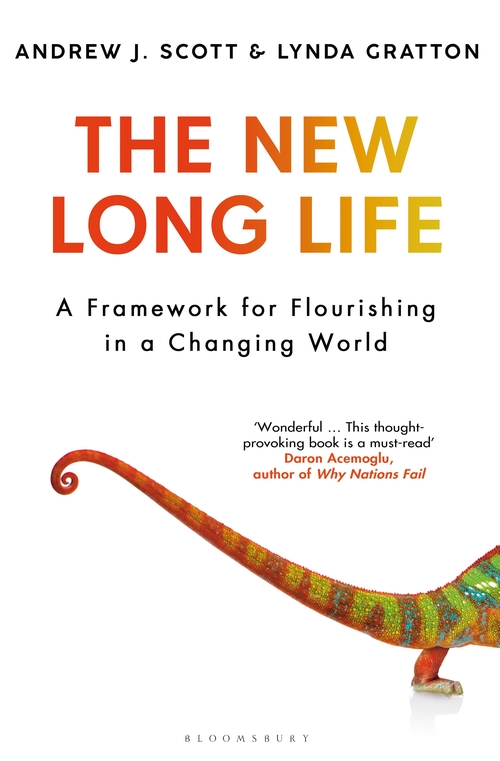
Book Review: The New Long Life


By Mark Venning, ChangeRangers.com

Special to the Financial Independence Hub

“In the face of longevity, if we want to reimagine age then we must first decouple the idea of a simple link between time and age. That requires imagining your age as malleable… It is this malleability that underpins the redesign of life stages.” Andrew J. Scott & Lynda Gratton, The New Long Life, 2020

Back together in The New Long Life: A Framework for Flourishing in a Changing World, Scott and Gratton have written the sequel to their highly lauded well-structured book from 2016, The 100-Year Life: Living and Working in and Age of Longevity. In the first book, the scene was set for deconstructing the concept of a traditional three-stage life; one where we shaped from 20th century clay, our social policies and societal norms, essentially into a lockstep world of education, employment, retirement.

Scott and Gratton challenged our minds, that if we were to look at the promise of living a longer life that would mean the lockstep three-stage experience would evolve and stretch, and we would have to reimagine a multi-stage life, more fluid, perhaps not so orderly. It would mean we would need to rethink how we finance this potential longer life, transform our personal journeys and as suggested now here in the sequel: rediscover our human ingenuity.

For all the side steps and jump-starts that a fluid and frequently interruptive multi-stage life may bring us, we will need to be better as masters of our own transitions.

“Human ingenuity has led us to extraordinary new technologies and substantial gains in healthy life expectancy. Yet … the answers to the question we have posed will be solved with social ingenuity.”

Continuous advance of technology and longevity

One of the great powers our two authors have is the ability to draw linkages between factors that are now shifting our society, and a prime example of that is both the continuous advance of technologies and longevity. By extension, this particular linkage recasts our notion of work and careers, wealth and health. What we do, where and how we work and for how long we choose to work. All this in mind the question left for us is: in what ways will we as individuals, employers, educators and governments reshape our society?

To answer that, The New Long Life poses leaning forward questions and threads many plausible possibilities around all this transitioning we will undoubtedly face regardless of age. Human questions is where the book begins and then nourishes our minds sprinkling ideas at us, somewhat like fish food for thought, right through each chapter. This is what makes this book together with the first, one masterful opus. Thus, my recommendation is to begin with a read of The 100-Year Life. (Reviewed by Mark here.) Continue Reading…

Retired Money: 2 useful Retirement books have starkly different views of wisdom of deferring CPP and even OAS to age 70

My latest MoneySense Retired Money column looks at two recently published books by two of the country’s top authors on Retirement Income Planning. You can find the full column by clicking on this highlighted headline: Near retirement without a Defined Benefit pension? Here’s what you need to know.

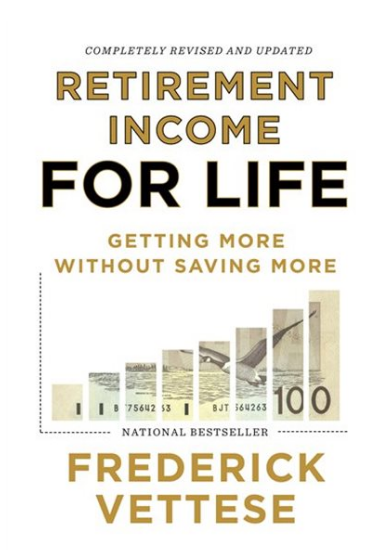
One of the new books is retired actuary Fred Vettese’s new revised edition of his book, Retirement Income For Life, which I first reviewed in 2018, and which you can find here. Vettese has revised and expanded the book to the spring of 2020, allowing him to look at the Covid-19 issue and how an extended Covid-related bear market could put further wrenches in retirement plans.

The book describes several “enhancements” to a base case of an average almost-retired couple with no DB pensions and roughly $600,000 in savings. This base case – Vettese dubs them the Thompson family — pay high investment management fees (on the order of 2%, typically via mutual funds).

Couples in his base case also tend to take CPP as soon as it’s on offer at age 60 and OAS as soon as possible at age 65. Vettese continues to pound the table about the value of these government pensions and recommends that people like the Thompsons delay CPP till age 70 if at all possible. Remember, in the absence of a DB plan, CPP and OAS are worth their weight in gold, being government-guaranteed-for-life sources of income that are inflation-indexed to boot.

Vettese is fine with ordinary average folk taking OAS at 65. However, and this seemed new to me, in a section for high-net worth couples (which he defines as having $3 million in investable assets), he suggests they should also delay OAS to age 70, along with CPP.

As an actuary, Vettese sees this enhancement as a simple case of transferring risk from a retiree’s shoulders to the government’s. Why worry about investment risk and longevity risk when the government can worry about it on your behalf?

Similarly, a related enhancement is to engage in the same type of risk transfer by converting a portion of registered savings to the shoulders of life insurance companies: he suggests 20% can be annuitized, ideally after age 70. That’s a bit less than the 30% his first edition he recommended immediately upon retirement.

One of Vettese’s enhancements to the base case is simple enough: to cut investment management fees. Larry Bates devoted an entire book to this theme: Beat the Bank, which I reviewed two years ago here.

Try the free PERC calculator

There are two other less compelling enhancements: knowing how much income to draw and having a backstop. Knowing how much income can be figured out with a free calculator that Vettese twigs readers to: PERC or the Personal Enhanced Retirement Calculator, available at perc.morneaushepell.com. Continue Reading…

My review of Bob Woodward’s Rage: “Trump is the wrong man for the job.”

Amazon.com

This will likely be my last review of a book on Donald Trump before the November election. Hopefully, he will be swept out of power and we’ll never again have to pay attention to Trump books or anything else to do with the man.

For those who have missed my earlier reviews, we looked at several early Trump books and how it may affect investors in this blog originally published at MoneySense.ca.

Then, this summer we looked at Mary Trump’s Too Much and Never Enough (here) and then Michael Cohen’s Disloyal (here.) While we have been slowly reading John Bolton’s The Room Where It Happened, we will probably not review it.

As for Woodward, Rage is his second book devoted to Trump (the first was Fear). Woodward has previously written books on four previous presidents. Trump did not grant interviews to him for Fear but famously submitted to 17 interviews for Rage, all but one of them tape-recorded.

That in itself was the basis for various Facebook memes where the ghost of a disgraced Richard Nixon chides Trump for the idiocy of letting Bob Woodward [whose reporting famously took Nixon down] tape-record him. When the early review copies of Rage came out, the focus was almost exclusively on Trump’s early admissions (on tape, no less) that he knew Coronavirus would be very serious but that he deliberately downplayed it.

Rage, by the way, refers to the emotion Trump evokes in much of the public, notably the Liberals he seems to go out of his way to antagonize. The term comes from Trump himself, reprinted in the book’s preliminary material: “I bring rage out. I do bring rage out. I always have.”

Access to Trump both a plus and a liability

With such extended access to a long-winded Trump, Rage by necessity offers yet another platform for Trump himself to pontificate, defend and blame, as if his Twitter feed and access to the Fox News’s of the world were not enough. All told, this consumes a fair bit of space, so you get plenty of content that doesn’t add much value, such as Trump awarding himself an “A” in his handling of the Coronavirus panic; or his contention that his predecessor, Obama, wasn’t so smart or a great speaker. Meanwhile Trump insists “I went to the best schools. i did great.” As you might expect, Trump’s obsession with Obama is never far away in his Woodward interviews, as here: “Ninety percent of the things he’s done, I’ve taken apart.”

But Woodward is writing as much for posterity as for present-day readers, and no doubt future historians will pore through these interview excerpts with great interest. Continue Reading…

Vanguard’s VRIF: Your new single-ticket Retirement Income Solution

Two years ago, Vanguard launched a suite of asset allocation ETFs that changed the game for DIY investors in their accumulation years. These balanced ETFs provide low-cost, global diversification, and automatic rebalancing with just one fund.

On Wednesday (Sept 16), Vanguard announced another evolution in the asset allocation ETF space with a new product aimed at retirees in the decumulation phase. The Vanguard Retirement Income ETF Portfolio, or VRIF, uses global diversification and a total return approach to provide steady monthly income at a target payout rate of 4% per year.

ETF TSX Symbol Management fee Target annual payout
Vanguard Retirement Income ETF Portfolio VRIF 0.29% 4%

Saving for retirement is by far the number one objective for investors and Vanguard believes that space is well covered with their now flagship products like VEQT, VGRO, and VBAL. An investor in his or her accumulation phase could simply move down the risk ladder, switching from VEQT to VGRO to VBAL as they get closer to retirement age.

But what to do with your ETF portfolio in retirement? It’s a question I get every time I mention the benefits of investing in asset allocation ETFs. Prior to today, the answer was to sell ETF units as necessary to meet your spending needs or rely on smaller, quarterly distributions of around 2% per year.

With VRIF, investors get a predictable monthly income stream (targeted at 4% per year) to help meet their regular spending needs and not have to worry about rebalancing and/or selling ETF units.

Indeed, you could think of VRIF as the retirement equivalent of VBAL.

Vanguard Retirement Income ETF Portfolio (VRIF)

VRIF is a single-ticket income solution. It’s a wrapper containing eight underlying Vanguard ETFs that offer global exposure to more than 29,000 individual equity and fixed income securities.

Related: Top ETFs and Model Portfolios in Canada

Here’s a look under the hood of VRIF:

Asset class ETF Weight
Canadian equity VCN 9.0%
Canadian aggregate fixed income VAB 2.0%
Canadian corporate fixed income VCB 24.0%
Emerging markets equity VEE 1.0%
U.S. fixed income (CAD-hedged) VBU 2.0%
U.S. equity VUN 18.0%
Developed ex North America equity VIU 22.0%
Global ex U.S. fixed income (CAD-hedged) VBG 22.0%

Here is the geographic breakdown of VRIF’s holdings:

  • Canada – 35%
  • United States – 20%
  • Developed ex North America – 44%
  • Emerging markets – 1%

VRIF focuses on a total return approach using an approximate asset allocation of 50% equity and 50% fixed income. This approach allows the portfolio to payout from capital appreciation in years when the portfolio yields fall below the target.

A total-return approach is more tax-friendly because VRIF can distribute from capital appreciation. In that case, only the difference between the cost basis and the sale price is taxed. Meanwhile, the full dividend distribution from underlying securities is taxable.

Vanguard highlights the transparency of VRIF and its underlying holdings, saying because its building blocks are clear, you always know what you’re investing in and why, adding that regular monitoring and rebalancing helps maintain exposures across key sub asset classes and risk levels.

VRIF’s 0.29% management fee (before taxes) is roughly one-third the cost of any comparable monthly income mutual fund in Canada. Costs matter, especially to retirees with sizeable portfolios who are looking to keep more of their returns and protect their investment base. Continue Reading…