Once you achieve Financial Independence, you may choose to leave salaried employment but with decades of vibrant life ahead, it’s too soon to do nothing. The new stage of life between traditional employment and Full Retirement we call Victory Lap, or Victory Lap Retirement (also the title of a new book to be published in August 2016. You can pre-order now at VictoryLapRetirement.com). You may choose to start a business, go back to school or launch an Encore Act or Legacy Career. Perhaps you become a free agent, consultant, freelance writer or to change careers and re-enter the corporate world or government.
Mark Machin is president and CEO of the Canada Pension Plan Investment Board (CPPIB.) Speaking Tuesday to financial advisors attending Advocis Symposium 2017 in Toronto, he said “unlike virtually every other industrial country in the world,” Canada “has solved its national pension solvency issues.”
While you could argue that even America’s Social Security system is not solid for the next generation of American retirees, the CPP is on a solid actuarial footing. Canada’s chief actuary says CPP is sustainable over 75 years, assuming a 3.9% real [after-inflation] rate of return: CPPIB’s 10-year annualized real rate of return is 5.3%.
Despite this, many Canadians — and perhaps some of their advisors — continue to profess their belief that the CPP won’t be around for them by the time they retire. 64% believe either that CPP will be out of money by the time they retire, or don’t know whether it will be there to pay them in retirement, Machin told Advocis.
Half of retirees greatly rely on CPP
However, in practice, Canadians tend to have more faith in the CPP than they claim: 42% of working-age Canadians expect to rely on the CPP when they retire (up from just 13% 15 years ago). In 2016, more than half of Canadians who are actually receiving CPP said they rely “to a great extent” upon it.
Source: Mercer Pension Health Index published October 2, 2017
By Brent Simmons, Sun Life Financial
Special to the Financial Independence Hub
Recently, employees and retirees of Sears were stunned to learn they may not receive all of their defined benefit (DB) pension when it declared bankruptcy. They learned their pension plan was underfunded and the company had requested that it be allowed to stop making the contributions required by Ontario laws. The plight of Sears employees and retirees has left many Canadians wondering if their DB pension plan is healthy and if their DB pension is safe.
The pension challenge
With a DB pension plan, a company promises their employees a pension for life and is responsible for paying the pension: whatever the cost ends up being. The problem is that low interest rates and choppy equity markets have made the funding level of many pension plans look like a roller roaster ride. This can be seen in the chart at the top of this blog.
Another challenge facing pension plans is that Canadians are living longer, meaning that pensions need to be paid for a longer time. A common rule of thumb is that one year of additional life expectancy at age 65 can increase the cost of the pension plan by 3% to 4%.
In a tough economy, the need to contribute to a pension plan can often come at a time when a company’s core business is also facing financial difficulties. If a company becomes bankrupt, then the company likely won’t be able to pay the contributions owed to the pension plan and employees may indeed face a shortfall in its pensions.
How Group Annuities protect their employees’ pensions
The good news is that a growing number of Canadian companies are taking steps to protect their employees’ pensions. They are buying group annuities to transfer the financial risk of their pension plans to insurance companies, which are subject to strict regulations and must have funds on hand at all times to pay promised pensions. With a group annuity, an insurer assumes responsibility for providing the pensions to a company’s retirees in exchange for a fee, and the retirees continue to receive their promised pension.
The piece is based on a half-day conference held in Toronto on Wednesday sponsored by Franklin Templeton Investments. The third annual Retirement Innovation Summit was an equal mix of sessions on Retirement readiness and updates by Franklin Templeton executives on the current state of the markets.
The big theme was the well-established (two decades now) shift from the guaranteed-for-life Defined Benefit pensions earlier generations enjoyed, to market-variable alternatives like Defined Contribution pensions. As a result, longevity risk and market risk has been gradually shifting from the shoulders of employers to those of their workers/employees. And that in turn has meant that would-be retirees have to devote a lot more attention to the markets and investing than older generations that enjoyed what seems in retrospect to be a “golden age” of retirement income security.
Retirement is a gradual process, not a cliff
As for Retirement Readiness, one speaker described how Retirement itself has become more tentative. Instead of moving abruptly from 100% work mode to 100% leisure the moment you reach the traditional retirement age of 65, workers are experimenting with retirement and more often than not returning to the workforce, only to rinse and repeat.
Since the US financial crisis, the numbers of people aged 65 or more who are still working full-time has been on the rise. Of those still working after 65, only one in five did so because they felt they had to because of shaky personal finances. For the other four in five, it’s “because they want to or truth to tell, their spouse wants them out of the house,” the speaker said.
Furthermore, among both full- and part-time workers in that age category, 40% reported they had retired twice already: they had quit the working world, returned a few months or years later, then quit again and then returned to work again.”
Taking a Retirement Victory Lap
So much for the so-called “Retirement Cliff.” This of course is a major theme of the book I co-authored with Mike Drak: Victory Lap Retirement. We basically argue that retirement is a long process that involves slowly moving into. After all, you never see an airplane land by suddenly putting on the brakes in mid-air and dropping vertically: there is a gradual “glide path” to a smooth landing.
So it is with Retirement in our view: call it Semi-Retirement or an encore career or a legacy career but in essence it’s about moving gradually over five or ten years from 100% full-time work to perhaps 80%, 50%, 30% and so on, so that by the time you’re fully retired (perhaps in your 70s), the shock to your system is much less severe.
Through their financial advisers, easy-to-use online dashboard and financial tools, they are making investing more accessible for Canadians from coast to coast.
Jon Chevreau
Jon Chevreau: Welcome, Tea. While many so-called robo-advisers seem to focus on young people building wealth, what about the end game? How do you handle the shift for older investors from accumulation into spending your savings in retirement?
Tea Nicola: Once a client who is accumulating assets decides that retirement is on the horizon and they let us know, we lead them into the retirement transition process. At this stage, they probably have a pretty good idea as to what they would like to spend after taxes. Their goal is to understand now if their savings and all their sources of income will be enough to fund their retirement years.
The conventional wisdom is to collect all the sources of income that the client will have and analyze it year by year. This step is essential to make sure that the goals are met. That includes the monthly cash flow for basic expenses, the annual travel budgets and one-off purchases as well as any legacies that they may desire.
We then make sure their savings can meet all those goals. If there are shortfalls, we adjust the savings rate to meet the goals by the time they want to stop working. Then, we iterate this every six months or so, both before and after the retirement date. We do this to make sure the transition is smooth and that routines are appropriately established.
Jon: You’re talking about managing expectations?
Tea: I would call it being realistic about expectations. For instance, we need to be careful about talking about a monthly income when it comes to drawing down on retirement savings.
What we typically see is an uneven drawdown, with extra spending in the first few years of retirement. The client is in a rush to do all the things they held off on while working. So, they go on world tour, get a golf membership, enjoy some fine dining, or generally treat themselves to something special. But after a few years, their spending habits ‘normalize.’ The initial exuberance declines and their expenses follow suit. You get cases like one client in her 90s, who is literally worth millions, who now has monthly expenses of about $2,000 a month.
With that in mind, our financial plans help clients to achieve the goals they want to achieve, without necessarily boxing them into a lifestyle category that doesn’t really apply for most of their retirement. This involves very realistic, practical planning that I would say goes into a bit more depth than other robo-advisers, or even many traditional wealth management firms.
Jon: Sometimes you’ll hear a kind of magic number bandied about for how much people need to retire. $1 million. $2 million … Is there a guideline that really makes sense?
Tea: It depends on the person, which is why financial planning needs to be tailored for each individual. Just like with salaries, we know that someone making $75,000 can feel like they’ve got as much money as they could possibly need. Continue Reading…
One of Steve Nease’s cartoons from Victory Lap Retirement
My view about money changed once I left the corporate world. “Why?,” I wondered.
Early in my life I was lead to believe money was the most important measure, the one thing that matters on a personal scorecard. I became wired to succeed, earn promotions and win awards. All in the pursuit of “more money,” money for the family, money for more stuff.
This pursuit came at a cost; pressure to produce personal results in a competitive environment doesn’t come without hard work, long hours and time away from the family.
We end up spending more time at work or thinking about work when we are out of the office. We sacrifice time with our families and time pursuing our passions. All that time working in a corporate environment causes you to conform; to become the corporate person somewhere along the way you lose the freedom to be the real you. We trade our true personality in exchange for economic security: a security which in today’s environment is not even guaranteed.
My relationship with money changed when I finally began to feel financially secure late in my career. My priorities changed and I was able to step back and realize that my career was only providing financial security, but little else.
I learned that the worst thing you can do is to spend time working at a job that does not provide fulfillment, all for a little more money. Living, maybe existing is a better word, causes you to lose yourself a little bit each day. You find yourself sitting at work, glancing now and then at your pension statement, trying to hang on for a retirement which if not planned gets you away from work, but still may not be fulfilling. Sure, you can save a little more for a retirement, but you really have no idea how you will spend your time. The paradox is that for many of us our financial situation is at an all-time high, but the quality of life is at an all-time low.
I was lucky to be “retired” by the Corp.
In hindsight I was lucky to be “retired” by the corp.; it freed me to pursue what Maslow calls self-actualization. Continue Reading…


 Posted By
 Posted By
 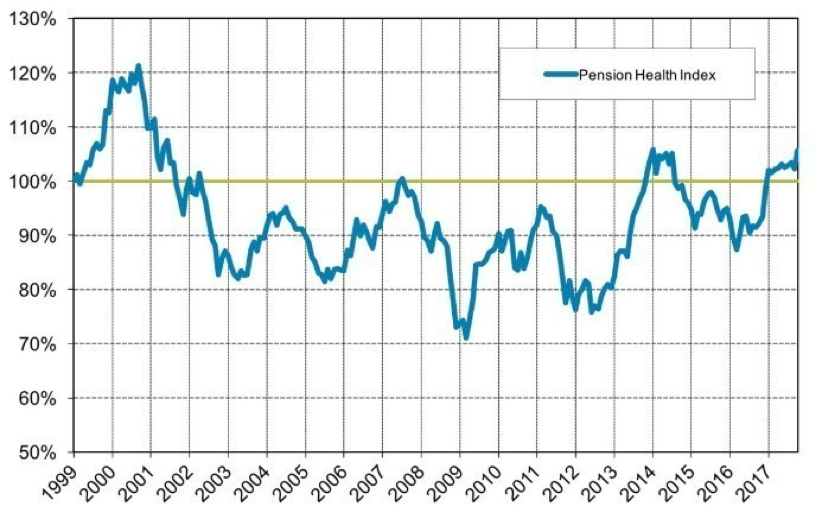 Source: Mercer Pension Health Index published October 2, 2017


 Posted By