

Victory Lap

Once you achieve Financial Independence, you may choose to leave salaried employment but with decades of vibrant life ahead, it’s too soon to do nothing. The new stage of life between traditional employment and Full Retirement we call Victory Lap, or Victory Lap Retirement (also the title of a new book to be published in August 2016. You can pre-order now at VictoryLapRetirement.com). You may choose to start a business, go back to school or launch an Encore Act or Legacy Career. Perhaps you become a free agent, consultant, freelance writer or to change careers and re-enter the corporate world or government.

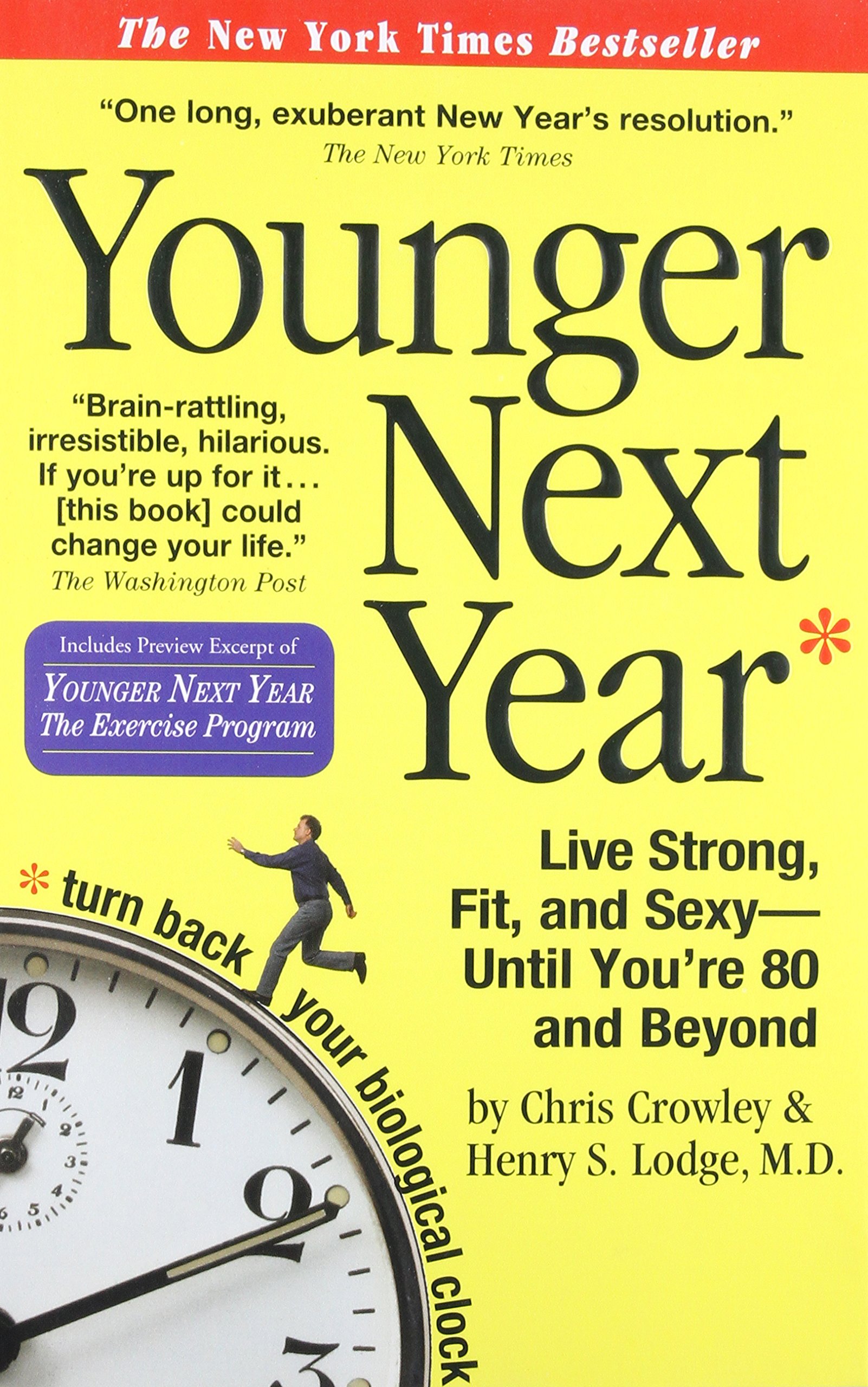
Younger Next Year (& creation of Younger Next Year – 2018 Facebook group)

Younger Next Year. How’s that for a New Year’s Resolution?

Seriously, as we head into 2018, who wouldn’t want to be younger in 2018 than they were in 2017?

Impossible, you scoff? Clearly, you haven’t read the New York Times bestselling book, Younger Next Year, or its spinoff titles, including Younger Next Year for Women.

The authors are a vibrant 70-year old (at the time of writing) and ex New York litigator Chris Crowley and his personal physician (25 years his junior), named Henry Lodge (Harry in most of the text; I should clarify that this is the late Henry Lodge, since he passed await at age 58  early in 2017 of prostate cancer. Ironic.)

The subtitle says it all: Live Strong, Fit and Sexy — Until You’re 80 and Beyond. I’m grateful to one of my sources — Hub contributor Doug Dahmer of Emeritus Retirement Strategies — both for twigging me to the book’s existence and to supplying me a copy. (He appears to have laid in a good stash of the book).

Take control of your Longevity

And for good reason. The book is all about taking control of your personal longevity, chiefly  through proper nutrition but first and foremost by engaging in daily exercise: aerobic activity at least four days a week and weight training for another two days a week. Week in and week out, for the rest of your life. And the payoff is what is promised in the subtitle.

Apart from daily exercise and “Quit eating crap” (to use the authors’ phrase, one of Harry’s 7 Rules reproduced below) the authors urge readers to “Connect and Commit,” which means staying engaged even after formal retirement. In fact, as we argue in our own book Victory Lap Retirement, there’s a case to be made for never entirely retiring. Leaving the corporate workplace, probably, but semi-retirement and self-employment from home are certainly viable alternatives.

While Younger Next Year only touches on retirement finances, it certainly reinforces the main theme of this web site (FindependenceHub.com). It’s encapsulated in Harry’s 4th Rule: Spend Less Than You Make.

Harry’s Rules

I can see at this point that it’s best to simply list Harry’s 7 Rules, which formally appear in the book’s appendix (page 305 of my copy): Continue Reading…


Retired Money: How TFSAs can give seniors more tax-free retirement funds

If you’re a senior, the holy grail in retirement is to have as much tax-free retirement funds as possible.

My latest MoneySense Retired Money column looks at this goal: Click on the highlighted text to access the full piece:  How Seniors can use TFSAs to have more in retirement.

This site has always been a strong proponent of Tax-free Savings Accounts (TFSAs) for young people. Starting at age 18, TFSAs are great vehicles for accumulating short-term savings for goals like saving a down payment for a home, buying a new car, or even going on to post-graduate studies or starting a business. And unlike RRSPs, the $5500 annual contribution room for TFSAs does not require having earned income the previous year. So as of next week, with the arrival of 2018, it’s highly advisable to add another $5,500 to your TFSAs. But not just if you’re young!

The MoneySense column makes the point that TFSAs are equally desirable for seniors in retirement, or for those in semi-retirement who are preparing for full retirement.

Why? First, unlike the RRIFs that many RRSPs become, and which generate taxable income, TFSAs generate no taxable income: neither on the withdrawals nor the investment income (whether dividends, capital gains or interest). In addition, TFSAs do not trigger clawbacks of means-tested government retirement income programs like Old Age Security or the Guaranteed Income Supplement.

But there’s another big benefit TFSAs confer on seniors and retirees: ongoing tax-sheltering of investment income well beyond age 71. In contrast, you can no longer contribute to RRSPs after the year you turn 71 and cannot contribute new money to RRIFs: they’re strictly vehicles that shelter what you’ve got until the next forced annual withdrawal limit, which escalates over time from 5.28% at 71 to 20% a year once you reach 95.

Unlike RRSPs and RRIFs, seniors can continue to add to their TFSAs each and every year even after age 71. Even if you live past 100, as my friend Meta has (and who, as the column relates, continues to use the TFSA herself!)

Two ways seniors can get money for TFSAs without having to find “new” money

Continue Reading…

Your (last) greatest show on earth

By Heather Compton

Special to the Financial Independence Hub

What do you envision when it comes to your final wishes? Would there be a formal service? If so, who would officiate? Do you wish to be cremated or buried or donate your remains to science?

I get it, end of life conversations are difficult and even if you are prepared to have the discussion, dollars-to-donuts your kids or responsible family members don’t want to go there.

Regretfully I’ve been involved with funeral planning for a number of relatives, and even some clients, and these are the decisions families find most difficult. When the time comes —  and it will —  the question inevitably asked is some variation of “What do you think mom would have wanted?”

If those closest to you know your personal wishes they don’t have to make it up in the funeral director’s showroom while debating between the grand showcase coffin and the budget version you might have preferred!

Bless Mom — she was very clear — cremation by the most frugal means possible, and a nice lunch for our friends.  My Scottish depression-era mother liked the memorial society option because they negotiate funeral cost discounts.

The Memorial Society Association of Canada’s website identifies contacts across the country. A modest membership fee gets you an information package to help document decisions plus they pre-negotiate cost-conscious plans with funeral homes. You can file your wishes with the funeral home or with a memorial society but keep a copy with your other important documents.

Fire Drill Conversations

Because these are difficult conversations, I suggest you treat them like a fire drill: keep it short, discuss what’s needed, make sure everyone understands, document and call it done.  Have another fire drill if your thoughts or wishes change.

Here goes:

► Style of service Continue Reading…

Advanced RRSP Strategies (Beyond the Basics)

RRSPs are a valuable tool for many taxpayers, which is why they are the backbone of many retirement plans. Getting the most out of your RRSP often involves thinking several years ahead, rather than just when the contribution deadline is looming.

Here are five RRSP strategies to get you thinking beyond the basics:

Claiming RRSP deductions

Most of us claim our RRSP deductions in the tax year we make the contribution, but you don’t have to. In fact, you can choose to deduct only a portion or none at all and carry it forward.

If you expect to move into a higher tax bracket next year from say, a big promotion, or the sale of rental property, you should still make your contribution to take advantage of tax-free compounding. But, it may be worth waiting to claim the deduction the next year (or later) when your marginal rate will be higher and you will get a substantially bigger tax refund.

Level out income

Continue Reading…

How to build a sound and profitable Retirement portfolio

By Patrick McKeough, TSINetwork.ca

Special to the Financial Independence Hub

To decide if an investment belongs in your portfolio for retirement, you need to take a close look at its attributes or features. But, just as important, you need a close look at how well the investment suits your needs. A superficial look can steer you in the wrong direction.

From time to time, for instance, investors say “Now that I’m retired, I can’t invest in stocks any more. I can’t risk a 30% to 40% drop in the value of my portfolio.” But these same investors may buy annuities without considering the fact that annuity rates are related to bond yields. Both are at historically low levels. A revival of inflation could do extraordinary damage to the purchasing power you get from the fixed returns on bonds or annuities.

Retirement planning and four key factors to consider when investing for retirement

Retirement planning is the process of setting retirement goals, estimating the income needed to meet those goals and assessing your potential sources of retirement income. These days, more investors suffer from what you might call “pre-retirement financial stress syndrome.” That’s the malady that strikes when it dawns on you that you don’t have enough money saved to be able to earn the retirement income stream you were banking on. The best way to overcome this is with sound investing.

Additionally, here are four key factors to consider for retirement saving:

  • How much you expect to save prior to retirement;
  • The return you expect on your savings;
  • How much of that return you’ll have left after taxes;
  • How much retirement income you’ll need once you’ve left the workforce.

Should you consider investment products in your portfolio for retirement?

The financial industry has created income-producing investment products to cater to investors who are wary of stock-market uncertainty. These products can provide steady income that’s higher than bond interest, or dividend yields from stocks. However, these products are almost always subject to hidden fees and risks that continually drain your capital, or leave it vulnerable to unexpected losses.

Successful investors understand that occasional market plunges are normal and unavoidable. A drop of 30% to 40% in stock prices is rare. But after the plunge ends, stocks bounce back and eventually recover. Meanwhile, if you follow our Successful Investor approach, you’ll still have dividend income. What’s more, you don’t need to (and probably won’t) sell at the low in prices.

You can maintain reserves for your cash flow needs by selling some stocks every year, during times of high and low prices.

Continue Reading…