Victory Lap

Once you achieve Financial Independence, you may choose to leave salaried employment but with decades of vibrant life ahead, it’s too soon to do nothing. The new stage of life between traditional employment and Full Retirement we call Victory Lap, or Victory Lap Retirement (also the title of a new book to be published in August 2016. You can pre-order now at VictoryLapRetirement.com). You may choose to start a business, go back to school or launch an Encore Act or Legacy Career. Perhaps you become a free agent, consultant, freelance writer or to change careers and re-enter the corporate world or government.

Working part-time in Semi-Retirement a boon to finances

Man Hand writing Work Part Time with black marker on visual screen. Isolated on sky. Business, technology, internet concept. Stock PhotoI predict that many aging Baby Boomers will — either by preference or financial necessity — delay traditional full-stop Retirement and instead embrace Semi-Retirement.

My latest Retired Money column, which has just been published at MoneySense.ca, explores the positive effect on retirement nest eggs of working at least part-time after the traditional retirement age of 65. For full article and chart, click on Should you work part-time in retirement?

It’s based on an analysis by ETF Capital Management, which showed the powerful impact of earning just $1,000 in part-time income each month between the age of 65 and 75; or in the case of couples $2,000 a month between them.

Not working at all after the traditional retirement age of 65 has financial implications, never mind boredom and lack of social interaction. In the case of a retiree with lifestyle expenses of $60,000 who undertakes a full-stop retirement at 65, and earns no extra income, there is a sharp fall in a $500,000 (combined registered and non-registered) portfolio starting at age 65. By the time they reach their early 80s, the nest egg is depleted to zero.

But a couple earning just $2,000 a month between them part-time after 65 and going until 75 will find the extra income delays the portfolio’s drop below zero beyond their early 90s. Not only does the nest egg not decline the first ten years, but it actually rises! By the time you reach 75 and finally stop working even part-time, the portfolio declines from a higher level and much more gradually.

Of course, the more you work, the better: for a couple earning $3,000 a month between them, the portfolio still has more than $200,000 by their 90s!  Similarly, the analysis also shows what happens if you work extra hard, which many might argue wouldn’t even qualify as retirement. At $4,000 a month the portfolio is barely depleted at all by the time they reach 100!

Isn’t this really Semi-Retirement?

Continue Reading…

Millennials can learn from Boomers’ reinvention of Retirement

dcitizen2
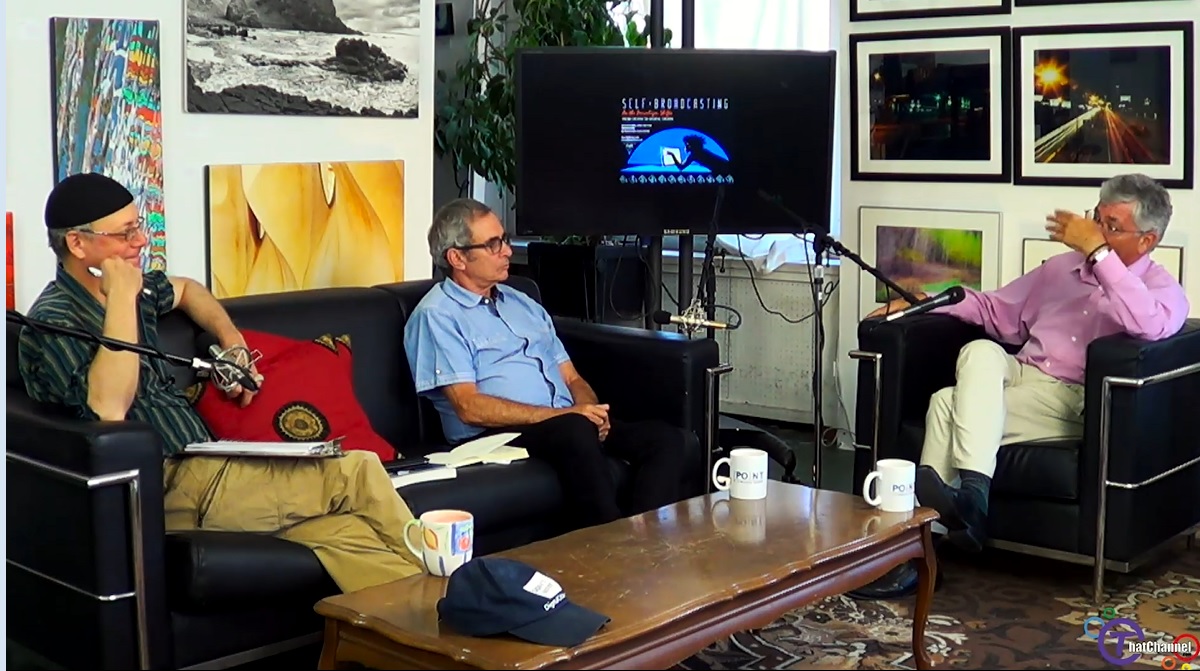
Digital Citizen Show. Left to right: Hugh Reilly, Norman Evans, Jon Chevreau

By Kollin Lore, Hub Staff

We are edging nearer to 2031, the year when all Baby Boomers will be age 65 and above, and most will at least be contemplating some form of Retirement or Semi-Retirement.

It will also be a time when the millennials will have pretty much all grown up and taken over the workforce.

Next month Jonathan Chevreau and Mike Drak’s Victory Lap Retirement will be published, a perfect time considering the age we are headed towards. However, though the book concerns the older generation, there is much to learn for millennials too.

Earlier in July, Chevreau discussed his upcoming book on Digital Citizen’s ThatChannel with creative director, Norman Evans, Laura Tyson, and host, Hugh Reilly. Click on the highlighted link to access the YouTube video: Get Ready to Earn Your “Playcheque.”

“The Boomers have reinvented every stage in life they have gone through,” said Chevreau. “Now they are going to reinvent retirement, by starting with the word ‘retirement’ because they are not ready to stop … That’s why Mike and I created the phrase Victory Lap.”

This titular ‘Victory Lap’ concerns finding that balance between stress and boredom following retirement. It means staying active and can include anything from travelling the world, to part time jobs, to volunteering to more time with family.

Of the many activities in which to partake during the Victory Lap, volunteering is an especially valuable past time to consider. Continue Reading…

How small business lending has changed since 2008

DeathtoStock_Medium6
Photo: deathtothestockphoto.com

By David Gens, founder and CEO of Merchant Advance Capital

Special to the Financial Independence Hub

The small business lending landscape today bears little resemblance — functionally, structurally or in terms of customer priorities — to what it was at the moment of the 2008 financial crisis. The intervening years have seen the creation of many new alternative finance companies, who are able to efficiently deliver credit by leveraging technology. Here’s how these developments affect the range of choices among your borrowing options.

Online lending growth consistent, lenders gain trust

Conventionally, a small business owner would attempt to reach out to a major bank for financing: a process that has become less and less viable as banks become less willing to accept the risk of lending to new businesses with limited credit profiles and limited hard assets with which to secure a loan.

Today, online small-business loans from alternative lenders account for about 2% of all small-business loans despite their ability to offer more tenable and accessible financing agreements for SMB owners. Growth, however, is a solid prediction for the industry: loans from the same providers are expected to comprise 16% of the total small business loan volume by 2020, according to a 2015 report by Morgan Stanley.

Consumers and businesses now have alternative financing options outside of traditional banking – moreover, these alternatives have gathered increasing mainstream relevance and investor confidence, moving beyond the high-risk/high speed niche to which they were originally confined.

Access to capital a key motivator

Continue Reading…

Wisdom Tree Canada’s first 6 ETFs; plus 6 ways to prolong nest eggs

wisdomtree-investments-squarelogo-1449147347386We mentioned this was coming in the FP early in June but it’s now official: the first batch of WisdomTree ETFs are now available in Canada.

While WisdomTree Canada opened its office earlier this year, the first six products started trading on the Toronto Stock Exchange Thursday (July 14).

The US parent company is best known for its dividend-weighted ETFs and currency-hedged equity strategies. The initial lineup is focused on the U.S., European and broad international equities. The Head of WisdomTree Canada is Raj Lala, pictured below.

Here’s what he said in a press release today:

AAEAAQAAAAAAAAA9AAAAJDEyOTQ5MmM5LWQ5MzQtNDA5OC05YWJiLTY2ZGFhMTQyYjMyMQ
Raj Lala

“By combining the best elements of active and passive investing, WisdomTree’s Smart Beta ETFs give Canadians the opportunity to participate in effective, risk-managed investments. We look forward to growing our business in Canada through a commitment to anticipating and addressing key investor needs.”

Here are the six ETFs and their TSX tickers: Continue Reading…

RRIF or Annuities?

MarieEngenBy Marie Engen, Boomer & Echo

Special to the Financial Independence Hub

We all know that in the year you turn 71 you will have until December 31 to convert your RRSP into a RRIF or an annuity. Which do you choose?

First, let’s recap the basics.

RRIF option

The year after you set up your RRIF you will have to start withdrawing a mandatory minimum amount. At age 71 the minimum is 5.28% of your balance on January 1. That percentage increases as you get older. Of course, you can withdraw more than the minimum and there is no maximum withdrawal amount for a regular RRIF. For this comparison we’ll use the minimum amount.

You will continue to decide where to invest your RRIF assets and your investments will continue to grow on a tax-sheltered basis, but the amount you withdraw is taxed at your marginal tax rate.

On your death, the remaining assets are generally transferred to the surviving spouse, tax free, or goes to your estate and is taxed.

Annuity option

An annuity is a specialized financial product provided by an insurance company. In exchange for a lump sum investment from your RRSP you receive regular retirement income for the rest of your life.

Once you choose to purchase an annuity there is no access to your capital. You basically are giving it up for a guaranteed income that never decreases. It creates a personal pension plan for those without pension plans.

Annuity income is based on several factors: Continue Reading…