Victory Lap

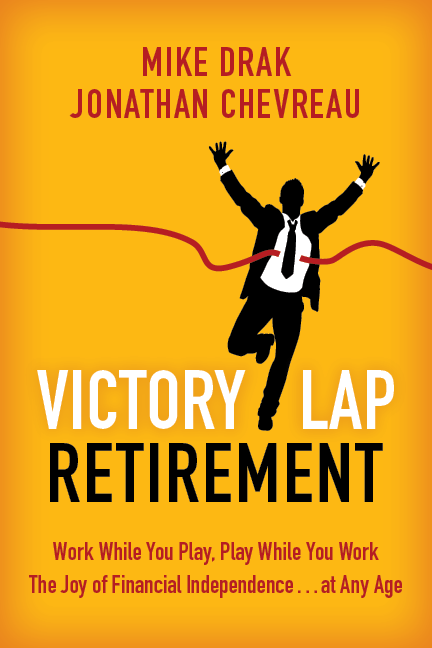
Once you achieve Financial Independence, you may choose to leave salaried employment but with decades of vibrant life ahead, it’s too soon to do nothing. The new stage of life between traditional employment and Full Retirement we call Victory Lap, or Victory Lap Retirement (also the title of a new book to be published in August 2016. You can pre-order now at VictoryLapRetirement.com). You may choose to start a business, go back to school or launch an Encore Act or Legacy Career. Perhaps you become a free agent, consultant, freelance writer or to change careers and re-enter the corporate world or government.

The Ageless Generation

Jane Fonda at the Jane Fonda Hand And Foot Print Ceremony as part of the 2013 TCM Classic Film Festival, TCL Chinese Theater, Hollywood, CA 04-27-13
Jane Fonda in 2013

Are the Baby Boomers part of the Ageless Generation?

Many of us seem to act as if that were the case but there’s little doubt most of us feel younger than we appear. To me, the poster child for this ageless generation is Jane Fonda, whose famous workout videos appear to have held her in good stead in her personal twilight career.

(Technically, since she was born in 1937, Jane Fonda is not a post-war baby boomer but her spirit certainly seems to epitomize the zeitgeist of the generation that came soon after her).

If you get Netflix check out the recently released series Grace & Frankie, where  Fonda plays a 70-year old recent divorcee: even though she herself is actually 77! Equally vibrant are her aging costars: Lilly Tomlin, Martin Sheen and Sam Waterston (best known as the prosecutor on Law & Order). Tomlin is 75 and the two male co-stars are 74.

Medical advances will transform the global economy

41X0rgzpqKL._SY344_BO1,204,203,200_
Amazon.com

The Ageless Generation also happens to be the title of a recent (2013) book by Dr. Alex Zhavornonkov, director of the Biogerontology Research Foundation and founder of the International Aging Research Portfolio. It’s one of about a dozen books I read in recent months in preparation for a talk on Longevity that I gave on Monday to the National Elder Planning Issues Conference in Niagara Falls.

The book’s subtitle summarizes the gist of it: How advances in biomedicine will transform the global economy. Since the focus is on the United States, it will come as no surprise that  Zhavornonkov believes breakthroughs in extending Longevity can only make a shaky Social Security and Medicare system that much more fragile in the United States, and by extension their equivalent programs in other advanced nations.

Pressure on Social Security & Medicare

Continue Reading…

We may be saving enough, yet still not be ready for retirement

pinpoint__dsc1211_opt_367_x_326
Lisa Taylor

By Lisa Taylor, Challenge Factory

Special to the Financial Independence Hub

Recently, Malcolm Hamilton’s C.D. Howe Institute paper, Do Canadians Save Too Little?, challenged the prevailing view that Canadians are not financially prepared for retirement. His Financial Post column summarized the key findings of his paper and highlighted that many of the assumptions made about retirement are not accurate. Canadians are saving and the determination of how much saving is enough is dependent on many non-financial factors. [See also the Hub’s blog on this: JC]

Indeed, the question of “retirement readiness” is more complicated than calculations predicting financial security.

Meaning of “Retirement” has changed

Retirement has changed. Every formal definition of the verb “to retire” focuses on retreat, withdrawal and conclusion. The original meaning of the word included a complete withdrawal from work, a focus on rest or seclusion, a retreat from battle or the time to go to bed. We retire equipment when it is taken out of service. We retire a bond by taking it out of circulation. Continue Reading…

Retirement Reflections Entering our 25th year of Financial Independence

retirement_reflections1
Billy and Akaisha Kaderli

By Billy and Akaisha Kaderli

Special to the Financial Independence Hub

In January we began our 25th year of Financial Independence. Few people can say they have 24 years of self-funded retirement by age of 62, and have a higher net worth after spending and inflation than when they started. This is something of which we are quite proud.

As we have aged one thing we have learned is that the long term is getting shorter every day. Life is to be enjoyed now, not someday – the older we get, the more we appreciate that view. Life is continuously full of opportunities and we want to take them.

Opportunities abound

retirement_reflections7For example, last year we were approached by a startup company that sponsored us for several months in Saigon, Vietnam. Continue Reading…

The 6 stages of Financial Independence

Sales funnel. Marketing or Business ChartBy Jonathan Chevreau

The Financial Independence Hub

I’ve been doing lots of reading lately about a new stage of life between MidLife and traditional Retirement. You can read the details in Marc Freedman’s The Big Shift, which confirmed what I’ve been slowly piecing together since my career change this time last year.

The  Financial Independence Hub organizes blogs in six categories that are quite similar to the Ages & Stages that MoneySense has long espoused, both in its articles and in its Special Interest Publication, Guide to Retiring Wealthy. You can find these six blog categories in the horizontal grey band that appears below the horizontal blue band at the top of the Hub’s home page.

Ages & Stages: The Life Cycle approach to Investing

Continue Reading…

Crashing Through The Retirement Barrier

A green word Freedom crashes through the walls of a maze to break through the barriers of oppression

By Michael Drak,

Special to the Financial Independence Hub

On May 6th 1954, Roger Bannister became the first person in the world to run a sub-4 minute mile. At the time no one believed the human body was capable of going that fast and although many had tried none had succeeded up to that point. Then along came Roger Bannister, who ignored the nay-sayers and posted a mile of 3 minutes 59.4 seconds.

The interesting thing is that after the sub-4 minute mile limitation was broken many other athletes posted sub-4 minute times, starting almost immediately after Roger Bannister proved it could be done.

Self-imposed mental barrier

So what happened, why the sudden success? Continue Reading…