Once you achieve Financial Independence, you may choose to leave salaried employment but with decades of vibrant life ahead, it’s too soon to do nothing. The new stage of life between traditional employment and Full Retirement we call Victory Lap, or Victory Lap Retirement (also the title of a new book to be published in August 2016. You can pre-order now at VictoryLapRetirement.com). You may choose to start a business, go back to school or launch an Encore Act or Legacy Career. Perhaps you become a free agent, consultant, freelance writer or to change careers and re-enter the corporate world or government.
Money management is essential to help your savings thrive and benefit your [U.S.] retirement accounts. Discover movements to minimize taxable income.
By Dan Coconate
Special to Financial Independence Hub
Navigating the path to a financially secure retirement can often seem like navigating a labyrinth with no exit. With so many potential strategies and considerations, it’s easy to feel overwhelmed. However, efficient tax management is key to unlocking a financially comfortable retirement.
By adeptly managing your taxable income, particularly through individual retirement accounts (IRAs) [or in Canada, RRSPs], you can pave a clear path through the complexities of retirement planning, positioning yourself for a secure, worry-free future. Understanding the necessary movements to minimize taxable income in a retirement account will help you optimize and maximize your retirement savings.
Contribute to a Traditional IRA
Investing in a traditional IRA can be a smart move to effectively reduce your taxable income. Your contributions may be tax deductible, depending on your income and whether your work’s retirement plan also covers your spouse.
The more you contribute to your traditional IRA within the IRS contribution limits, the more you can reduce your taxable income for the year.
Consider a Roth IRA Conversion
A Roth IRA conversion is a strategic financial decision that can secure tax-free income during retirement. When you convert from a traditional IRA to a Roth IRA, you pay taxes on the converted amount in the year of conversion. [Roth IRAs are the U.S. equivalent of Canada’s Tax-Free Savings Accounts or TFSAs] Continue Reading…
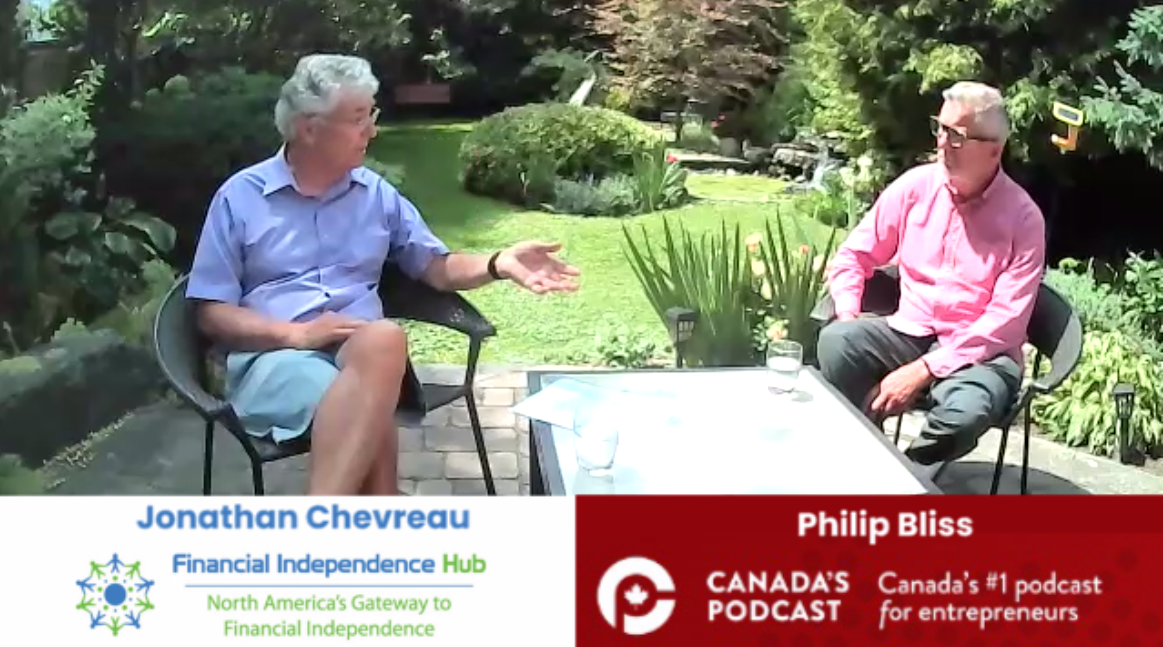
Jon Chevreau and Canada Podcasts’ Philip Bliss: https://canadaspodcast.com/findependencehub/
By Philip Bliss
Special to Financial Independence Hub
In an age where knowledge is easily accessible, podcasts have emerged as one of the most potent tools for personal development.
Findependence [aka Financial Independence] is a goal many aspire to, but achieving it often requires a solid understanding of money management, investments, and entrepreneurship. This is where podcasts shine, providing a wealth of knowledge and inspiration that can be instrumental in your journey towards financial freedom.
This new tool is particularly valuable in the fast-paced world of entrepreneurship, where the quest for knowledge and inspiration is ceaseless. In this digital age, Canada’s Podcast has emerged as a game-changer, becoming a cornerstone for Canadian entrepreneurial development and a key to enabling Findependence. Let’s explore why these audio/video gems are so critical to the journey of every aspiring entrepreneur.
1.) Education at your Fingertips
Podcasts offer a wide array of financial knowledge, from personal finance basics to advanced investment strategies. By tuning into podcasts, you can learn about budgeting, saving, and investing while going about your daily routine. Whether you’re commuting, exercising, or doing household chores, these audio programs allow you to convert idle time into a valuable learning opportunity.
Some popular finance podcasts like “The Dave Ramsey Show” and “BiggerPockets Money” offer practical advice on budgeting, getting out of debt, and achieving financial freedom. These shows are like having a personal finance mentor guiding you through the intricacies of money management.
2.) Diverse Perspectives and Ideas
Findependence is not a one-size-fits-all goal. Everyone’s journey is unique, and podcasts reflect this diversity. Podcast hosts often bring their personal experiences and perspectives to the table, offering a rich tapestry of ideas and approaches to achieving financial success.
You can listen to real-life stories of people who have achieved findependence, learning from their triumphs and pitfalls. This diversity of experiences can help you tailor your approach to fit your own circumstances and goals.
3.) Investing Insights
For those looking to grow their wealth through investments, podcasts can be a treasure trove of valuable insights. Whether you’re interested in stocks, real estate, cryptocurrencies, or other investment avenues, there’s likely a podcast that caters to your interests.
Podcasts like “Invest Like the Best” and “The Motley Fool” provide deep dives into various investment strategies, market analysis, and expert interviews. By regularly listening to such shows, you can stay updated on market trends and make informed investment decisions.
4.) Motivation and Inspiration
Findependence can be a long and challenging journey. At times, you may find yourself discouraged or unsure about your financial decisions. Podcasts can serve as a source of motivation and inspiration, reminding you of the benefits of findependence and keeping your goals in focus.
Many findependence podcasts share stories of people who have achieved their financial goals against all odds. These tales of perseverance and success can fuel your determination and keep you on track, even when the path seems daunting.
5.) Building a Supportive Community
Podcasts often come with dedicated communities. These communities provide a space to discuss financial topics, share experiences, and seek advice from like-minded individuals. Engaging with these communities can be a valuable source of support as you work towards findependence. Continue Reading…
Let’s face it: When families list their favorite financial planning projects, legacy planning rarely makes the cut. It may feel as if you’re putting the emphasis exclusively on death and taxes, rather than your lifetime pursuits such as building a career, pursuing your personal interests, stewarding your kids into adulthood, and retiring in style.
Then again, I believe the term “legacy planning” is misleading to begin with. It sounds so dry and formal — as if it’s only for uber-rich, multigenerational dynasties, or the tail end of your lifespan.
No wonder most people put off planning for it.
In reality, legacy planning can be worthwhile for almost anyone. And it’s not just for later in life; key aspects of it can help you enjoy a more enriched life today. In today’s Timeless Tip, we’ll cover the possibilities.
What is Legacy Planning?
Instead of treating legacy planning as a tedious, end-of-life chore, I like to think of it as being more like a bonus round of lifestyle planning across four core quests:
Family Ties: Legacy planning helps you keep more of your wealth in the family. Importantly, it lets you define who your family is, in a world where multiple marriages and blended families may more often be the norm than an exception to the rule.
You or your Heirs: Legacy planning can also be defined by what it is not. If your top priority is having enough to enjoy your retirement in style, your legacy planning will differ from someone who dreams of leaving the largest possible inheritance to their heirs.
Charitable Giving: Legacy planning also helps you chart out how and when you’d like to support your causes and charities of interest. Hint: You don’t have to wait until you’re gone to leave a legacy.
Tax Reduction: Even if you’re fine with letting inheritance laws guide how your estate will be distributed, most of us would prefer a tax-efficient transfer. Legacy planning strategies abound here.
How do you define “Family”?
First, let’s address the piece most of us associate with legacy planning: Who gets what stuff after you’re gone? If your estate seems perfectly straightforward, you may be tempted to just let your heirs sort it out. Unfortunately, this can leave you and your loved ones uneasy — not just moving forward, but right now.
Unintended Consequences: Check your provincial inheritance laws, and you may be surprised by what will happen to your assets if you die intestate (without a will). Your preferences may differ dramatically from the government’s.
Unresolved Heirlooms: Resolving which loved ones are to receive which treasured heirlooms and other portions of your wealth, can bring you and your family more peace — today, and moving forward.
The Angst of Uncertainty: Most of us also feel better knowing we’ve done what we can to spare our heirs the pain of having to untangle an unplanned estate at the same time they are grieving a profound loss.
The logistics of estate planning need not be extensive. They can range from essential to more advanced:
Wills: A basic will might suffice if you simply want to ensure particular people directly inherit particular pieces or portions of your estate, as permitted by law — especially when your preferences differ from provincial law.
Trusts and Foundations: You may want to up the ante with targeted trusts to cover additional nuances in your life. For example, trusts can provide for underage heirs, an heir with special needs, or other complexities, such as if your family owns a business in which some, but not all family members are involved. Private foundations come into play if you are interested in increasing the scope of your multigenerational charitable giving.
Insurance: Life insurance is also an often-overlooked tool for providing gap funding to cover taxable wealth transfers, especially when family businesses are involved.
Bottom line, making plans today for your wealth transfer to happen with minimal muss, fuss, costs, and complications can free you to better enjoy your assets throughout your life.
Spending or Preserving?
As we covered in “Retiring Reliably, Leaving a Legacy or Balancing Both?, ” another key question is: Do you want to earmark excess wealth for your optimal retirement, an optimal legacy, or a balance of both? Different lifestyles call for different legacy plans.
You may not think of investment management as part of traditional legacy planning. But you’ll be better at both if you combine forces. For example, if you want to emphasize leaving a legacy, your investment portfolio’s average expected return should exceed your withdrawal rate, so inflation doesn’t eat away at the balance. This usually means keeping more of your investments working in the markets, while also arranging for a way to take out cash on a regular, tax-efficient basis. Continue Reading…
Canada has a bold vision – to build a more accessible, inclusive and effective financial literacy ecosystem for all. The five-year plan, laid out in the National Financial Literacy Strategy 2021-2026, is an important step forward to achieving sweeping financial literacy. But one cohort is noticeably absent from this ambitious strategy – older widowed women.
During Financial Literacy Month in November, we had an opportunity to cast a light on financial education and empowerment for this often overlooked and underserved, but statistically significant, group. In 2022, there were approximately 1.5 million widowed women compared to the roughly 472,000 widowed men, reports Statista Research Department. As our nation nears “super-aged” status, where 20 per cent of our population will be 65 years or older, these numbers will continue to climb.
Longer life expectancies for women, paired with women generally marrying or partnering with older men, leaves them more likely to spend at least some of their retirement in widowhood. As such, it’s estimated that 90 per cent of women will become the sole financial decision-maker at some point in their lifetime, representing a substantial segment of Canada’s wealth management sector.
Lower financial literacy than male counterparts
However, this same group generally reports lower levels of financial literacy than their male counterparts. While many reasons account for this disparity, traditional societal norms play a significant role – older generations of women were more likely to stay home and rear children while men typically joined the workforce, granting them greater financial exposure.
Now, we have an opportunity and a responsibility to change this. Widespread financial literacy matters, but in our effort to educate the masses we can’t leave certain groups behind. By narrowing the knowledge gap, we can empower widowed women from and after the Silent Generation with a voice – we can give them a say in their own financial future.
Women will soon control half of accumulated Wealth
By 2026, women in Canada will control roughly half of all accumulated financial wealth, estimates Strategic Insights, up from one-third a decade earlier. While this is a welcomed shift, many women’s’ lack of core financial understanding and involvement is sobering. Too often, it’s men who assume a leading role in personal wealth management, specifically retirement and estate planning. This despite the fact that women, on average, survive their husbands by roughly five years. Yet, only 17 per cent of women in Canada over the age of 65 have an up-to-date will, according to a survey from LegalWills Canada. Continue Reading…
The following is an edited transcript of an interview with Michael Kovacs, CEO of Harvest ETFs, conducted by Financial Independence Hub CFO Jonathan Chevreau.
Jon Chevreau (JC)
Thanks for taking the time today, Michael. We all know that 2022 was a pretty bad year as markets were impacted by higher interest rates. That turbulence bled into much of 2023, although the last few weeks have seemed much rosier.
How do you respond to unitholders of funds who are currently down year over year? Does your covered call writing protect retirees?
Michael Kovacs
Michael Kovacs (MK)
Thanks for having me, Jon. It is important to remember that we offer equity income funds. That means that you have to look at the total return of the product, which includes the price of the ETF and its accumulating distributions.
Yes, there has been turbulence in 2022 and through much of 2023. However, over that period, products like the Harvest Healthcare Leaders Income Fund (HHL) have paid consistent distributions.
Let’s look at the Harvest Diversified Monthly Income ETF (HDIF). In terms of actual returns, this ETF is down nearly double-digit percentage-wise in the year-over-year period (as of early November). But, when you look at the distributions paid over that same period, HDIF has delivered positive cashflow for its unitholders, which reduces the decline by more than half.
JC
Are you saying that between the covered calls, the distribution and the leverage plus the underlying equity income, that a retiree could expect annual yields as high as 10% or 12% or higher?
MK
Yes. Yields are anywhere from 1.5% to 3%, depending on the equity category. Then you have option writing. We can go right up to 33% on any of those portfolios, which generates additional yield. So, to be able to generate 9-10% is very achievable. And we’ve been able to do that consistently for a quite a few years now.
Jon Chevreau
JC
What is your view on the current interest rate climate? Have we reached a top? If so, when will they start to come down?
MK
Many of us remember the high interest rates of the 1980s, especially some of your readers who were trying to obtain their first mortgages. We have experienced a big jump in interest rates over the past two years. However, we believe that we have probably seen the top for rates for now. Or, if we haven’t, we are very close to the top. That means there are going to be some great opportunities in fixed-income markets. The next move for interest rates may be down by mid-to-late 2024.
That said, there are still great opportunities that will benefit equities and bonds in the current climate. Our first launch in the Bond area is the Harvest Premium Yield Treasury ETF (HPYT). We’ve launched with a high current yield. We are targeting long treasury bonds in this fund. This is about generating a high level of income while owning a very good credit-worthy security like a U.S. Treasury. So, if rates start declining next year, it is a great time to be holding fixed income.
JC
Findependence Hub readers tend to be retirees who want steady cash flow. What is Harvest’s view of cash flow for retirees?
MK
I think cash flow for retirees is essential. Once your employment income has gone, you must depend on your investments, your pensions, your CPP, and so on. The recent increases in interest rates have been good for retirees in the short term. Higher rates allow retirees to keep shorter-term cash and generate a safe yield of 5% or more.
Our longer-term equity products aim to have that heavy bias toward equities. For example, the Harvest Healthcare Leaders Income ETF (HHL) is typically written at about 25-28% average, with the other 70% or so fully exposed to health care stocks. The covered call option writing strategy allows us to generate a high level of income.
Cash flow is the basis behind our name: Harvest. People have spent decades building up capital, sowing the seeds. Our products allow them to harvest the fruits of their life-long labour.
We believe our equity-income and fixed-income products are a fantastic way to do that. If we can help you preserve capital and generate consistent income, we are doing our job.
JC
There is also interest among investors in asset allocation ETFs. Is HDIF essentially your answer to that demand?
MK
You’re correct. Some people prefer to allocate to specific funds, but the idea behind HDIF is to allocate to the best of Harvest’s top products that generate cash flow. In the case of HDIF, you do have a leverage component. You are increasing the yield but at the same time, you do increase your risk as well. Continue Reading…


 Posted By